
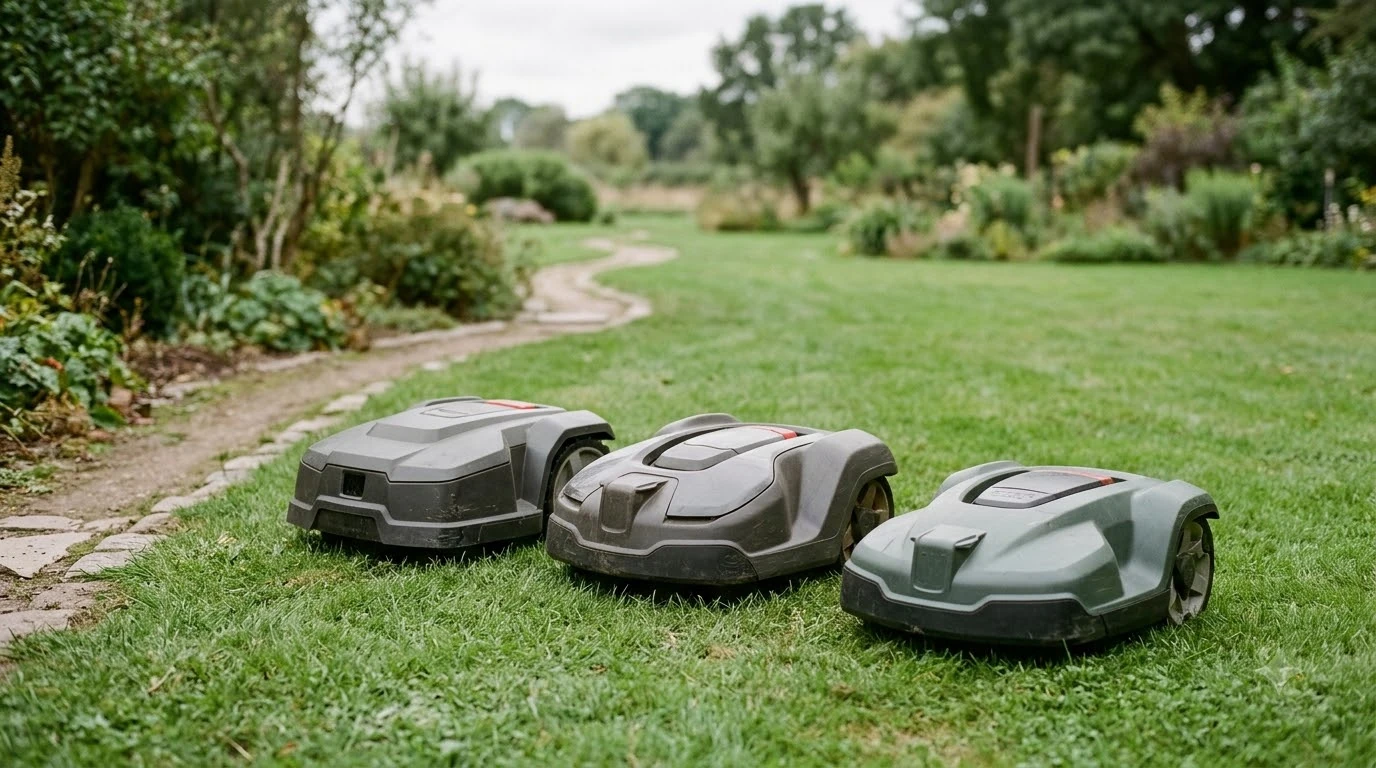

The best robot lawn mower for Tennessee lawns is the one whose cutting range, slope rating and storm handling fit your grass and yard. UT Extension lists tall fescue at about 2.5 to 4 inches in spring and 3 to 5 inches in summer, so the mower’s height range is the first thing to check, as of November 2026.
The short answer
- Cool-season lawns (tall fescue): the mower needs a summer setting around 3 to 5 inches.
- Warm-season lawns (bermudagrass, zoysiagrass): spring and fall cuts sit near 1.5 to 2 inches, so check the low end of the range.
- Slopes: Husqvarna rates standard Automowers at 25 to 50 percent and some AWD models up to 70 percent, depending on the model.
- Storms: many robot mowers run in light rain, but heavy rain and lightning call for closing the charging cover and cutting power.
Match the mower to your grass height
A Tennessee lawn can be cool-season or warm-season grass, so the first check for the best robot lawn mower for Tennessee lawns is which grass you have. The UT Extension turf memo for Lawrence County gives seasonal mowing ranges that differ by grass type. Tall fescue is mowed highest, and warm-season grass is mowed lowest in spring. The table below uses those ranges.
| Grass type | Spring | Summer | Fall |
|---|---|---|---|
| Tall fescue and fescue blends | About 2.5 to 4 in | About 3 to 5 in | About 2.5 to 4 in |
| Bermudagrass | About 1.5 to 2 in | About 2 to 3.5 in | About 2 to 3.5 in |
| Zoysiagrass | About 1.5 to 2 in | About 2 to 2.5 in | About 2 to 2.5 in |
The same UT memo says spring mowing heights can be a bit shorter than summer heights, and that heights should rise as temperatures warm to encourage deeper roots. It also notes that low-input lawns generally do better at taller settings. A mower that cannot reach about 3 inches is a poor fit for a tall fescue lawn in summer, by our reading; our fescue cutting height guide has more on the range. For warm-season lawns, the low end of the mower’s range matters more.
Height also affects weeds. NC State TurfFiles reported a single field-lab study in which tall fescue cut at 1, 2, 3 and 4 inches had crabgrass cover of 95, 48, 13 and 0 percent by mid-September. That is one study from a neighboring state, so treat it as a direction, not a guarantee for a Tennessee yard.
How often the mower should run
Run time depends on how fast the grass grows, and the grass type changes that rate. NC State Extension says tall fescue may need mowing every 5 to 7 days in late spring, and it advises not letting tall fescue grow past 5 inches from June through August. Those are practical limits for any mower schedule, not fixed rules.
Our reading is that a robot mower on a schedule that runs daily or near-daily can keep up with fast spring growth, while a mower set to run only a few times a week may leave tall fescue too long in May.
Slopes, hills and wire layout
When you compare the best robot lawn mower for Tennessee lawns on slopes, the model’s rating matters more than a general claim. Husqvarna explains that slope is calculated as rise over run, multiplied by 100. A rise of 15 cm over 100 cm of run is a 15 percent slope. Husqvarna lists standard Automower models at 25 to 50 percent depending on the model, with AWD models up to 70 percent in the work area and 50 percent near the boundary wire. Husqvarna’s slope installation guide gives these figures, and they apply to Husqvarna models only.
Before buying, check these points against your yard:
- Measure the steepest section, not the average, using rise over run multiplied by 100 (see how to measure yard slope).
- Note banks and terraces near the boundary, since the guide asks for a barrier of at least 15 cm (6 in) on the outer edge of a roadside.
- Plan the guide wire to cross the slope diagonally, where the installer can manage it.
- Expect more slipping on wet slopes, because Husqvarna warns that obstacles on slopes raise the slip risk in wet conditions.
Our reading is that a yard with a bank near a tree line needs a slope check before any purchase, even if the flat sections look simple.
Rain, heat and storms
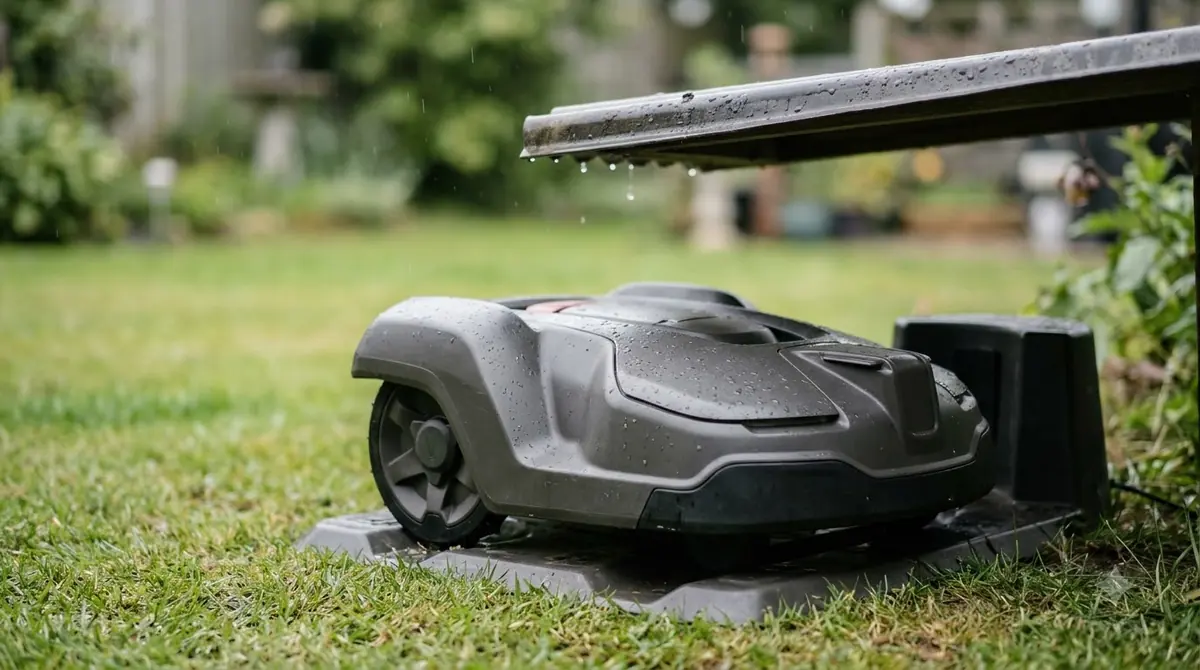
Many robot mowers are certified to cut in rain, but the sources set limits. UGA Extension says robotic mowers can operate in light rain and does not address heavier rain. Husqvarna says many of its robot mowers have certified rain operation. Its general lawn advice is to wait at least 24 hours after rain before mowing. Our guide on whether robot mowers work in rain covers the manual side.
Thunderstorms need a different routine. Husqvarna’s storm guide gives these steps:
- Close the charging cover. Keep the station shut before weather moves in.
- Disconnect the power. Cut power to the charging station before lightning and heavy rain.
- Check the rain rule for your model. Read the manual for its rain operation limits before a storm forecast, since certification differs by model.
Summer heat is a separate question. The sources above do not give temperature limits for robot mowers, so this guide does not state one. Our reading is to check the manufacturer’s operating temperature range and to schedule runs for cooler hours on the hottest days.
Warm-season and cool-season lawns in Tennessee
Bermudagrass and zoysiagrass are cut low in spring, around 1.5 to 2 inches, and UT Extension notes that scalping is optional in early spring after the risk of frost has passed. If you scalp, bag the clippings, because removing them reduces smothering of new growth. The same memo warns that scalping can increase weed pressure by exposing soil to sunlight.
Large patch is a disease that UT Extension says is common in zoysiagrass and bermudagrass during cool, wet conditions in spring and fall. It shows up as circular, discolored patches. Good drainage, avoiding heavy nitrogen and mowing at recommended heights all reduce the risk. For a robot mower, that means a steady, low-stress cut rather than a sudden drop in height, as covered in robot mowers for bermudagrass.
Fertilizing timing differs too. UT Extension advises waiting until soil reaches about 65 degrees F, usually late April through May, before feeding warm-season grass. Cool-season grass can take a light spring application of 0.5 to 1.5 pounds of nitrogen per 1,000 square feet when daytime temperatures stay between 60 and 75 degrees F.
Best robot lawn mower for Tennessee lawns: what to check before you buy
The best robot lawn mower for Tennessee lawns should be checked against the yard you have, not a generic best-seller list. Use this checklist before you buy:
- Grass type: identify tall fescue or warm-season grass, and compare the mower’s height range to the UT Extension table.
- Summer height: confirm the mower reaches about 3 to 5 inches if the lawn is tall fescue.
- Steepest slope: measure rise over run and compare it with the model’s rating.
- Navigation: decide between boundary wire and wire-free systems, and check the installation work each one needs.
- Storm handling: confirm the charging station can be covered and that power can be cut quickly.
- Warranty and parts: check the official warranty terms and parts availability as of November 2026.
Our reading is that for the best robot lawn mower for Tennessee lawns, the cutting range and slope rating eliminate most poor matches. Price is a weaker guide, because the cheapest model may not reach the height your grass needs.
Frequently asked questions
Can a robot mower cut tall fescue at 4 inches?
Check the model’s maximum height setting against UT Extension’s 3 to 5 inch summer range for tall fescue. A mower whose top setting is below 3 inches will not match a summer tall fescue lawn well, by our reading.
Do robot mowers work in Tennessee rain?
UGA Extension says robotic mowers can operate in light rain and does not address heavier rain. Many manufacturers certify rain operation for specific models, so check the model’s manual for the rain rule before relying on it in a storm.
Do I need boundary wire for a robot mower?
It depends on the navigation system. Boundary wire defines the mowing area in many models, while some wire-free systems use other positioning methods. Check the manufacturer’s manual for the navigation type and the installation work it requires, and read do robot mowers need a boundary wire for the trade-offs.
Should I scalp my lawn before using a robot mower?
UT Extension says scalping warm-season grass in early spring is optional and carries risks. It can speed green-up, but it can also raise weed pressure by exposing soil. If you scalp, do it after frost risk has passed and bag the clippings.
Sources
- UT Extension Lawrence County Timely Turfgrass Memo, Spring 2025 (University of Tennessee Extension): seasonal mowing heights by grass type, spring vs summer height, scalping, and large patch.
- NC State TurfFiles, mowing height and weed populations (NC State University): crabgrass cover by tall fescue mowing height in a single study.
- NC State tall fescue lawn maintenance calendar (NC State Extension): mowing frequency in late spring and the summer height limit.
- Husqvarna guide to installing an Automower on steep slopes (Husqvarna): slope formula, model slope ratings, and wire layout.
- UGA Today, extension specialist on robotic mowers (University of Georgia Extension): robotic mowers in light rain.
- Husqvarna guide to protecting an Automower during thunderstorms (Husqvarna): charging cover and power steps.
 Up next8 min readBest Robot MowersBest Robot Lawn Mower for New Jersey Lawns: What to Check FirstUpdated Nov 14, 2026
 8 min readBest Robot MowersBest Robot Lawn Mower for the Southeast Lawns: What to Check FirstUpdated Nov 11, 2026
 8 min readBest Robot MowersBest Robot Lawn Mower Under $1500: What to Check FirstUpdated Nov 12, 2026
 7 min readBest Robot MowersWhich Dreame Robot Mower Should I Buy? Limits to Check FirstUpdated Nov 13, 2026
 8 min readBest Robot MowersBest Robot Lawn Mower for Arizona Lawns: What to Check FirstUpdated Nov 11, 2026
 8 min readBest Robot MowersBest Robot Lawn Mower for North Carolina Lawns: What to Check FirstUpdated Nov 13, 2026