
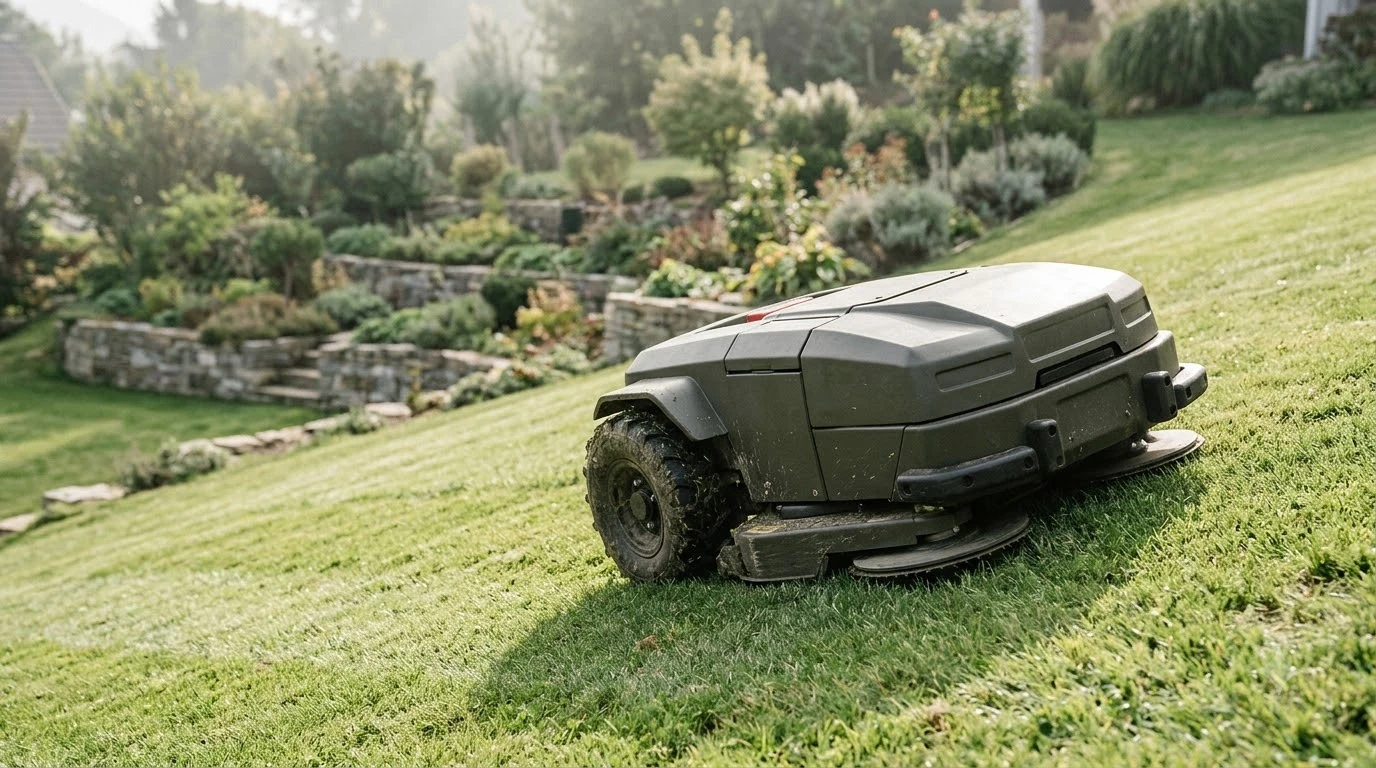

A robot lawn mower for 35 percent slope needs a listed work-area rating above 35 percent in the part of the yard it actually mows, and a boundary rating that also clears the steep edge. A 35 percent grade rises 35 feet for every 100 feet measured flat, which is about 19 degrees. Many standard models list 40 percent in the work area, so the spec sheet decides the answer for your lawn. For a wider view of how ratings are written, see our guide to robot mower slope ratings.
The short answer
- Work area. Look for a work-area rating of at least 40 percent if your steepest strip reaches 35 percent. Husqvarna lists that figure for several standard models.
- Boundary. The boundary rating is often much lower, at 15 percent for those same 40 percent models, so the outer wire must sit on ground flatter than that.
- Measure. Measure rise over run on the steepest strip, not the lawn average.
- Margin. A rating is an absolute limit, not a daily target, and wet grass lowers grip.
What 35 percent means in degrees and run
Slope is measured as rise over run. Husqvarna’s support page gives the formula as vertical height divided by horizontal distance, multiplied by 100, with an example of 15 cm over 100 cm, which equals 15 percent. Iowa State University Extension uses the same rise-over-run method and shows that a 1:12 ratio equals 8.33 percent.
Applied to 35 percent, the hill rises 1 foot for every 2.9 feet of flat distance. In degrees, 35 percent is about 19.3 degrees by standard trigonometry (our calculation). One vendor blog pairs 35 percent with 19.7 degrees, a small gap that does not change the decision.
Heads up
Some listings mix percent and degrees, and a few vendor conversions do not match the standard formula. Check the unit on the spec sheet before you compare two models.
How listed ratings sit around 35 percent
A 35 percent yard falls between the common mid-range ratings and the top of the advanced range. Eufy’s rating tiers, published on its Australian blog, place basic mowers at 10 to 25 percent, mid-range models at up to 35 percent, advanced residential models at up to 40 percent, and all-wheel-drive models at up to 70 percent. On that scale, 35 percent sits at the ceiling of mid-range, so an advanced model leaves more margin.
For a robot lawn mower for 35 percent slope, Husqvarna’s support page is a useful source, because it gives model-level limits. The table below groups the figures it lists.
| Husqvarna model group | Max slope, work area | Max slope, boundary |
|---|---|---|
| 105 | 25 percent | 15 percent |
| 305, 310, 315, 315X, 405X to 450X | 40 percent | 15 percent |
| 320 NERA, 430X NERA, 450X NERA, 430V NERA, 450V NERA | 50 percent | 25 percent |
| 435X AWD | 70 percent (35 degrees) | 50 percent |
The page also states that areas with slopes that are too steep “must be excluded from the installation.” For a 35 percent yard, that means a model with a 40 percent work-area rating can work only if the steep section is inside the work area and the wire keeps the outer edge on gentler ground.
Why the boundary decides more than the work area
The boundary wire marks where the mower turns back, so its rating matters most at the outer edge of a steep lawn. For a robot lawn mower for 35 percent slope, a 40 percent work-area model with a 15 percent boundary limit tells you the outer edge cannot sit on a 35 percent slope.
Husqvarna’s guidance for steep areas is to move the boundary inward on flat ground when the outer edge is too steep, and to create stay-out zones around slopes beyond the mower’s limit (see our guide to setting up no-go zones on a robot mower). For traction, it advises laying the guide wire diagonally across the slope rather than straight up and down.
On all-wheel-drive models, Husqvarna asks for at least 50 cm (1.6 ft) of level ground between flat areas and steep slopes. Its clearance rules also call for 1.5 m (5 ft) between the boundary wire and any obstacle, so a tree or garden bed close to a steep edge needs room before you commit to the layout.
Our reading: for a 35 percent yard, plan the boundary around the steep section first, then pick the model. Relying on the mower to stay within its rating on the outer edge is a risky plan.
Wet grass and loose soil cut into the rating
A listed rating describes a model on a dry slope. Wet grass changes grip, and the rating does not adjust for that, which is why a robot lawn mower for 35 percent slope needs margin. Our explainer on robot mower wheels slipping on grass covers the usual causes. Eufy’s blog says wet grass reduces tyre grip, causing a mower to slide sideways or slip downhill, and it calls the rated maximum “an absolute limit rather than a target for daily mowing.”
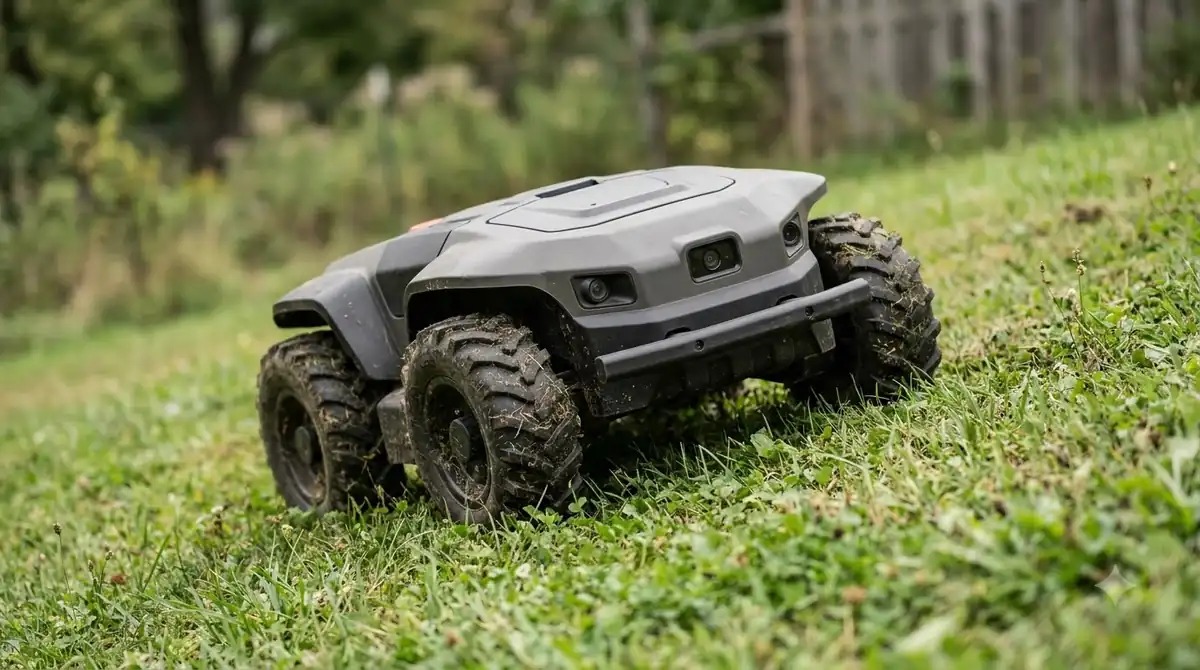
Sunseeker’s blog notes that slippage is more likely on clay soil, new turf, or areas with heavy shade. Steeper inclines also shorten runtime per charge, according to Eufy, so a 35 percent yard can mean more trips back to the dock.
New sod deserves extra care on a steep lawn. Iowa State advises that on slopes steeper than 10 percent, each strip of sod should be secured with 2 to 3 wooden stakes or sod staples, laid from the bottom of the slope upward, and removed once the sod has rooted, usually within two to four weeks. New turf is one of the slip conditions Sunseeker lists, so the sod work and the mower’s first weeks on it belong in the same plan.
How to measure the steepest strip before you buy
Measure the steepest strip where the mower would actually run, including the section nearest the boundary. A level string and a tape are enough, and our guide on how to measure yard slope shows other ways to get the same number.
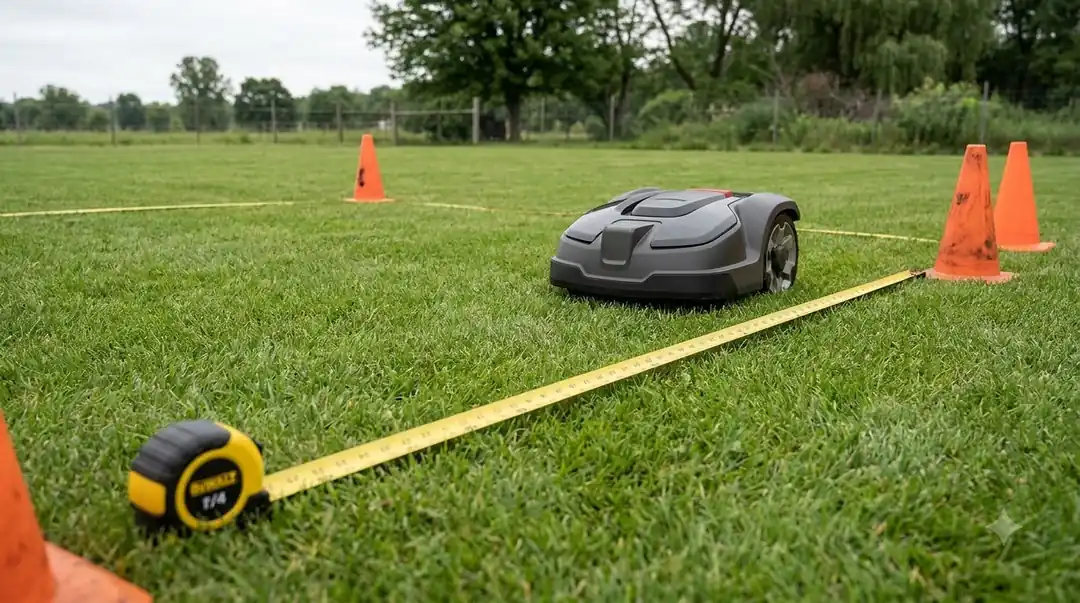
- Find the steepest strip. Walk the area where you expect the mower to work, and mark the steepest line from top to bottom.
- Measure the drop. Hold a level string from the high point, then measure the vertical gap at the low end.
- Divide by the run. Divide the drop by the horizontal length of the string and multiply by 100 for percent. A 3.5 foot drop over 10 feet of run is 35 percent (our arithmetic).
- Compare with the work-area rating. Check the figure against the work-area rating for that zone of the lawn.
- Check the boundary. Where the wire runs on the slope, compare the measurement with the boundary rating.
What to check before you buy a robot lawn mower for 35 percent slope
Use this checklist on any spec sheet before you commit to a robot lawn mower for 35 percent slope.
- Unit. Confirm whether the rating is in percent or degrees, and convert the other unit yourself if needed.
- Work area and boundary. Find both figures, since they are often different.
- Steepest strip. Compare your measured figure with the rating, not the yard average.
- Wet-weather margin. Treat the rating as a limit, and plan for slower, shorter runs after rain.
- Model source. Use the manufacturer’s manual or support page for the number, not a retailer summary.
Frequently asked questions
Can a robot mower handle a 35 percent slope?
Some can. A robot lawn mower for 35 percent slope needs the right ratings on both counts, and Husqvarna lists standard models with a 40 percent work-area rating, but the boundary limit and the steepest section decide whether a given yard works.
Is 35 percent steep for a robot mower?
It is above the level where Iowa State University Extension describes turf mowing as impractical for hand mowing, which it puts at about 30 percent. A robot’s rating is a different test, so our reading is to treat 35 percent as a serious slope that needs the spec sheet checked closely.
Do I need all-wheel drive for a 35 percent slope?
Not always. Several standard models list 40 percent in the work area. All-wheel-drive models list up to 70 percent, so they leave more margin, which we see as useful on wet or heavily shaded slopes. Our AWD robot mower explainer covers how that drive type works.
How do I convert 35 percent to degrees?
Take the arctangent of 0.35, which gives about 19.3 degrees. Equivalently, the hill rises 1 foot for every 2.9 feet of flat distance. One vendor blog lists 19.7 degrees for the same figure.
Sources
- How to optimise an Automower installation for steep slopes (Husqvarna): slope formula, model work-area and boundary limits, steep-area rule, wire direction.
- Gardening on slopes and hillsides (Iowa State University Extension): rise-over-run definition, 1:12 ratio, steepness thresholds.
- Robot lawn mower slope limits (Eufy, vendor blog): rating tiers, rated maximum as a limit, wet-grass grip, runtime on inclines.
- Robot lawn mowers on uneven or sloped lawns (Sunseeker, retailer blog): wheel-slip conditions on clay, new turf and shaded lawns.
 Up next7 min readBy YardRobot Lawn Mower for a 25 Percent Slope: What to Check Before You BuyUpdated Nov 11, 2026
 9 min readBy YardRobot Lawn Mower for a 30 Percent Slope: What to Check Before You BuyUpdated Nov 11, 2026
 10 min readBy YardRobot Lawn Mower for 45 Percent Slope: What to Check Before You BuyUpdated Nov 11, 2026
 8 min readBy YardRobot Mower for Soggy Lawn: What to Check Before You BuyUpdated Nov 11, 2026
 8 min readBy YardBest Robot Mower for a Townhouse Yard: Layout Checks Before You BuyUpdated Nov 13, 2026
 9 min readBy YardBest AWD Robot Mower for Hilly Backyard: 6 Things to Check Before You BuyUpdated Nov 13, 2026