
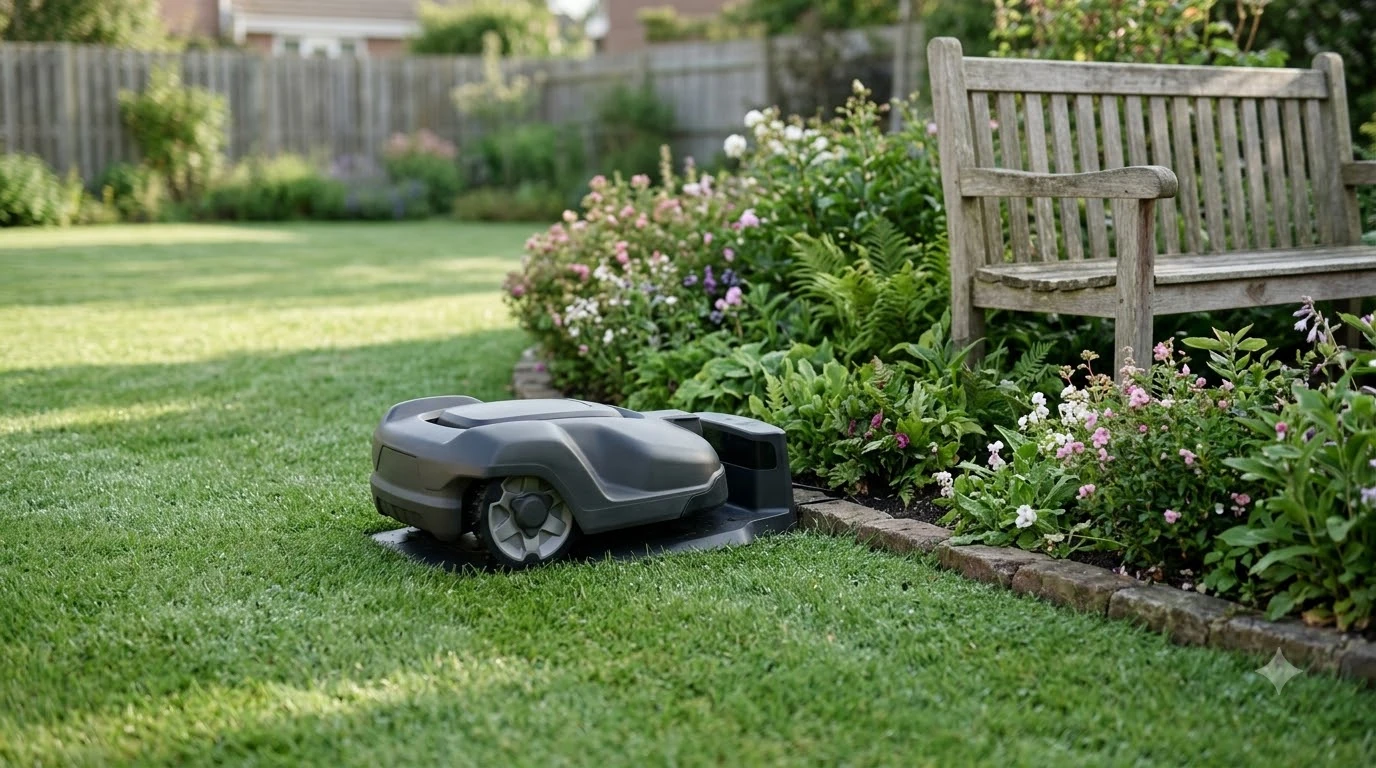

The best robot lawn mower under $1500 is the one whose rated coverage, slope limit and navigation match your yard. Manufacturer price guides place entry-level models in this band as of Nov 2026, so the budget is realistic for a small to mid-size lawn. Coverage and slope decide whether a model fits, more than the feature list does.
This guide does not rank models. It explains what to check in this price band, using the figures in two manufacturer buying guides and how each guide defines them.
The short answer
- Size up: choose a rating at least 20 to 30 percent above your mowing area, because real coverage drops near trees, slopes and boundaries.
- Check two slope numbers: the maximum slope inside the working area and the maximum slope at the boundary.
- Drive: Dreame advises against two-wheel drive if any section is steeper than about 35 percent.
- Navigation: wire-free RTK skips trenching, but its accuracy falls under tree canopy and near tall buildings.
- Price: the manufacturers estimate entry-level models at $500 to $1,000 (Dreame) or $800 to $1,500 (Sunseeker), as of Nov 2026.
Best robot lawn mower under $1500: how much lawn it covers
Shoppers looking for the best robot lawn mower under $1500 will mostly find entry and mid-range models, which Dreame ties to lawns of up to about 0.5 acre. Dreame’s buying guide places entry models under 1,000 square meters and mid-range models up to 2,000 square meters. It also says most North American suburban lots run 800 to 2,000 square meters, about 0.2 to 0.5 acres, of actual mowing area.
Rated coverage is not the same as real coverage. Sunseeker’s guide gives the same headroom rule, at least 20 percent above your calculated area. Dreame says a rating should exceed your mowing area by at least 20 to 30 percent, and that a mower can lose 20 to 30 percent of its rated coverage to trees, slopes, boundaries and wet grass. Its example: a 0.5-acre rating realistically covers 0.35 to 0.4 acres, so for a 0.5-acre lawn the guide advises sizing up by at least 30 to 50 percent.
| Yard size (Dreame guidance) | Tier in the guide | What the guide says to check |
|---|---|---|
| Under 1,000 m2 (about 0.25 acre) | Entry | Apply the 20 to 30 percent coverage headroom |
| 1,000 to 2,000 m2 (about 0.25 to 0.5 acre) | Mid-range | Size up by 30 to 50 percent for a full run |
| Over 2,000 m2 (about 0.5 acre) | Premium | Cutting width of 30 cm (12 in) or more |
Two practical limits apply to any mower in this price band. Dreame notes that a passage below 82 cm (32 in) can be too narrow for some models, and that a cutting width below 30 cm (12 in) can take several hours on a 2,000 square meter lawn. Measure your narrowest gate before you buy, and see our guide on how to choose a robot mower for your lawn size for the full sizing steps. Sunseeker lists a typical cutting height of 1 to 3 inches, so confirm the adjustable range against the grass you have.
Heads up
The loss rates and the 20 to 40 percent overestimate figure are the manufacturer’s own estimates, not independent measurements. Treat them as planning numbers.
Slopes and drive: when two-wheel drive is not enough
For the best robot lawn mower under $1500 on gentle lawns, two-wheel drive is usually enough, but Dreame advises ruling out 2WD models if any section of the lawn is steeper than about 35 percent. Sunseeker’s buying guide advises all-wheel drive for inclines above 30 percent. Our comparison of AWD vs 2WD robot mowers for hills goes deeper on the drive choice. The two cut-offs differ, so our reading is that any slope above 30 percent is a reason to check the drive type before comparing prices.
Sunseeker also separates two ratings: the maximum slope within the working area and the maximum slope at the boundary. A model in this price band can handle a gentle lawn but struggle along a steep border, so check both numbers. The guide gives no degree or percent values for either, so read them from the maker’s specification sheet.
Sunseeker suggests measuring slope with a level app or digital inclinometer, taking several readings at the steepest sections. Dreame adds that 2WD models slip on wet grass, although its guide gives no figure for how much traction is lost. If your lawn stays damp for long periods, the drive system matters more than the price tier.
Navigation: boundary wire, RTK GPS and LiDAR
Boundary wire takes 2 to 3 hours of digging to install, while a model with RTK or LiDAR skips that work. Dreame gives these setup figures for each navigation type:
- Boundary wire: 2 to 3 hours of digging, plus about one more hour for dock placement and app pairing.
- RTK GPS: 30 to 60 minutes with a clear sky view, with centimeter-level accuracy in open sky.
- LiDAR and vision: 15 to 30 minutes for wire-free LiDAR and 20 to 45 minutes for vision-based setup.
RTK accuracy degrades under tree canopy and near tall buildings, and Dreame gives no numeric tolerance for that loss. Sunseeker says LiDAR needs a relatively unobstructed environment and does not mention canopy. If you are weighing the two, see RTK vs LiDAR for a robot mower. Our reading: a yard with dense trees may suit boundary wire better than RTK, while an open lawn is the simplest case for RTK.
Running costs: blades, batteries and warranty
Dreame puts blade replacement at $20 to $40 per season and battery replacement at $100 to $300 every 3 to 5 years, as of Nov 2026. Its guide says batteries hold about 80 percent of their capacity over that period, which sets a practical replacement point.

- Blades: $20 to $40 per season, and Sunseeker says replacement may be needed every 1 to 2 months in peak season.
- Batteries: about 80 percent capacity for 3 to 5 years, then $100 to $300 to replace.
- Electricity: about $15 to $25 per year, per Dreame.
Warranties differ between the two guides. Sunseeker lists 2 to 3 years for the mower and 1 to 2 years for the battery, while Dreame’s checklist asks for a battery warranty of at least 3 years. Compare the battery terms directly, since that is the part you will replace first, and read our robot mower warranty guide for what coverage usually excludes.
Dreame compares this with a lawn service charging $30 to $65 per visit over a 4 to 8 month season, and says most owners recover their costs in 2 to 3 seasons. That payback figure is the manufacturer’s own estimate, so use it as a planning number, not a promise (our piece on whether a robot mower is cheaper than a lawn service looks at it further).
What to check before you buy
Before you choose the best robot lawn mower under $1500, go through this list against your own yard. Each item comes from the two guides above, plus our reading of what they imply.
- Rated coverage at least 20 to 30 percent above your mowing area.
- Maximum slope inside the working area and at the boundary, read from the spec sheet.
- Drive type if any section is steeper than about 30 to 35 percent.
- Navigation that fits your sky view and tree cover.
- A passage of at least 82 cm (32 in) at your narrowest gate.
- A battery warranty of at least 3 years.
- Blade and battery replacement costs listed by the maker.
The best robot lawn mower under $1500 is a sensible pick when the spec sheet matches your lawn. No price band replaces a check of slope, coverage and navigation against your own yard.
Frequently asked questions
Is a robot lawn mower under $1500 worth it?
For a lawn of about 0.25 to 0.5 acre with moderate slopes, the best robot lawn mower under $1500 can be a practical choice. Dreame compares running costs with a lawn service at $30 to $65 per visit, so the payback depends on how many seasons you keep the mower.
Can a robot mower under $1500 climb a steep slope?
It depends on the rating and the drive system. Dreame advises ruling out two-wheel drive where any section is steeper than about 35 percent, and Sunseeker advises all-wheel drive above 30 percent. Check the maximum slope inside the working area and at the boundary.
How long does setup take?
Boundary wire takes 2 to 3 hours of digging, plus about one more hour for the dock and app. Dreame gives 30 to 60 minutes for RTK GPS with a clear sky view, and 15 to 30 minutes for wire-free LiDAR.
How long does a robot mower last?
Dreame says premium mowers are built to last 7 to 10 years with maintenance. Its guide also says batteries hold about 80 percent capacity for 3 to 5 years, and replacement costs $100 to $300.
Sources
- How to Choose a Robot Lawn Mower for Your Yard (Dreame, manufacturer guide dated May 19, 2026): lawn size headroom, slope and drive, setup times, blade and battery costs, lawn service comparison.
- How to Choose the Right Robotic Mower (Sunseeker, manufacturer guide dated Dec 23, 2025): slope ratings, all-wheel drive threshold, cutting height, blade interval, warranty terms.
 Up next9 min readBest Robot MowersBest LiDAR Robot Mower Under $1500: What the Spec Sheets ShowUpdated Nov 16, 2026
 6 min readBest Robot MowersBest Wire-Free Robot Mower Under $1500: What the Spec Sheets ShowUpdated Nov 14, 2026
 7 min readBest Robot MowersWhat to Expect From a Robot Mower Under 1500Updated Nov 11, 2026
 8 min readBest Robot MowersBest Robot Lawn Mower Under $5000: What to Check Before You BuyUpdated Nov 12, 2026
 9 min readBest Robot MowersBest Robot Lawn Mower Under $700: What to Check Before You BuyUpdated Nov 12, 2026
 7 min readBest Robot MowersBest Robot Lawn Mower Under $3000: What to Check Before You BuyUpdated Nov 14, 2026