
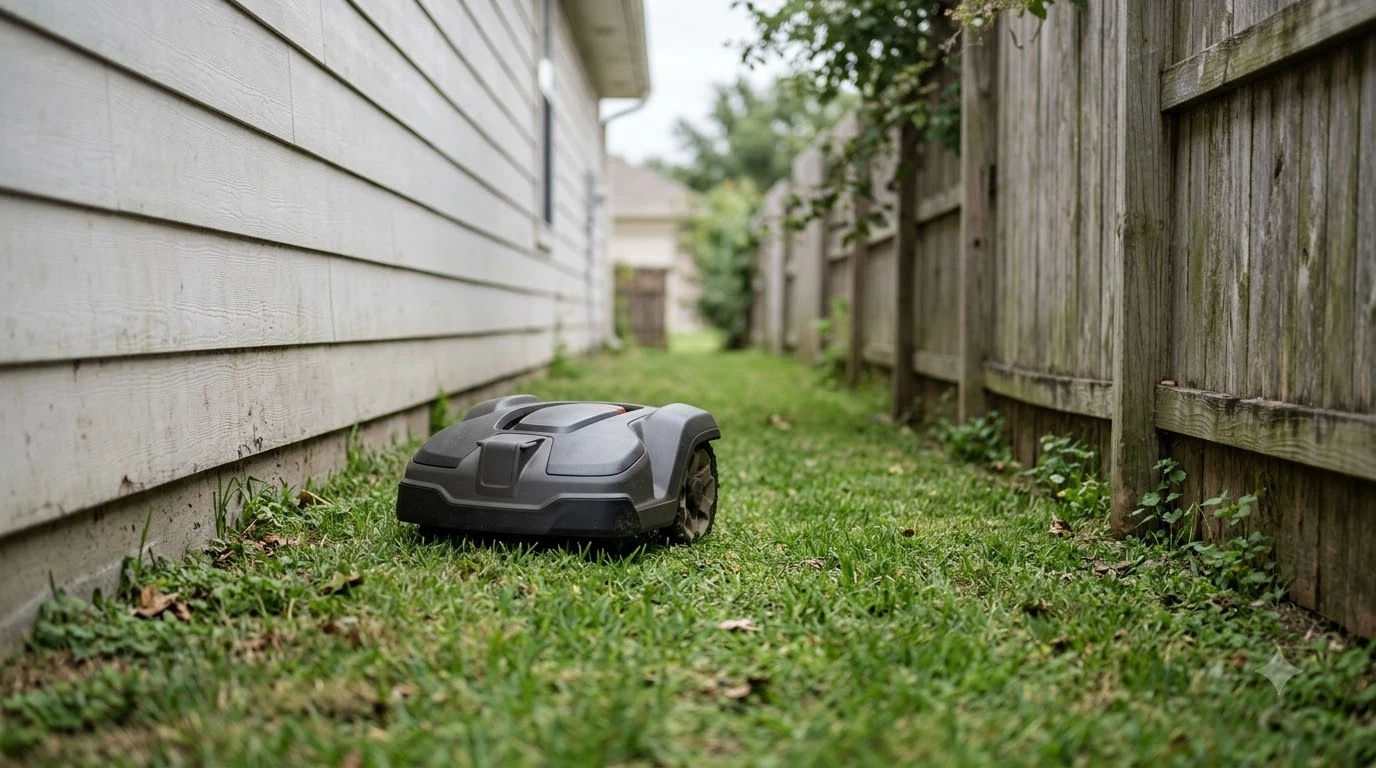

Can a robot mower work in a long narrow yard? Yes, as long as its narrowest passage is wide enough. The yard’s total length rarely decides it. The manufacturer’s minimum distance between boundary wires does, and that minimum changes depending on whether a guide wire is installed. Husqvarna’s current guidance is 60 cm (24 in) with a guide wire and 2 m (6 ft 6 in) without one.
The short answer
- Length: a long strip is fine if the mower can run its full length without a pinch point.
- With a guide wire: Husqvarna recommends at least 60 cm between boundary wires.
- Without a guide wire: Husqvarna recommends at least 2 m, and Gardena says 1.5 m for long passages.
- Obstacles: walls and fences add clearance on top of the base width.
- Before you buy: measure the narrowest point and check the manual for your model.
Can a robot mower work in a long narrow yard? Why length matters less
A long, narrow yard is limited by its narrowest point and by whether the mower can turn around at the far end, not by how many meters it spans. A robot mower works within the area bounded by its perimeter wire, so a strip that is long but consistently wide enough behaves much like any other lawn. The problem comes from a single pinch point, such as a gap between a fence and a flower bed that is narrower than the mower’s required passage.
Because of this, the first job is to walk the yard and find the narrowest section. That measurement, not the total square footage, tells you whether the layout will work.
Passage width is the real limit
Passage width is measured between the two boundary wires that form the corridor. Husqvarna gives two figures, and the difference between them is the most useful thing to know about a narrow yard. According to Husqvarna’s passage guide, a passage with a guide wire needs at least 60 cm (24 in) between boundary wires, with the guide wire itself kept at least 30 cm (12 in) from the boundary wire. A passage without a guide wire needs at least 2 m (6 ft 6 in) between boundary wires for the mower to follow the wire reliably.
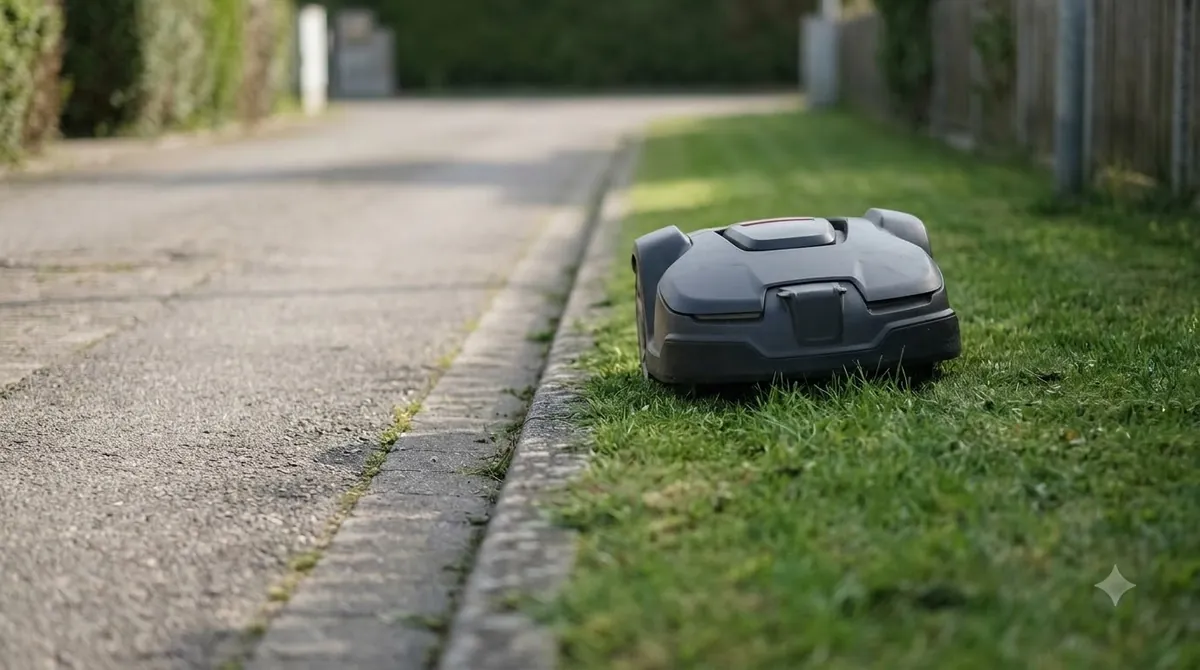
The practical reading is that a guide wire is what makes a narrow corridor workable.
So, can a robot mower work in a long narrow yard that has no guide wire? Only if the passage is about 1.5 m to 2 m wide, which is the safer target from the published figures. Gardena’s FAQ describes long narrow passages with a guide wire as 60 cm wide, measured from boundary wire to boundary wire, and says long passages without a guide wire should be at least 1.5 m wide. Those numbers come from two different manufacturers and two different wording styles, so check the figure for your exact model before you commit to a layout. Husqvarna’s passage instructions are the most detailed public source on the spacing rules.
Obstacles add to the width you need
The base width is not the whole story, because obstacles sit inside the passage and take up space. Gardena says the distance from an obstacle is added to the 60 cm minimum. Its example places a house wall 35 cm from the boundary cable on each side, which gives a required width of 35 + 60 + 35 = 130 cm.
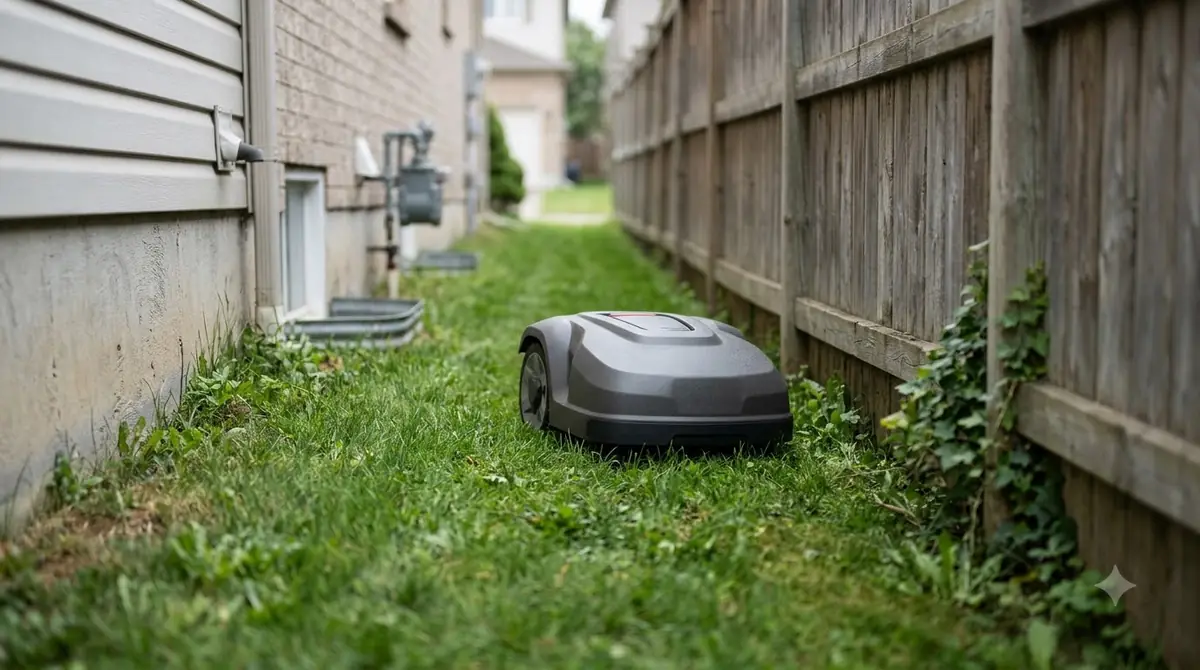
This matters for a long yard because fences and house walls often run along the whole length of the strip. A fence that looks fine at one end can pinch the path at another if it bends. Measure at several points, not just one. A long strip also adds wire, so check boundary wire length for a long strip before you order.
Gardena’s own product listings give a narrow passage of 60 cm wall to wall, which does not match the 130 cm example in the same FAQ. The company says exact distances for each model are in the operating manual, so the manual is the figure to follow.
What to do if the mower gets stuck
If a mower keeps stalling or cannot follow the wire through a narrow corridor, Husqvarna’s guidance is to adjust the corridor width setting rather than move the wire straight away. The steps below follow the general approach in Husqvarna’s support article.
- Confirm the passage width. Measure boundary wire to boundary wire at the narrowest point.
- Check the guide wire spacing. The guide wire should stay at least 30 cm from the boundary wire.
- Adjust the corridor width. Husqvarna says this setting can help when the mower gets stuck following the wire through a passage.
- Watch a few cycles. Check whether the mower now completes passages without stopping. If it still does not, the manual for your model is the next place to look.
Heads up
Husqvarna’s support article links to a separate guide on the corridor width setting. Read that guide before changing the value for your model.
Checking your own yard before you buy
Can a robot mower work in a long narrow yard like yours? Before you buy, decide whether the yard is a single long zone or a set of connected zones. A side strip that is much narrower than the rest of the lawn is often easier to handle as its own zone, which many mowers allow. Our reading is that a yard works best when it has one consistent passage width and a clear route back to the charging station; the dock placement rules explain where the dock fits.
- Narrowest point: measure it, then add obstacle clearance on each side, since that figure decides whether a robot mower can work in a long narrow yard.
- Guide wire: plan for one if the passage is under 2 m.
- Turning room: check that the mower can turn at the far end of the strip.
- Model manual: confirm the minimum passage width for the exact model.
- Slope and surface: a narrow strip on a slope may need a different model.
Whether the mower can turn at the far end is one of the questions the public sources answer least clearly. How it sweeps a strip also depends on how robot mower mowing patterns work. Ask the manufacturer or read the model manual before you assume the strip will work. If the strip bends, the guides on mowing an L-shaped yard and, for odd outlines, working in an irregularly shaped lawn apply.
Frequently asked questions
Can a robot mower mow a strip that is only 60 cm wide?
Possibly, but only with a guide wire. Husqvarna and Gardena both give 60 cm as the base figure for a passage with a guide wire. Without one, the published minimums are much wider, so a 60 cm strip usually needs a guide wire and careful setup.
Do I always need a guide wire for a narrow passage?
Not always, but it is the safer choice for passages under about 2 m. Husqvarna recommends at least 2 m between boundary wires when no guide wire is used. Our reading is that narrower passages depend on a guide wire to work reliably.
Does a long lawn need a bigger mower?
Can a robot mower work in a long narrow yard without a bigger model? Yes, because length alone does not make a larger model necessary. The key figures are the narrowest passage width and the mower’s cutting capacity for your total area. Check the manual for the minimum passage width of the model you are considering.
Can a robot mower turn around at the end of a long strip?
This depends on the model and the layout at the far end. The sources reviewed here do not give a single turning-room figure that applies to every mower. Check the manual for the model and plan extra space at the end of the strip if you can.
Sources
- How to create a passage in an Automower boundary wire installation (Husqvarna): minimum passage widths with and without a guide wire, guide wire spacing, and corridor width advice.
- Gardena robotic mower FAQ (Gardena): 60 cm base width with a guide wire, 1.5 m for long passages without one, and obstacle clearance example.
 Up next8 min readBy YardRobot Mower for Narrow Side Yard Passages: What Widths Work?Updated Nov 11, 2026
 9 min readBy YardHow Long Does a Robot Mower Take to Mow an Acre?Updated Nov 11, 2026
 9 min readBy YardHow Do I Know If a Robot Mower Will Work in My Yard?Updated Nov 11, 2026
 9 min readBy YardCan a Robot Mower Work in an L-Shaped Yard?Updated Nov 11, 2026
 8 min readBy YardRobot Mower for Front and Back Yard: What WorksUpdated Nov 11, 2026
 9 min readBy YardCan a Robot Mower Work in a Yard With a Gate Between Zones?Updated Nov 11, 2026