
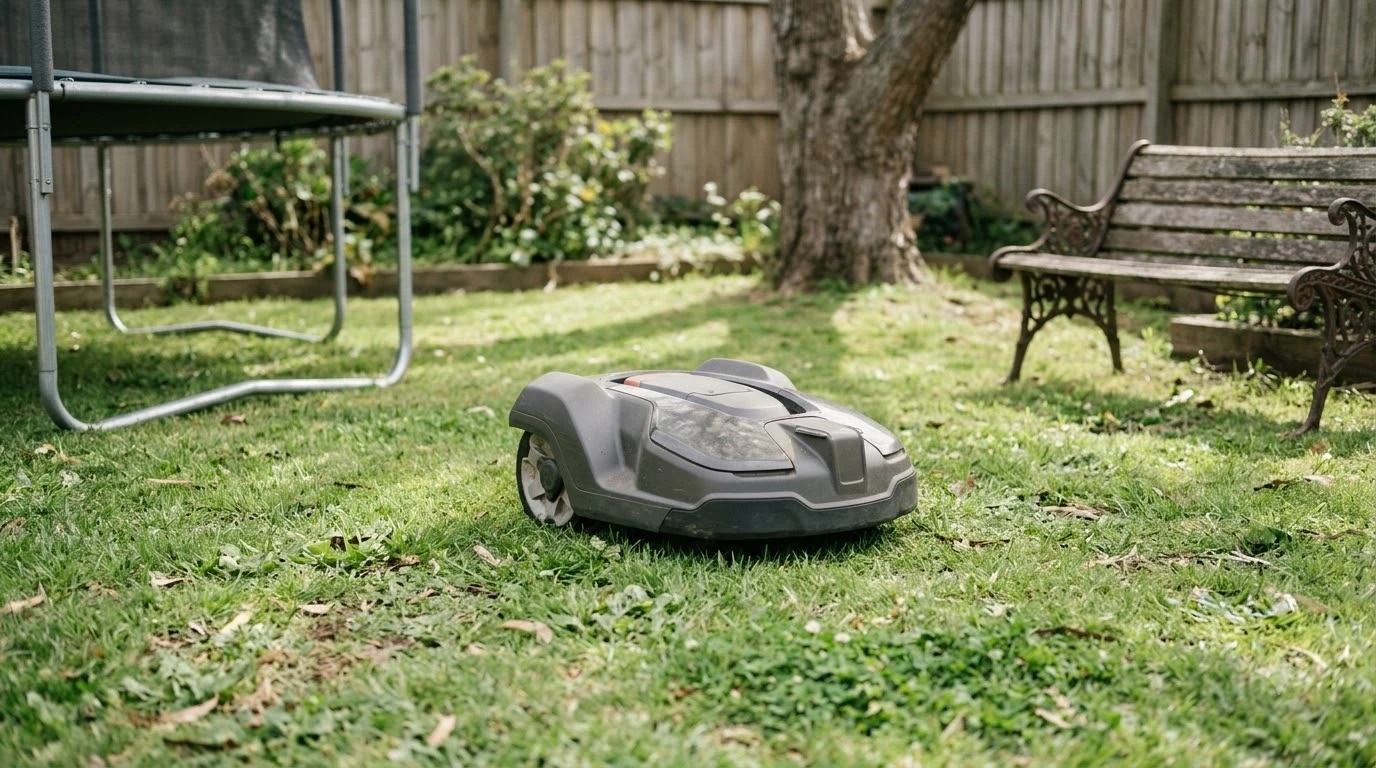

How does a robot mower handle trees? Mainly by sensing them and steering around, and the parts that need the most attention are the trunk zone, fallen fruit and branches, and the tree roots under the grass. Manufacturers describe obstacle sensors that stop the mower and change its direction, while satellite navigation can weaken under dense canopy. The sections below explain each part and what to check in your own yard.
The short answer
- Trunks: onboard sensors detect obstacles, and the mower stops, backs off and steers away. Vendors describe this as the normal response.
- Fallen fruit and small branches: how they are handled depends on the blade type. Robomow says star blades chop fallen fruit, while blade discs can nick it.
- Canopy and satellites: vendor claims say systems with vision or ultrasonic sensors keep positioning when satellite signal is blocked. These are not independent tests.
- Roots and traffic: tree roots compete with turf for water and nutrients, and mowing counts as traffic that should be cut back where possible.
How does a robot mower handle trees at the trunk?
A robot mower uses onboard sensors to find obstacles, and manufacturers describe the basic response as stop, back away and steer in another direction. Robomow says its sensors detect large obstacles so the mower can change direction. Lymow, a robot mower vendor, lists five ultrasonic sensors, a front bumper with two Hall sensors that halts the blades and movement on impact, and a camera system that classifies obstacles. Its blog says the system treats tree trunks as permanent features, alongside flower bed borders, but it does not describe trunk contact in detail.
These are vendor figures from marketing pages, so treat them as claims to check rather than measured results. The practical point is that a trunk is a fixed obstacle the sensors should see, while a thin root or a low branch may be harder to read. Our reading is that the trunk zone is the place to watch most closely during the first few weeks. A separate guide covers obstacle detection on a robot mower in general.
Branches, fruit and cones: how blade type changes the result
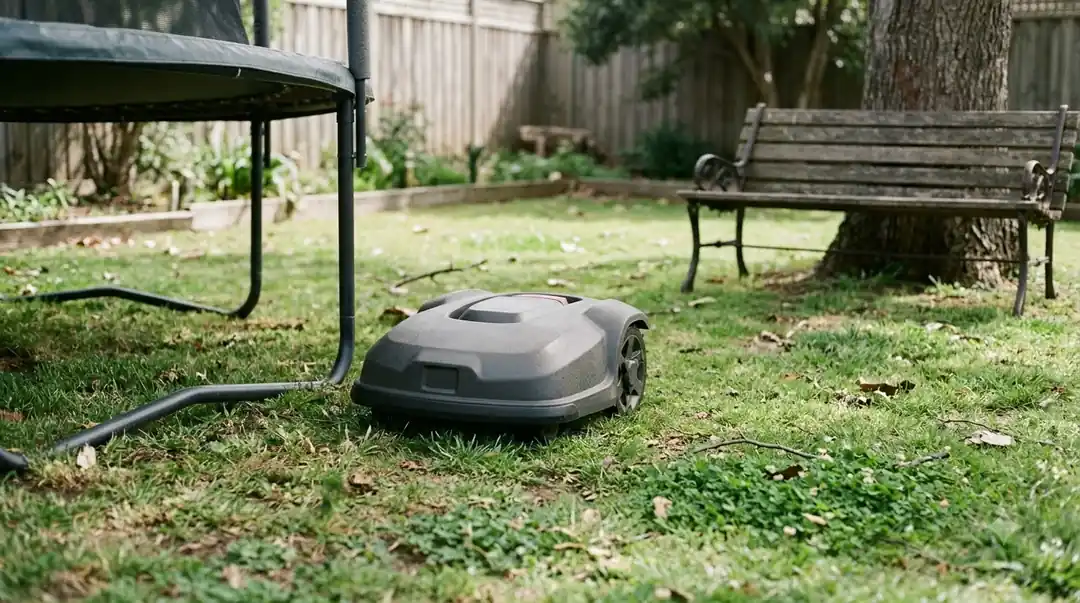
Smaller debris is where a robot mower most often has trouble, and the blade type changes the outcome. Robomow’s blog says fallen fruit and small debris are often simply run over, and that the mower’s sensors avoid larger branches. It also says cones can jam the mower and lift the drive wheels off the ground, and that blade discs are much more sensitive to nuts than star blades. Its advice is to collect debris regularly, use a fruit collector or fit an apple deflector that pushes objects to the lawn edge.
| Debris under trees | Star blades (Robomow) | Blade discs (Robomow) |
|---|---|---|
| Fallen fruit | Chopped up by the blades | Nicked, which can affect the fruit and the cut |
| Small branches | Only larger ones cause problems | Small branches can cause problems |
| Nuts | Blades only dull slightly | Much more sensitive, and cutting performance drops quickly |
The table is based on one manufacturer page, so it describes that brand’s design choices rather than the whole category. Check which blade type your model uses before you assume it will cope with a heavy fruit or nut drop, and see changing damaged robot mower blades when the blades start to dull.
Satellite signal under the canopy
How does a robot mower handle trees that block the sky? Dense tree cover is the main reason a satellite-only mower may struggle. Lymow says its RTK-VSLAM approach keeps positioning reliable when canopy blocks satellite signal, by combining satellite data with vision and ultrasonic sensing. The same page quotes GPS-only accuracy of 1 to 3 cm in open sky and claims centimeter-level accuracy under dense canopy for its own system. Those are vendor claims without an independent test behind them.
Our reading is that the question to ask is not whether a mower has satellite navigation, but what it does when the signal drops. Ask the seller or read the manual for the fallback method, whether that is vision, ultrasonic sensing, LiDAR or boundary wire, and whether the mower keeps mowing or stops until the signal returns.
Tree roots, shade and traffic near trunks
The grass under a tree is a separate problem from the mower’s sensors, and the wheel marks a mower can leave are covered in robot mower wheel ruts and brown patches. Mississippi State University Extension says trees compete with turf for resources such as water, sunlight and nutrients, and that turf under shade may need extra water because of root competition. The same publication says mowing is a form of traffic that should be reduced when possible, and that under many shade trees, riding mower wheels are a main cause of turf decline.
The extension guidance suggests two practical fixes for tight mowing patterns under trees. One is to raise the mowing height, since a greater leaf surface helps with solar absorption in shade. The other is to combine that with string trimming, or to use mulch under the drip line of trees that need a tight turning pattern. Our reading is that a robot mower makes many passes over the same ground, so a mulched ring at the drip line can keep the mower from grinding the most stressed turf.
How does a robot mower handle trees in practice? These five steps cover the setup.
- Map the tree zones first. Note where the trunks, lower branches and shadiest spots sit before you set the boundary.
- Clear fruit, nuts and cones. Collect them regularly, or fit a deflector if your model supports one, so the blades do not jam or nick.
- Check the blade type. Star blades handle small debris differently from blade discs, according to the manufacturer guidance above.
- Protect the root zone. Mulch under the drip line where the mower turns tightly, and avoid running the same path over bare roots.
- Watch the first runs. Look for pauses, repeated corrections or docking trouble near the trees, and adjust the boundary or the schedule if they repeat.
Leaves and wet debris near trees
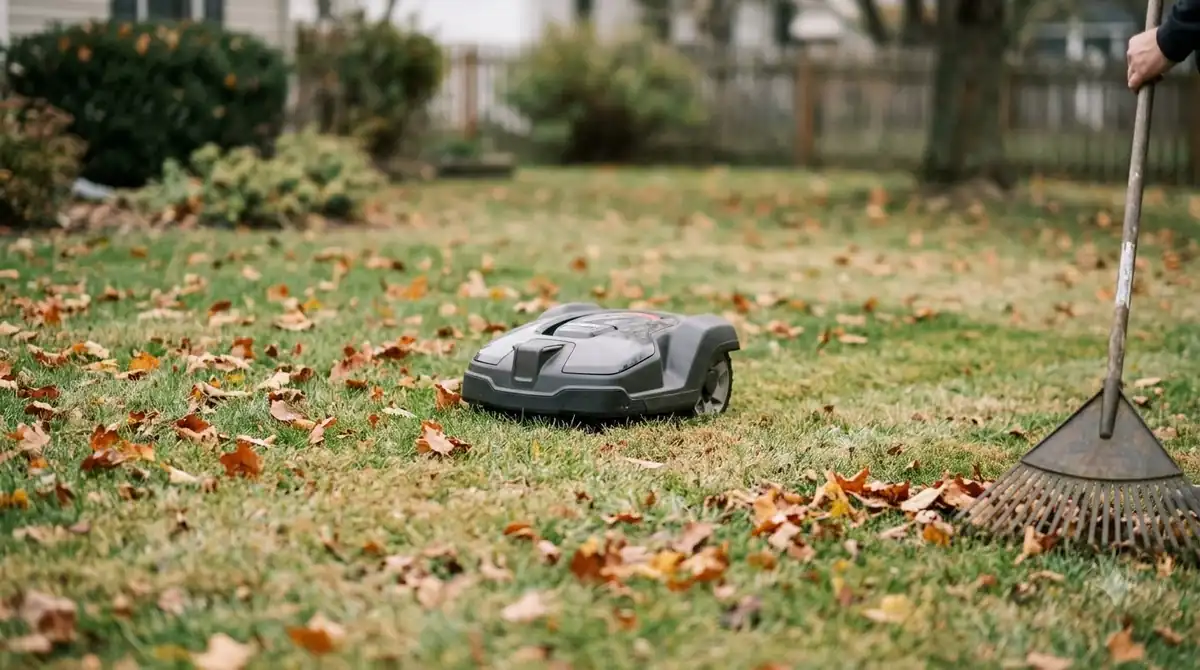
How does a robot mower handle trees that drop leaves? Autumn leaves add a different kind of problem, covered in full in what fall leaves do to a robot mower. Robomow’s blog says robotic mowers were not designed as leaf shredders, and that wet leaves tend to stay put and are only cut by the device.
It also says damp leaves stick to the wheels, which makes slipping worse on slopes, and it advises avoiding operation when there are many wet leaves in the garden. Its guidance is to rake or use a leaf blower before mowing. For the wire side, see wire layout around trunks and obstacles. The same page warns that stones can cause serious damage to the blades, so a yard under trees should be checked for stones and sticks as well as leaves.
Frequently asked questions
Can a robot mower cut around a tree trunk?
Manufacturers describe sensors that detect obstacles, after which the mower stops, backs off and steers in another direction. Lymow’s vendor blog says its system treats tree trunks as permanent features. Check the trunk zone during the first runs, because these are vendor descriptions and not independent tests.
Does a robot mower chop up fallen fruit?
It depends on the blade type. Robomow says star blades chop fallen fruit, while blade discs can nick it and are more sensitive to nuts. Collecting fruit regularly is the simplest way to avoid trouble, according to the same manufacturer page.
Can a robot mower lose satellite signal under trees?
Dense canopy can weaken satellite signal, which matters most for satellite-only navigation. Some vendors say systems with vision or ultrasonic sensing keep positioning under canopy. Ask what the fallback method is and whether the mower keeps working when the signal drops.
Should I change how I mow the grass under trees?
Mississippi State University Extension advises raising the mowing height in shade and reducing mowing traffic where possible. It also suggests mulch under the drip line of trees that need a tight turning pattern. Those points come from turf guidance, not robot mower tests.
Sources
- How does the robotic lawnmower deal with fallen fruit and the like? (Robomow, manufacturer blog): blade type, branches, cones and debris handling.
- What does a robotic lawnmower do with leaves (Robomow, manufacturer blog): wet leaves, wheel slip and stones.
- Can Robot Mowers Avoid Flower Beds and Trees in 2026? (Lymow, vendor blog): sensor list and canopy claims, read as vendor marketing.
- Selecting and Managing Turfgrass for Shade (Mississippi State University Extension): root competition, mowing traffic and mowing around trees.
 Up next9 min readBy YardHow Does a Robot Mower Handle a Playset?Updated Nov 11, 2026
 9 min readBy YardHow Does a Robot Mower Handle Sprinkler Heads?Updated Nov 11, 2026
 8 min readBy YardHow Does a Robot Mower Handle a Pond?Updated Nov 11, 2026
 8 min readBy YardHow Does a Robot Mower Handle a Trampoline?Updated Nov 11, 2026
 9 min readBy YardHow Does a Robot Mower Handle Garden Furniture?Updated Nov 11, 2026
 7 min readBy YardHow Does a Robot Mower Handle Fallen Branches?Updated Nov 11, 2026