
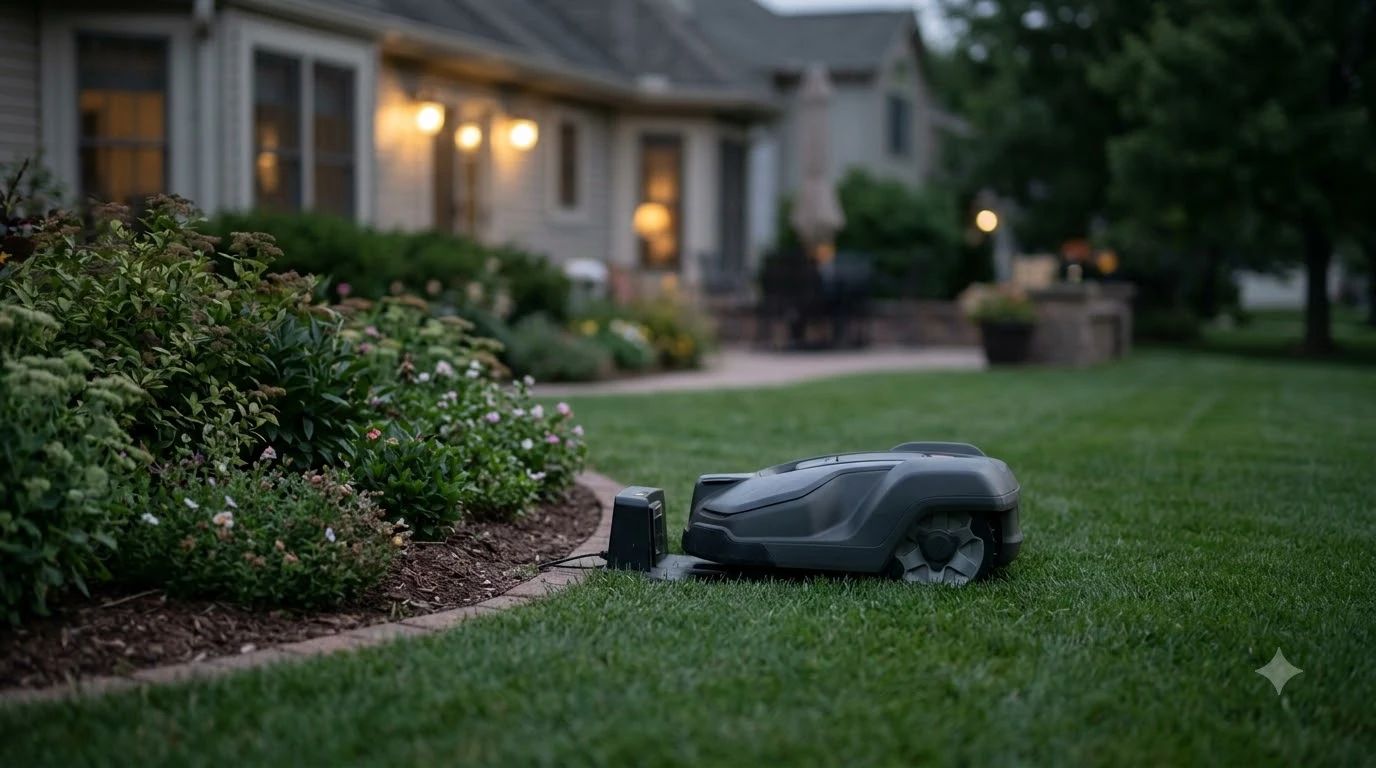

The best robot mower for shaded lawn is rarely one that depends on satellite signal alone. Dense tree canopy can block and reflect the satellite signals that RTK navigation needs, so a mower with vision or LiDAR backup usually copes better under trees. Grass type and cutting height matter just as much, because turf in shade grows slowly and thins under stress.
The short answer
- Navigation: for heavy canopy, prefer a mower that pairs RTK with vision or LiDAR, or a boundary-wire model that does not rely on satellites.
- Sun: if a patch gets less than 4 hours of sun a day, expect thin grass there, whatever mower you buy.
- Height: raise the cut by about one-half to 1 inch above your normal setting in shade.
- Check first: map how much of the sky each zone can see before you choose a model.
Why shade is hard for robot mowers
Most robot mowers that use GPS need a clear view of the sky. A vendor guide on RTK accuracy notes that RTK needs clear sky above roughly 15 degrees from the horizon, and that dense canopy blocks and reflects satellite signals, so the mower loses its fix more often. In practice, a lawn with mature trees on one side can have open, reliable areas in the middle and patchy coverage close to the trunks.
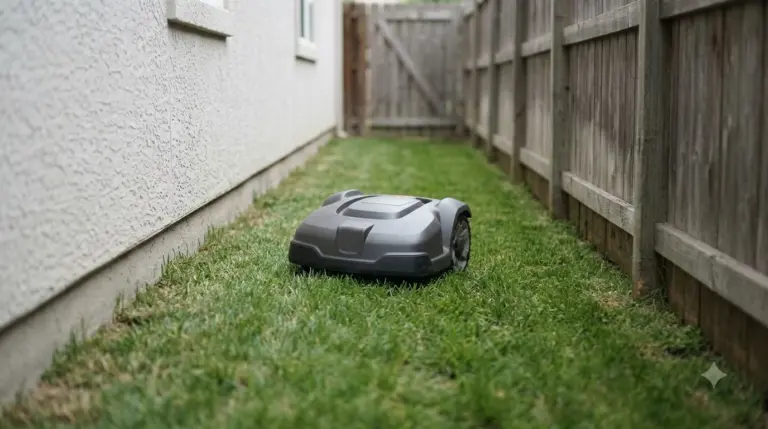
The same guide adds that signals can also bounce off metal, walls or glass before they reach the antenna, so a shed, a parked car or a brick wall beside the shade can make the position jump. It also notes that a narrow side yard between a house and a fence can hide low satellites and make RTK less stable.
Adding more satellite systems helps, but it does not solve the problem completely. The same guide says that using GPS and GLONASS together can improve fixes between rows of tree canopy, yet extra satellites do not remove reflections. The RTKdata accuracy guide is written by a vendor, so treat its exact figures as a starting point rather than a guarantee.
Navigation backups that cope better with tree cover
The practical fix for shade is a second way to know where the mower is. The same guide describes RTK paired with vision and an inertial measurement unit (IMU) as the setup that holds up better: the satellite signal gives global position, cameras add local context, and the IMU bridges short signal gaps, though it drifts over time.
Vision has its own limits. It can struggle in low light, fog, heavy rain, or with dirty lenses, so a mower that relies on it may perform worse at dusk or after a storm. LiDAR is different: it detects nearby structures and obstacles, but on its own it does not give an absolute position in the yard. That is why LiDAR is usually combined with another positioning method.
Our reading: the best robot mower for shaded lawn conditions is the one with a second way to find its position, and a boundary-wire mower does not depend on satellites at all, so it is a reasonable option for a yard that is mostly shade. The trade-off is installing the wire, which takes time and needs the layout planned in advance. A wire-free model with RTK and vision backup is the better fit if you want to avoid wire but your yard is heavily shaded.
For a closer look at positioning under branches, see our guide to robot mowers that work under trees without RTK, and for wire-free options in general read the best robot mower without a boundary wire. If you choose wire, how to install a robot mower boundary wire covers the layout.

Grass in shade: what grows and what thins
Whichever robot mower you shortlist for a shaded lawn, it can only cut what is growing. Clemson HGIC advises that if an area gets less than 4 hours of sunlight per day, it is too shady for grass to grow well, and turf there is less tolerant of stress. The HGIC shade guide ranks grass types by shade tolerance.
Among cool-season grasses, fine fescues tolerate shade better than tall fescues. Among warm-season grasses, St. Augustinegrass has the best shade tolerance, while Zoysiagrass tolerates light or moderate shade better than centipedegrass, and neither survives heavy shade. Bermudagrass has extremely poor shade tolerance. If your shaded lawn is already thin, changing the grass may matter more than changing the mower. HGIC also notes that trees and shrubs compete with turf for nutrients and water, that dense canopies and shallow roots often cause turf failure, and that pruning low branches so the lowest are over 6 feet high lets in more light. In fall, rake, blow or bag leaves so they do not smother the grass.
Clemson HGIC’s grass selection table rates St. Augustinegrass and zoysiagrass as excellent for shade, tall fescue as good, carpetgrass and centipedegrass as fair, and Bermudagrass as very poor. The HGIC lawn grass selection guide also notes that tree root competition can limit which grasses are suitable, which matters under mature trees.
Cultivar also counts. HGIC rates Captiva, Delmar, Jade, Mercedes, and Seville as good for shade among St. Augustinegrass cultivars, while Floratam, Palmetto, Raleigh, and Sapphire are rated lower. The St. Augustinegrass factsheet lists the full comparison chart.
Mowing height for shaded lawns
Shaded grass should be cut higher. HGIC recommends that the mowing height in shade be one-half to 1 inch higher than normal. Our reading is that taller blades keep more leaf area on the grass, which helps turf that already gets little light. St. Augustinegrass is mowed at 3 to 4 inches for standard cultivars, according to HGIC, and higher still under shade and stress.
The one-third rule still applies. HGIC advises removing no more than one-third of the grass height at any one mowing, and removing clippings so they do not block more light. On a robot mower, that usually means running the mower more often on a higher setting rather than cutting low once a week. When you compare candidates for the best robot mower for shaded lawn use, check that the cutting height range goes high enough, and read the best mowing height for a robot-mowed lawn for the basics.
Best robot mower for shaded lawn: what to check before you buy
Most of the decision comes down to a few checks you can make in your own yard. Use the table below to compare what each setup handles.
| Yard condition | What to look for | Why it matters |
|---|---|---|
| Light tree cover, open sky in most zones | RTK with a sky-view check, or wire-free with RTK | Fixes are likely to hold in most areas |
| Dense canopy over part of the lawn | Vision or LiDAR backup alongside RTK | Covers zones where satellite signal drops |
| Heavy shade across most of the yard | Boundary-wire model, or a mower with strong non-GPS navigation | Does not rely on satellite signal |
| Grass under 4 hours of sun | Shade-tolerant grass, higher cut, deep and infrequent watering | Turf thins regardless of the mower |
Also check the cutting height range the model supports, the slope the mower can climb, and how easily you can move the boundary or charging station if trees grow or shade shifts over the season. Our reading is that a mower you can adjust is worth more than one with the highest spec sheet.
Frequently asked questions
Can a robot mower work under trees?
Yes, but reliability depends on how dense the canopy is. Dense canopy can block and reflect satellite signals, so RTK-only mowers may lose their fix more often. Vision or LiDAR backup usually helps in those zones.
How much sun does grass need to grow?
Clemson HGIC says an area that gets less than 4 hours of sunlight per day is too shady for grass to grow well. Fine fescues and St. Augustinegrass tolerate shade better than most other common lawn grasses.
Should I raise the mowing height in shade?
Yes. HGIC recommends mowing one-half to 1 inch higher than normal in shade, while never removing more than one-third of the grass height at once.
Is a boundary-wire mower the best robot mower for shaded lawn conditions?
It can be, because it does not depend on satellite signal. Our reading is that it is a sound choice for heavy shade, with the trade-off that the wire has to be installed and laid out first.
Sources
- Growing Grass in Shade (Clemson HGIC): light requirements, shade-tolerant grass types, and mowing height in shade.
- Selecting a Lawn Grass (Clemson HGIC): shade tolerance ratings by grass type and the effect of tree root competition.
- Mowing Lawns (Clemson HGIC): one-third rule and mowing stressed turf at a higher cut.
- St. Augustinegrass (Clemson HGIC): shade tolerance, cultivar ratings, and mowing height ranges.
- Wire-free Robot Mower RTK Accuracy Guide for 2026 (RTKdata, vendor): canopy effect, sky-view guidance, and vision and LiDAR backup.
 Up next8 min readBy YardRobot Mower for Compacted Soil Lawn: 4 Checks FirstUpdated Nov 11, 2026
 8 min readBy YardRobot Lawn Mower for Bumpy Uneven Lawn: What to Check FirstUpdated Nov 11, 2026
 7 min readBy YardRobot Lawn Mower for 45 Percent Slope: What to Check Before You BuyUpdated Nov 11, 2026
 8 min readBy YardRobot Mower for Yard With Heavy Tree Canopy: What to CheckUpdated Nov 11, 2026
 8 min readBy YardLiDAR Robot Mower for a Wooded Lot: What Works and What to CheckUpdated Nov 11, 2026
 8 min readBy YardRobot Mower for Lawn Next to a Two-Story House: What to CheckUpdated Nov 11, 2026