
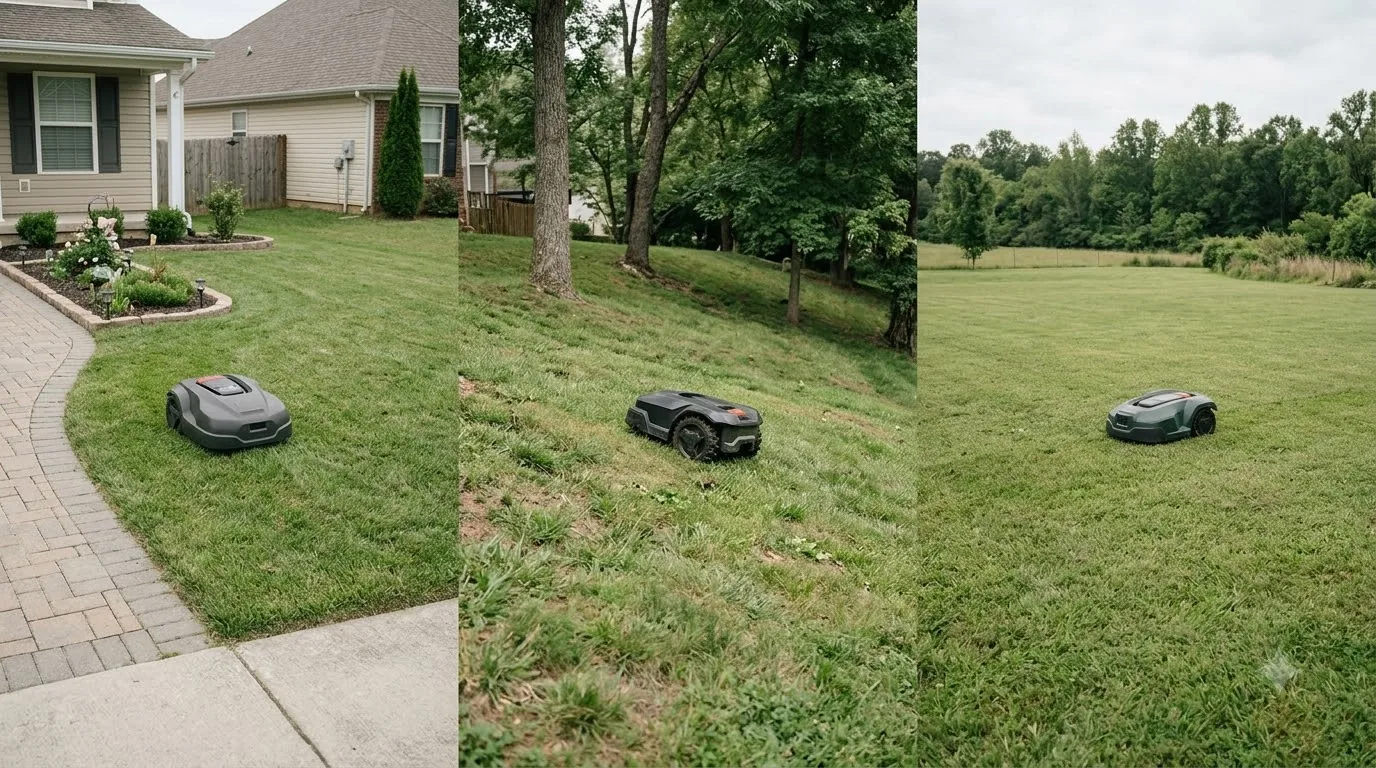

How does a robot mower handle a boulder in the lawn? It senses the rock, bumps into it if needed, and turns away. Whether it keeps cutting cleanly depends on the boulder’s height, the mower’s sensors, and whether you set a stay-out zone around it.
The short answer
- Tall, rigid boulders: generally bumped and avoided, not cut over.
- Low or hard-to-see boulders: mark them with a stay-out zone or remove them before the first mow.
- Night operation: sensor coverage differs by model, so check your manual.
- Stone paths: some models will avoid them unless you create a low-clearance zone.
Why a boulder is different from a small stone
A boulder is a large, rigid object, so a robot mower mainly avoids it through contact and sensing rather than by cutting over it. Robomow’s RT user guide says rigid obstacles higher than 15 cm (6 in), such as trees and poles, are bumped and avoided, so they need no boundary wire. Our reading is that the same logic applies to a tall boulder you can see from across the yard, and it is the reason the walk-around before the first mow matters. Lower objects, per the same guide, need a wire or a zone, which is why low boulders get separate treatment below.
Stones can also damage the mower. Robomow notes that stones can damage the housing and ricochet off the blades, which is one reason clearing the lawn matters even when the mower would not get stuck. Our reading is that a boulder you can see is easier to plan around than a low stone you cannot, so mark the boulders you find on the walk-around.
How does a robot mower handle a boulder in the lawn with sensors?
Camera-equipped models detect and avoid objects in real time, and bump contact is the fallback when the sensors do not catch an object. Husqvarna’s support article describes the behavior differently by model line, and the list below sticks to what that article states. It does not mention rocks or stones, so read it as the model’s behavior toward objects in general. Our overview of how robot mowers avoid obstacles gives the wider picture.
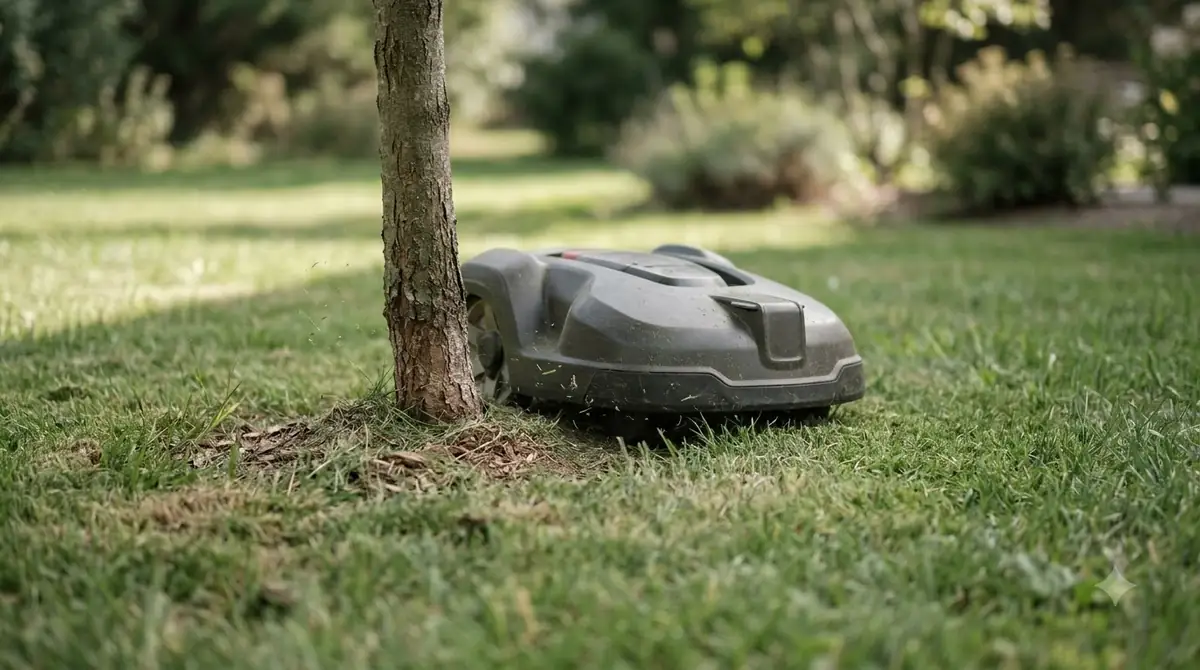
- NERA models: keep a larger safety distance from high-risk objects and approach low-risk objects more closely.
- Aspire R6V, 308V and 312V: keep one consistent safety distance for all obstacle types during daytime operation.
- At night: NERA models use infrared sensors to detect objects, while Aspire models have no vision support and may collide with objects.
The article gives no distances in centimeters for the safety zone, so the exact behavior around a boulder will depend on the model you own. Check the manual for the distances your mower uses, and treat a boulder as a bump-only object if you run the mower at night.
When a boulder needs a stay-out zone
So how does a robot mower handle a boulder in the lawn when a zone is drawn? It skips the marked area. A stay-out zone is the safer choice for any boulder you do not want the mower to bump repeatedly, and our explainer on what a no-go zone on a robot mower is covers the idea. Husqvarna’s guidance is that permanent objects, such as garden furniture or trampolines, should be inside a stay-out zone, which also helps the mower plan its route more efficiently.
- Taller than 15 cm: rigid objects are usually bumped and turned away from, per Robomow’s guide.
- Low boulders: put them in a stay-out zone or remove them.
- Boulders in a bed or next to a fixed feature: a stay-out zone keeps the route predictable.
Worx support takes the same approach for any obstruction that cannot be removed: mark the area with magnetic strips or a fence so the mower stays out. Our reading is that a fence or strip is only as good as its placement, so set the zone a little wider than the boulder itself. If you prefer a physical marker, see our pick of a garden fence for a robot mower no-go zone.
Stone paths, low rocks and low-clearance zones
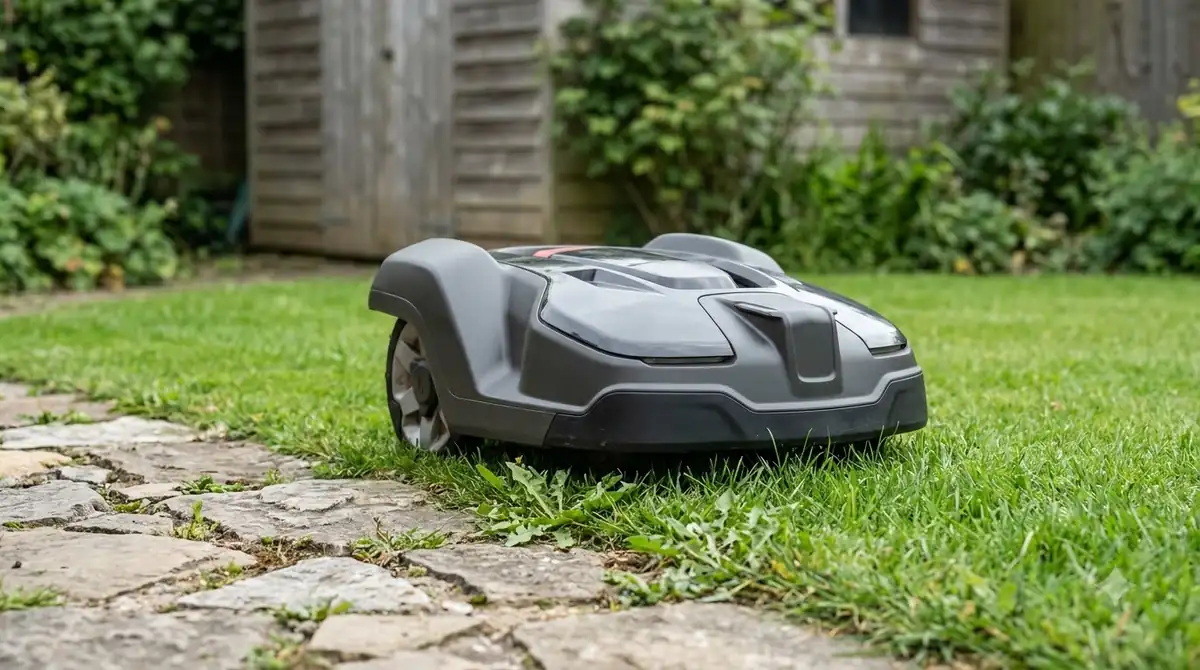
Ecovacs says stone, slate or cobblestone paths can activate the obstacle-avoidance function, so the mower will not cross them on its own. Its fix is a low-clearance zone, where visual obstacle avoidance is turned off and the mower relies only on its bumper plates to detect objects.
That fix trades one risk for another. With visual avoidance off, the mower only reacts after it touches the object, so a low-clearance zone should be drawn around the stones you actually want it to cross, not across the whole lawn. The Ecovacs FAQ is written in Danish and gives no measurements, so treat the steps as the manufacturer’s logic rather than a set of numbers. A related setup is covered in our guide to a yard with gravel path crossings.
What to check before the first mow
How does a robot mower handle a boulder in the lawn at your address? Walk the lawn, clear loose stones, and fill holes before the first mow, since Ecovacs support lists these among its fixes for robot mowers that get stuck. Do this before you set zones, because the zones are easier to place on a clear lawn.
- Walk the lawn. Remove loose stones and any loose wires the mower could catch on.
- Fill holes and low spots. A low spot next to a boulder can trap the mower.
- Decide for each boulder. Remove it, fence it with a stay-out zone, or leave it inside the boundary with the mower’s sensors in use.
- Trim long grass. Ecovacs recommends trimming grass under 10 cm before the first run, which makes stones easier to see.
- Review the map after the first run. Adjust any zone that the mower keeps bumping into.
Frequently asked questions
Will a robot mower run over a boulder?
No, not usually. How does a robot mower handle a boulder in the lawn that is tall? It bumps and turns away rather than climbing. Rigid objects taller than 15 cm are generally bumped and avoided rather than climbed, according to Robomow’s RT user guide. Low or flat boulders can behave differently, so check the manual for your model.
Do I have to move every boulder before mowing?
No. Remove loose or low stones, and put a stay-out zone around the boulders you want the mower to avoid. Worx support lists removal or magnetic strips and fences as the two options when a boulder cannot be moved.
Does night mowing change how a boulder is handled?
It can. Husqvarna says NERA models use infrared sensors to detect objects at night, while Aspire models have no vision support at night and may collide with objects. If you mow at night, treat any boulder inside the lawn as a bump-only object.
Can a robot mower cut around a boulder in a flower bed?
Usually only with a stay-out zone. Husqvarna recommends stay-out zones for permanent objects, which helps the mower plan its route around them. Check your model’s manual for the exact behavior near beds.
Sources
- Object detection and avoidance with AI vision technology (Husqvarna): camera detection, stay-out zones for permanent objects, night behavior by model.
- Robomow RT user guide (Robomow): 15 cm rule for rigid obstacles.
- Robomow blog on robotic mowers getting stuck (Robomow): stones can damage the housing and ricochet off blades.
- Ecovacs help FAQ on stone paths and obstacle avoidance (Ecovacs, Danish-language page): stone paths and low-clearance zones.
- Ecovacs support FAQ on getting stuck (Ecovacs): clear stones, fill holes, trim grass before mowing.
- Worx support on mowers getting stuck by obstacles (Worx): remove obstructions or mark the area.
 Up next9 min readBy YardHow Does a Robot Mower Handle Tree Stumps in the Lawn?Updated Nov 12, 2026
 8 min readBy YardHow Does a Robot Mower Handle a Lawn with Lamp Posts?Updated Nov 12, 2026
 8 min readBy YardHow Does a Robot Mower Handle a Patio? Wire and Edge RulesUpdated Nov 12, 2026
 6 min readBy YardHow Does a Robot Mower Handle a Wheelbarrow Left on the Lawn?Updated Nov 12, 2026
 9 min readBy YardHow Does a Robot Mower Handle a Well Cap or Utility Pedestal in the Lawn?Updated Nov 12, 2026
 9 min readBy YardHow Does a Robot Mower Handle Lawn Ornaments?Updated Nov 11, 2026