
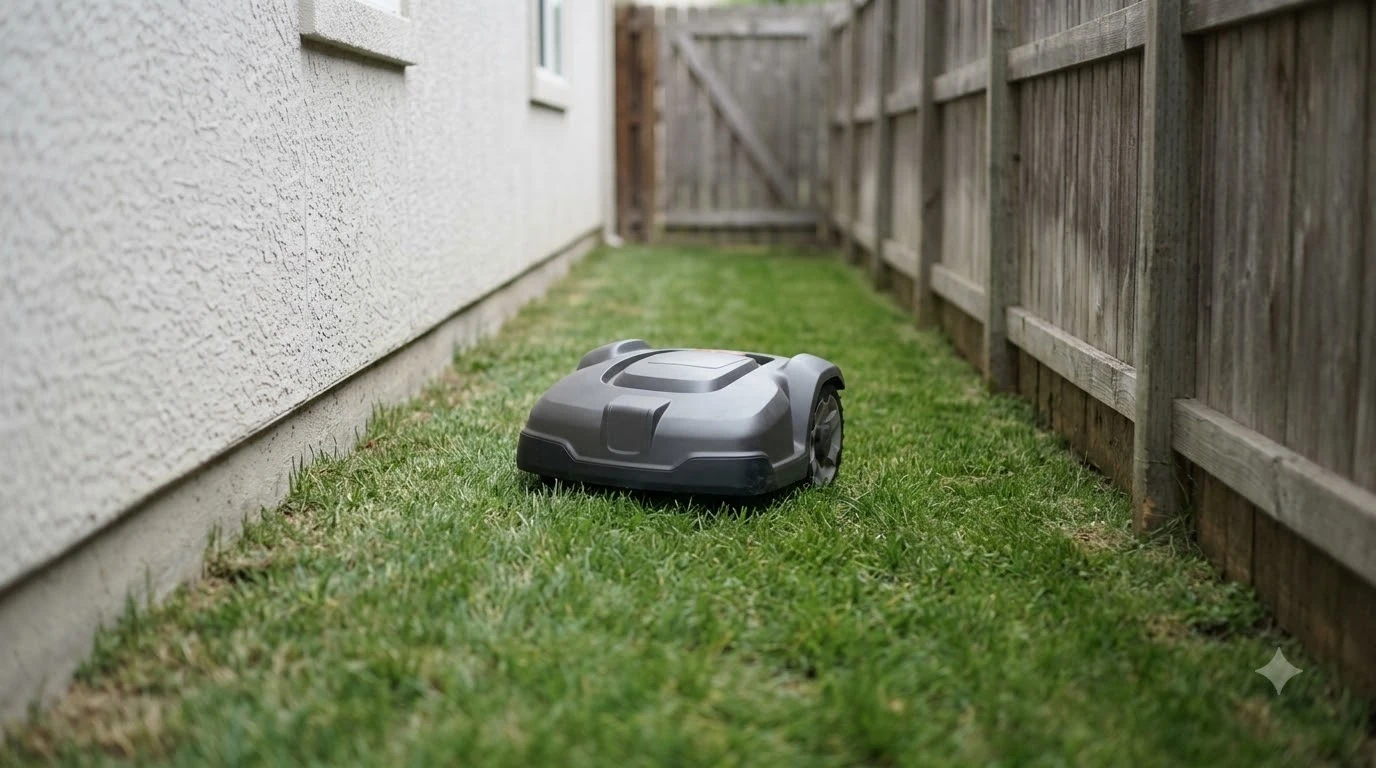

A robot mower for narrow side yard passages needs at least 60 cm (24 in) between boundary wires when a guide wire leads it through. Without a guide wire, Husqvarna recommends at least 2 m (6 ft 6 in) between the boundary wires on each side of the passage. Those are the figures as of 2026-11-10.
The short answer
- With a guide wire: 60 cm (24 in) between boundary wires, per Husqvarna and Gardena.
- Without a guide wire: 2 m (6 ft 6 in) for Husqvarna, and at least 1.5 m for Gardena.
- Obstacles: add each wall or fence clearance on top of the minimum.
- Your model: the owner’s manual figure for your mower comes first.
What a side yard passage needs
For a robot mower for narrow side yard passages, the gap that counts is the distance between the two boundary wires, not the distance between the house and the fence. A side yard that looks wide enough can still fail if a wall, downspout or gas meter takes up part of the strip. Gardena’s FAQ states the rule plainly: the distance to any obstacle is added to the 60 cm minimum for the passage.
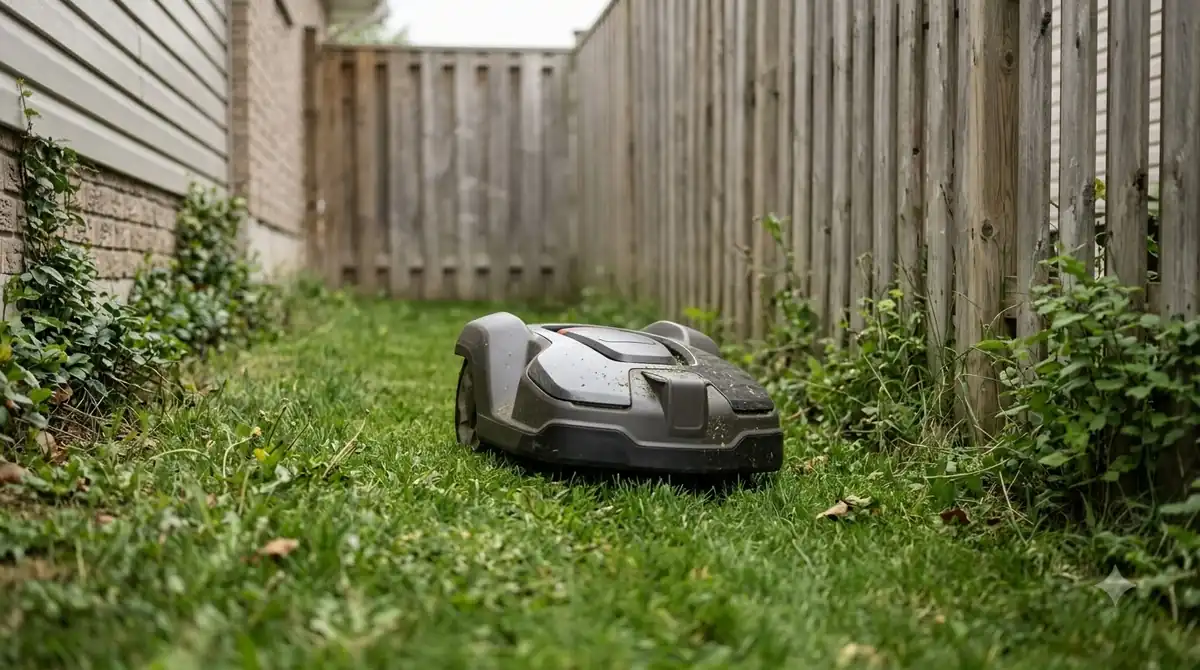
The charging station is the starting point for every guide wire route. Husqvarna asks you to measure the distance along the guide wire from the charging station to the start of a narrow passage, so the station needs a clear spot at the open end of the side yard, not inside it. See where the charging station should go for the general rules.
When a guide wire makes a narrow side yard workable
A guide wire is a second wire, connected to the boundary loop, that runs down the middle of a passage and leads the mower through it. Husqvarna says a guide wire can manage passages as narrow as 60 cm (2 ft). It also says a guide wire is strongly recommended for any passage narrower than 2 m (6.5 ft), because the mower otherwise has to find its own way.
Husqvarna’s guide wire instructions set a few rules that matter in a side yard:
- Keep the guide wire at least 30 cm (12 in) from the boundary wire.
- The mower always runs to the left of the guide wire as you face the charging station, so keep as much clear space as you can on that side.
- Avoid sharp bends above 45 degrees, which make the wire hard for the mower to follow.
- Do not let the guide wire cross a boundary wire, for example around an island.
The 30 cm rule uses space of its own. In a passage 60 cm wide, the guide wire sits in the middle and leaves 30 cm to each boundary wire, which is why Husqvarna’s 60 cm figure is a floor, not a comfortable target. Our reading is that a passage at the bare minimum leaves little margin for a wheel that drifts off the line.
If you have not laid wire before, installing a boundary wire and burying or pegging the wire cover the basics.
Minimum widths by brand
When you shop for a robot mower for narrow side yard passages, note that Husqvarna and Gardena give different minimums, and neither replaces the manual for your model. The table below lists the figures each company published on its support pages, as read on 2026-11-10.
| Brand | With guide wire | Without guide wire |
|---|---|---|
| Husqvarna Automower | 60 cm (24 in) between boundary wires; guide wire at least 30 cm (12 in) from the boundary wire | 2 m (6 ft 6 in) between boundary wires |
| Gardena robotic mowers | 60 cm (CorridorCut), boundary wire to boundary wire | At least 1.5 m |
Husqvarna’s support page also says that for the 435X AWD and 535 AWD, a passage width of 2 m (6 ft 6 in) is recommended for a good cutting result. That is a stricter goal than the 60 cm minimum, and it matters if you want even cutting along the strip, not just access to it.
Robot mower for narrow side yard passages: how to measure
Measure before you buy or lay any wire. A tape held straight across the gap gives a number you can compare with the brand figures above.
- Measure at the front and the back. Take the gap at both ends of the strip, because the narrowest point limits the whole passage.
- Subtract each obstacle clearance. Use the clearance from your model’s manual for each wall, fence or bed, not a guess.
- Compare the result with the minimum. Check it against 60 cm with a guide wire, or 1.5 m to 2 m without one, depending on your brand.
- Mark the guide wire line. Keep 30 cm from the boundary wire and confirm the left side of the line has room.
Gardena’s worked example shows the arithmetic. It places a mower between two house walls with 35 cm from each wall to the boundary cable, which adds up to 35 cm + 60 cm + 35 cm = 130 cm of total width. A side yard of 130 cm can therefore hold the minimum passage, but only if both obstacles are as the example assumes. A strip with a fence on one side and a wall on the other is measured the same way, with a clearance for each side.
When the side yard is too narrow or the mower gets stuck
If the gap is below your model’s minimum, the passage is outside what the manuals describe, and the mower may not enter it reliably. In that case, our reading is that the better choice is to change the route, move the boundary wire, or mow the strip by hand with a trimmer.
A strip with several obstacles needs a clearance for each one, not just for the wall; keeping wire clear of walls and obstacles shows the routing. The manuals describe obstacle distances by type, so write down each clearance from the manual before you add up the gap. A side yard that fails on paper is far cheaper to fix than one that fails after the first run. Beds along the strip are a separate case, covered in keeping a mower out of flower beds.
If the mower already enters the passage and then gets stuck, Husqvarna’s first advice is to adjust the corridor width. Its support page does not give a number for that setting, so follow the menu for your model and watch several runs before you change it again.
What to check before you lay wire
Before you choose a robot mower for narrow side yard passages, work through these points before you put a peg in the ground.

- The passage figure for your exact model, taken from its manual.
- A guide wire position at least 30 cm from the boundary wire, if you use one.
- Free space on the left side of the guide wire, as you face the charging station.
- Clearances for each obstacle, not only for the walls.
A narrow side yard rarely fails because of one number. It usually fails because the measured gap, the obstacle clearances and the guide wire position were never checked together. Work through the steps above with the manual open, and you will know early whether the strip suits a robot mower or needs a different plan.
Heads up
The manual for your model overrides general figures from any brand page, including the ones in this article. Check it before you buy a mower for a narrow strip.
Frequently asked questions
How narrow can a robot mower passage be with a guide wire?
Husqvarna gives 60 cm (24 in) between boundary wires as the minimum with a guide wire, and Gardena gives 60 cm for its CorridorCut setup. Both figures assume the guide wire is installed as the manual describes, with the guide wire at least 30 cm from the boundary wire on Husqvarna’s setup.
Is a guide wire required for a narrow side yard?
Husqvarna strongly recommends one for any passage narrower than 2 m. Without it, the minimum width rises to 2 m on its support page, and Gardena’s figure without a guide wire is at least 1.5 m.
How much room do I need beside a wall?
Gardena’s worked example adds 35 cm from each house wall to the 60 cm passage, for a total of 130 cm. The clearance for other obstacles varies, so check the operation manual for your model.
What should I do if the mower keeps getting stuck in the passage?
Husqvarna advises adjusting the corridor width first, and its support page does not list a figure for that setting, so check the menu for your model. If the mower still struggles, confirm the guide wire is at least 30 cm from the boundary wire, check that the mower runs on the free side of the guide wire, and measure the gap again.
Sources
- How to create a passage in an Automower boundary wire installation (Husqvarna): minimum spacing with and without a guide wire, guide wire distance, 435X and 535 AWD passage width.
- How to lay a guide wire in a boundary wire Automower installation (Husqvarna): run side, 45 degree limit, 60 cm passage with guide wire, narrow passage guidance.
- Robotic Lawnmower FAQs (Gardena): 60 cm CorridorCut passage, 1.5 m without a guide wire, obstacle clearance example.
 Up next9 min readBy YardWhat Is the Minimum Passage Width for a Robot Mower?Updated Nov 11, 2026
 8 min readBy YardHow Narrow Can a Robot Mower Passage Be? Simple 2026 RulesUpdated Nov 11, 2026
 7 min readBy YardCan a Robot Mower Work in a Long Narrow Yard?Updated Nov 11, 2026
 9 min readBy YardCan a Robot Mower Work in a Lawn on Both Sides of the House?Updated Nov 11, 2026
 9 min readBy YardRobot Mower for Side Slopes and DitchesUpdated Nov 11, 2026
 9 min readBy YardCan a Robot Mower Work in an L-Shaped Yard?Updated Nov 11, 2026