
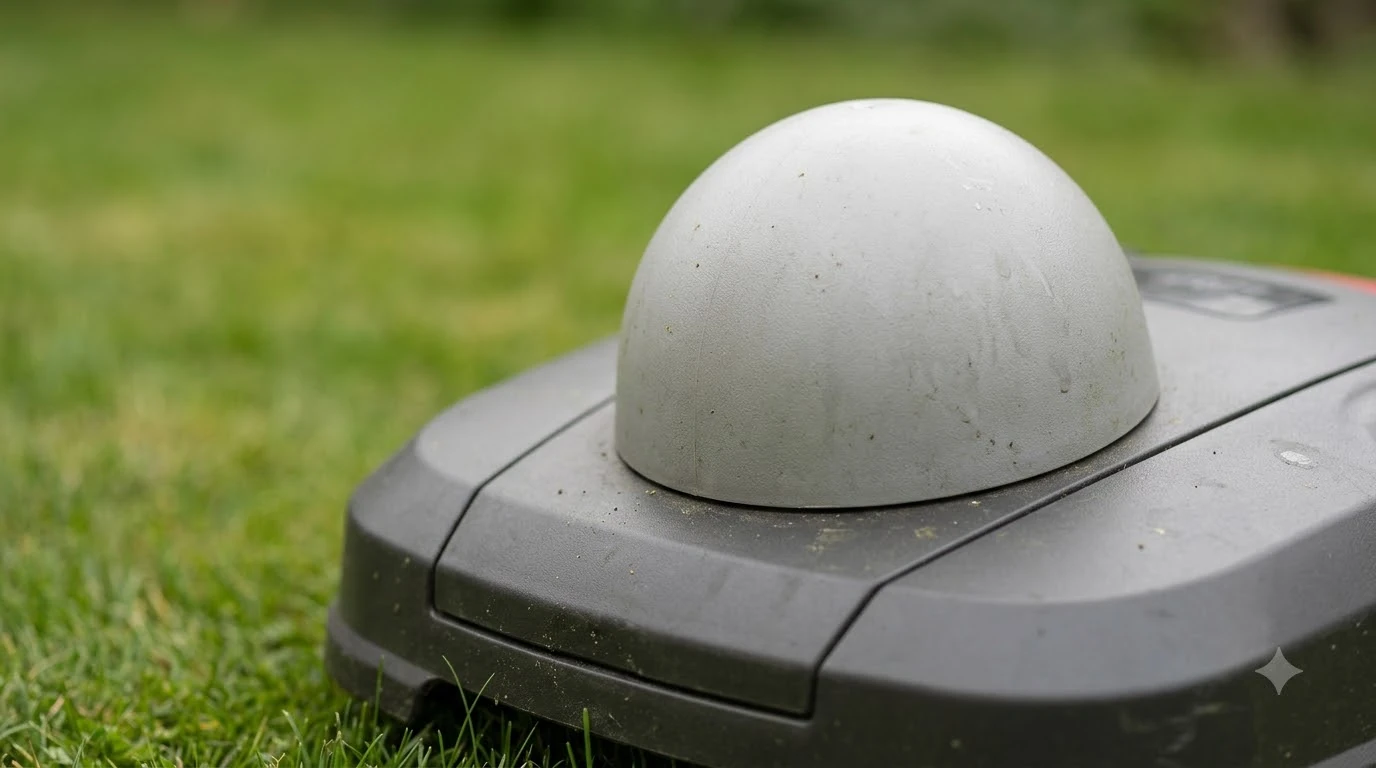

An RTK robot mower near tall buildings can lose its precise fix, because the building blocks satellites and reflects their signals. The result is less accurate positioning, and in tight yards the mower may wander near walls or hesitate at the boundary. Our reading is that open sky above the base station and the mowing area matters more than the brand name.
The short answer
- Blocking: tall buildings hide satellites, so the receiver tracks fewer of them.
- Reflection: signals bounce off walls, glass, and metal and arrive late, which can bias the position.
- Float: a drop from fix to float means the mower has lost its most precise mode.
- Rule of thumb: one RTK vendor guide asks for roughly 15 degrees of clear sky above the horizon.
Why an RTK robot mower near tall buildings loses accuracy
Tall buildings hurt RTK in two ways at the same time, which is why an RTK robot mower near tall buildings behaves differently from one in an open field. They block satellites that sit low in the sky, and they reflect signals from satellites that remain visible. Both effects reach the mower’s receiver, and RTK depends on both the base station and the mower seeing a clean set of signals.
RTK needs a minimum number of satellites before it can work. Trimble’s documentation says an RTK solution requires at least four continuously tracked satellites, and initialization requires at least five common satellites tracked at both the base and the rover. Our reading is that a building hiding a large part of the sky can push a yard below those counts for part of the day, which is the core risk for any RTK robot mower near tall buildings.
Blocking and reflection are two different problems
Blocking reduces how many satellites the receiver can see, while reflection corrupts the signals it still receives. Trimble states that obstructions limit the number of visible satellites and can also induce signal multipath. Trimble’s RTK critical factors page covers both effects in one place.
Multipath is the reflection problem. It happens when satellite signals bounce off metal, walls, or glass before reaching the antenna. Those reflected signals arrive late, which can shift the position and cause sudden jumps. For phase measurements, Trimble puts multipath error at about 1 to 5 cm, so our reading is that the bigger risk for a mower is the sudden jump rather than a slow drift.
Swift Navigation puts the point more broadly: anything that blocks or reflects satellite signals will introduce errors. Its troubleshooting guide lists tall buildings, dense tree canopies, tunnels, and even large vehicles as sources of degraded accuracy. Swift’s RTK and NTRIP troubleshooting guide is a useful checklist for this kind of problem.
Fix and float: what a weak signal looks like
A drop from fix to float is the clearest sign that a receiver has lost its best accuracy. In fix mode the receiver has resolved carrier-phase ambiguities to whole numbers. In float mode it has not, so accuracy is lower and varies by receiver.
Swift explains that when the baseline between base and rover is too long, the status typically drops from fix to float because the integer ambiguity cannot be resolved. Our reading is that a nearby building can cause a similar drop, because it weakens the signals the receiver depends on. Swift advises running a few immediate checks as soon as the status shifts from fix to float.
A vendor guide from RTKdata lists the symptoms owners may see in practice: boundary hesitation, wobbly paths, missed strips, or out-of-bounds moves near hazards. Those symptoms are typical of a mower that has slipped out of fix near a structure. They are not proof of a fault on their own, so check the sky view first.
How much sky view does an RTK robot mower near tall buildings need?
For this setup, the clearest target in the sources is a clear view of the sky above roughly 15 degrees from the horizon. RTKdata presents this as a rule of thumb for RTK, not a certified specification, so treat it as a planning number.
The narrow side yard is the usual problem spot. RTKdata says a side yard between a house and a fence hides low satellites and often causes RTK instability. Trimble also warns that a lower elevation mask, which lets a receiver use satellites nearer the horizon, can degrade performance. For a closer look at tight lots, see our guide to a robot mower for narrow side yard passages.
| Spot in a tight yard | What limits the sky | Our reading |
|---|---|---|
| Side yard between house and fence | Walls on both sides hide low satellites | Highest risk of instability |
| Back corner next to a tall wall | One side of the sky is blocked | Check the fix status before trusting it |
| Open lawn in the middle of the yard | Most of the sky is clear | Usually the best place to hold a fix |
| Area under a tree canopy | Branches block and scatter signals | Expect float at times |
These risk levels are our reading of the sky-view rules above, not measured results. For the tree row, our guide to a robot mower that works under trees without RTK goes further. The point is to walk each zone and count how much sky you can see from the ground.
Placing the base station away from structures
The base station should have the widest sky view you can find, and it should sit away from reflective surfaces. Swift recommends placing the base at the highest possible point with no large objects in the immediate vicinity. RTKdata advises moving the base or dock away from reflective surfaces and leaving a buffer along those edges.
- Find the highest open spot. Choose a point above fence lines and away from walls where the sky is widest.
- Keep the base clear of metal. Move it away from metal fences, sheds, and parked vehicles. Our guide on where to mount an RTK base station has more on mounting.
- Confirm the antenna points up. Swift’s first checks are to confirm the antenna points directly up and that nothing blocks its view.
- Check the cables. Loose connections can look like signal problems, so confirm the cables are seated before you blame the site.
Heads up
RTKdata cites NOAA National Geodetic Survey guidance to avoid placing a base within 30 meters (about 98 feet) of structures taller than the antenna. That figure comes from a vendor guide, so check the original NGS guidance before you set up a base in a tight yard.
When a boundary wire is the safer fallback
A boundary wire does not depend on satellites, so buildings and reflections do not affect where the mower finds its edge. That is the main trade-off to weigh against an RTK robot mower near tall buildings, and our comparison of boundary wire vs RTK installation time compares the setup effort. Our reading is that a wire-based system can be the simpler choice when the sky is blocked on most sides.

The trade-off is installation. A wire has to be laid around the lawn and secured with stakes, and any obstacle inside the lawn needs its own routing. Read how to install a robot mower boundary wire before you commit.
A pre-install checklist for tight yards
Before you buy an RTK robot mower near tall buildings, walk the site and count the sky from several points. The checks below use the sources above and do not replace the manufacturer’s installation guide.
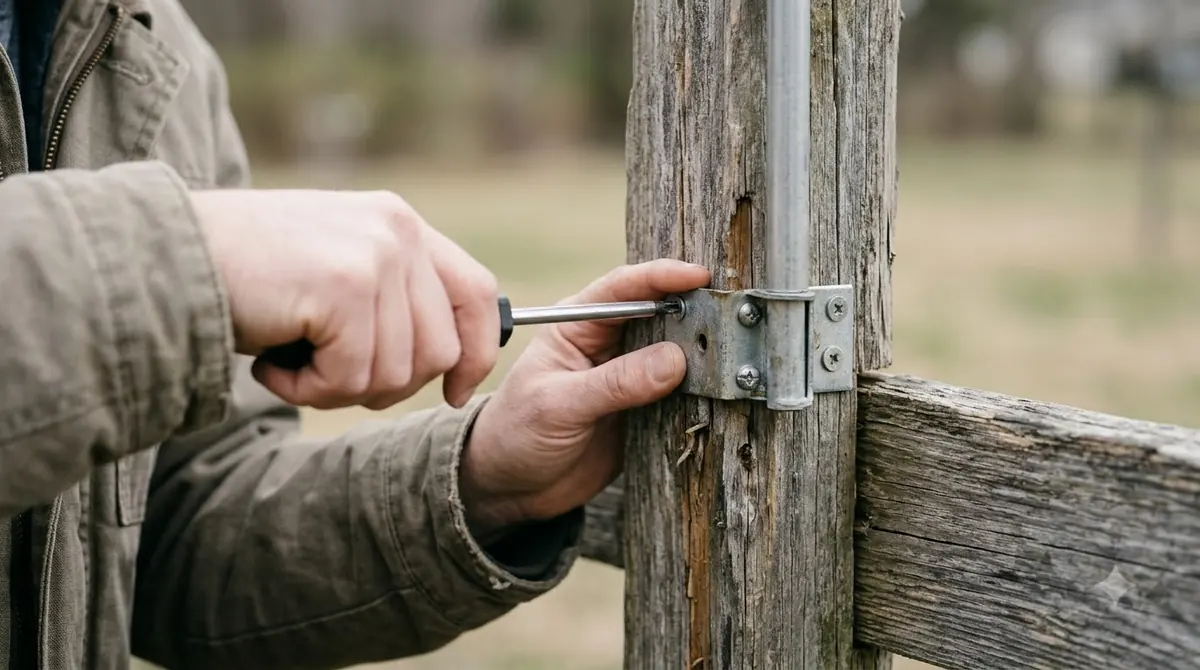
- Map the buildings. Note which walls and fences sit within a few meters of the lawn edge.
- Check each zone. Stand at each boundary and note how much sky is visible above the fence line.
- Find the base spot. Pick a point with the widest view and no reflective surfaces nearby.
- Ask about fallback. Ask the seller what the mower does when it drops from fix to float.
Frequently asked questions
Can an RTK robot mower work next to a tall building?
Yes, but accuracy can drop. An RTK robot mower near tall buildings can lose satellites that the walls block and get reflected signals, so a mower may hold a fix in open areas and fall to float near walls. Check the status in the zones closest to the building before you rely on the mower there.
How much sky does an RTK mower need?
One RTK vendor guide gives roughly 15 degrees of clear sky above the horizon as a rule of thumb. It is a planning number, not a certified specification. Walk each zone and judge the view from the ground before you decide.
Why does my mower drift only near the house?
Walls and glass near the house can reflect signals, and a narrow side yard can hide low satellites. Reflected signals arrive late and can shift the position. Open lawn away from the house usually holds a better fix.
Is a boundary wire better in a tight yard?
Not always. A boundary wire does not depend on satellites, so buildings do not affect where the mower finds its edge. It does need installation work around the lawn and any obstacles. Our reading is that the choice depends on how much sky the yard keeps.
Sources
- Trimble, critical factors for RTK accuracy (manufacturer documentation): obstructions, multipath, satellite counts, and elevation mask.
- Swift Navigation, troubleshooting common RTK and NTRIP issues (GNSS maker): fix to float drops, obstructions, and antenna checks.
- RTKdata, wire-free robot mower RTK accuracy guide (vendor guide that cites NOAA NGS): the 15-degree sky rule, side yards, multipath, and base placement.
 Up next8 min readBy YardRobot Mower That Works Under Trees Without RTK: What to Look ForUpdated Nov 11, 2026
 8 min readBy YardRobot Mower for Tall Fescue Lawns: Height Limits That MatterUpdated Nov 11, 2026
 8 min readBy YardBest Mowing Height for Fescue: Tall vs Fine Fescue GuideUpdated Nov 11, 2026
 8 min readBy YardWhere to Place RTK Antenna in a Yard With TreesUpdated Nov 11, 2026
 8 min readBy YardRobot Lawn Mower for Bumpy Uneven Lawn: What to Check FirstUpdated Nov 11, 2026
 8 min readBy YardCan a Robot Mower Work in an Irregular Shaped Lawn?Updated Nov 11, 2026