
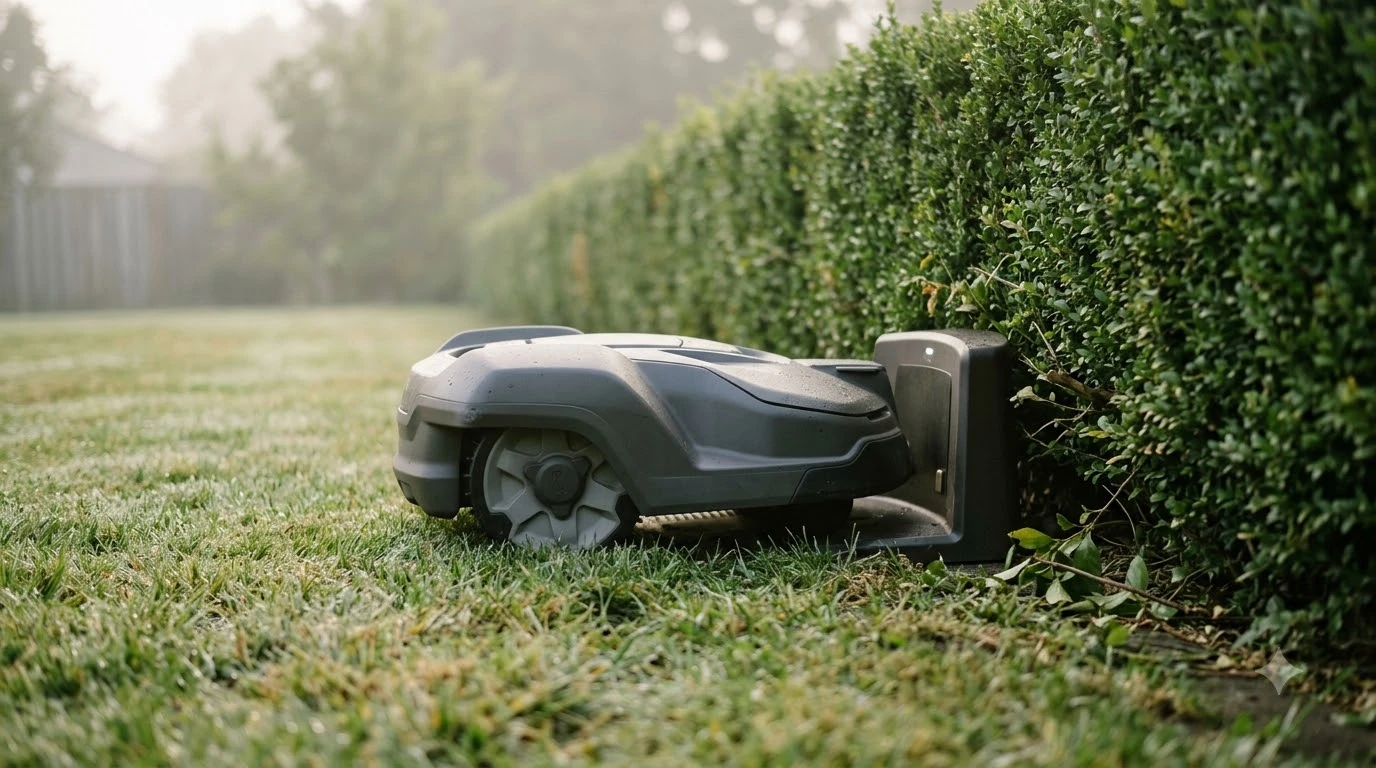

This MOVA LiDAX Ultra 3000 AWD review covers a robot mower listed for lawns up to 0.75 acre per map and slopes up to 80%, with all-wheel drive and wire-free LiDAR navigation. These are the figures on a third-party listing. They are published specs, not independent test results, and the official MOVA page was not available when this review was prepared.
The short answer
- Coverage: rated for up to 0.75 acre per map, with two saved maps supported.
- Slope: rated to 80%, which is a ceiling, not a working target.
- Drive: all-wheel drive with four hub motors, unlike the 2WD LiDAX Ultra 2000.
- Navigation: 360-degree 3D LiDAR with AI dual vision, and no boundary wire or RTK base, according to the listing.
- Runtime: 170 minutes per charge with a 65-minute charge time, as listed.
- Not listed: battery chemistry, the test conditions behind the runtime figure, and warranty terms beyond the 3-year length.
MOVA LiDAX Ultra 3000 AWD review: specs as listed
This mova lidax ultra 3000 awd review starts with the published figures. The 3000 AWD is the larger, all-wheel-drive model in MOVA’s LiDAX Ultra range. The figures below come from a third-party listing page marked as updated in November 2026. The official MOVA product page could not be read at the time of writing, so check the manufacturer’s page before relying on any single number.
| Spec | What the listing shows | Note |
|---|---|---|
| Maximum area | 0.75 acre (3,035 m²) | Per map; two saved maps supported |
| Maximum slope | 80% | Rating ceiling |
| Cutting width | 15.8 in (40.1 cm) | Listed |
| Cutting height | 1.2 to 3.9 in (30 to 99 mm) | Adjustable in the app |
| Drive | All-wheel drive, four hub motors | Listed |
| Navigation | UltraView 3.0, 360-degree 3D LiDAR with AI dual vision | No perimeter wire, no RTK |
| Battery | 7.5 Ah, not user-swappable | Chemistry not listed |
| Runtime and charge | 170 minutes; 65 minutes to charge | Test conditions not listed |
| Weight | 52 lb (23.6 kg) | Mower only |
| Dimensions | 29.1 × 20.9 × 12.6 in (740 × 532 × 321 mm) | Mower only |
| Water rating | IPX6 mower; IPX4 charging station | Listed |
| Warranty | 3 years | Terms beyond length not listed |
How the 3000 AWD navigates without a boundary wire
The listing says the mower combines a 360-degree 3D LiDAR with AI dual vision, and that it needs neither a perimeter wire nor an RTK base station. Lidar is a distance-sensing method that builds a picture of the surroundings from laser returns, and the camera pair handles recognition of objects in the path. The listing describes two saved maps, which is useful when a yard is split by a driveway or a garden bed. Our guide to wire-free versus boundary wire mowers compares the two setup styles.
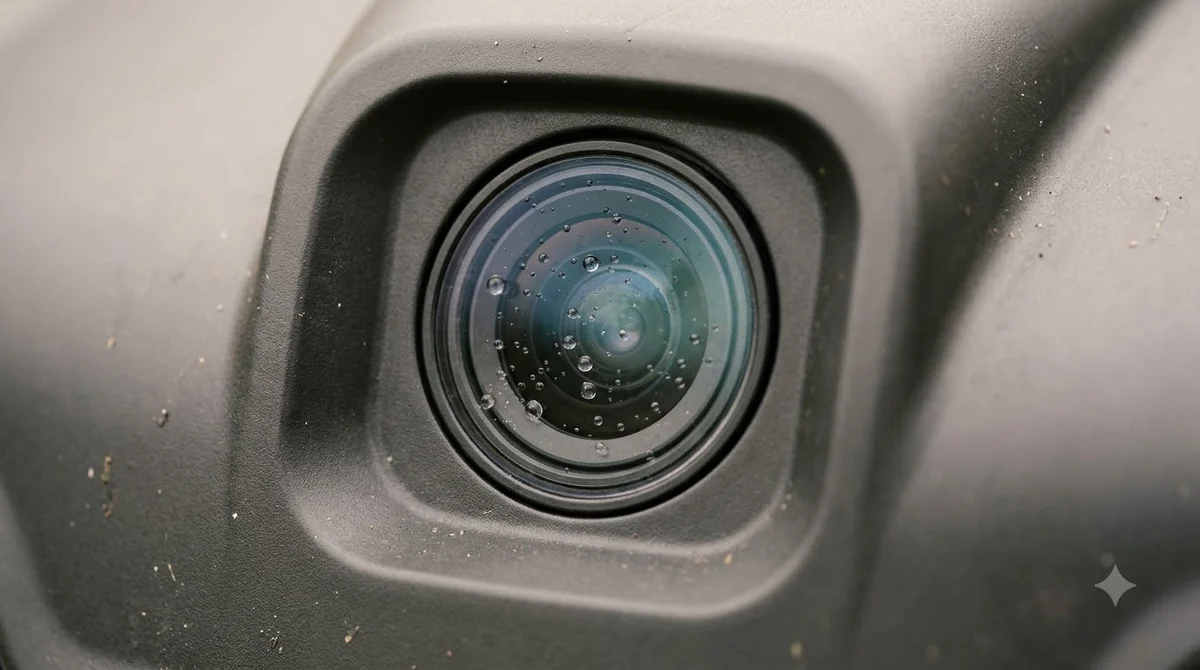
These are MOVA’s published design choices as reported by the listing. We have no independent test data for how the system behaves in dusk, rain, or dense shade, so the wire-free claim should be read as a claim until a tested source confirms it. The listing page is the source for every figure in this section.
What 80% slope means on a real lawn
An 80% rating is the steepest grade the listing claims the mower can handle. Slope percentage is the vertical rise divided by the horizontal distance, multiplied by 100, so 15 cm of rise over 100 cm of run is a 15% slope. Husqvarna’s installation guidance says areas that are too steep must be excluded from the installation, and that slipping risk rises on steep slopes, especially in wet conditions. Its guide also notes that clogged wheels make slopes harder to manage. Husqvarna’s steep-slope guide sets out the formula and the exclusion advice.
Eufy, a retailer, describes the maximum rated slope as “an absolute limit rather than a target for daily mowing.” It adds that wet grass reduces tyre grip and that the unit can slide or slip downhill, and that running at the top incline continuously increases tyre slip, motor strain and battery drain. Because Eufy sells robot mowers, read this as vendor advice rather than independent testing.
Heads up
80% works out to an angle of about 38.7 degrees. A slope rating on a spec sheet says nothing about grass length, soil type, or how wet the lawn is. Our reading is to keep any zone close to the rating outside the mowing area and to check the wheels for clippings after each run. Our guide to setting up a robot mower on a slope goes further.
All-wheel drive versus the 2WD Ultra 2000
The 3000 AWD drives all four wheels through four hub motors. The LiDAX Ultra 2000 is listed as 2WD. Eufy’s guidance, cited above, notes that wet grass reduces tyre grip, which is the situation where the drive layout matters most. The drive layout is the main hardware difference between the two models on the pages read here.
Our reading is that the AWD layout is the strongest reason to choose the 3000 over the 2000 when the lawn has real slopes. The listing does not say how much better it performs on any particular grade, so the choice should rest on the lawn’s actual slopes and size.
Obstacles, pets and children
The listing says the mower can climb obstacles up to 2.4 in (61 mm) high, uses dual 1080p cameras for AI obstacle avoidance, detects pets and children, and has lift and tilt sensors. The listing also reports an IPX6 rating for the mower and IPX4 for the charging station.
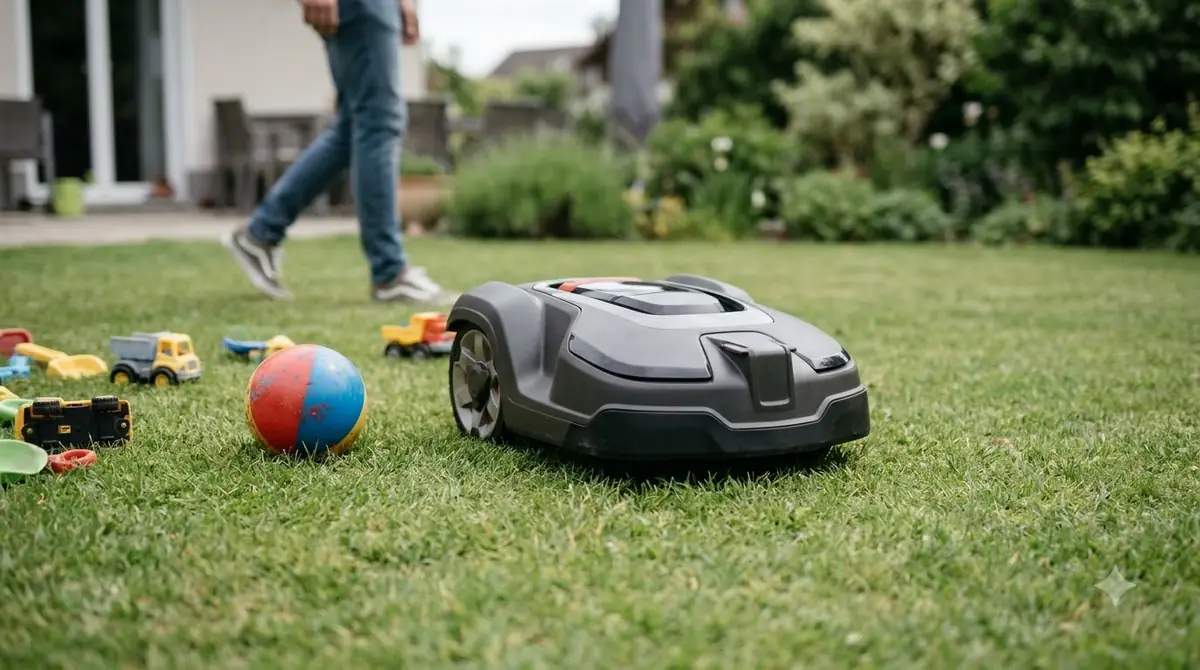
These are published claims, not independent measurements. Before buying, check how the app handles a toy, a hose or a garden tool left on the lawn (our note on cleaning robot mower sensors covers upkeep), and read the manual’s section on lift and tilt cut-off. Those checks say more about fit for your yard than the feature list does.
Runtime, charging and battery
The listing gives 170 minutes of runtime per charge and 65 minutes to recharge. The 7.5 Ah battery cannot be swapped by the owner, so a replacement means service or a new unit. The listing does not give battery chemistry, and it does not say what mowing conditions produce the 170-minute figure. Treat the number as the listing’s figure rather than a guaranteed result on your lawn.
The 2000 retailer page lists a 5 Ah battery but no runtime, so the two models cannot be compared on runtime from the pages read here.
MOVA LiDAX Ultra 3000 AWD review against the Ultra 2000
On the pages read here, the 3000 covers more area, takes steeper grades and is heavier than the 2000, so a mova lidax ultra 3000 awd review should compare the two on lawn size first. The table uses the listing for the 3000 and the retailer page for the 2000.
| Spec | LiDAX Ultra 3000 AWD | LiDAX Ultra 2000 |
|---|---|---|
| Maximum area | 0.75 acre per map | 0.5 acre |
| Maximum slope | 80% | 45% |
| Drive | All-wheel drive, four hub motors | 2WD |
| Battery | 7.5 Ah, not swappable | 5 Ah |
| Weight | 52 lb | 30.4 lb |
| Navigation | UltraView 3.0, LiDAR with AI dual vision | Not listed on the retailer page |
| Obstacle handling | 2.4 in climb; dual 1080p cameras; pet and child detection | Not listed |
| Runtime | 170 minutes | Not listed |
| Water rating | IPX6 mower | Not listed |
Our reading: the 2000 fits a yard up to about 0.5 acre with gentle ground, while the 3000 is the one to look at when the lawn is larger than that or the slopes are steeper. Other robot mowers on the market have different rated areas (see which MOVA robot mower to consider for the wider range), slopes and navigation systems, so this comparison covers only the two MOVA models.

What the MOVA LiDAX Ultra 3000 AWD review leaves out
The pages read for this review leave several things out: battery chemistry, the conditions behind the runtime figure, warranty terms beyond the 3-year length, noise level, and any independent test results. Prices are not stated here, because they change and this site does not list fixed prices. Check the official product page and warranty card before buying.
Who this model suits, in our reading
The 3000 AWD suits owners with a lawn approaching 0.75 acre per map, slopes that would strain a 2WD unit, and a wish to avoid a perimeter wire. It is a weaker fit for yards above 0.75 acre per map, grades at or near 80%, or buyers who need a known runtime under specific conditions. No ranking is implied: the right choice depends on the lawn’s size, slope and the owner’s setup preferences.
Frequently asked questions
Does the MOVA LiDAX Ultra 3000 AWD need a boundary wire?
The listing says no. It describes LiDAR and AI vision navigation with no perimeter wire and no RTK base station. Check the manual’s setup steps for your yard before buying.
What does an 80% slope rating mean?
An 80% grade rises 80 cm for every 100 cm of horizontal distance. It is the listed maximum, and wet grass or worn wheels reduce real grip, so running at the limit is not a daily target.
Is the 3000 AWD worth more than the 2000?
Our reading is that the 3000 makes more sense for lawns larger than about 0.5 acre per map or with steeper ground, since it has AWD and a higher slope rating. This article does not compare prices.
How long does it run on one charge?
The listing gives 170 minutes of runtime and 65 minutes to charge. The listing does not state the conditions behind the runtime figure, so treat it as a listed number.
Sources
- Smart Home Compared, MOVA LiDAX Ultra 3000 AWD listing (third-party): area, slope, drive, navigation, battery, runtime, weight, dimensions, IP ratings and warranty length. Page marked updated November 2026.
- FreshlyCharged, MOVA LiDAX Ultra 2000 product page (retailer): 0.5 acre, 45% incline, 2WD, 5 Ah battery, 30.4 lb.
- Husqvarna, how to optimise a robotic lawn mower installation for steep slopes (manufacturer): slope formula, exclusion of steep areas, slipping risk and wheel grip.
- Eufy, robot lawn mower slope limits (retailer): maximum slope as an absolute limit, wet grass grip and wheel slip.
 Up next8 min readReviews & CompareMOVA LiDAX Ultra 1000 Review: Specs, Slope and LimitsUpdated Nov 16, 2026
 7 min readReviews & CompareMOVA LiDAX Ultra 2000 Review: Specs, Slope and LimitsUpdated Nov 12, 2026
 7 min readReviews & CompareMammotion LUBA 3 AWD vs MOVA LiDAX Ultra 2000: What the Published Specs ShowUpdated Nov 13, 2026
 8 min readReviews & CompareMOVA LiDAX Ultra 2000 vs Segway Navimow X3: Specs ComparedUpdated Nov 11, 2026
 8 min readReviews & CompareMOVA LiDAX Ultra 2000 vs Dreame A2: Published Specs ComparedUpdated Nov 13, 2026
 7 min readReviews & CompareMOVA LiDAX Ultra 1000 vs ECOVACS GOAT O1000 LiDAR PRO: Which Fits Your Lawn?Updated Nov 16, 2026