
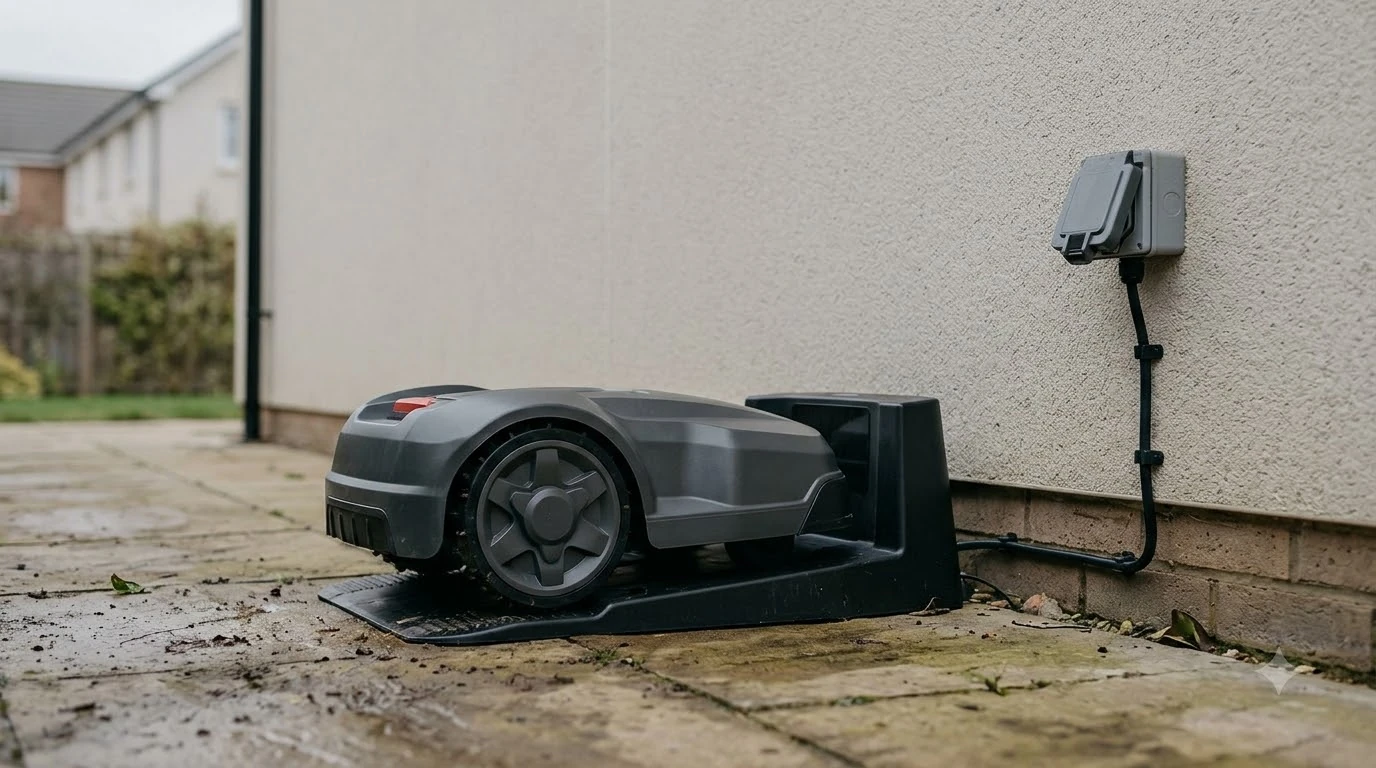

Is a best robot mower dock mat required? No. None of the manufacturer pages we read asks for one. What the docks do need is a level, firm, clear base. Husqvarna asks for a level surface with an unbent baseplate, and Mammotion warns that a station that moves even slightly may stop the robot from docking correctly. This guide sets out what the sources actually specify, and what to check if you still want a pad or mat under the dock.
The short answer
- Mats are not in the manuals: Husqvarna and Mammotion both describe the base without mentioning a mat, pad or platform.
- Level and fixed: the station must sit on level, flat, solid ground and be secured with stakes or expansion bolts.
- Clearance: Husqvarna lists 6 m (20 ft) of free space in front for wire-free installs; Mammotion lists at least 1.5 m (5 ft) in front and on both sides.
- If you add a pad: it must not tilt, flex or shift the dock, and the clearances must still hold (our reading).
Best robot mower dock mat: what the manufacturers specify
Two of the most detailed installation guides we read describe the base in similar terms, and neither names a mat. The short version is that the sources ask for a level, stable base, not a particular surface product.
Husqvarna’s automower charging station placement guide says to “Ensure that the charging station is on a level surface,” and that “The baseplate of the charging station must not be bent.” In its mower house checklist it also says to ensure under-deck framing doesn’t “deform the baseplate,” so a roof or cover frame can warp the base as well as the ground beneath it. The page does not mention mats, pads, platforms, gravel or grass as a base surface.
Mammotion’s charging station installation guide asks for “Flat and level ground” and says to “Always install on flat and solid ground.” It warns that “A charging station that is not level or stable may cause misalignment during docking,” but it gives no numeric tilt limit. Like Husqvarna, it does not mention a base pad, mat or platform.
| Source | What it asks for at the base | Mat, pad or platform mentioned? |
|---|---|---|
| Husqvarna placement guide | Level surface; baseplate must not be bent or deformed by cover framing | No |
| Mammotion installation guide | Flat, level and solid ground; secured with stakes or expansion bolts | No |
| Penn State Extension (lawn establishment) | Lawn subgrade free of depressions where water can collect | No; it covers lawn grading, not docks |
Why a stable base matters for docking
A dock that moves can cause the robot to miss its contacts, and a mat that shifts under the base could do the same. Mammotion puts it plainly: “If the station moves slightly, the robot may fail to dock correctly.” Its guide asks you to “Use stakes or expansion bolts to firmly secure the station,” which is the step that keeps the base in place once it is set.
Husqvarna gives a useful order of work. For boundary-wire installs it says not to secure the station to the ground “until you have installed all the wires” and verified that the installation works, so you can confirm docking before you fix the base in place. Our reading is that the same logic applies to any pad: place it, test a docking run, and only then anchor the station. Our guide to robot mower charging station anchor screws covers the anchoring step.
Our reading is that a mat which rocks, sinks at one corner or raises one side of the dock creates the same problem as a loose station. None of the sources we read tests a pad, so treat this as a check to run rather than a rule from the manufacturer.
Clearance around the dock
The space you must keep clear depends on how the station is installed, not on whether you add a pad. Husqvarna lists “at least 6 m/20 ft. of free space in front of the charging station” for EPOS wire-free installations. For physical boundary-wire installations it lists 3 m (10 ft) in front, 150 cm (60 in) to the right and left of the centre of the station, and 60 cm (2 ft) behind.
Mammotion asks for “at least 5 ft (1.5 m) of clear space in front and on both sides.” It also asks for open sky above the station and warns against “heavy tree cover or roof edges,” because “Obstructions above the station may affect positioning and docking performance.”
| Installation | In front | Sides | Behind |
|---|---|---|---|
| Husqvarna, EPOS wire-free | 6 m / 20 ft | Not stated | Not stated |
| Husqvarna, boundary wire | 3 m / 10 ft | 150 cm / 60 in from centre, each side | 60 cm / 2 ft |
| Mammotion | 1.5 m / 5 ft | 1.5 m / 5 ft, each side | Not stated |
Because the figures differ between brands and install types, the manual for your own model is the authority. If you do add a pad, measure the clear space from the pad’s edge, not from the old ground line. That is the working space the robot actually sees, which is our reading rather than a manufacturer statement.
Ground criteria: level, firm and draining
Look for ground that stays level through the seasons, not just on the day you install the station.
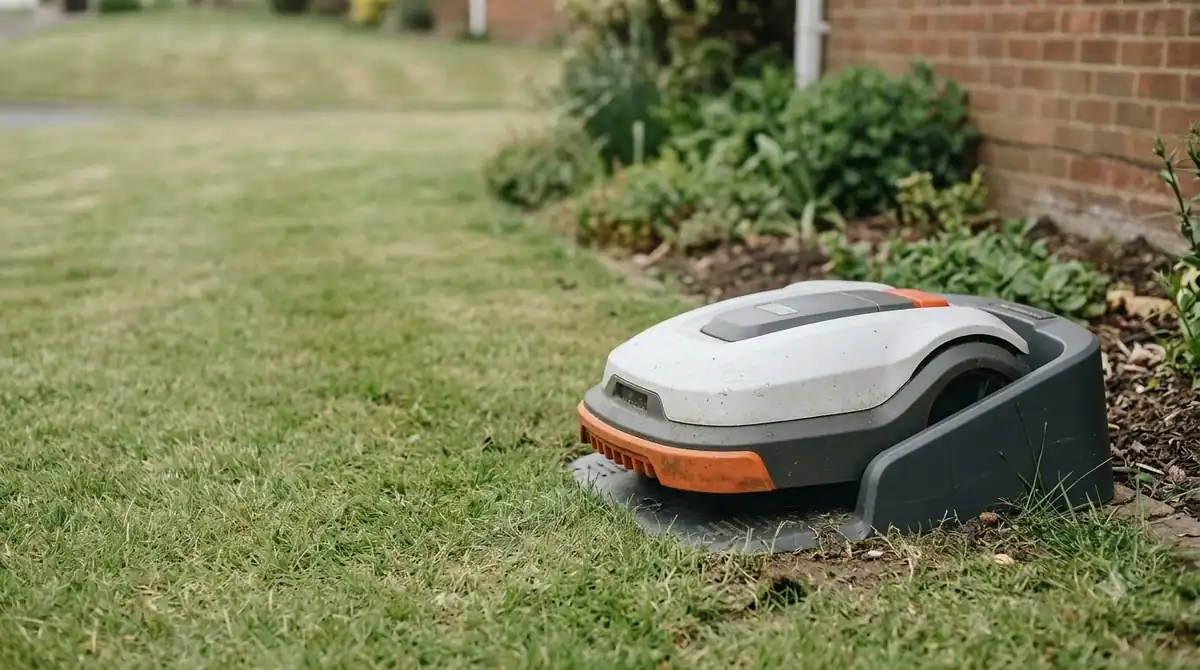
Penn State Extension’s lawn establishment guide says that “The subgrade should be free of depressions where water can accumulate.” It also recommends that the grade “slope gently away from any building foundation at a 1 to 4 percent slope.” Those are rules for grading a lawn, not for docks, but the logic carries over: water that pools under a dock can soften the ground and tilt the base (our reading).
The same guide says that an alternative to mechanical firming is to let rainfall or irrigation water settle the soil. Our reading is that a base set on fresh fill may sink as the soil settles, so recheck the level after the first heavy rain.
Mammotion lists “Installing on Uneven or Soft Ground” among its common mistakes, and its avoid list includes “Under trees or dense foliage” and “Locations blocked by walls, fences, or large objects.” A dock placed in a tight corner or a hidden spot can therefore fail on space as well as on level. For a wider look at siting, see where to put a robot mower charging station.

Debris and grass around the contacts
The charging contacts sit low on the dock, and grass can collect around them. None of the three sources we read gives a rule for grass at the contacts, so this section is our reading and should be checked against your manual. A robot mower cover for the charging station can shelter the dock from sun and rain, and Husqvarna says to shelter the station from sun or use a mower house.
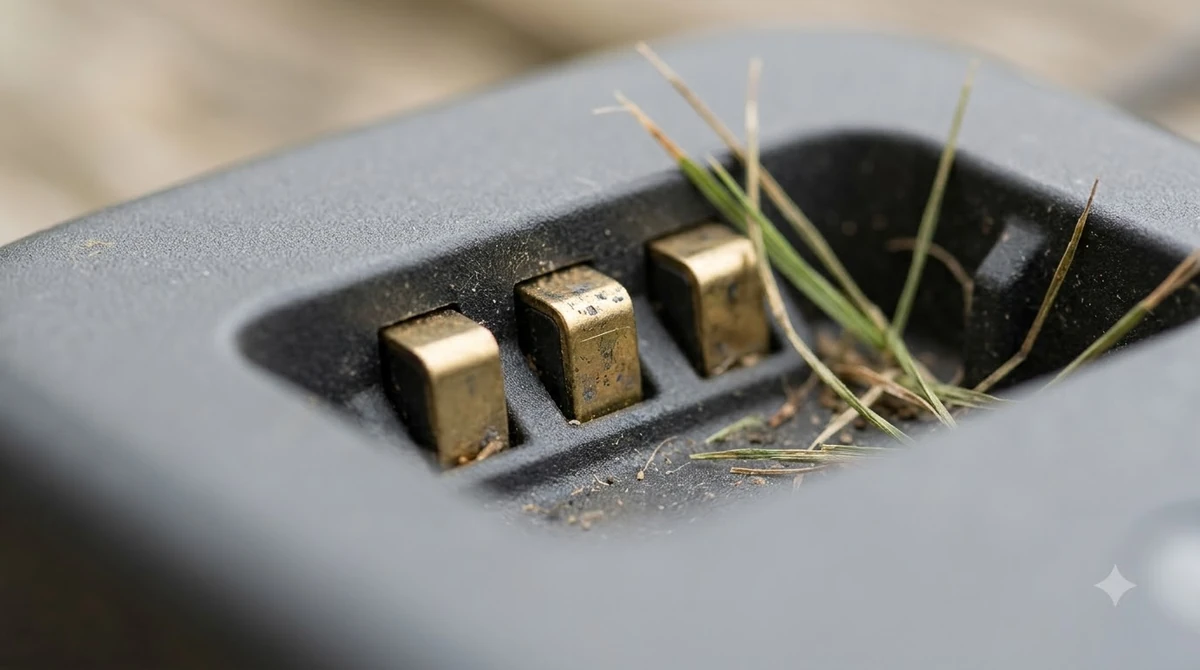
Our reading is that a short trim around the dock and a quick brush-off of clippings after mowing keeps debris from building up at the contacts. The sources do not say how often to clean the contacts, and we did not find a manufacturer statement that addresses grass at the dock.
Criteria if you add a mat or pad
If you are shopping for a best robot mower dock mat anyway, the sources set the limits, not any product. Judge any pad against the criteria below.
- It keeps the dock level. Husqvarna says the baseplate must not be bent. A pad that flexes or compresses under the dock’s weight fails that test.
- It does not shift or raise the dock. Mammotion warns that a station that moves may not dock correctly. The station should still be anchored with the included stakes, or expansion bolts on concrete, through the method the manual allows.
- It keeps the clearances. After the pad goes down, measure the front, sides and rear again. The Husqvarna figures of 6 m or 3 m in front and the Mammotion figure of 1.5 m still apply.
- It does not trap debris. Avoid a pad with raised lips or pockets beside the contacts, where clippings can collect (our reading).
- It does not conflict with the warranty. We did not find a manufacturer statement on mats, so check the manual or the maker’s support team before you buy one.
What to check before you buy
The checks below matter more than any brand name when you weigh a best robot mower dock mat, and none of them depends on a price. If docking already fails, read why a robot mower is not returning to base first.
- Read your model’s manual for its clearance figures and ground requirements. They differ by brand and install type.
- Confirm whether your system is a wire-free EPOS install or a boundary-wire install, since the clearance figures differ.
- Check the level of the baseplate itself with a spirit level (our reading; the sources ask for a level station but do not give a method).
- Anchor with the included ground stakes, and use expansion bolts on concrete.
- If the dock sits under a mower house or cover, check that the framing does not warp the baseplate.
- Recheck the level after the first heavy rain and at the start of each mowing season.
This guide does not rank products or give prices. Prices change, and none of the sources we read gives a fixed price for a dock accessory. Check any price on the day you buy.
Frequently asked questions
Do I need a best robot mower dock mat?
No manufacturer page we read requires one. Husqvarna and Mammotion both ask for a level, firm and clear base, and neither mentions a mat, pad or platform.
How level does a charging station need to be?
Husqvarna says the station must be on “a level surface.” Mammotion asks for “Flat and level ground” and gives no numeric tilt limit. Check your model’s manual for any figure it does give.
How much space should be kept clear in front of the dock?
For Husqvarna’s EPOS wire-free installs, the figure is 6 m (20 ft). For boundary-wire installs it is 3 m (10 ft). Mammotion asks for at least 1.5 m (5 ft) in front and on both sides.
Can a dock sink into soft ground?
It can, which is why Mammotion warns against installing on soft or uneven ground and notes that a station that moves may not dock correctly. Penn State Extension notes that rainfall or irrigation water can settle soil, so recheck the level after heavy rain.
Sources
- Husqvarna, Automower charging station optimal placement and mower house guide (manufacturer): level surface, baseplate, and clearance figures for EPOS and boundary-wire installs.
- Mammotion, charging station installation guide (manufacturer): flat, level and solid ground, anchoring with stakes or expansion bolts, and the 1.5 m clear-space figure.
- Penn State Extension, Lawn Establishment (university extension): subgrade free of depressions, 1 to 4 percent grade away from foundations, and rainfall settling soil.
 Up next8 min readGearBest Heavy-Duty Turf Staples for Securing Dock Mats on Robot Mower LawnsUpdated Nov 19, 2026
 6 min readGearHow Often Should You Replace a Robot Mower Battery? 2 to 5 YearsUpdated Nov 14, 2026
 7 min readGearRobot Mower Blade Sharpening or Replace: What the Makers SayUpdated Nov 19, 2026
 8 min readGearBest Outdoor Extension Cord for Robot Mower Charger: What the Makers AllowUpdated Nov 10, 2026
 7 min readGearRobot Mower Dock Leveling Pad: When One HelpsUpdated Nov 20, 2026
 9 min readGearBest Solar-Powered Security Light for a Robot Mower Dock: Fit and Setup GuideUpdated Nov 19, 2026