
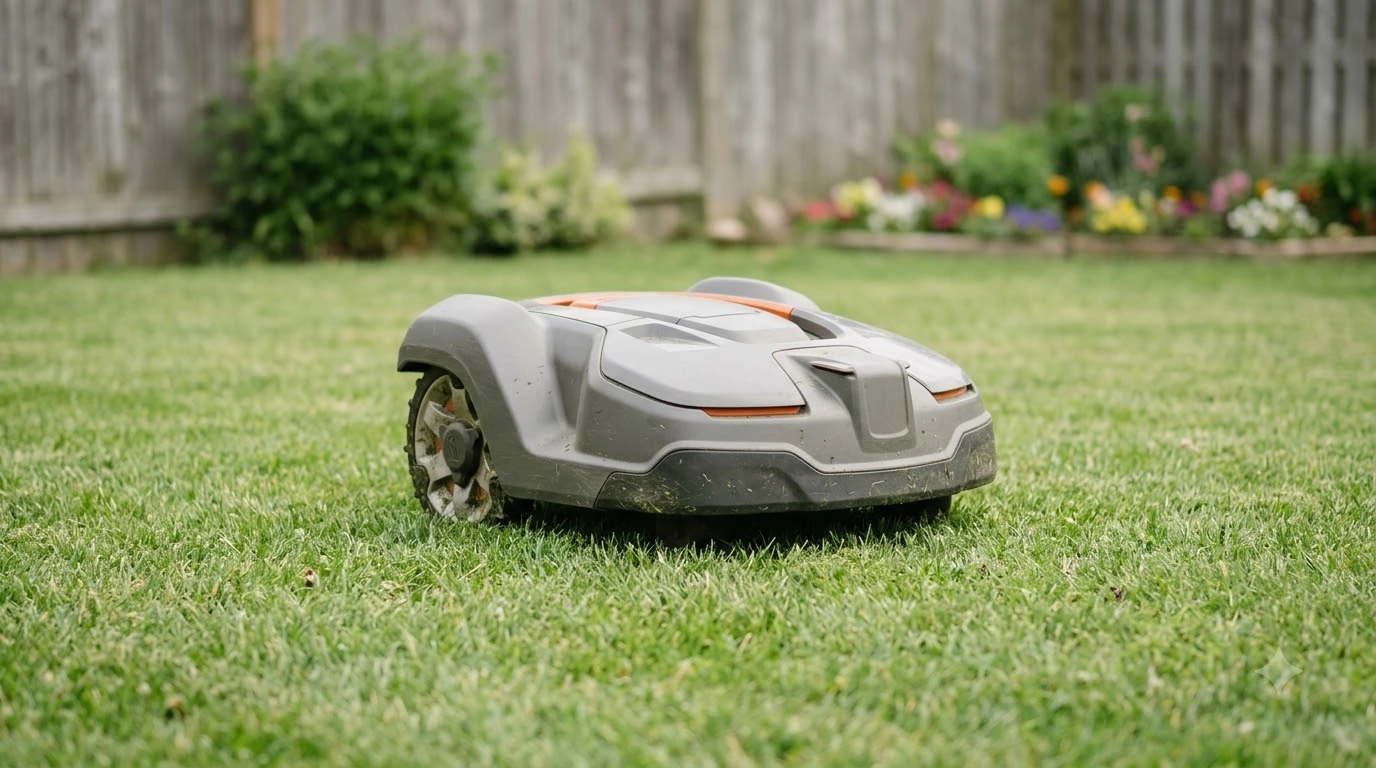

A robot mower removes the pushing, but not all of the work: robot mower vs self-propelled mower for seniors comes down to less walking and effort against setup, app use and lifting the machine. Our reading of the manufacturer and safety sources we opened is that a robot is the lower-effort option on a suitable lawn, while a self-propelled mower keeps you walking behind a spinning blade. The specs below are as of 2026-11-10.
The short answer
- Effort: in the robot mower vs self-propelled mower for seniors choice, the robot runs on a schedule once it is set up. A self-propelled mower drives its own wheels, but you still walk behind it and steer it.
- Weight: Husqvarna lists 39.9 lb for the Automower 435 iQ AWD and 28.7 lb for the 430X, so the robot body still has to be lifted at times.
- Slopes: the 435 iQ AWD is rated for slopes up to 70% inside its installation area, and the 430X up to 45%. Both ratings drop at the boundary.
- Safety: the blades on a walk-behind mower spin at about 200 miles per hour, according to Texas A&M AgriLife. Robots carry their own blades and sensors, so the choice does not remove blade risk.
Why the walk-behind question matters for older owners
The robot mower vs self-propelled mower for seniors question is mostly about how much of the job your body does. A self-propelled mower still asks you to walk the full lawn, turn at each edge and keep your footing on slopes. A robot asks you to set it up once and then mostly watch it.
Texas A&M AgriLife’s safety bulletin E-356 describes walk-behind mowers as both self-propelled and push-type, and notes that these mowers are often used by young children because they are lightweight and easy to manipulate. The same bulletin advises mowing back and forth along the side of a steep hill, never up and down it. That is a walk-behind rule, and it means the operator stays close to the slope while the machine is running. For the push-mower side of the comparison, see our robot mower vs push mower guide.
Injury risk: what the CPSC figures show
Blade contact is the main injury pattern for walk-behind mowers. In a 1990 release, the U.S. Consumer Product Safety Commission said walk-behind mower injuries fell from about 41,900 emergency room cases in 1983 to about 25,800 in 1989, a 38 percent drop, and that blade contact accounted for 64 percent of emergency room treatments. Those figures are old, and they describe walk-behind mowers as a group, not the self-propelled models alone.
The CPSC special report on adults 65 and older is more recent in its data, covering 1991 to 2002. It counted 1,451,140 adults 65 and older treated in U.S. emergency rooms for consumer-product injuries in 2002, and found that adults 75 and older had about twice the rate of adults 65 to 74. Among those 75 and older, about three-quarters of the emergency room visits linked to consumer products involved falls. The report covers all consumer products, not mowers alone, and it lists yard and garden equipment among the notable product categories. We found no mower-only figure for older adults in the sources we read.
Our reading is that a robot reduces contact with a running blade, because you are not walking behind it. It does not remove the need for care when you lift it, clean it or handle its blades. For a plain-language overview, see whether robot mowers are dangerous.
Physical effort: robot mower vs self-propelled mower for seniors
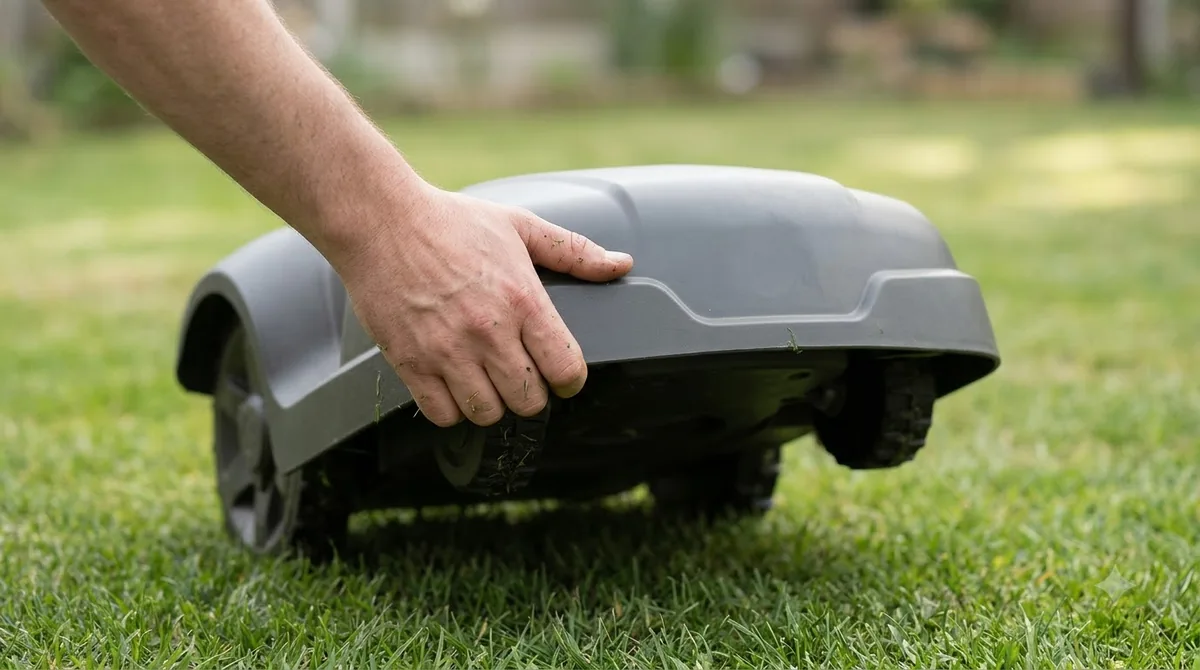
A robot does not need pushing, and that is the main effort saving. The lift still matters. Husqvarna lists the 435 iQ AWD at 39.9 lb and the 430X at 28.7 lb, so lifting one out of the grass to clean or service it is a real task for many people.
The 435 iQ AWD page also says six spare blades come with the unit and that blades “can be changed in minutes,” with one year of free blades included. The FAQ on the same site says the underside is not approved for hose washing, and recommends brushing off grass debris as needed. Our reading is that a senior owner should plan for these short handling jobs, and should ask whether a family member or dealer can do them.

Setup and controls: where the robot asks more of you
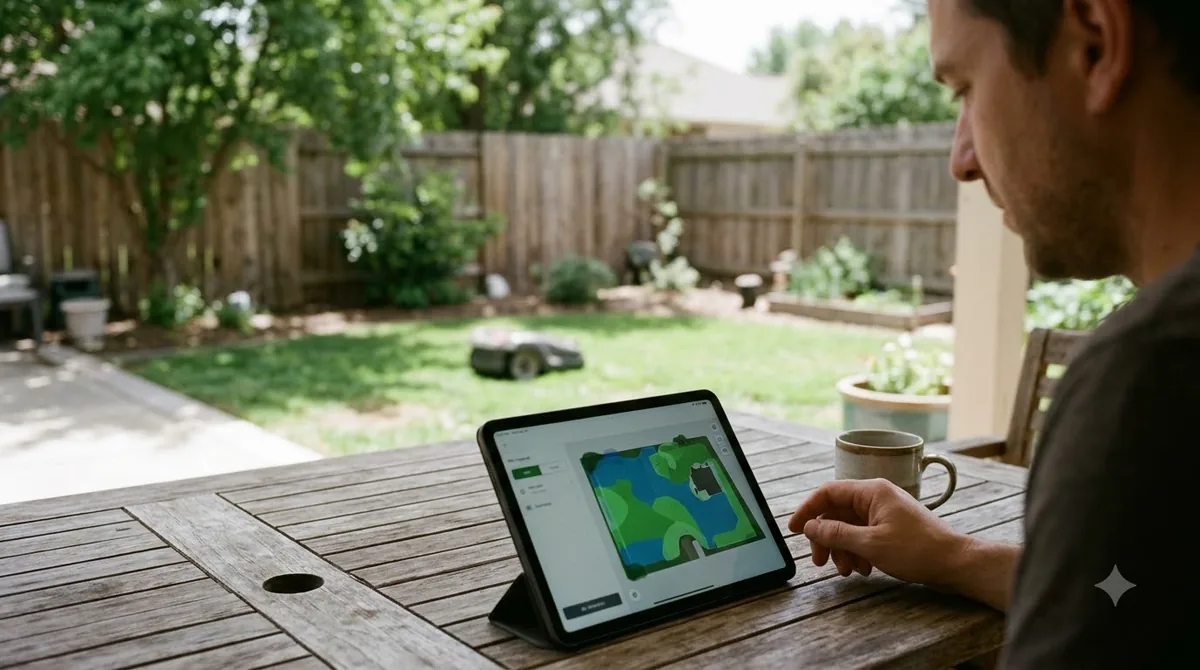
A robot is quick to use day to day, but setup takes more thought than starting a push or self-propelled mower. For the 435 iQ AWD, Husqvarna says the app guides you while you drive the mower around the lawn to set its boundaries, and that professional installation is optional. The same app adjusts cut height, schedules and mowing patterns.
The 435 iQ AWD lists both virtual wire and physical wire, and says installation is wire-free through EPOS, with a reference station included. The Husqvarna Cloud option is available only in select locations, according to the page. Our reading is that if the app and the setup steps are hard to follow, the robot’s low-effort promise can turn into a frustrating first month.
Slopes, lawn size and where each type fits
Slope is the first limit to check. Husqvarna rates the 435 iQ AWD for slopes up to 70% inside its installation area and 50% at the boundary, and it covers about 1.3 acres (plus or minus 20 percent). The 430X is rated for 45% inside the installation and 15% at the boundary, and covers about 0.8 acre. The 430X page also labels the model “Discontinued”, so check the current catalog before buying. Our guide on how steep a hill a robot mower can handle explains how to read these ratings.
A self-propelled mower has no such rating in these sources. Its limit is the operator’s footing and the advice to mow across a steep hill only from the side, as the Texas A&M bulletin describes. Our reading is that a senior with weak balance should not mow a steep slope with either type, and should look for a flat or gently sloped area for any robot.
Noise and time on the lawn
Noise is one place where the robot has a clear figure. Husqvarna lists 60 dB(A) for the 435 iQ AWD and 58 dB(A) for the 430X, both as perceived sound levels. The sources we opened did not give a comparable noise figure for a self-propelled mower, so we do not compare the two numbers directly. For more on the robot side, see how loud robot mowers are.
Time on the lawn differs most. A robot mows on the schedule you set in the app, and you walk out only for setup, checks and cleaning. A self-propelled mower needs you present for each session. Our reading is that the robot suits someone who wants the lawn kept short without a weekly walk, while a self-propelled mower suits someone who likes the walk and wants to see the cut as it happens.
Who each option suits
For the robot mower vs self-propelled mower for seniors decision, a robot mower suits a senior with a reasonably flat, mostly open lawn of about one acre or less, who is comfortable with a phone app and can get help lifting the unit for cleaning. It is also a fit for someone who wants to avoid walking behind a blade altogether. If you doubt the robot route suits you, read who should not buy a robot mower first.
A self-propelled mower suits a senior who wants to keep the walk, has a small lawn with few obstacles, and can manage the handling of the machine on the day. The robot’s effort saving only applies if the lawn fits within the slope and size limits above.
What to check before you buy
For a robot mower vs self-propelled mower for seniors decision, check the lawn size and maximum slope against the model’s rating, not a general figure. Look at the weight of the body, the blade replacement steps and whether the setup needs a dealer or a helper. For a self-propelled mower, check whether the handle height and the grip suit your height and hands. Ask whether a family member or local dealer can help with setup and the first few weeks of mowing.
Frequently asked questions
Is a robot mower easier than a self-propelled mower for seniors?
In the robot mower vs self-propelled mower for seniors choice, on a flat, suitable lawn, a robot removes the walking and pushing, so it is usually the lower-effort choice. Our reading is that the trade is setup, app use and lifting the body for cleaning, so it is not effort-free.
How much does a robot mower weigh?
Husqvarna lists 39.9 lb for the Automower 435 iQ AWD and 28.7 lb for the 430X. Check the exact model you plan to buy, because weights vary across the range.
What slope can a robot mower handle?
Husqvarna rates the 435 iQ AWD for slopes up to 70% inside its installation area and 50% at the boundary, and the 430X for 45% inside and 15% at the boundary. Ratings differ by model, so use the rating for the model you buy.
Does a robot mower still need blade work?
Yes. Husqvarna says the 435 iQ AWD includes six spare blades that can be changed in minutes, and includes one year of free blades. Blade care is still an owner task, even though the mower does the cutting.
Sources
- Power Lawnmower Injuries Decline (U.S. CPSC, 1990): walk-behind mower injury counts for 1983 and 1989, and the share of blade-contact treatments.
- Emergency Room Injuries, Adults 65 and Older (U.S. CPSC special report): 2002 emergency room counts for adults 65 and older, the 75-plus vs 65-to-74 rate, and falls among adults 75 and older.
- Lawn Mower Safety, E-356 (Texas A&M AgriLife Extension, rev. 07/05): blade speed, walk-behind types, and slope mowing advice.
- Automower 435 iQ AWD (Husqvarna): lawn size, slope ratings, noise, weight, blades, setup and app features.
- Automower 430X (Husqvarna): lawn size, slope ratings, noise, weight and discontinued status.
- Robotic lawn mowers (Husqvarna): the model range and boundary types listed on the category page.
 Up next8 min readReviews & CompareRobot Mower Comparison Chart 2026: Which Specs Decide the ChoiceUpdated Nov 11, 2026
 7 min readReviews & CompareWhich Robot Mower Brand Lasts the Longest? What the Evidence ShowsUpdated Nov 11, 2026
 8 min readReviews & CompareWorx Landroid vs Husqvarna Robot Mower: What the Specs ShowUpdated Nov 11, 2026
 8 min readReviews & CompareMammotion vs Segway Navimow Robot Mower: 5 Specs ComparedUpdated Nov 11, 2026
 8 min readReviews & CompareWhich Robot Mower Brand Has the Best Customer Service?Updated Nov 11, 2026
 7 min readReviews & CompareBoundary Wire vs RTK Installation Time: What the Guides SayUpdated Nov 11, 2026