
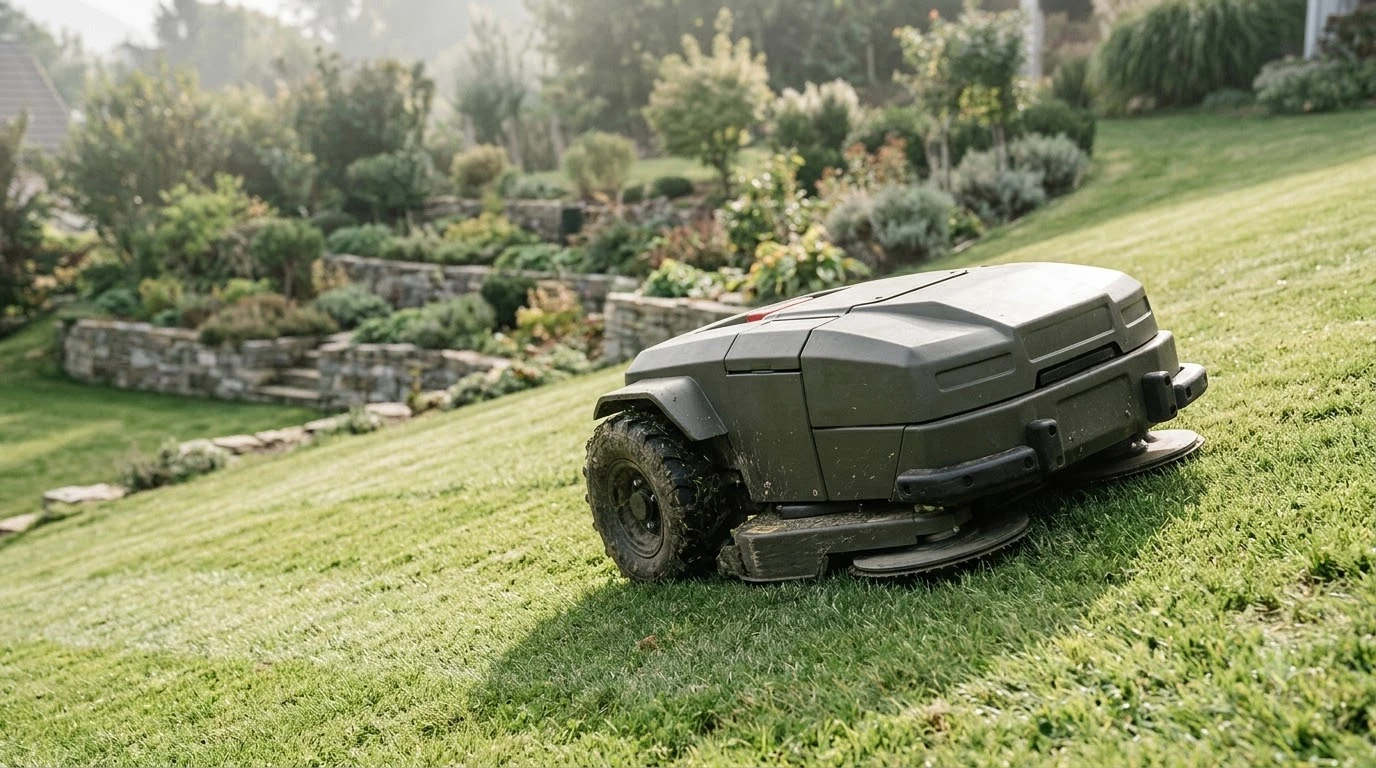

The best robot lawn mower for hills is the one whose rated slope, printed on the brand’s own spec page, clears your steepest measured point with room to spare. No single model wins every yard. As of Nov 2026, Navimow’s AWD i2 models are rated 45% (24°), its LiDAR Pro models 55% (29°), and eufy’s E15 and E18 18°, so the number you need comes from the spec page for your exact model.
The short answer
- Measure first: find the steepest strip of your lawn and express it as a percent.
- Check the unit: brands print percent, degrees, or both. Convert before you compare two models.
- Read the brand’s spec page: the rating, the recommended lawn size, and whether the page labels the drive as AWD.
- Leave margin: our reading is to keep your steepest slope well under the rating, not right at it.
Why the best robot lawn mower for hills starts with the spec page
The best pick on a hill depends on the steepest slope you have, so the first filter is a rating you can check on a spec page, not a ranking in a roundup.
Roundups often name one top pick for hills. That pick may not suit your lawn, because the lawn sets the requirement and the mower has to meet it. The more useful question is whether the rating printed for a specific model clears your measured slope. Ratings are model-specific. The Navimow page below shows two different slope ratings within one brand, so a figure for one series does not carry over to the next.
Measure your steepest point before you shop
Measure the steepest strip you want the mower to cover, not the average slope of the whole yard, then convert that reading into a percent so it matches the ratings. A long straight level and a tape measure are enough for most lawns, and our guide to measuring yard slope in percent and degrees covers other methods. Write the number down first, because the best robot lawn mower for hills on your shortlist has to clear it.
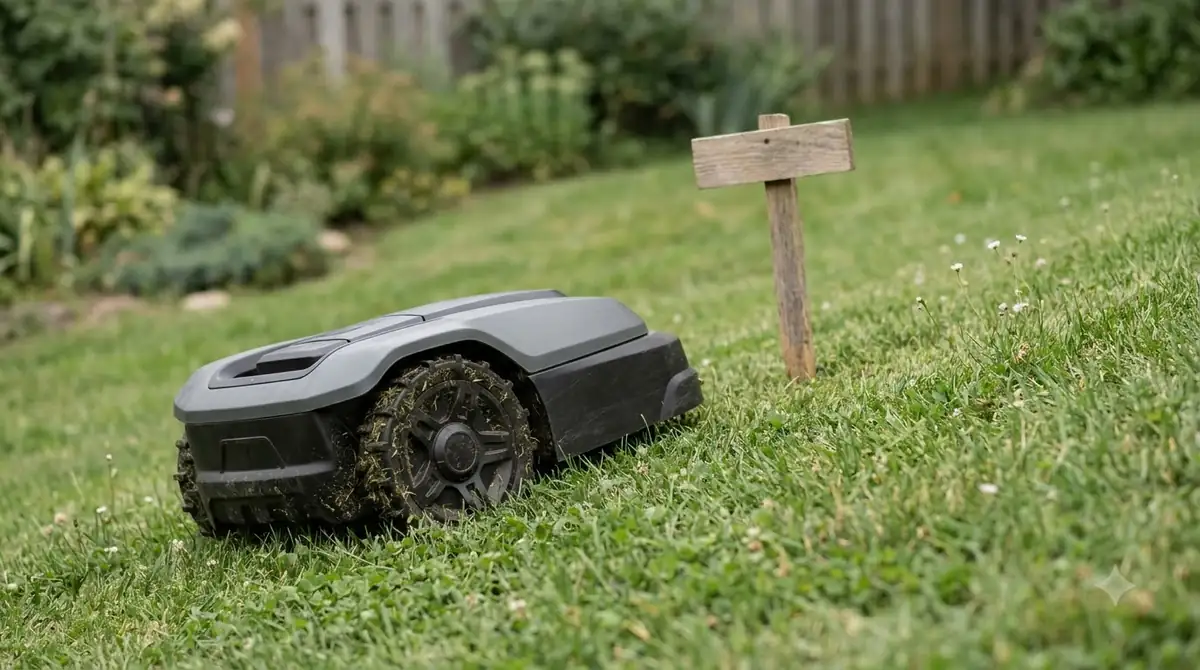
- Pick a straight line. Run it from the flat ground up the steepest part you want to check.
- Measure the run. Lay a long level along the line and measure the horizontal distance it covers.
- Measure the rise. Measure the vertical gap under the high end of the level, from the grass to the underside of the level.
- Divide and multiply. Divide the rise by the run, then multiply by 100 to get the percent.
Percent is rise divided by run, times 100. A rise of 15 cm over a run of 100 cm is a 15% slope. Keep both measurements in the same unit, so the result is the same whether you use centimeters or inches. Our reading is to take readings at two or three points on the steepest section, because a single spot can miss the hardest stretch.
Convert percent to degrees before you compare
A 50% slope is about 26.6 degrees, not 50 degrees, so percent and degrees are different numbers for the same hill (see robot mower slope rating explained for the full picture). Confirm the unit on every spec page before you put two models side by side.
The table gives the conversions we calculated with the tangent function, next to the ratings we read on the Navimow and eufy pages.
| Percent (rise over run) | Degrees (angle) | Where it appears in this guide |
|---|---|---|
| about 32.5% | 18° | eufy E15 and E18, printed in degrees only |
| about 44.5%, printed as 45% | 24° | Navimow i205 AWD, i208 AWD and the LiDAR i208, i215, i220 |
| about 55.4%, printed as 55% | 29° | Navimow i210 LiDAR Pro and i220 LiDAR Pro |
| 100% | 45° | a reference point only, no model here reaches it |
The conversions are our calculation. The brands print their own rounded pairs, such as 45% and 24°, and we quote those pairs as printed.
Navimow: the AWD and LiDAR Pro ratings differ
Navimow’s AWD i2 models and its LiDAR Pro models carry different slope ratings and lawn-size ranges, so check the exact model name before you use a number from the brand.
The table below comes from Navimow’s i-series specification page, as of Nov 2026. It lists the maximum slope, the recommended lawn size, and whether the page labels the drive as AWD.
| Navimow model | Max slope | Recommended lawn | Drive stated on page |
|---|---|---|---|
| i205 AWD | 45% (24°) | 500 to 1,000 m² | AWD |
| i208 AWD | 45% (24°) | 500 to 1,000 m² | AWD |
| i208 LiDAR | 45% (24°) | 800 to 2,000 m² | Not stated |
| i215 LiDAR | 45% (24°) | 800 to 2,000 m² | Not stated |
| i210 LiDAR Pro | 55% (29°) | 1,000 to 2,000 m² | Not stated |
| i220 LiDAR Pro | 55% (29°) | 1,000 to 2,000 m² | Not stated |
Only the i2 AWD series is labeled AWD on the page we read. For the other rows, the page does not say whether the drive is two-wheel or all-wheel, so do not assume either. The i1 models, the i105e and i108e, list lawn sizes but no slope rating on the same page.
Our reading is that, for a steep yard, the best robot lawn mower for hills in this table is a row that states AWD or carries the 55% rating, with a recommended lawn size that still fits your total area. For a wider look at drive types, see AWD vs 2WD robot mowers for hills.
eufy E18: one 18° rating and wire-free navigation
The eufy E18 is rated at 18 degrees, which is the lowest rating among the models compared in this guide, and its page describes wire-free navigation.
The eufy E-series page gives one maximum slope for both the E15 and the E18: 18 degrees, with no percent figure. The two models differ in recommended lawn size, 800 m² (0.2 acre) for the E15 and 1,200 m² (0.3 acre) for the E18. The page headline reads “No Wire, No RTK, No Signal Issue,” so the E18 does not use a boundary wire. The page does not state the drive type.
An 18-degree rating is about 32.5% on a percent scale, which suits gentler ground than the 45% and 55% Navimow rows. If your steepest strip is above that figure, the E18 is not the right question to ask. Our reading is to check whether a higher-rated model fits the lawn size first, because the best robot lawn mower for hills in a steep yard rarely sits at the bottom of the slope range.
Mammotion LUBA 3 AWD: the page we read gives coverage, not a slope figure
The LUBA 3 AWD page we read lists lawn coverage but no maximum slope, so you need to ask the brand before you rely on a steepness number for a hill.
Mammotion’s page states coverage: the LUBA 3 AWD 1500(H) is listed for lawns up to 1,500 m² (0.37 acre), and the 15Ah battery is described as covering up to 1,700 m² (0.42 acre) with stable performance.
The page does not give a maximum slope for any LUBA 3 AWD model, in percent or degrees. Third-party listings quote a steepness figure for this model, but we did not find it on the manufacturer’s page, so we do not use it here. Our reading is to request the slope rating in writing or check the manual before you buy for a steep yard. Until you have that number, you cannot treat this model as the best robot lawn mower for hills in your yard.
Wet grass and wheel grip
Wet grass and clogged wheels reduce grip, and none of the manufacturer pages we read gives a rating for wet slopes (our guide on whether robot mowers slide on wet slopes goes deeper). A dry-lawn rating describes the mower under the brand’s stated conditions, and it is the upper bound for a damp yard, not a guarantee.
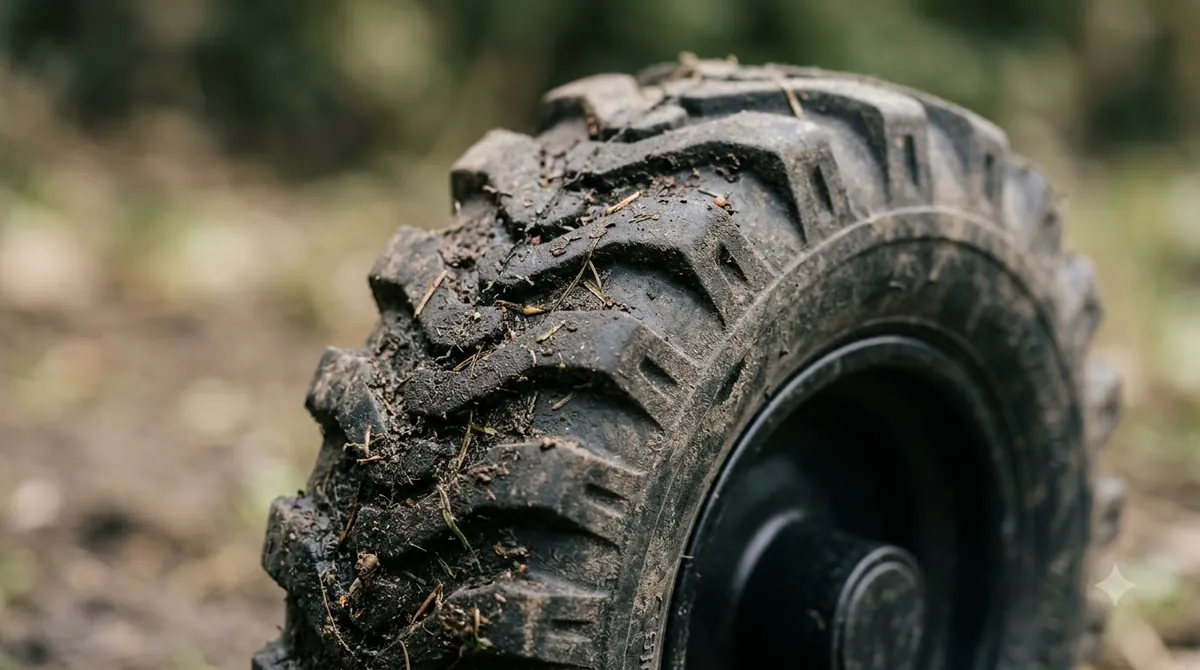
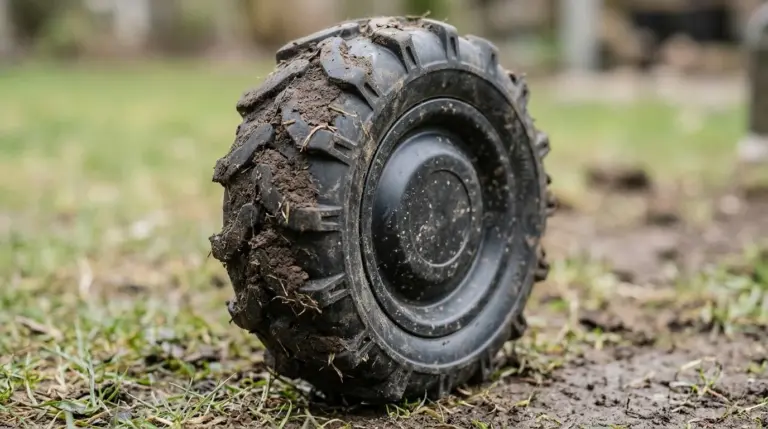
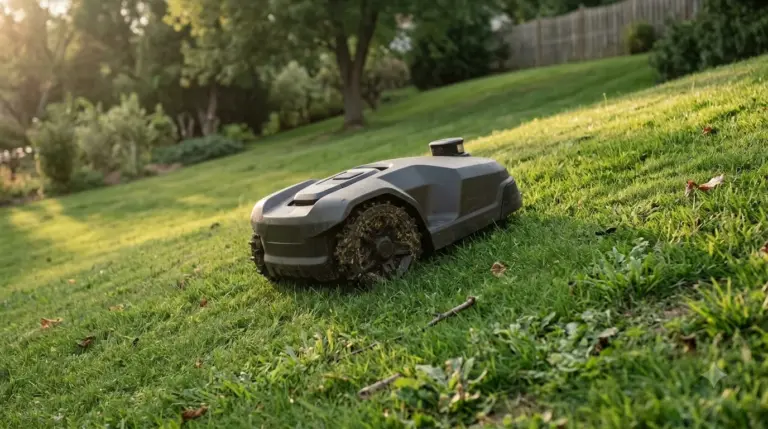
Mud packs into the tread lugs, which is the kind of build-up that cuts traction on a slope. Keeping the wheels clear of clippings and soil helps the mower keep its footing.
- Clear the wheels: knock off clippings and soil after each session on a slope.
- Watch the first wet run: observe the mower on a damp slope before you rely on it for the whole season.
- Stop on slips: if the mower slips on a section, reduce the slope it covers or change the boundary.
What to check before you buy
Before you buy, confirm the rating for your exact model and check that it clears your steepest measured slope with margin.
- Model and series: the rating depends on the exact name, not the brand.
- Slope in both units: the percent and degree figures, converted and checked against each other.
- Lawn size: the recommended area should cover your total lawn, not just the steepest part.
- Drive type: whether the page labels AWD, and why that matters on steep ground.
- Navigation: wire or wire-free, and what that means for the edges of a slope.
- Wet weather: no page we read gives a wet-slope rating, so plan a check on damp grass.
Our reading is that the best robot lawn mower for hills in your yard is one whose rating sits well above your measured slope, not one that barely clears it. A page without a slope figure is a reason to ask the brand, not a reason to assume.
Frequently asked questions
How steep a hill can a robot mower handle?
It depends on the model. On the Navimow page we read, the AWD i2 models are rated 45% (24°) and the LiDAR Pro models 55% (29°). eufy lists 18° for the E15 and E18. Check the rating for your exact model.
What is the best robot lawn mower for hills?
No single model is the best for every hill. The best match is the model whose printed slope rating clears your steepest measured point, with the drive type and lawn size checked against your yard.
Do I need AWD for a steep hill?
The Navimow page labels only its i2 AWD series as AWD, and the eufy and most LiDAR rows do not state a drive type. Our reading is that a steep yard justifies choosing a model that states AWD and carries a higher rating.
Should I compare slope in percent or degrees?
Use the same unit for every model. Percent is rise over run, and degrees is the angle of the ground. A 50% slope is about 26.6 degrees, so the two numbers are not interchangeable.
Is the printed slope rating the safe limit?
The pages we read give the rating without listing the test conditions behind it. Our reading is to keep your measured steepest slope well under the rating, and to check the first wet session before relying on it.
Sources
- Navimow i-series specifications (Segway Navimow): maximum slope, recommended lawn size and AWD labels for each i-series model.
- eufy E-series robot lawn mower (eufy): 18° maximum slope, lawn sizes and wire-free wording for the E15 and E18.
- LUBA 3 AWD (Mammotion): coverage figures for the LUBA 3 AWD 1500(H); no maximum slope is stated on the page.
 Up next8 min readBy YardNavimow vs Mammotion vs eufy Small Yard: Which Published Specs MatterUpdated Nov 12, 2026
 8 min readBy YardVision Robot Mower for Yard with Poor Satellite Signal: What the Specs ShowUpdated Nov 11, 2026
 7 min readBy YardBest Robot Mower for Steep Hills and Slopes: Key CriteriaUpdated Nov 18, 2026
 7 min readBy YardWill a Robot Mower Get Stuck on a Lawn with Mole Hills?Updated Nov 11, 2026
 7 min readBy YardDo Robot Mowers Tip Over on Hills?Updated Nov 11, 2026
 8 min readBy YardHow Steep a Hill Can a Robot Mower Handle?Updated Nov 11, 2026