
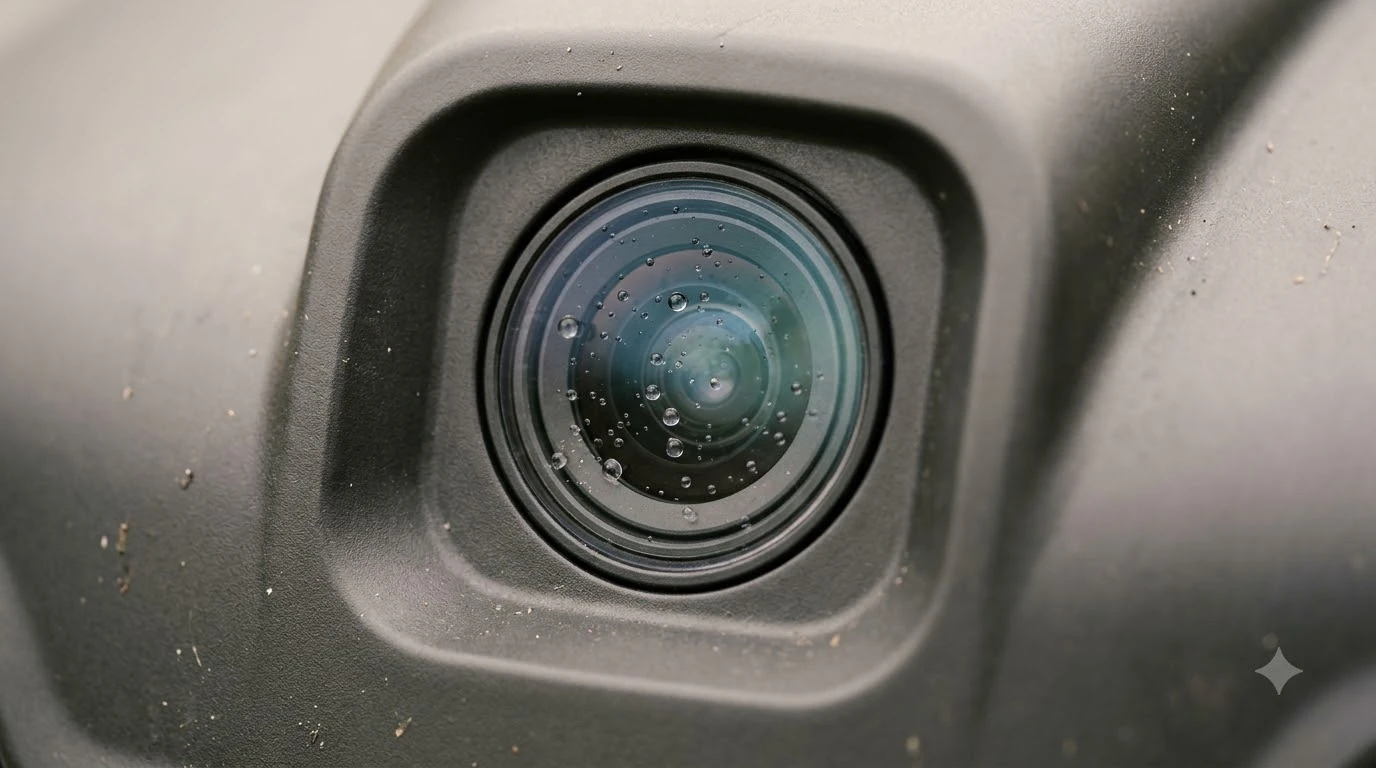

How do vision robot mowers see the lawn? They use one or more onboard cameras and software that labels what each part of the image is. Grass is recognized by color, texture and surface pattern, while paths, mulch, flower beds and objects are separated out so the mower knows where it can cut. The processing runs on the mower itself, and most manufacturers pair it with satellite positioning or other sensors rather than relying on the camera alone.
The short answer
- The camera: a camera built into the mower looks at the area ahead of it, the same way a person would scan the ground while walking.
- The software: an AI model tells grass from non-grass and sorts objects by risk, so the mower can slow down, go around, or stop.
- The backup: when satellite signal drops, many models use the camera to find grass and keep mowing a short distance until the signal returns.
- The limit: most vision systems depend on light, and some models only work in daylight.
What the camera actually looks at
The camera is the eye of the system, and it sits on the body of the mower where it can see the ground in front. Manufacturers describe the hardware in different ways. Mammotion says its vision cameras can be monocular, stereo or 3D, and they all face the area ahead so the mower can read the surface before it reaches it. The camera does not need to map the whole yard in one pass. It keeps reading the next few feet as the mower moves. The mapping method behind camera mowers is covered in how VSLAM navigation works, which goes deeper than this overview.
Husqvarna describes its AI vision system in similar terms. The mower detects objects in real time, and its image processing happens locally on the mower. According to Husqvarna’s support page, images are not stored, transmitted or shared. That matters to many buyers, because the mower makes its decisions without sending a live video feed to a server.
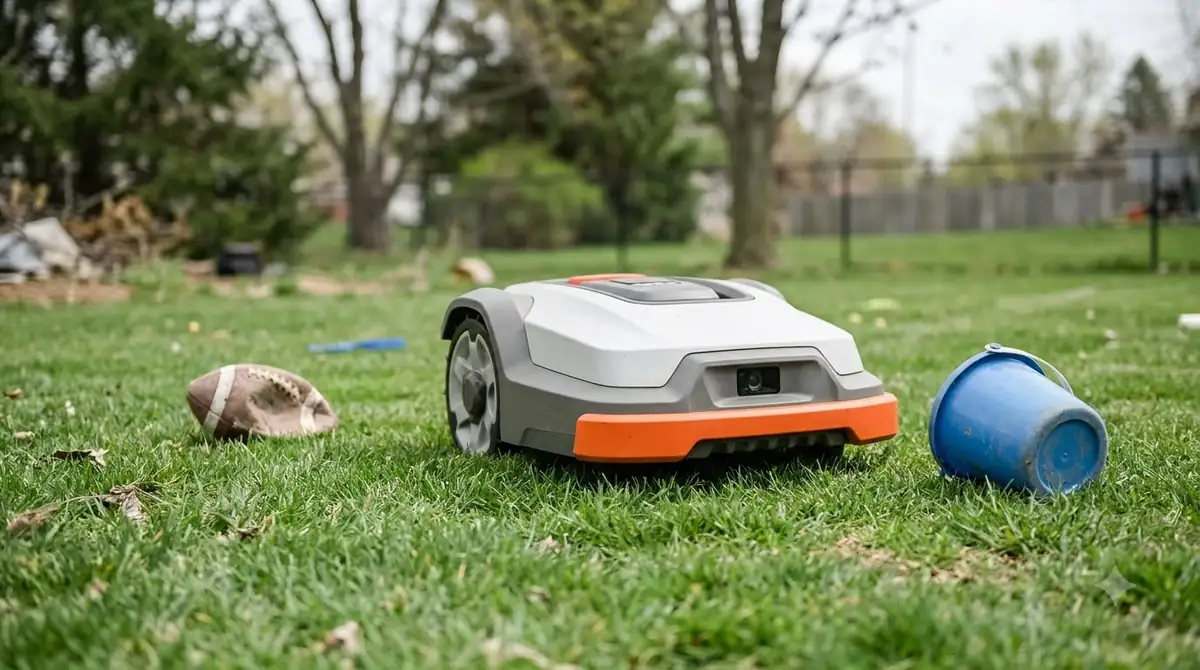
How do vision robot mowers see the lawn in practice?
Once the image is captured, the software has to decide what each patch of the picture is. Grass is recognized by a mix of color, texture and surface pattern. Paths, mulch, gravel and bare soil look different enough that the system can keep the blades off them, and this is the basis for the boundary features some models offer.
Recognition does not work the same way for every object. Husqvarna sorts obstacles into two groups. High-risk objects include people, animals and items such as water hoses, and the mower keeps a larger safety distance from them. Low-risk objects include toys, garden furniture and flowerpots, and the mower gets closer before it turns. The practical result is that a child’s ball and a dog should not get the same response, and the better systems are built around that difference.
Heads up
Object classes are a manufacturer design choice, not a universal standard. Two mowers that both say they have vision can classify the same object differently, so check how each brand describes its risk groups before you assume the same behavior.
How vision works with satellite positioning
A camera alone cannot tell the mower where it is across the whole yard. That job usually belongs to RTK satellite positioning, and many manufacturers say the two work together. Mammotion says vision can be combined with RTK, which gives centimeter-level position but can struggle near dense tree cover, tall buildings or uneven ground. It also names LiDAR as a companion sensor, because LiDAR works regardless of lighting and identifies shapes without classifying them. Some mowers use vision in place of a boundary wire, while others use it as a backup. Some vision mowers add satellite corrections, and network RTK for vision mowers describes one common source. Satellite status messages are easier to read after what an RTK fixed solution means.
Husqvarna’s documentation describes a fallback. When the satellite signal is lost, the camera checks for grass. If it sees grass, the mower keeps going for a limited distance. If it sees no grass, it rotates to search, and if still nothing is found, it stops and searches for satellite again. The support page does not give a distance for the limited run, so treat the exact behavior as something to confirm in the manual.
| Sensing approach | What it helps with | Where it struggles |
|---|---|---|
| Camera (vision) | Spotting grass, edges and objects in front of the mower | Low light, glare, heavy rain, fog, dirty lenses |
| RTK satellite | Knowing the mower’s position across the yard | Dense tree cover, tall buildings, uneven terrain |
| LiDAR | Detecting shapes regardless of lighting | Does not classify what an object is |
Night, rain and dirty lenses
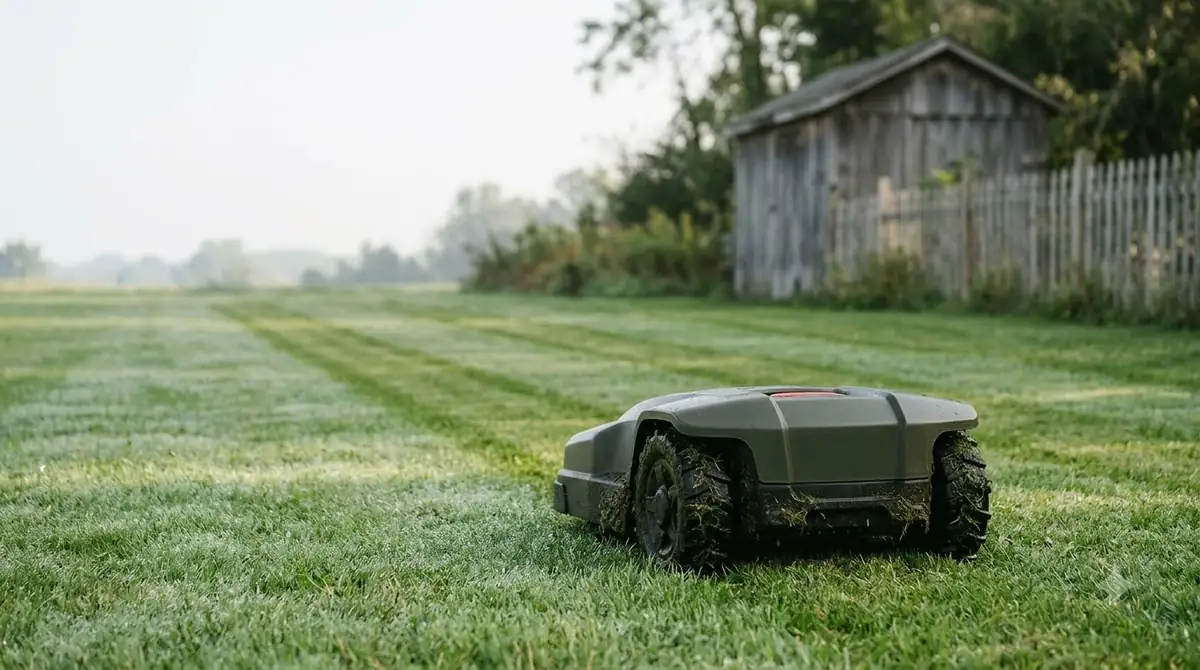
Lighting is the biggest limit. Husqvarna says some of its vision models work in daylight only, while others use an infrared camera to operate day and night. Mammotion notes that low light or night reduces recognition accuracy unless supplemental lighting is used, and that glare, strong shadows and uneven light can confuse detection. Rain, fog and snow can also hide detail, and a dirty or scratched lens lowers confidence. Low light is the hardest case for cameras, and obstacle detection after dark shows model-by-model results. Whether the mower can work at night at all is discussed in mowing in low light conditions. Dirty lenses are a common cause of poor results, so wiping camera lenses and sensors is a routine worth adding.
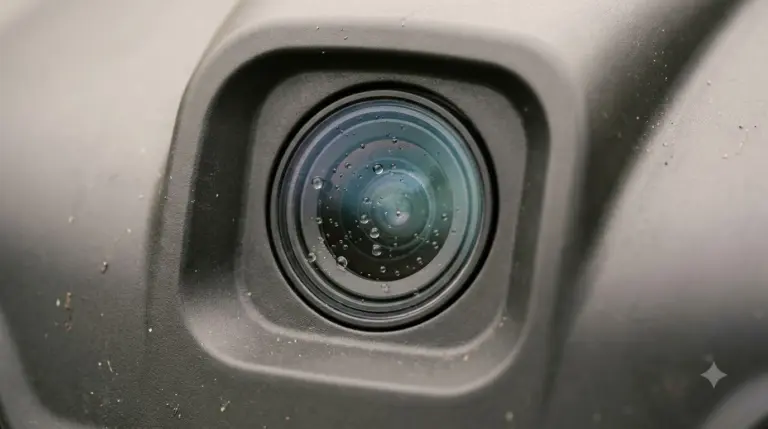
Husqvarna gives owners a camera visibility setting for heavy rain or dirt on the lens, with two options: keep mowing, or pause. Its guidance for cleaning the lens is to use water to remove dirt and then wipe gently with a soft cloth. Neither source gives a lux threshold or a fixed cleaning schedule, so you will need to watch how your own mower behaves in your yard’s conditions.
What to check on a spec sheet before you buy
Vision claims can sound alike on a product page, so look for specifics. Find out whether the camera works at night or only in daylight, which obstacle classes the mower recognizes, whether it has a fallback when satellite signal is lost, and whether the lens can be cleaned easily. If your yard has a lot of mulch beds or gravel edges, ask how the system handles those surfaces, because grass and non-grass recognition is where many owners notice problems first. Laser-based models solve the same problem differently, as LiDAR compared with vision systems explains. For a head-to-head between a vision model and a satellite model, see Landroid Vision versus Luba 3 AWD.
Frequently asked questions
How do vision robot mowers see the lawn in the dark?
It depends on the model. Husqvarna lists some vision models as daytime only, and others as day and night with an infrared camera. Manufacturers also say recognition gets less accurate in low light unless extra lighting is used, so check the specific model’s documentation.
Does a vision mower send video to the cloud?
Husqvarna states that image processing happens on the mower and that images are not stored, transmitted or shared. Other brands may handle data differently, so read the privacy and data section of each manufacturer’s documentation.
Can a vision mower work without satellite signal?
Some can keep mowing for a limited distance using the camera to find grass, then search again for satellite. The exact behavior varies by brand, and the manufacturer’s support pages are the place to confirm the fallback for your model.
Are vision mowers better than boundary wire mowers?
Neither is better in every yard. Vision mowers can avoid wire installation, but they depend on lighting and lens condition. Wire-based mowers avoid those lighting limits but need the wire laid and maintained. Our reading is that the right choice depends on your yard’s layout, your light conditions, and how much installation work you want to do.
Sources
- Husqvarna support: How Automower AI vision technology works (manufacturer): local processing, no stored images, satellite fallback, day and night models.
- Husqvarna support: Object detection and avoidance (manufacturer): high-risk and low-risk object classes, lens visibility setting, lens cleaning.
- Mammotion: How AI vision robot lawn mowers work (manufacturer blog): camera types, grass vs non-grass recognition, hybrid use with RTK and LiDAR.
 Up next6 min readLearnHow to Update Worx Landroid Vision FirmwareUpdated Nov 12, 2026
 8 min readLearnHow Long Does the Worx Landroid Vision Battery Last?Updated Nov 12, 2026
 8 min readLearnSegway Navimow Vision Fence Not Working: Causes and FixesUpdated Nov 11, 2026
 7 min readLearnHow to Set Up Worx Landroid Vision, Step by StepUpdated Nov 10, 2026
 7 min readLearnDo Robot Lawn Mowers Need Lithium Batteries? What to KnowUpdated Nov 14, 2026
 7 min readLearnHow Much Does It Cost to Install a Robot Mower?Updated Nov 14, 2026