
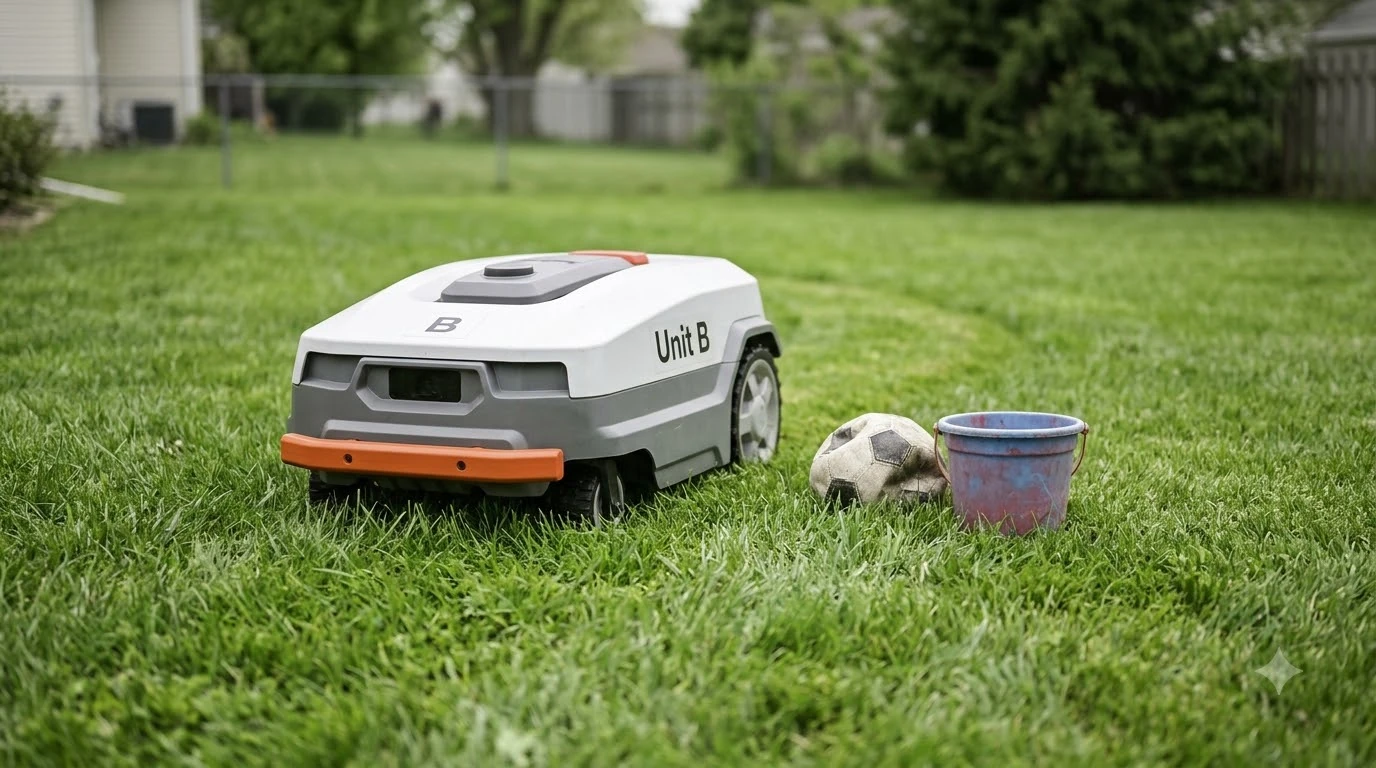

The best robot mower for a yard with a fountain is one that you can fence off from the water with a reliable no-go zone or a physical border. Manufacturer support pages consistently say to keep the mower clear of water features such as ponds, pools, and fountains, and to leave a buffer around them. The model matters less than how well you can define that exclusion area, so this guide covers what to check and what to plan for.
The short answer
- Must-have: the mower needs a way to define a no-go zone around the fountain, either by mapping or by a boundary wire.
- Buffer: leave space between the mower path and the water edge, and check the spec sheet for how close it can run.
- Grass near water: plan on hand trimming or a trimmer for the grass the mower will not reach.
- Edge test: a clear physical edge, such as a stone curb, is easier to trust than a drawn line on a map.
Best robot mower for a yard with a fountain: why it needs a no-go zone
A fountain is more than a bed of plants. It has a basin, a pump, power or water lines, and often a raised rim that can catch a wheel. Mammotion’s support article lists the things a no-go zone is created for, including pools, flowerbeds, trees, roots, and ditches. A fountain sits in the same family of obstacles, because the mower should not enter the water and should not run over the cords or lines that feed it. A fountain is usually part of a larger water feature, so the mower picks for yards with ponds cover the shared edge and wet-ground checks. Low planted basins beside a fountain raise the same soft-ground question, which working around a rain garden bed covers in more detail.
Our reading is that the fountain should be treated the same way as a pool. Draw the zone around the whole installation, not only the water surface, so the mower keeps clear of the pump housing and any hoses on the ground.
How to set a no-go zone around a fountain
Mammotion describes the process in two steps. First, guide the robot to the edge of the zone and start mapping. Second, control the robot along the perimeter of the no-go zone and back to the start point to complete the map. That method works for any model with mapping, so it is the first thing to check on a spec sheet. The same stay-away logic applies to any open water, and how a robot mower treats pond edges shows what a fountain basin needs.
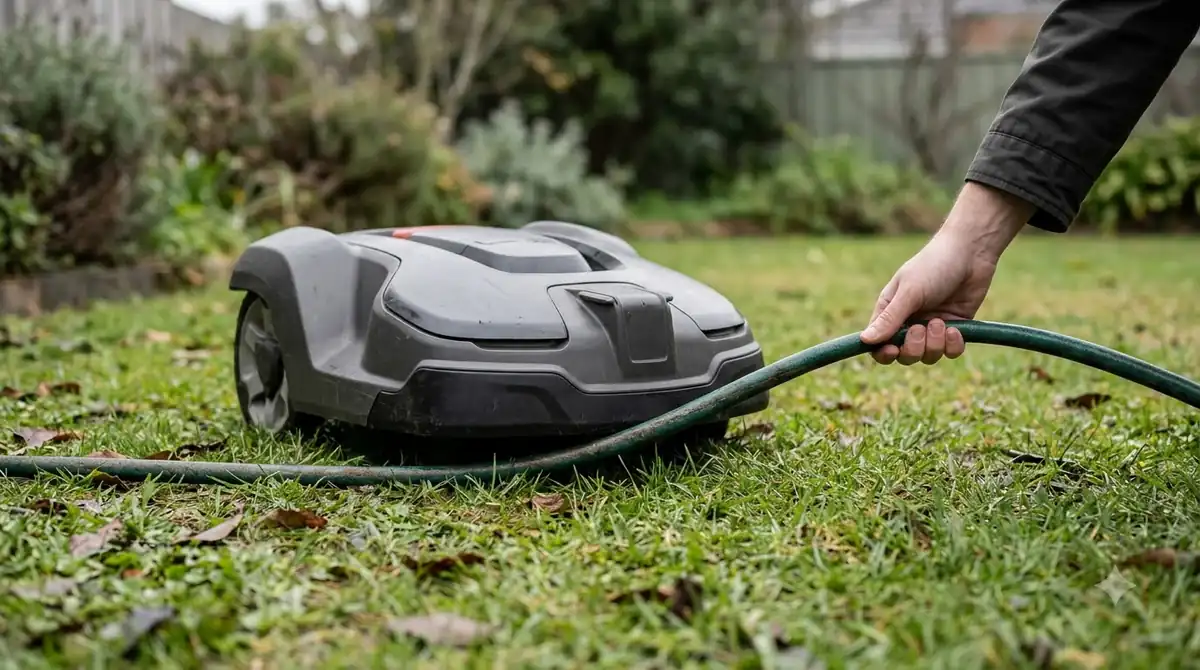
- Walk the area first. Before mapping, look at the fountain edge, the basin rim, and any cords or pipes running across the lawn.
- Map the zone with a buffer. Set the boundary a little wider than the basin so the mower stops before the rim, not at it.
- Test the path. Run one full cycle and watch how the mower behaves near the zone. If it hesitates or hugs the edge, widen the buffer.
- Recheck after changes. A new plant bed or a moved hose can change the safe path, so review the map each season.
Heads up
Some vendors describe water features as areas where the mower should not operate at all. Read your model’s manual for the exact rule before you rely on a no-go zone alone, and do not let the mower run unattended with a hose or cord in the lawn.
Boundary wire versus mapping near water
A boundary wire gives a physical limit that the mower can sense, which is useful if your fountain sits at the edge of the lawn. A mapping system depends on the positioning technology in the model, such as RTK, lidar, or vision, so the accuracy near water depends on the signal and the layout of the yard. Trees and tall fences can weaken satellite signals, so check the positioning setup before you trust a map around the fountain. Where the fountain pump is wired close to the lawn edge, the koi pond wire depth and signal notes explain how buried cable behaves near water. Separate lawn areas raise the same boundary choices, as covered in yards with multiple small patches.
For a fountain surrounded by lawn on all sides, a wire may be easier to trust. For a fountain near the middle of a large open yard, a mapped no-go zone is usually simpler to build and change later.
Mowing the grass the robot cannot reach
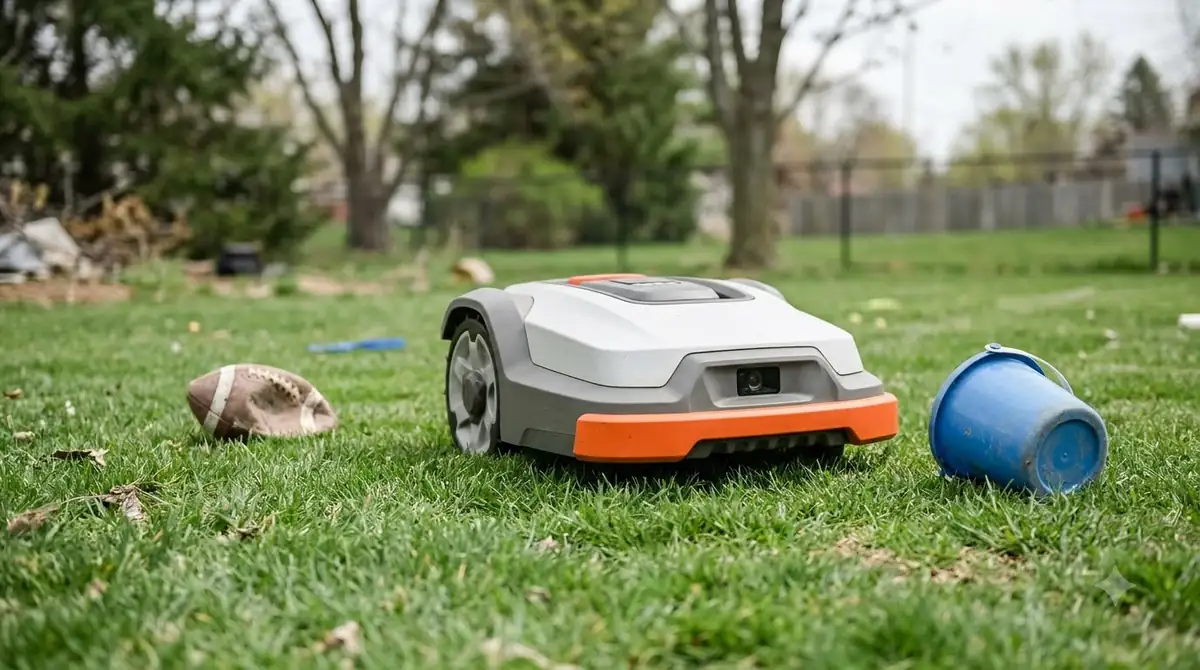
A buffer means some grass stays uncut. Unmown grass near the water will need regular hand trimming or a suitable trimmer, and our reading is that the same logic applies to a fountain. The strip between the mower path and the basin will need a trimmer every few weeks, or it will grow over the rim and make the edge look untidy. Pop-up heads and supply lines near the basin can snag a deck, and sprinkler head handling on a lawn describes the usual fixes.
Plan the buffer width with that trimming in mind. A narrow buffer saves time on the map but adds more trimming. A wider buffer keeps the robot safer but leaves more grass to cut by hand. Our reading is that a 12 to 18 inch strip is a practical starting point, but the right width depends on your model, the fountain shape, and the grass height.
What to check before you buy
When you compare models for a yard with a fountain, look at how the mower defines an exclusion zone. Can you draw a custom shape on an app map, or is the zone limited to a fixed circle? Can you edit it later without starting the map over? A model that cannot change its zone easily will be harder to live with after a garden redesign. Decorative rock channels beside a fountain call for the same hard edge, so picks for a dry creek bed yard are a useful comparison.
Also ask whether the mower can handle a rim or step at the fountain edge. Many robot mowers are designed for flat lawns, so a raised basin may need a physical border or a hand-trimmed strip rather than a mower that climbs close to it.
Related reads: Readers weighing a water feature next to the turf may also want to read about mowing near an open pool edge.
Frequently asked questions
Can a robot mower run near a fountain?
Manufacturers generally say to keep the mower away from water features. Set a no-go zone with a buffer around the fountain and check the manual for the exact rule.
Do I need a boundary wire around a fountain?
Not always. A wire gives a physical limit, while a mapped no-go zone may be enough in an open yard. The right choice depends on the model and the layout of your lawn.
How wide should the buffer be around a fountain?
There is no single standard. Our reading is that a 12 to 18 inch strip is a practical starting point, adjusted after a test run and the grass height.
Who trims the grass the mower cannot reach?
You will need to trim it by hand or with a trimmer, on a regular schedule, because the mower will not reach the buffer strip.
Sources
- Mammotion, How to create a no-go zone (manufacturer support): no-go zones are created for pools, flowerbeds, trees, roots, ditches, and other obstructions; steps for mapping the zone.
- Husqvarna, Creating stay-out zones (manufacturer support): how stay-out zones are defined on supported models.
 Up next9 min readBy YardRobot Mower for a Sloped Front Yard: Limits, Edges and SetupUpdated Nov 11, 2026
 7 min readBy YardRobot Mower for a Lawn With a Sunken Patio: Boundary SetupUpdated Nov 14, 2026
 6 min readBy YardRobot Mower for a Lawn With a Compost Bin: Zone and Route SetupUpdated Nov 14, 2026
 7 min readBy YardRobot Mower with Chicken Manure on the Lawn: Cleanup and SetupUpdated Nov 14, 2026
 7 min readBy YardRobot Mower for a Lawn With a Dog Run: Safe SetupUpdated Nov 14, 2026
 7 min readBy YardRobot Mower for a Lawn With a Rain Barrel: Placement and Hose SetupUpdated Nov 14, 2026