
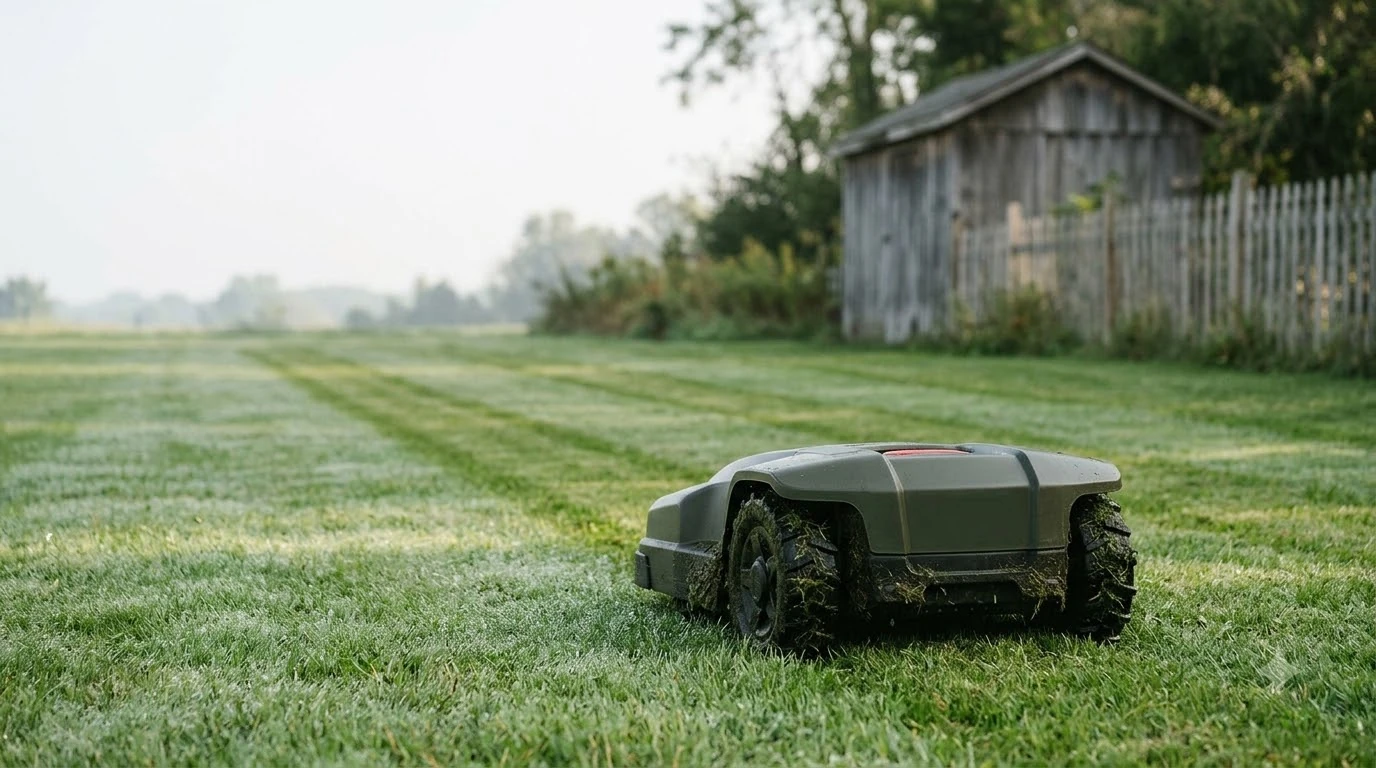

A robot mower for a lawn with a dog run can work, but only if the run stays out of the mowing area and the dog is kept away from the mower. Robot mowers use obstacle sensors rather than true pet recognition, and the manufacturers we read say they are not a pet-safety device. This guide covers how to plan the yard, what the sensors can and cannot do, and what to check before you buy for a yard with a dog run.
The short answer
- Keep the run out of the mowing zone: plan the boundary so the mower never enters the dog’s area, and check that the model can be set up that way.
- Sensors are not a guarantee: Carnegie Mellon describes touch-based bumping at low speed, and Mammotion says its mower should not be treated as a pet-safety device.
- Schedule around the dog: Mammotion suggests mowing when the dog is indoors, and Petbook advises daytime runs under supervision.
- Clear the lawn first: remove toys, bowls, waste and loose objects before every run.
- Our reading: a dog run adds a fenced zone, so pick a model you can set up around it before you compare cutting features.
Why a robot mower for a lawn with a dog run needs different planning
A dog run is a fenced area where the dog spends time, often with gravel, mulch or bare soil. For a robot mower, that means two things. First, the mower should not drive into the run and risk tangling with the dog or the fence. Second, the run needs a different surface plan, because bare or gravel areas can confuse some models. Our reading is that the lawn layout matters more than the mower brand at this step. Dogs are one of several animals that change mower planning, which pets and animals on a mowed lawn describes. A flock needs separation like a dog run does, which backyard chicken flock mowing explains.
The mower and the dog should not share the same space at the same time. Think of the run as a separate zone, and build the schedule and boundary around it. That also means checking where the charging station sits relative to the run, so the mower never has to pass the dog to dock.
What the sensors can and cannot do
Carnegie Mellon’s robotic mower guidance describes detection by touch sensing, which it calls “bumping,” at very low speed. The mower also shuts off if it is picked up during use. The same guidance tells owners not to let a pet approach or chase the mower, and not to pick up or move a mower that has bumped them. Those points matter because a bump sensor reacts after contact, not before. Fixed poles and spilled seed are another obstacle set, covered in setting up around bird feeders.
Mammotion is more direct: it says a robot mower should not be treated as a pet-safety device because of its obstacle detection. Navimow and some other brands market pet detection, but those are manufacturer claims without an independent test range in the sources we read. A dog that runs at the mower will not be reliably avoided by a sensor alone.
Set up the lawn before the first run
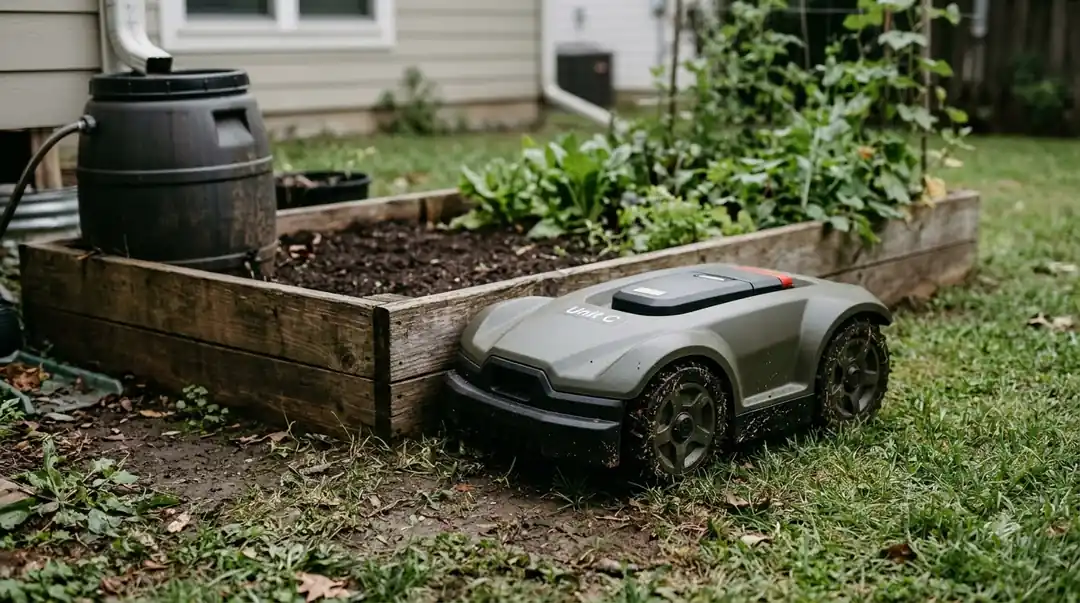
A pre-run check is the cheapest safety step. Mammotion advises clearing toys, bowls, waste and other loose objects before each operation, and avoiding any interaction between the pet and the mower while it runs. For a yard with a dog run, that means walking the lawn edge where the run meets the grass, checking the gate, and confirming that nothing has been left in the mowing path. Waste left on the lawn is a common failure point, which dog poop on a robot-mowed lawn covers in full.
Petbook, citing a wildlife expert, notes that small dogs and cats face higher risk, especially at night. It recommends running the mower only in daylight under supervision, keeping pets indoors during the run, and checking the lawn before every use, especially at dusk or in wet weather. Those steps add a few minutes but remove most of the surprise.
How to plan the schedule around the dog
The simplest rule is to run the mower when the dog is inside. Mammotion’s dog guidance suggests using the app to schedule mowing for times when the dog is indoors. In practice, that might mean a midday run when the dog is napping in the house, or an early-morning run before the dog goes outside. Animal waste affects the schedule in a similar way, as manure on a robot-mowed lawn shows.
Keep the schedule consistent. Dogs learn routines, and a mower that runs at the same time every day becomes less surprising. Our reading is that a fixed, supervised window is safer than an always-on schedule that runs while the dog is in the yard.
What to check on a model before you buy
- Ask about boundary setup. Confirm the model can keep the mower out of the run area, and what tools the setup uses.
- Confirm the sensor behavior. Ask how the model reacts to contact and whether it stops when lifted.
- Check the charging station location. The dock should sit away from the run, so the mower never passes the dog to recharge.
- Read the safety wording. Compare the manufacturer’s pet claims with its pet-safety statements, and treat them as claims until tested.
- Plan the supervision. Decide who is responsible for the pet during each run, and whether the dog can stay indoors.
Small dogs and dogs that chase deserve extra care. The Petbook advice about small dogs at night is a reason to keep the run outside the mowing window, not just outside the mowing map. Animal enclosures on larger properties are covered in horse paddock robot mower choices.
When a dog run is a reason to choose differently
A dog run is manageable on most lawns, but it can rule out certain setups. A large yard split into several zones may need a mower that can follow more complex boundaries, while a small yard with a run may do better with a compact model and a supervised daytime schedule. Our reading is that a dog that chases, or a small dog that roams, is a stronger reason to keep the mower away from the run altogether, even if the model has good sensors. Dogs often dig, and ground squirrel holes under the mower covers surface damage from burrowers.
For the sensor description, see the Carnegie Mellon robotic mower guide. For the pre-run checklist, the Mammotion dog-friendly backyard guide lists the steps.
Related reads: Another soil hazard that often affects pets is described in fire ant mounds in the lawn.
Frequently asked questions
Can a robot mower work in a yard with a dog run?
Yes, if the run is kept out of the mowing area and the dog is kept away from the mower during operation. Sensors help, but they are not a pet-safety device.
Will the mower detect my dog and stop?
Not reliably. Carnegie Mellon describes touch-based bumping at low speed, which reacts after contact. Manufacturer pet-detection claims are not independently tested in the sources we read.
When is the safest time to run the mower?
When the dog is indoors, in daylight, under supervision. Petbook recommends daytime runs with pets kept inside, and Mammotion suggests app scheduling for times the dog is indoors.
Should a small dog be kept away from the mower entirely?
Petbook cites a wildlife expert who says small dogs and cats face higher risk, especially at night. Our reading is to keep small dogs indoors during every run.
Sources
- Carnegie Mellon University, robotic mower guide (university): touch sensing, lift shutoff, do not let pets chase.
- Mammotion dog-friendly backyard guide (manufacturer): not a pet-safety device, pre-run clearing, app scheduling.
- Petbook robotic mower caution (pet magazine): small dog risk at night, daytime supervised runs.
 Up next9 min readBy YardRobot Mower and Dog Poop: Should You Let It Mow Over Waste?Updated Nov 11, 2026
 8 min readBy YardCan a Robot Mower Run After Applying Lime to the Lawn?Updated Nov 12, 2026
 7 min readBy YardShould a Robot Mower Run on Dormant Grass?Updated Nov 12, 2026
 9 min readBy YardCan a Robot Mower Run on Frosty Grass?Updated Nov 12, 2026
 8 min readBy YardBest Time of Day to Run a Robot MowerUpdated Nov 11, 2026
 7 min readBy YardRobot Mower with Chicken Manure on the Lawn: Cleanup and SetupUpdated Nov 14, 2026