
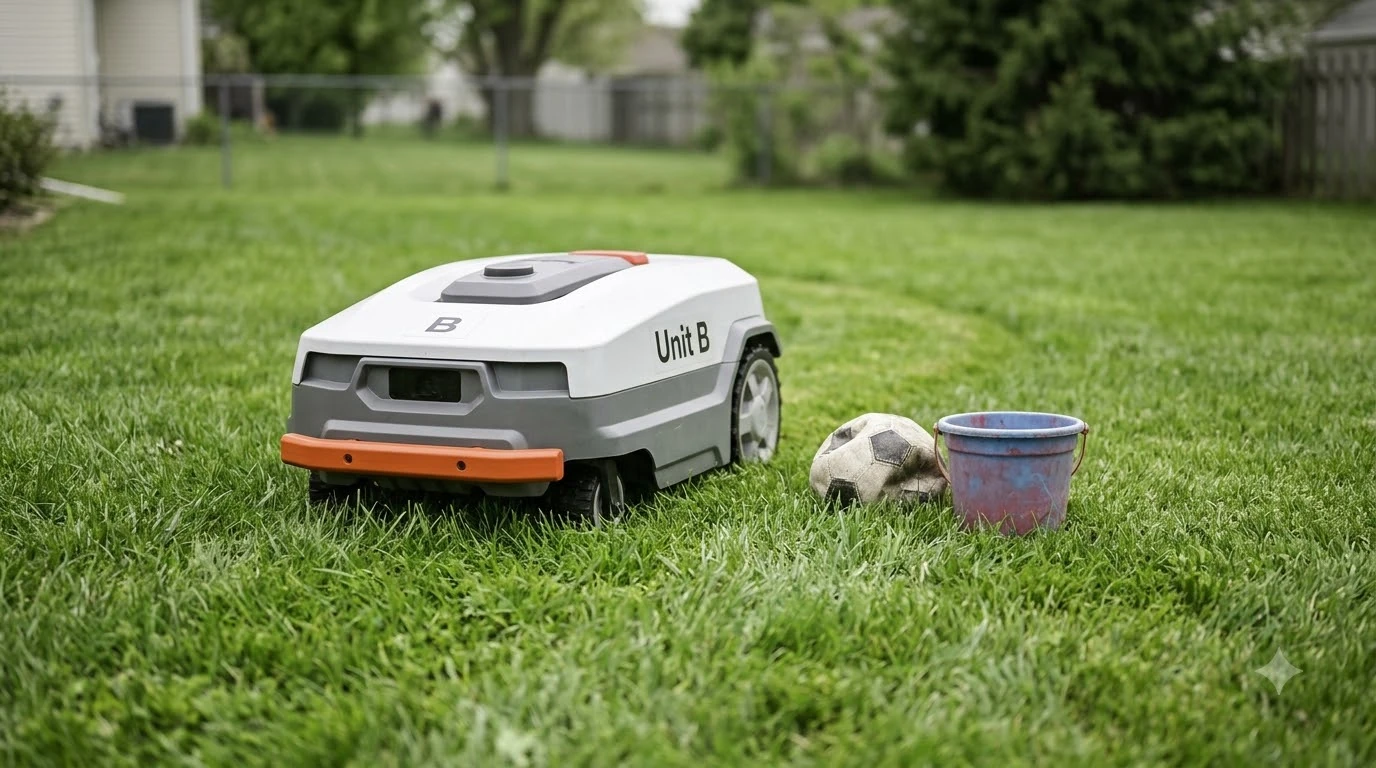

How do robot mowers mow around trees? They do it in two ways: by knowing the boundary of the tree area, and by sensing the trunk, roots and low branches as they go. The mower follows a boundary or a map, then uses bump, camera or LiDAR sensors to keep clear of the trunk. Trees also change how the mower navigates, because the canopy can block or reflect satellite signals, which matters for mowers that rely on RTK positioning.
The short answer
- Boundary first: the mower stays inside the lawn boundary, and a tree trunk can be treated as an edge or a no-go area.
- Sensors next: bump, camera or LiDAR sensors help the mower slow down and turn away from the trunk and roots.
- Satellite trouble: dense canopy can weaken RTK signal, so a tree-heavy yard may need LiDAR or a boundary wire.
- Check the map: trees and their shadow zones are the first things to review after setup.
How the mower knows where the tree is
A robot mower does not see a tree the way you do. It relies on a map of the lawn, which is built from a boundary wire, satellite positioning or a combination of sensors. Once the boundary is set, the trunk is usually treated as an obstacle inside the lawn, or as a hole the mower must cut around. Many models let you draw a no-go zone in the app, which keeps the mower from entering the root area or the space right under a low canopy. Camera models recognize trunks differently, as how camera mowers spot trees explains. Laser sensing outlines trunks in detail, as LiDAR obstacle mapping around trunks shows.
How precise that map is depends on the navigation method. A boundary wire gives a clear edge, but the wire has to run around the trunk. RTK positioning gives centimeter-level position in open sky, while LiDAR builds a three-dimensional picture of its surroundings and updates it while it works. Each method has a different weak spot when trees are involved.
Why tree cover can disrupt satellite navigation
This is where tree-heavy yards cause the most trouble. Ecovacs notes that RTK positioning struggles under dense trees and buildings, because obstructions interfere with the satellite connection, and it advises placing the base station in an open, unobstructed area. Mowrator explains that trees can block, weaken and reflect satellite signals, which the company calls multipath. When the fix is lost, the mower may pause, slow down or correct its route before it continues. Leaf cover often reduces accuracy, as RTK float under tree cover explains. A strong fix is harder beneath leaves, as holding an RTK fix under canopy shows. Dropouts near trees are common, as causes of RTK signal loss explains.
LiDAR is the usual alternative in shaded yards. Ecovacs describes LiDAR as unaffected by shade or nearby structures, though fog and heavy rain can scatter the laser pulses. Anker’s LiDAR guide says sensors also need cleaning after rain, mud or dust, which is worth remembering if your lawn is under a tree that drops sap, pollen or fine debris.
Heads up
Vendor comparisons, including the ones we read, are written by the companies that sell the sensors. They describe their own systems as strong in shade, but none of the pages we read gives a measured accuracy figure for a yard under a particular tree. Test the mower in your own yard before you rely on it.
How do robot mowers mow around trees at the trunk and roots?
Once the mower is close to a trunk, the sensors take over. A bump sensor tells the mower it has touched something and turns it away, which is useful for thick roots that stick out of the grass. A camera or LiDAR sensor can slow the mower earlier, so it turns before it reaches the trunk. Low branches are the hardest case, because a sensor may not see a branch that hangs at mower height, so many owners trim the lowest limbs before they set up the schedule. Fallen branches collect near roots, as mowing over sticks under trees explains. Seeds and cones are another hazard, as acorns and pine cones near roots discusses.
Roots and exposed stumps can also leave bare patches or uneven cuts around the base of the tree. If the mower keeps returning to the same spot, check whether a root is lifting the wheel or the blades are missing a section of grass. Those problems are usually easier to fix by adjusting the no-go zone than by changing the schedule.
What to check before you set up a yard with trees
Start by walking the lawn and marking the trunks, roots and low branches. Then check the satellite map or the boundary plan after the first run. Look for places where the mower paused, lost the signal or took an unexpected path, because those spots are where the tree is affecting navigation.
If the yard has a large canopy over most of the lawn, ask the seller whether the mower uses RTK, LiDAR, a boundary wire or a mix. Each method has a different answer for shade, and that answer matters more than any single feature on the product page.

Frequently asked questions
Can a robot mower cut right up to a tree trunk?
Usually it cuts close to the trunk but not into it. The exact clearance depends on the sensors and the boundary or map settings, and the mower may leave a small uncut ring. Check the first few runs and adjust the no-go zone if the ring is too large.
Does a tree canopy stop a robot mower from working?
Not always. Dense canopy can weaken RTK satellite signal, so the mower may pause or slow down. LiDAR and boundary wire systems are less affected by the satellite issue, though fog and heavy rain can still affect laser sensors.
Will a robot mower damage tree roots?
The mower cuts only grass, but the wheels and blades can rub against exposed roots and damage the surface. Keep the mower away from thick roots with a no-go zone where possible, and do not let it drive over soft, exposed soil around the base of a young tree.
Should I trim low branches before I set up the mower?
Yes, it is a good idea. Low branches are hard for some sensors to detect, and a branch at mower height can catch the mower or lead it into an awkward path. Trimming them also makes it easier to walk the lawn and check the boundary.
Sources
- Ecovacs: LiDAR vs RTK robot lawn mowers (manufacturer blog): RTK struggles under dense trees, base station placement, LiDAR unaffected by shade.
- Mowrator: RTK robot mower signal loss and trees (manufacturer blog): trees block, weaken and reflect satellite signals; pause, slow and route correction.
- Anker: How LiDAR robot lawn mowers work (manufacturer blog): LiDAR builds a 3D map, fog and heavy rain effects, sensor cleaning.
 Up next8 min readLearnWhy Does My Robot Mower Leave Unmowed Circles Around Trees?Updated Nov 19, 2026
 10 min readLearnWhy does my robot mower turn around before reaching the edge?Updated Nov 19, 2026
 7 min readLearnNavimow X430 Setup: Step by Step From Charging Dock to First MowUpdated Nov 13, 2026
 8 min readLearnDo Robot Mowers Mow in Straight Lines? 6 Smart ChecksUpdated Nov 11, 2026
 8 min readLearnCan a Robot Mower Mow Over Sticks? What the Sources SayUpdated Nov 11, 2026
 9 min readLearnWhy Do Robot Mowers Mow Every Day?Updated Nov 11, 2026