
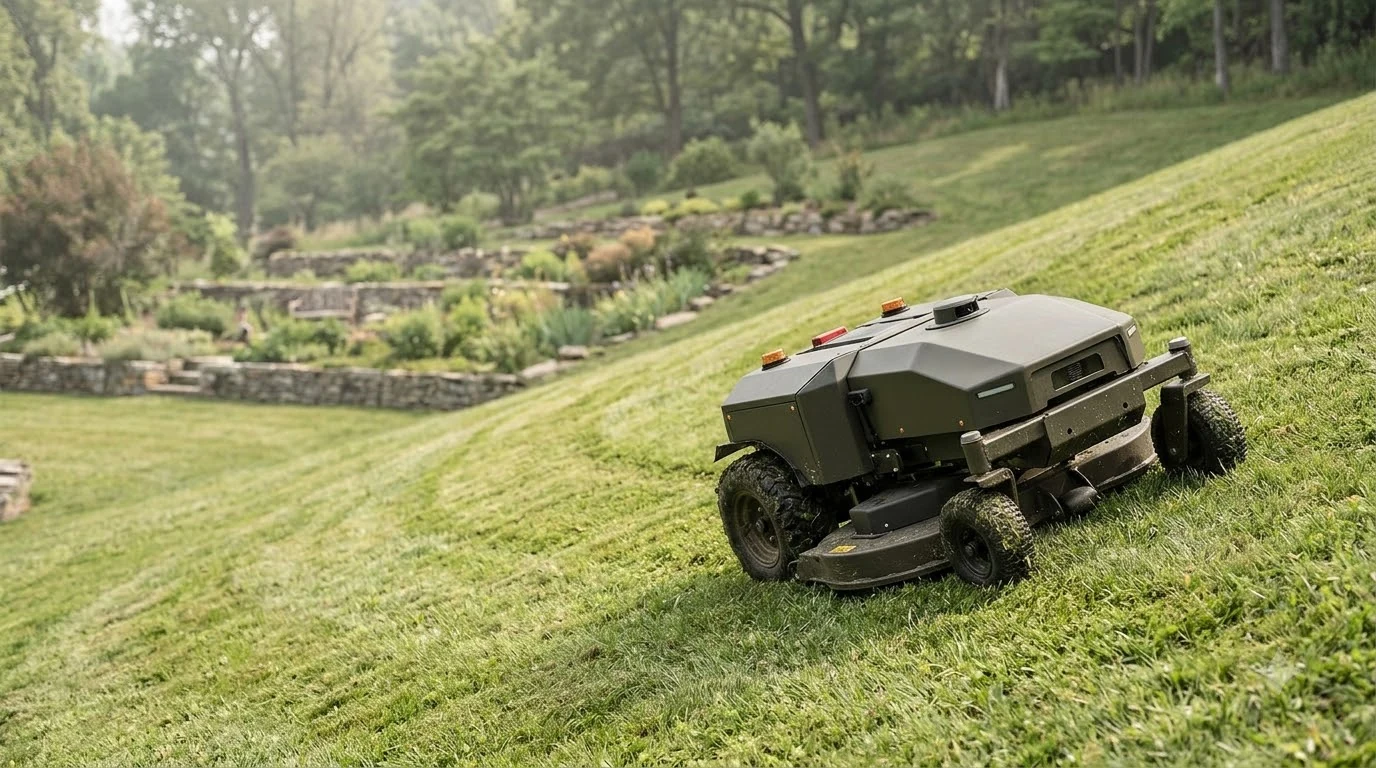

The best robot mower for a yard split by a creek is one that can map two separate lawn areas and keep clear of the banks. A creek or dry stream bed breaks the lawn into zones the mower cannot cross, and the banks often add slope. Manufacturer guides describe how obstacles and slopes are handled, so the planning comes down to the boundary setup, the no-go zone, and the bank distance. This guide covers how to plan around each.
The short answer
- Two zones: a yard split by a creek needs a mower that can map or wire each side, or a plan to cut one side at a time.
- Banks and slopes: keep the boundary well back from the bank edge, because slopes change how a mower handles the wire and the turn.
- Stones and gravel: a dry creek bed lined with stone can trap or damage a mower, so keep it outside the mowing area.
- Water: never let the mower enter the creek, and check the manual for what it does near water.
Best robot mower for a yard split by a creek: what the creek changes
A creek turns one lawn into two areas that the mower must reach without crossing the water. Unless you install a crossing that the mower can drive over, each side needs its own boundary or its own map. Our reading is that this is the main reason to choose a model with flexible mapping, because a single wire loop around a split yard is harder to build and more likely to fail. A creek is moving water rather than a pond, but the waterfront lawn picks around a pond share the same edge and wet-ground checks. Open water of any kind needs a clear margin, and swimming pool edge safeguards show how mowers are kept back from it.
The creek itself is a bigger concern than the grass. A natural or dry creek bed often has a sloped bank, loose stones, and a channel that drops away from the lawn. Robot mowers are designed for flat or gently sloping lawns, so the bank should be treated as an obstacle, not as mowing space.
Keeping a dry creek bed away from the mower
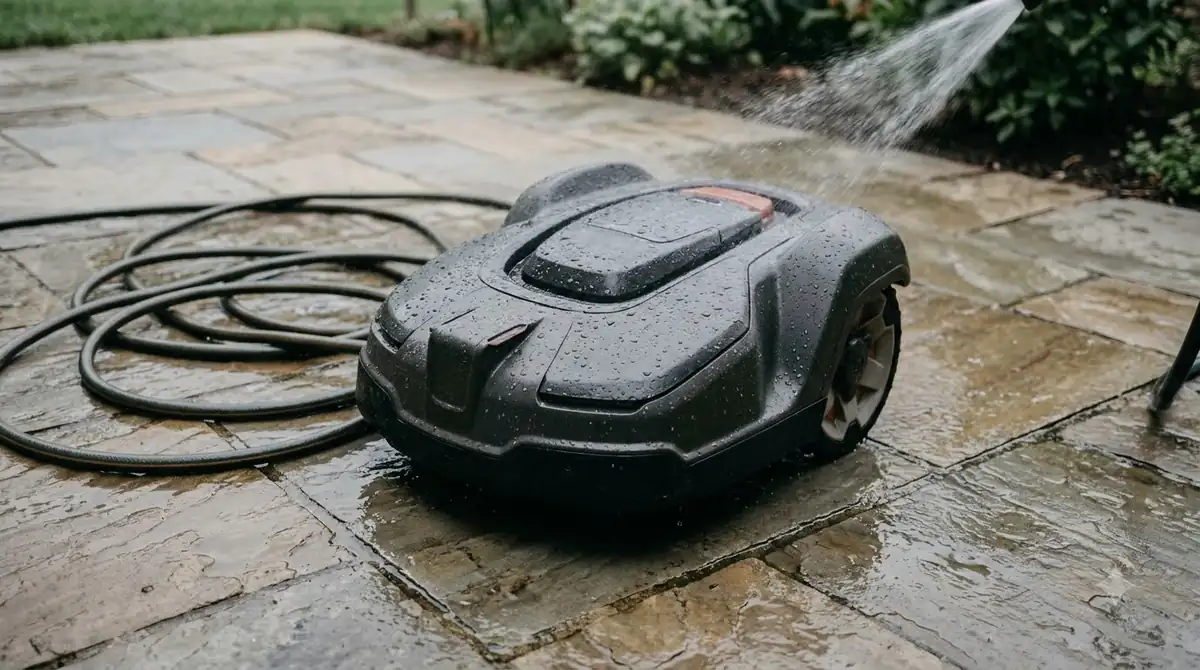
A dry stream bed is usually lined with stone or gravel over landscape fabric. The University of Arkansas Extension describes dry stream beds as stone-lined channels that mimic a natural watercourse, often with plants along the edges. That construction is a problem for a robot mower, because stones can damage the housing and gravel can trap the wheels.
Robomow’s blog says stones can damage the housing and ricochet off the blades, and that a gravel bed can trap the robot. It advises against stony paths for the mower. Our reading is that the bed itself should sit outside the mowing zone, with a physical edge between the lawn and the stone.
Heads up
Check your local rules before you change the drainage of a dry creek bed or a live stream. The UA Extension publication notes that year-round water flow may need permits before any change.
Bank distance and slope
The banks of a creek are often steeper than the rest of the yard. Husqvarna’s steep-slope guide recommends positioning the boundary further in on flat ground before the slope begins, and leaving at least 50 cm of level ground between a flat area and a steep one. For steeper models, the same guide advises keeping 1.5 m from the bottom of the slope to the boundary wire. Steep banks need a flat buffer before the edge, and the sloped ditch and bank buffer guidance explains how wide to keep it.
Robomow’s user guide notes that a wire along an edge slope over 10 percent needs care when the ground is wet. That is a useful rule of thumb for a creek bank. Our reading is that the boundary should stay well back from the top of any bank, and that the mower should never be left to run unattended near water.
Boundary wire, mapping, or both
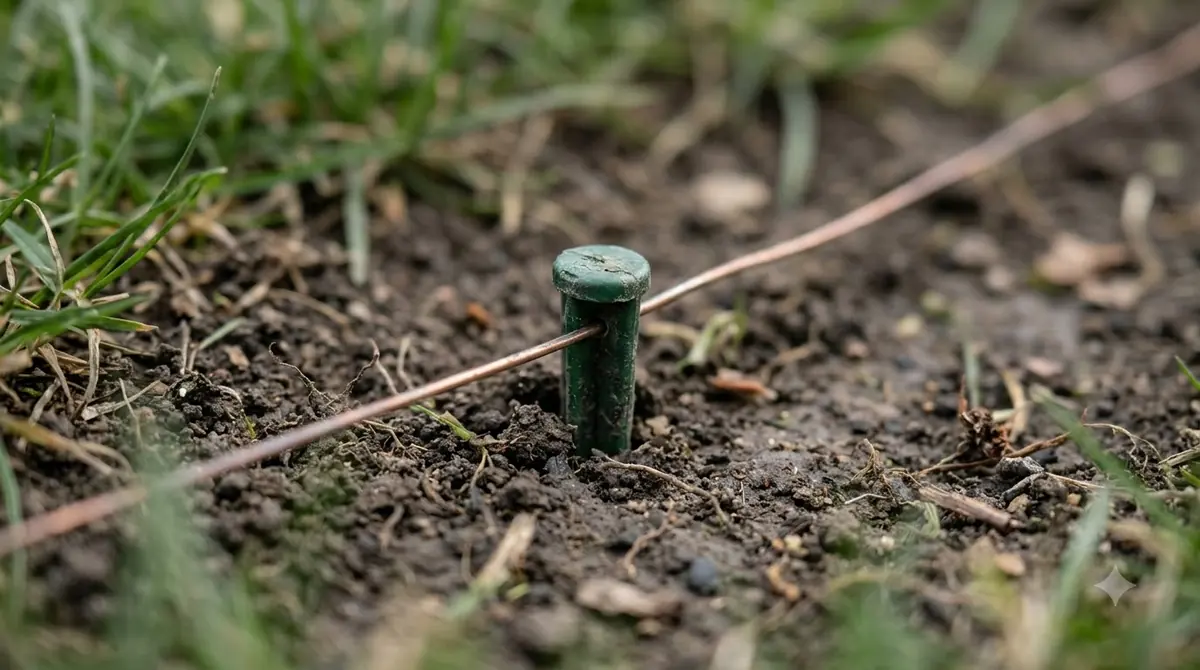
A wire loop works well when each side of the creek has a clear, flat edge. The wire can run around the lawn and along the creek bank, but it must stay out of the slope. A mapped system can define each side as its own area and mark the creek as a no-go zone. Some models also support multiple zones, so the mower can move from one side to the other only if you allow it. Signal strength can change close to wet ground, which the notes on wire depth near water edges cover for a pond-side lawn.
Our reading is that a split yard usually does best with a no-go zone along the creek plus a separate boundary on each side. That gives you a clear exclusion area and avoids long wire runs across the water.
Obstacles and objects near the creek
Ecovacs’ FAQ says to remove items that can trap a robot, such as leaves, stones, and loose wires. Its guidance also mentions physical enclosures higher than 15 cm around problem areas. Robomow’s user guide says objects lower than 15 cm should be surrounded with perimeter wire, while taller rigid obstacles need no wire. Those numbers are useful when you plan a fence or a row of stones along a creek edge. A planted basin near the creek is another soft obstacle, and rain garden edge handling follows a similar no-go approach.
- Walk the creek line. Mark the top of the bank, the stone edge, and any loose gravel that could roll toward the lawn.
- Set the no-go zone first. Put it a little wider than the bank so the mower stops before the edge.
- Add a physical edge. A low fence or a row of stones can protect the lawn between the grass and the stream bed.
- Test each side. Run the mower through a full cycle on each side and watch how it turns near the creek.
Related reads: Lawns beside a creek can hold water after heavy rain, so the stuck risk in flood-prone low spots is worth reading next.
Frequently asked questions
Can a robot mower cross a creek?
Not as a general rule. Plan each side of the yard as its own zone, and keep the creek and the bank outside the mowing area.
Is a dry creek bed safe for a robot mower?
Stone and gravel can damage the housing and trap the wheels. Keep the bed outside the mowing zone with a physical edge.
How far back should the boundary stay from a creek bank?
Husqvarna’s steep-slope guide suggests keeping 1.5 m from the bottom of a steep slope to the boundary wire on its steepest models. Test the distance on your own bank before you rely on it.
Do I need a wire or a map for a split yard?
It depends on the model and the layout. A wire suits flat, clear edges, while a mapped no-go zone is easier to change. Our reading is that many split yards use both.
Sources
- University of Arkansas Extension, dry stream beds (university extension): dry stream beds are stone-lined channels; permits may be needed for year-round water flow.
- Robomow RT user guide (manufacturer): objects under 15 cm need perimeter wire; slope over 10 percent needs care when wet.
- Husqvarna, optimising installation for steep slopes (manufacturer): boundary placement and distance from steep slopes.
 Up next8 min readBy YardBest Robot Mower for a Yard With a Dry Creek Bed: What to CheckUpdated Nov 12, 2026
 9 min readBy YardChoosing and Setting Up a Robot Mower for a Yard With a Split-Rail Wooden FenceUpdated Nov 19, 2026
 9 min readBy YardCan a Robot Mower Work in a Yard Split by a Driveway?Updated Nov 10, 2026
 7 min readBy YardBest Robot Mower for a Suburban Yard with a Play AreaUpdated Nov 17, 2026
 6 min readBy YardBest Robot Mower for a Yard with Maple Trees: What to CheckUpdated Nov 14, 2026
 7 min readBy YardBest Robot Mower for a Long Narrow Yard with a HedgeUpdated Nov 14, 2026