
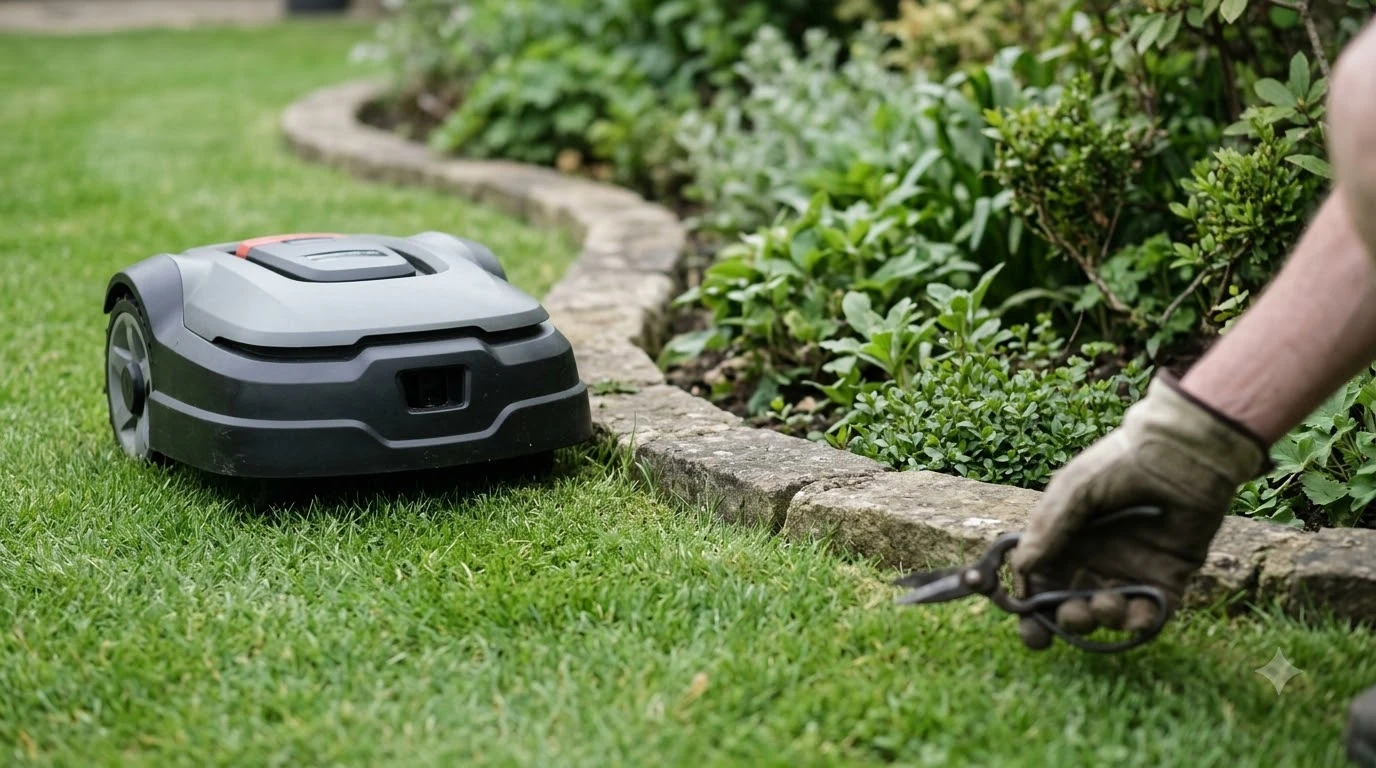

How to trim edges a robot mower misses starts with a clean hand-cut line: cut a clean line by hand with a spade or edger, then keep it tidy with a short touch-up two or three times a season. A robot mower stops short of beds, walls, and tight corners, so grass creeps in along those lines. Hand edging is the usual fix, and a little planning makes it much faster.
The short answer
- Main tool: a sharp spade or flat edger for a clean line along beds and walks.
- Depth: a cut about 4 inches deep and wide keeps grass from growing into the bed.
- Upkeep: touch up once or twice a year, more often in fast-growing grass.
- Planning: leave open soil at the edge when you mulch, so future edging is easier.
Why a robot mower leaves the edges
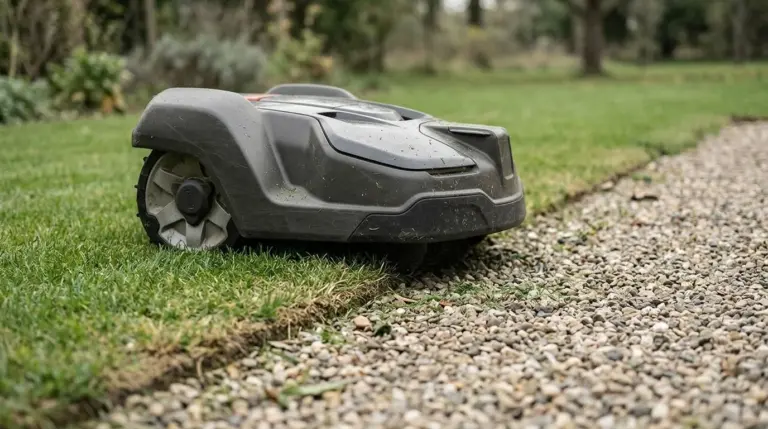
A robot mower follows its boundary and avoids obstacles, so it usually keeps a small gap from beds, walls, and garden edging. That gap is the strip of grass the mower misses. Over a season, grass creeps into the bed along that line, and the edge starts to look untidy even when the rest of the lawn is cut well. Corners show the same problem, which is covered in patches missed in corners with possible fixes. Strips left along the wire are covered in how wire position affects uncut strips. Edge gaps relate to the cut width, as cutting width and the uncut edge explains.
Knowing how to trim edges a robot mower misses starts with that gap. Our reading is that the gap is a design feature, not a fault. The mower is protecting plants and surfaces from its blades, so the edge is the part you maintain by hand.
How to trim edges a robot mower misses: cut a clean edge by hand
Hand edging is the traditional method. University of Illinois Extension describes starting with a sharp spade to cut a line between the bed and the turf, then removing the soil and grass inside it to form a small cliff. That cliff gives the bed a clear boundary, and the grass has to grow over the drop before it can reach the mulch.
The same guidance says an edging trench about 4 inches deep and 4 inches wide can keep bluegrass from growing into a bed. It is hard work, which is why many owners do it once or twice a year rather than every week. A flat-bladed spade or a half-moon edger is usually enough for a straight line.

Use a string trimmer with care
A string trimmer can tidy a curved edge faster than a spade, but it can also scalp the turf and nick the bed if you hold it low. Keep the head angled so the line stays at the cut edge, and work slowly around stakes, pavers, and wall corners. The goal is a clean line, not a close shave. Work in short passes and step back often, since a small wobble is easier to fix early than after a long run of cutting.
Before you start, check the area for the mower’s boundary wire or guide markers. A trimmer that cuts through a buried wire can disable the mower until it is repaired, so mark the wire line first if you are not sure where it runs.
Marking the line first saves time and avoids a crooked edge. A garden hose laid on the grass shows the curve clearly, and a few stakes or a string line help for a straight run. Stand back and look at the line from the house before you cut, since a curve that looks fine up close can wobble from a distance.
Keep the edge clean between cuts
The edge is easier to hold when the mowing setup supports it. Illinois Extension notes that when you mulch up to a lawn edge, leaving some open dirt helps. That open strip makes touch-up edging simpler and keeps grass out of the mulch. Flower beds usually need about an inch of mulch once it settles, while shrub beds often take two to three inches. Debris along the border can also leave gaps, as clearing sticks from the edge line explains for a typical garden. Uneven cuts along the edge are covered in uneven cutting along the edge. Edge grass left standing can set seed quickly, and guidance on cutting grass that has gone to seed covers how a robot mower handles seedheads.
Keep mulch away from the crown of perennials, since many grow up from the crown and cannot push through a thick layer. The grass line should stay a clear step below the mulch, so the mower and the trimmer do not fight over the same strip.
Plan the edge for the next season
A well-cut edge lasts longer when the bed is planned for it. Avoid permanent edging in new beds, since plants and bed shapes change over several seasons. Extension advice also favors a simple edge made with a spade or edging tool, then a stronger edge later if you want one. A steel, stone, or brick border can be added once the bed shape settles. A seasonal plan helps, as seasonal lawn care plan explains for typical lawns.
- Walk the line. Mark the bed edge with a hose or string to see the curve before you cut.
- Cut with a spade. Make a sharp line and remove the soil and grass inside it to form a small cliff.
- Trim the curves. Use a string trimmer carefully around stakes, walls, and tight corners.
- Touch up. Re-cut the line once or twice a year, and leave open soil when you mulch.
Frequently asked questions
How deep should I cut a lawn edge by hand?
An edging trench about 4 inches deep and 4 inches wide can keep grass like bluegrass from growing into a bed. A shallower cut often lets grass creep back sooner.
How often do I need to trim the edges a robot mower misses?
Hand edging usually needs a touch-up once or twice a year. Fast-growing grass may need more frequent passes, especially in spring.
Can a string trimmer replace a spade for edging?
A string trimmer can tidy a curve, but it does not form the small cliff that stops grass from creeping into a bed. Many owners use a spade for the main line and a trimmer for curves and tight spots.
Will a robot mower cut into the edge of a bed?
Most robot mowers keep a gap from beds and walls, which is why the edge has to be done by hand. Check the mower’s boundary and obstacle settings if it keeps running into a bed.
Sources
- Bed Edges (University of Illinois Extension): spade cut, the small cliff, 4-inch edging trench, and the once or twice a year touch-up.
- Edging and mulching landscape beds (University of Illinois Extension): open dirt when mulching, mulch depth for beds, and keeping mulch off perennial crowns.
 Up next9 min readLearnCan a Robot Mower Detect Black Garden Edging in Low Light?Updated Nov 19, 2026
 8 min readLearnCan You Sell a Used Robot Mower? What to Hand OverUpdated Nov 11, 2026
 7 min readLearnWhat Is Edge Mode on a Robot Mower and How Does It Work?Updated Nov 13, 2026
 10 min readLearnWhy does my robot mower turn around before reaching the edge?Updated Nov 19, 2026
 8 min readLearnWhat Is Edge Cutting on a Robot Mower?Updated Nov 11, 2026
 8 min readLearnRobot Mower Keeps Getting Stuck on Edges? Causes and FixesUpdated Nov 11, 2026