
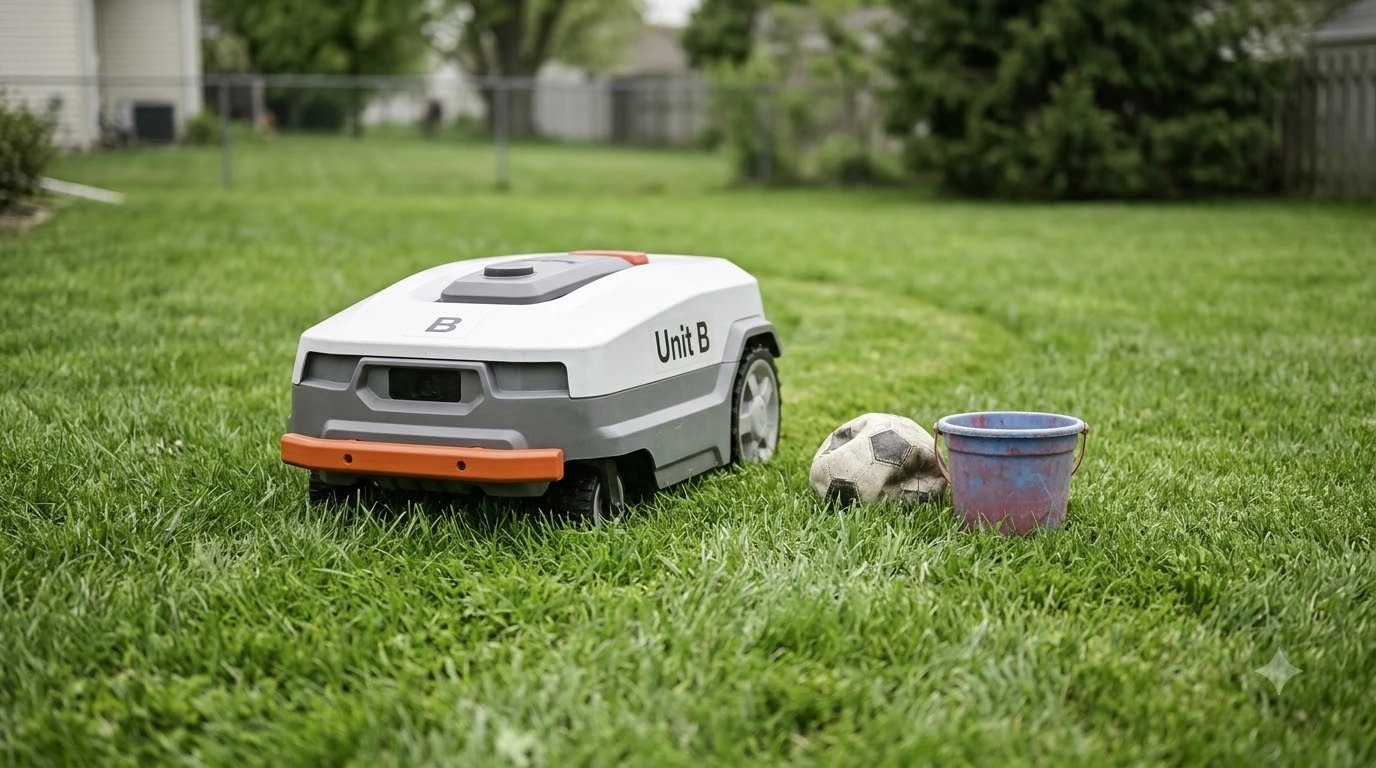

Why does my robot mower miss patches in corners? Usually because the corner is too tight for the mower to turn through, the boundary or path was laid out with a sharp angle, or the mower steers around something and never returns to the spot. Most fixes are about the layout, not the mower, so start with the corner shape and the passage width before you change any settings.
The short answer
- Sharp angles: a tight corner in the boundary can leave a pocket the mower cannot enter cleanly.
- Narrow passages: a passage that is too narrow can make the mower circle or skip the edge.
- Obstacles and signal: the mower may steer around an object or lose precision, then leave a small area behind.
- Quick test: watch one run, mark the missed spot, then check the shape of that corner before changing the schedule.
Why does my robot mower miss patches in corners?
A corner is where a robot mower has the least room to turn. The mower follows its boundary or path and then steers back into the lawn. A tight angle forces it to make a sharp change of direction, and some patches at the inside of the turn can be left behind. The result is a small uncut pocket that looks like a missed corner. Corner patches are one of several cutting complaints, and the cutting height and lawn results guide covers the rest. Similar gaps appear along paths, which are covered in uncut strips left behind by a mower with possible causes.
Husqvarna’s guidance on boundary wires shows the same concern in a different form. Its corridor-width setting exists because a mower can get stuck in narrow passages, and the company suggests adjusting the width when it does. A passage that is too tight leaves the mower with no room to finish a pass, so the grass beside it stays uncut.
The cause is usually the shape of the lawn rather than a fault. Corners in a yard often sit next to a bed, a path, or a fence, so the mower has to thread between obstacles at the same time as it turns. That combination is where missed patches show up most often.
Sharp corners and passages: check the layout
Look at the corner from above before you change anything. A right-angle corner in the boundary is harder for a mower to cover than a rounded one, so the usual fix is to soften the shape rather than adjust the cutting settings. The same is true for a passage that narrows to a point.
- Round the corner: a gentle curve gives the mower room to enter and leave the pocket.
- Widen the passage: if the mower circles or flattens grass in a narrow gap, the passage may be too tight for the mower’s path.
- Adjust the corridor width: on models that allow it, Husqvarna’s corridor-width setting can change how the mower follows a passage. The article gives a range of 1 to 9 with a factory setting of 6.
Heads up
In our reading, a passage that is too narrow for the mower can leave the lawn looking flattened, because the mower keeps circling there. A narrow gap that looks fine on the map may still cause this in real use.
Obstacles, signal, and turns
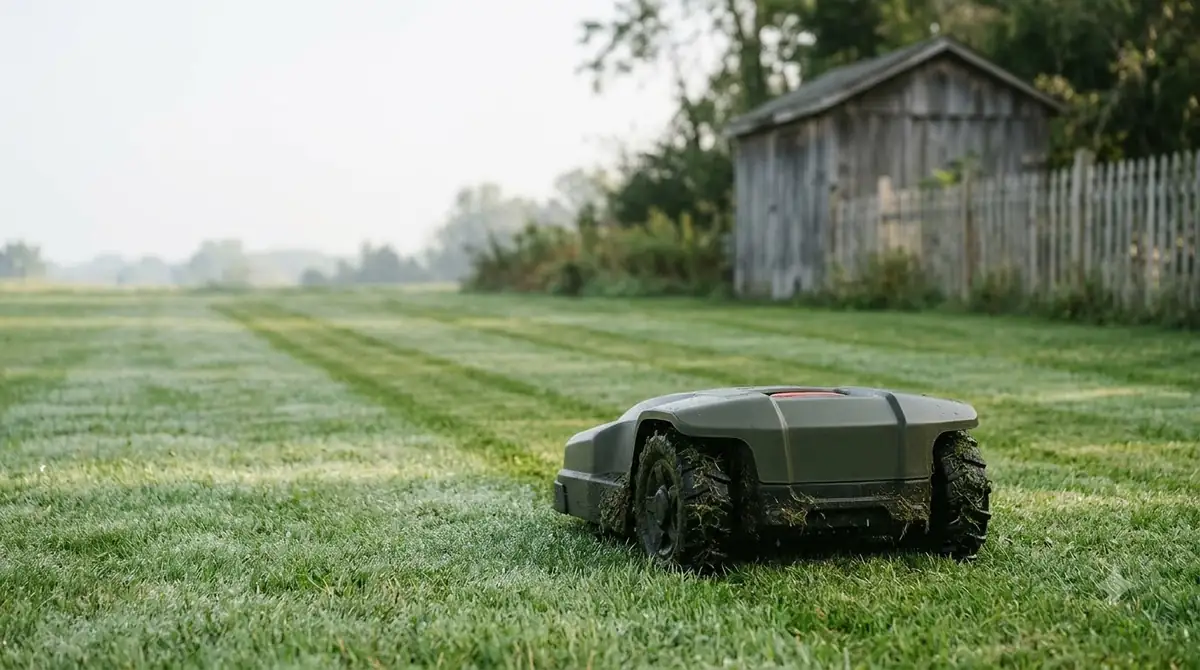
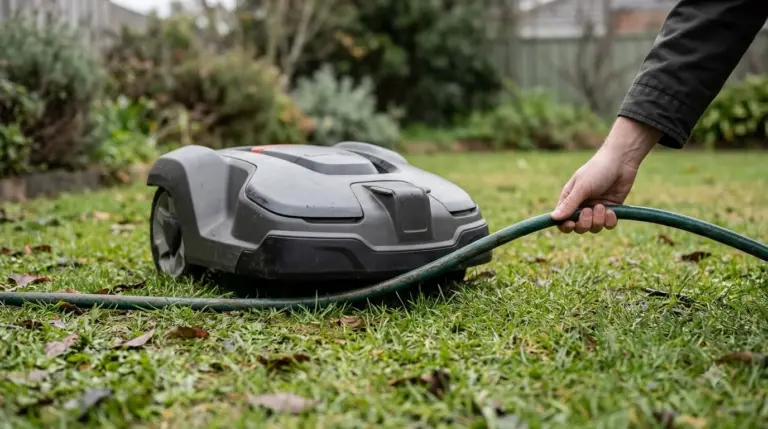
Corners often hide obstacles. A hose, a stone, or a garden item can make the mower steer around a spot, and it may not come back to finish the strip. Navimow’s support for a related problem lists three common causes: poor satellite signal, obstacle avoidance, and tall grass. For each, the company suggests a different response. Debris can interrupt turns, as sticks and other lawn debris explains for a typical garden. Drift is a related cause, and drifting off the mowing path lists the checks to make.
- Satellite signal: positioning errors can leave a cut missed, and Navimow says the mower usually covers the area after a few more passes.
- Obstacles: the mower steers around them, which can leave nearby grass uncut.
- Tall grass: Navimow advises setting the first cycle to a higher height when grass is over about 6 cm, rather than cutting too low at once.
Turns are the other factor. A turn sharper than the mower can manage forces it to slow, reverse, or reroute, and that is when a pocket is most likely to be skipped. If the missed area always sits at the same turn, the layout is the first thing to check.
How to find the exact cause
A reliable diagnosis takes one clear run, not a guess from the map. The steps below are our reading of how to narrow the cause, not a manufacturer procedure. Path planning also matters, as how robot mowers choose mowing paths explains. The wider picture of uneven results is in uneven cutting across the lawn with a list of causes.
- Mark the spot. Note where the uncut patch is, and whether it sits in a corner, a passage, or beside an obstacle.
- Watch one run. Check whether the mower slows, circles, or reroutes at that spot.
- Measure the passage. A gap that is tight for a person is usually tight for the mower too.
- Check obstacles and grass. Remove loose items from the corner and make sure the grass is not too tall for the first cut.
- Adjust one thing at a time. Change the corner shape or corridor width first, then run again before touching the schedule.

When to trim the corner by hand
Some corners will stay awkward even after the layout is fixed, especially in a yard with many beds and a fence line. In that case, trimming the last strip by hand or with a handheld trimmer is a practical answer. The mower does most of the work, and a short manual pass finishes the corner in a few minutes. A hand finish is often needed, as trimming the edges by hand shows step by step. Corner patches the mower misses often grow tall and head out, which is where robot mowers and seedhead grass become a practical issue.
Do not rely on hand trimming to hide a layout problem that repeats every run. If the same corner keeps missing, the boundary shape or passage is the real cause, and a different corner shape will do more than any amount of hand finishing.
Frequently asked questions
Why does my robot mower miss patches in corners?
The corner is usually too tight for the mower to turn through, or the boundary or path has a sharp angle that leaves a pocket uncut.
Can I fix missed corners by changing the mowing height?
Not usually. Height matters when grass is tall, and Navimow advises a higher first cycle in that case. Missed corners are more often a layout issue.
What is corridor width on a Husqvarna mower?
It is a setting that controls how the mower follows a boundary or guide wire through a passage. Husqvarna’s article gives a range of 1 to 9, with a factory setting of 6, on models that allow it.
Will the mower cover the missed patch on its own?
Sometimes. Navimow says a positioning error usually clears after a few more passes, but a corner that misses on every run needs a layout change or a hand trim.
Sources
- How to adjust the corridor width in a boundary wire Automower installation (Husqvarna): used for the corridor-width range and factory setting and the narrow-passage stuck issue.
- Navimow H1: what should I do if the certain area is uncut (Segway Navimow support): used for the satellite signal, obstacle, and tall grass causes and their fixes.
 Up next6 min readLearnWhy Does My Robot Mower Bump Into Things?Updated Nov 14, 2026
 6 min readLearnWhy Does My Robot Mower Spin in Circles? Causes and FixesUpdated Nov 14, 2026
 6 min readLearnWhy Does My Robot Mower Stop in the Middle of the Lawn?Updated Nov 14, 2026
 6 min readLearnWhy Does My Robot Mower Keep Going Back to the Charger?Updated Nov 14, 2026
 6 min readLearnWhy Does My Robot Mower Keep Going Back to the Dock?Updated Nov 14, 2026
 8 min readLearnWhy Does My Robot Mower Beep and Stop Mid-Cut? Common CausesUpdated Nov 14, 2026