
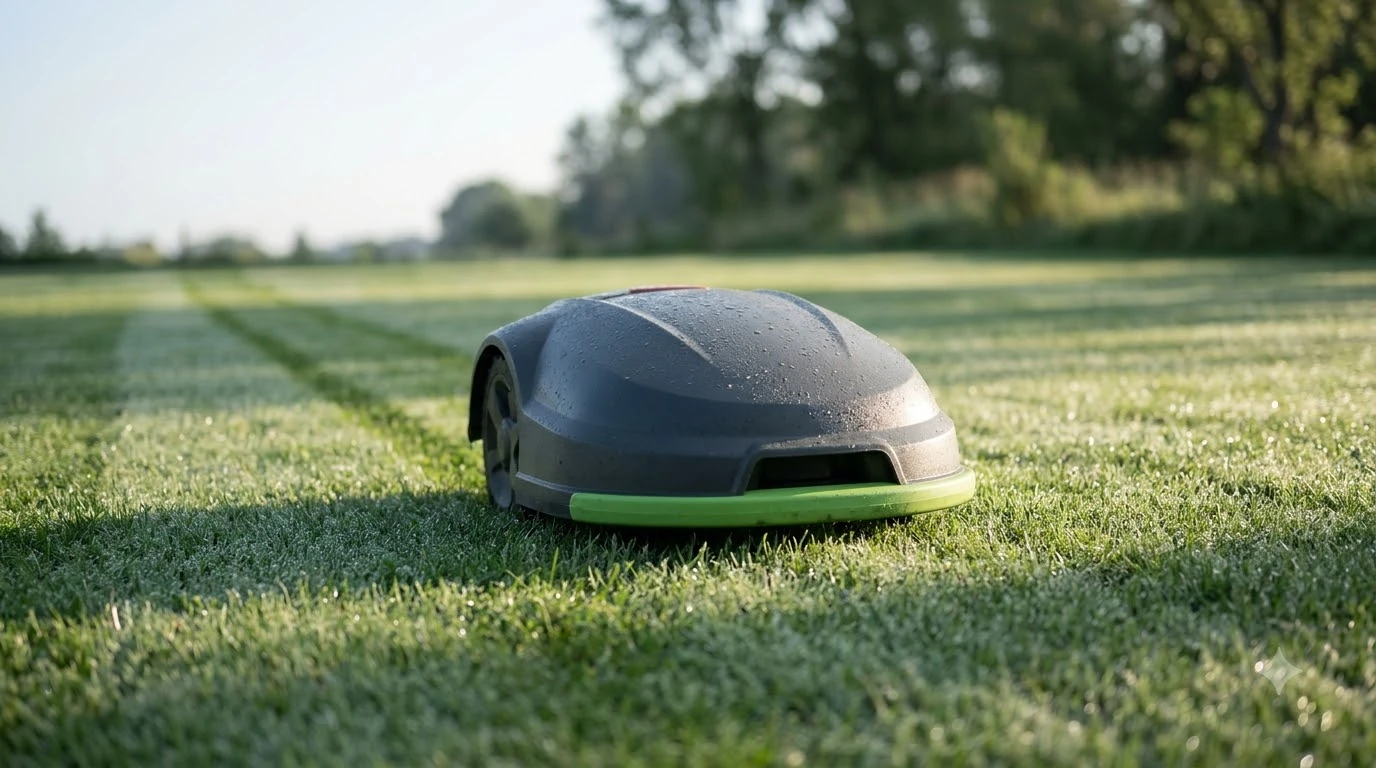

A robot mower cutting unevenly usually has one of four causes: the cutting height is too low or changed mid-season, the blades are dull or mismatched, the ground is uneven, or the grass is too tall or too wet. Check them in that order, because the first two are the cheapest to rule out. This guide explains what each sign looks like and what the sources say about it, as of November 2026.
The short answer
- Height first: most lawns suit 2.5 to 3 inches, and Robomow says no robot cuts below 15 mm.
- Blades second: torn, grayish or whitened grass tips point to dull or worn blades.
- Ground third: low spots and bumps make some areas scalped and others tall.
- Grass condition last: very tall or wet grass cuts poorly, so mow more often and wait for dry grass.
Robot mower cutting unevenly: the usual causes
Uneven cutting is a symptom with a short list of causes, and most of them show up as a pattern rather than a random mess. Scalped strips, tall tufts, and brown tips each point somewhere different. Start by looking at the lawn in daylight and noting where the damage sits: along one edge, in a low dip, or across the whole yard.
Our reading is that the cutting height and the blade condition explain most cases, so they are the first things to rule out. Ground problems matter, but they are usually a second-stage cause once the basics are right.
Check the cutting height before anything else
When a robot mower cutting unevenly leaves scalped patches, a cutting height that is too low is the usual reason. The one-third rule is the core test: a golden rule of lawn care is to remove only one-third of the grass blade in each mowing, as Clemson’s Home and Garden Information Center puts it. Removing more is called scalping, and repeated scalping thins the turf and leaves bare patches.
For most lawns, University of Illinois Extension suggests a mowing height between 2.5 and 3 inches. Its species ranges are narrower and lower for some grasses: Bermudagrass 1 to 2 inches, Zoysiagrass 1 to 3 inches, Kentucky bluegrass 2 to 3 inches, and tall fescue 2.5 to 3.5 inches. If your robot is set below the range for your grass, scalping is the likely result. Our guide on what height a robot mower should cut grass covers the robot-specific side.
Robot mowers have their own limits. Robomow’s guide to ideal cutting height recommends about 30 to 40 mm for robotic mowers in practice, notes that many models only offer 20 to 60 mm, and says no robot cuts below 15 mm. It also warns that cutting too low lets more sunlight reach the soil, which dries it out and encourages weeds.
Heads up
After any height change, give the lawn a few runs before judging the result, because one run can look uneven while the grass adjusts. Our reading is that changing the setting often makes it harder to tell which change helped.
Dull or mismatched blades leave torn grass tips
For a robot mower cutting unevenly, dull blades are the second thing to check, and they often look like a height problem. A sharp blade slices the grass cleanly, while a dull one tears it. Illinois Extension says a sharp blade cuts the grass blade cleanly, which gives an even appearance and avoids the disease risk that follows torn tissue.
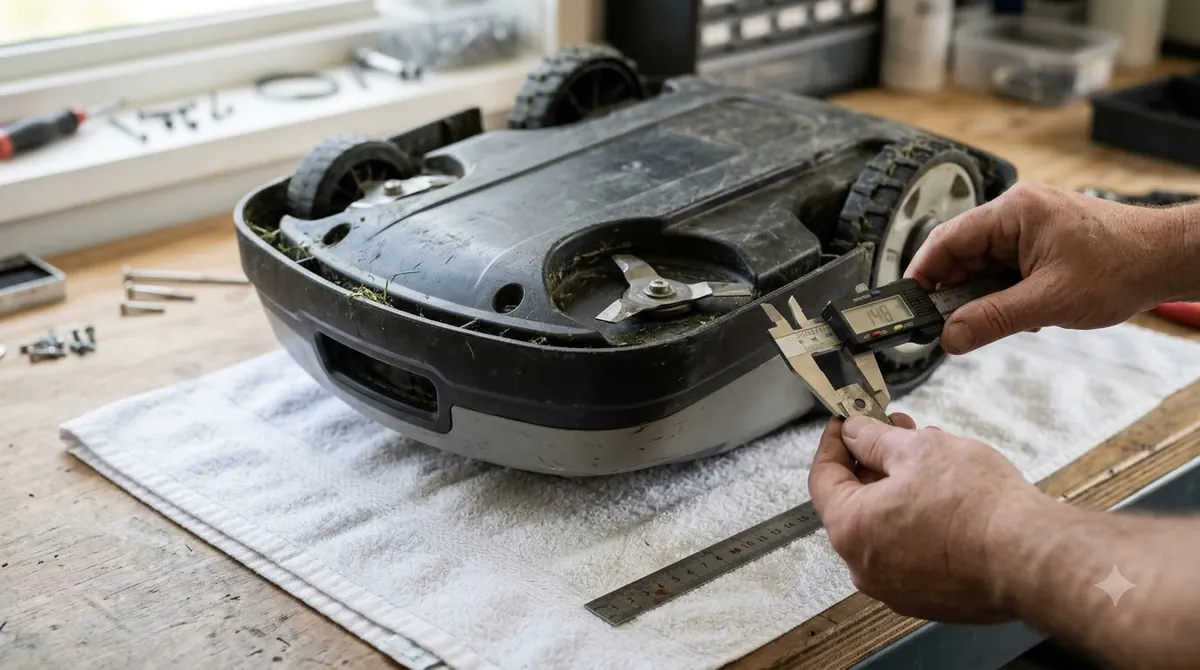
The signs are fairly consistent across sources. Virginia Tech extension notes that dull blades tear grass rather than slicing it, leaving a brownish-white cast where the tips have died. Husqvarna’s blade guidance lists frayed or whitened grass tips after mowing as a sign the blades need replacing. The University of California IPM program describes a lawn that turns grayish soon after mowing, with leaf tips that are torn, then yellow to brown.
Replacement timing varies more than the symptoms do. Husqvarna gives 3 to 6 weeks for the main disc blade under normal conditions, while Robomow’s blog suggests replacing disc blades every 2 to 3 months. Our reading is that the calendar is only a starting point. Inspect the blades every few weeks in the growing season and replace the set when the edges are chipped, bent, or worn. The signs are covered in more detail in dull robot mower blades signs, and how to change robot mower blades walks through the swap.
Mismatched blades are the less obvious cause. The sources we read do not test this, so this is our reading: a mower with one new blade and one worn blade may cut differently from each, which can make an otherwise even lawn look striped or ragged. Replacing blades as a full set, not one at a time, avoids the question.
Uneven ground makes some areas scalp and others stay tall
Uneven ground can make a robot mower cutting unevenly even when the height and blades are correct, because the deck sits closer to the grass in dips and higher above it on bumps. Low spots tend to get scalped when they are reached, and raised spots can be missed.
Not every bump is a problem. Eufy’s slope guidance says gentle, wide rolling bumps cause few problems for a robot mower. Sharper or localized dips are the issue. The Extension network’s answer on bumpy lawns says rolling may help a lawn that is bumpy without localized low spots, so low spots are a separate job. For a yard with many dips, see robot lawn mower for a bumpy uneven lawn.
Our reading is that you should map the problem before buying anything. Walk the lawn and mark the low spots with stakes or flags. If the unevenness is wide and gentle, rolling and reseeding may be enough. If the low spots are small and sharp, fill them with topsoil and reseed, then keep the boundary wire or no-go zones away from soft patches until the turf recovers.
Tall or wet grass cuts poorly, even with a good setup
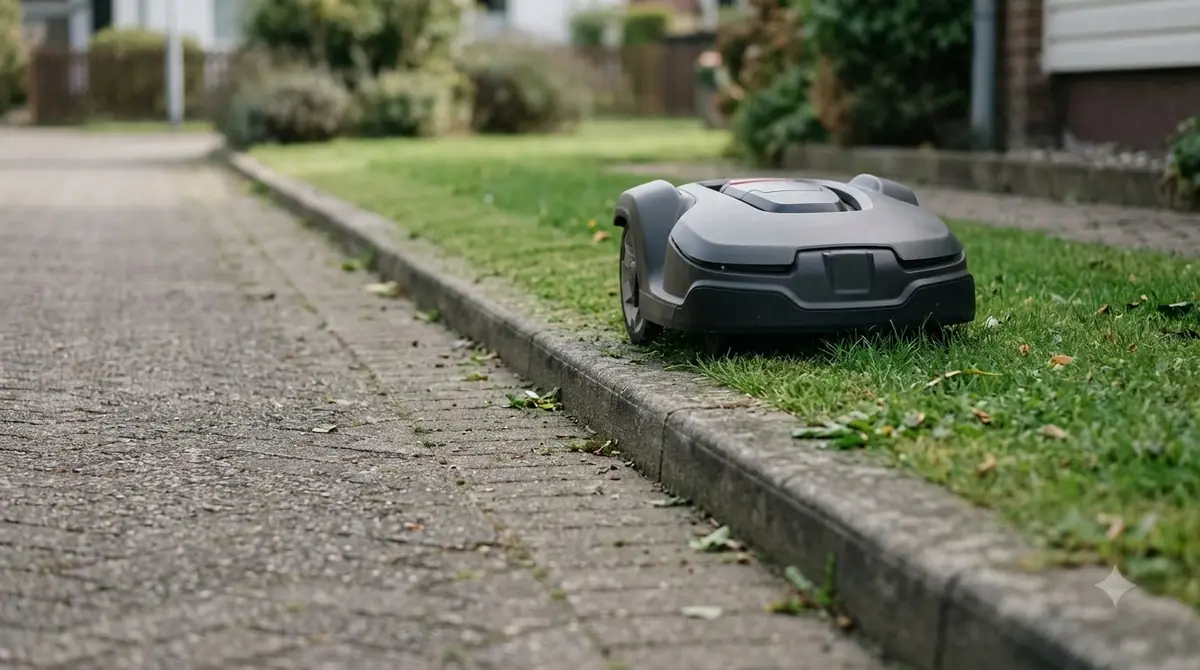
Grass condition changes the result as much as the settings do. Illinois Extension advises never mowing when the grass is wet, and it notes that mulching mowers perform poorly on lawns that are wet or too tall. A robot that meets a long, wet lawn may leave ragged tufts even if its blades are sharp, and robot mower wet grass explains when to wait.
The fix is timing rather than force. Mow more often when the grass grows fast, because cutting less each time keeps you within the one-third rule. Illinois suggests that mowing frequency should follow the growth rate, which may mean more than once a week in spring. Our reading is that a robot mower on a short, frequent schedule usually cuts more evenly than one set to run once a week on a long lawn.
A checklist for uneven cutting, in order
Work through these checks in order when a robot mower is cutting unevenly. Each step rules out one cause before you move to the next, which keeps you from replacing parts that were never the problem.
| Check | What to look for | Likely fix |
|---|---|---|
| Cutting height | Scalped strips, bare patches, or brown stems | Raise the height toward 2.5 to 3 inches for most lawns, or the range for your grass |
| Blade condition | Torn, grayish, or whitened grass tips | Replace the blades as a full set |
| Ground | Scalped low spots, tall tufts on bumps | Roll wide bumps, fill small dips with topsoil and reseed |
| Grass condition | Ragged cut after rain or on very tall grass | Wait for dry grass and mow more often |
If the pattern remains after these four steps, the cause is probably mechanical, such as a deck that does not sit level or a blade mount that has worn. Those need the manufacturer’s own checks, which go beyond what this guide covers.
Frequently asked questions
Why is my robot mower cutting unevenly in some spots?
The most common causes are a cutting height set too low, dull or mismatched blades, and low spots or bumps in the ground. Check the height first, then the blades, then the ground, because each step rules out one cause.
What cutting height should I use to avoid scalping?
Illinois Extension suggests 2.5 to 3 inches for most lawns, with narrower ranges for specific grasses. Robomow says no robot mower should cut below 15 mm. Remove no more than one-third of the blade in a single mowing.
How do I know if my robot mower blades are dull?
Look for torn, frayed, or whitened grass tips after mowing, and a lawn that looks grayish soon after a cut. Virginia Tech extension notes that dull blades tear grass instead of slicing it, which causes these signs.
Should I replace all the blades or just one?
Our reading is to replace them as a set, because mixing a new blade with a worn one may leave the cut uneven even when the height is right. Replacement intervals vary by model and conditions, so inspect the edges every few weeks in the growing season.
Sources
- Robomow, ideal cutting height for a robotic lawnmower (manufacturer): robot height range, 15 mm minimum, one-third rule, effects of cutting too low.
- Clemson HGIC, Mowing Height Matters (university extension): one-third rule and scalping.
- University of Illinois Extension, Mowing Your Lawn (university extension): suggested heights by grass type, sharp blades, wet-grass advice.
- Virginia Tech Extension, sharpen lawnmower blades (university extension): dull blades tear grass.
- UC IPM, dull mower blade damage (university extension): symptoms of torn leaf tips.
- Husqvarna, how and when to change the blades on your Automower (manufacturer): signs of worn blades and replacement interval.
- Eufy, robot lawn mower slope limits (manufacturer): effect of gentle rolling bumps.
- Ask Extension, bumpy lawn FAQ (extension network): rolling and localized low spots.
- Mammotion, robot mower blade change guide (manufacturer): irregular uncut patches, especially in wet grass.
 Up next6 min readLearnEcovacs GOAT App Problems and How to Fix ThemUpdated Nov 13, 2026
 6 min readLearnWorx Landroid Not Docking? Fix the Usual CausesUpdated Nov 10, 2026
 9 min readLearnRobot Mower Payback Period vs Lawn Service in 4 StepsUpdated Nov 11, 2026
 8 min readLearnWhat Is Edge Cutting on a Robot Mower?Updated Nov 11, 2026
 8 min readLearnWhat Is Cutting Width on a Robot Mower?Updated Nov 11, 2026
 9 min readLearnCan a Robot Mower Run Over a Garden Hose Without Cutting It?Updated Nov 19, 2026