
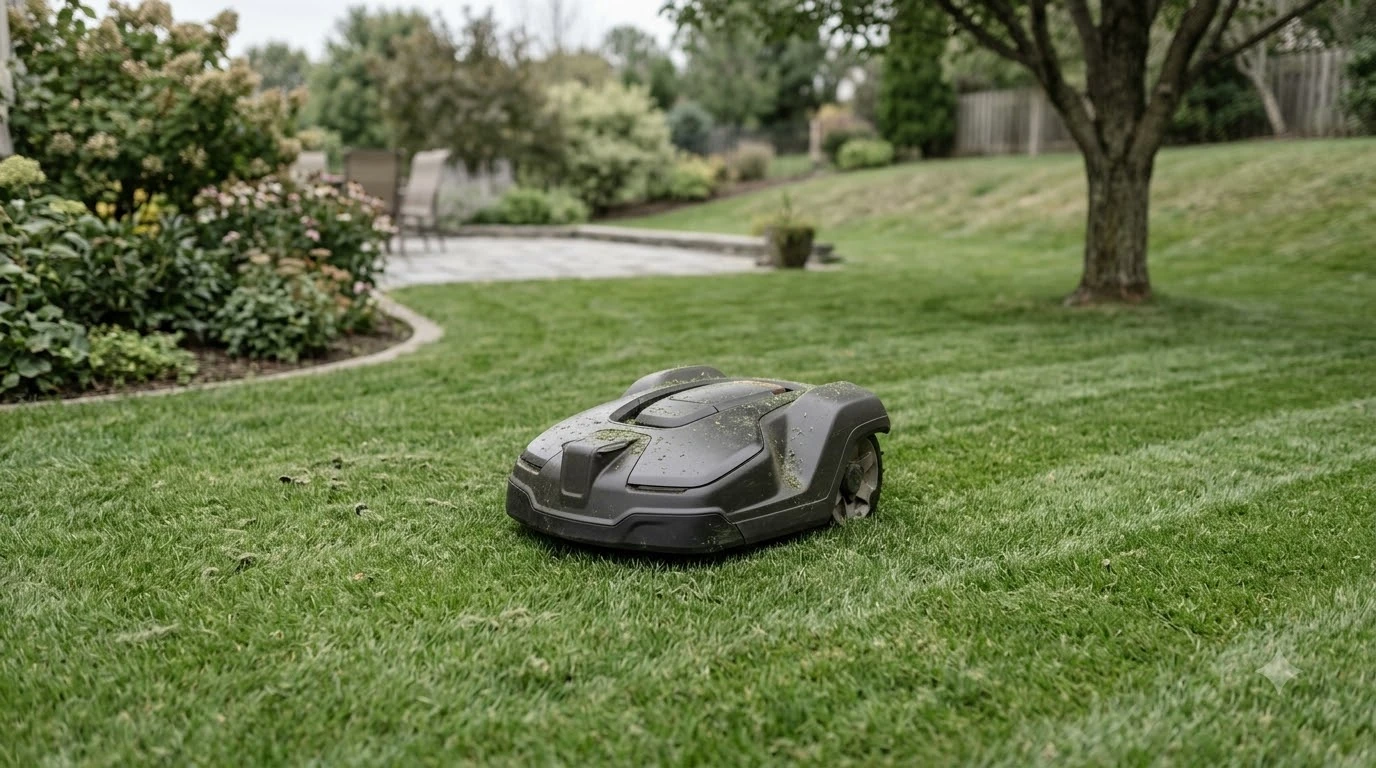

The best mowing height for a robot mowed lawn is usually 30 to 40 mm, or about 1.2 to 1.6 inches. Robot mower maker Robomow gives that range as its practical recommendation, and grass species, season and shade can move the number up or down. Because a robot cuts often, the setting matters more than it does with a weekly mower.
The short answer
- Typical target: 30 to 40 mm (about 1.2 to 1.6 inches) for most robot-mowed lawns.
- Grass type matters: cool-season grasses such as tall fescue are usually cut higher than bermudagrass.
- One-third rule: never remove more than one-third of the blade in a single cut.
- Season and stress: cut higher in summer heat, drought or shade, then lower the setting in steps.
What the best mowing height for a robot mowed lawn means
Robomow says a cutting length of 30 to 40 mm is recommended in practice for robot-mowed lawns. That works out to roughly 1.2 to 1.6 inches, based on the standard conversion of 25.4 mm to one inch. The same guidance notes that frequent robot mowing can slightly weaken a lawn, which is why a mid-range height is usually the safer starting point than the shortest setting.
Robot mowers do not all reach the same range. According to Robomow, many models offer 20 to 60 mm, while other models go from 20 to 100 mm. No robot on the market mows shorter than 15 mm. Check the range in your model’s manual before you decide the number is out of reach.
Match the height to your grass type
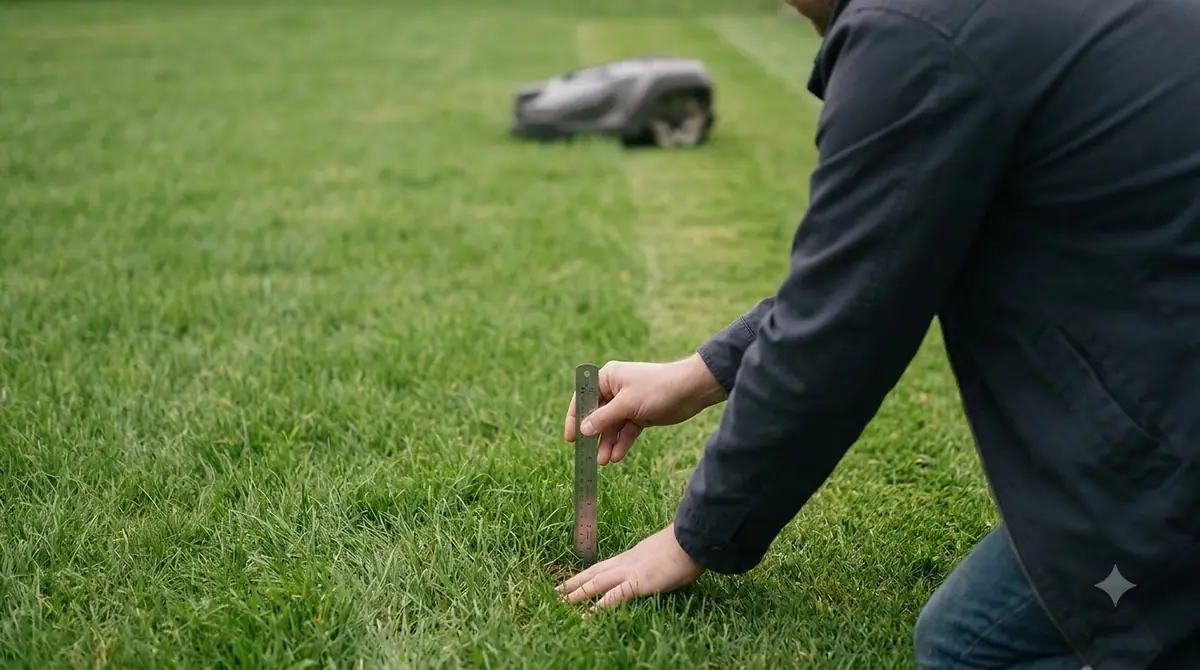
Cool-season grasses are usually cut higher than warm-season grasses. University of Illinois Extension lists tall fescue at 2.5 to 3.5 inches and Kentucky bluegrass at 2 to 3 inches, while Clemson’s extension guide lists common bermudagrass at 1 to 2 inches. Because the two extension sources give slightly different ranges for some grasses, the table below shows both.
| Grass | Clemson HGIC (inches) | University of Illinois Extension (inches) |
|---|---|---|
| Tall fescue | 2 to 3 in winter, 3 to 3.5 in summer | 2.5 to 3.5 |
| Fine fescue | 1.5 to 2.5 in winter, 2.5 to 3 in summer | 1.5 to 2 (creeping red fescue only) |
| Kentucky bluegrass | not listed | 2 to 3 |
| Perennial ryegrass | 1 to 2.5 in winter | 2 to 3 |
| Common bermudagrass | 1 to 2 | 1 to 2 |
| Hybrid bermudagrass | 0.5 to 1.5 | not listed |
| Zoysiagrass | 1 to 2 | 1 to 3 |
| Centipedegrass | 1.5 to 2 | not listed |
| St. Augustinegrass | 2.5 to 4 | not listed |
Illinois Extension also says that for most lawns, a height of 2.5 to 3 inches is a good range. Use the table as a starting point, then check your exact species with a local extension office, since the right number can change with your climate and mowing habits. Our reading is that a robot owner should find the species first, then choose the best mowing height for a robot mowed lawn from that range, rather than picking a number from a generic chart. Species-specific guides such as Bermuda grass cutting height go deeper on one grass.
Why the one-third rule matters more with a robot
Remove no more than one-third of the grass leaf in a single cut. UC IPM states the rule as mowing frequently enough so that only one-third of the leaf is removed at any one time. Clemson uses the same limit, and the full explanation is in the one-third rule for mowing.
A robot naturally follows this rule better than a weekly mower, because it trims small amounts often. The risk is the opposite problem. If a lawn is left too high and cut infrequently, Robomow says it produces fewer side shoots, which makes the turf thinner. Cutting too deeply has its own cost: more sunlight reaches the soil, which dries it faster and can encourage weeds, as covered in what happens when grass is cut too short.
Adjust for season, heat and shade
The best mowing height for a robot mowed lawn changes with the season, so raise the cut when the lawn is under stress, then lower it gradually. Clemson advises mowing turfgrass under heat, drought or shade at a higher level of cut. If grass grows too tall between mowings, the same guide says to raise the height and then reduce it gradually until the recommended height is reached.
- Summer heat and drought: Robomow recommends a longer cut during a prolonged summer drought, and says to avoid removing the protective layer of grass. See mowing in heat and drought for more.
- Shade: Robomow puts shade lawns at around 60 to 70 mm, well above its 30 to 40 mm guideline, and mowing height for shade grass covers that case.
- Last cut of autumn: 40 to 50 mm, according to the same guide.
- Spring start: wait until temperatures are consistently around 10 C (50 F), then remove no more than one-third of the blade length.
Illinois Extension notes that many resources suggest changing the height with the weather, but for most home lawns the easiest strategy is to set the mowing height and leave it there. Our reading is that a robot owner should change the setting only for a clear reason, such as shade, drought or a sharp growth spurt.
Set the height without scalping the lawn
Lower the robot in steps when the lawn has grown long. UC IPM advises avoiding sudden changes in height, so the safest approach is to move the height down a little at a time and let the lawn recover between cuts.
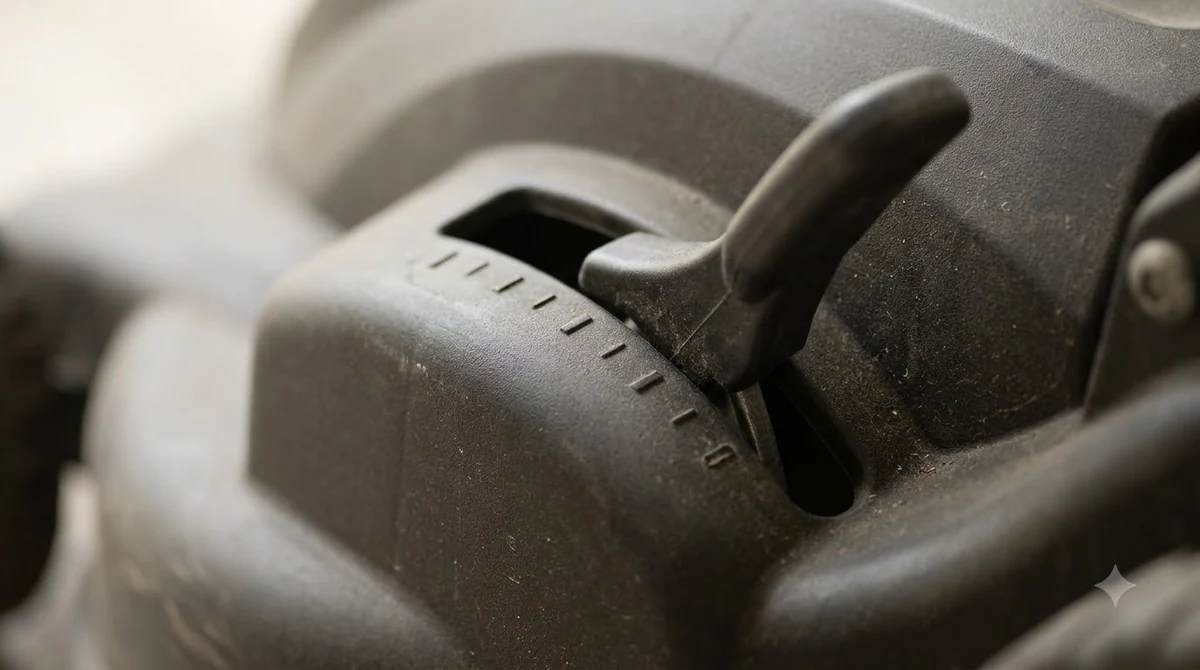
- Check the range. Confirm your model’s minimum and maximum height in the manual before you set the number.
- Set the middle of the range. For most lawns, a height of 30 to 40 mm is a good starting point.
- Lower in steps. If the lawn is long, reduce the height gradually instead of cutting to the target in one pass.
- Use a low setting only when needed. Robomow lists about 20 mm as the low end before dethatching.
- Let new grass grow first. For a newly seeded lawn, Robomow suggests letting it reach 80 to 100 mm, then cutting it to 50 mm.
What to check before you rely on the setting
Before you lock in the best mowing height for a robot mowed lawn, confirm that your robot’s height range covers the height your grass needs. Many models stop at 60 mm, and that can be too low for a shade lawn that Robomow puts at 60 to 70 mm.
Heads up
Robomow gives the 20 to 60 mm range as typical, but some models reach 100 mm. If your model tops out below your target, you cannot set the height you want, and a different model or a different grass plan may fit better.
Frequently asked questions
What height should a robot mower cut grass at?
The best mowing height for a robot mowed lawn is usually the 30 to 40 mm (about 1.2 to 1.6 inches) that Robomow recommends. The right number depends on grass species, season and shade, so check the range for your grass type before you set it.
How often should a robot mower cut the grass?
Cut often enough that only one-third of the grass leaf is removed at any one time, according to UC IPM. Robomow says growth timing matters too: lawns grow faster in spring than in a dry summer, and the lawn should not be mowed in early to mid November.
Should I raise the mowing height in summer?
Yes, if the lawn is under heat, drought or shade stress. Clemson advises mowing stressed turfgrass at a higher level of cut, then lowering the height gradually once conditions improve. Robomow recommends a longer cut during a prolonged summer drought.
Can a robot mower cut very short before dethatching?
Robomow says it can cut as low as 20 mm before dethatching. That is a one-time step, not a regular height, and the one-third rule still applies to normal mowing.
Sources
- What is the ideal cutting height for a robotic lawnmower? (Robomow): used for the 30 to 40 mm range, model height ranges, shade and autumn settings, and the one-third rule.
- Mowing Lawns, HGIC 1205 (Clemson Cooperative Extension): used for grass-type heights, the one-third rule and summer stress advice.
- Mowing your lawn (University of Illinois Extension): used for the grass-type height table and the 2.5 to 3 inch guidance for most lawns.
- UC Healthy Lawns: Mowing (UC IPM): used for the one-third leaf rule and mowing frequency.
 Up next9 min readLearnShould You Fertilize a Lawn Mowed by a Robot Mower?Updated Nov 11, 2026
 9 min readLearnShould I Buy a Robot Lawn Mower? Who It Suits and Who Should Skip ItUpdated Nov 11, 2026
 7 min readLearnHow to Reduce Robot Mower NoiseUpdated Nov 11, 2026
 7 min readLearnRobot Mower Not Charging? How to Fix It Step by StepUpdated Nov 11, 2026
 7 min readLearnWhat Is a Robot Lawn Mower?Updated Nov 11, 2026
 9 min readLearnHow to Install a Robot Mower Boundary WireUpdated Nov 11, 2026