
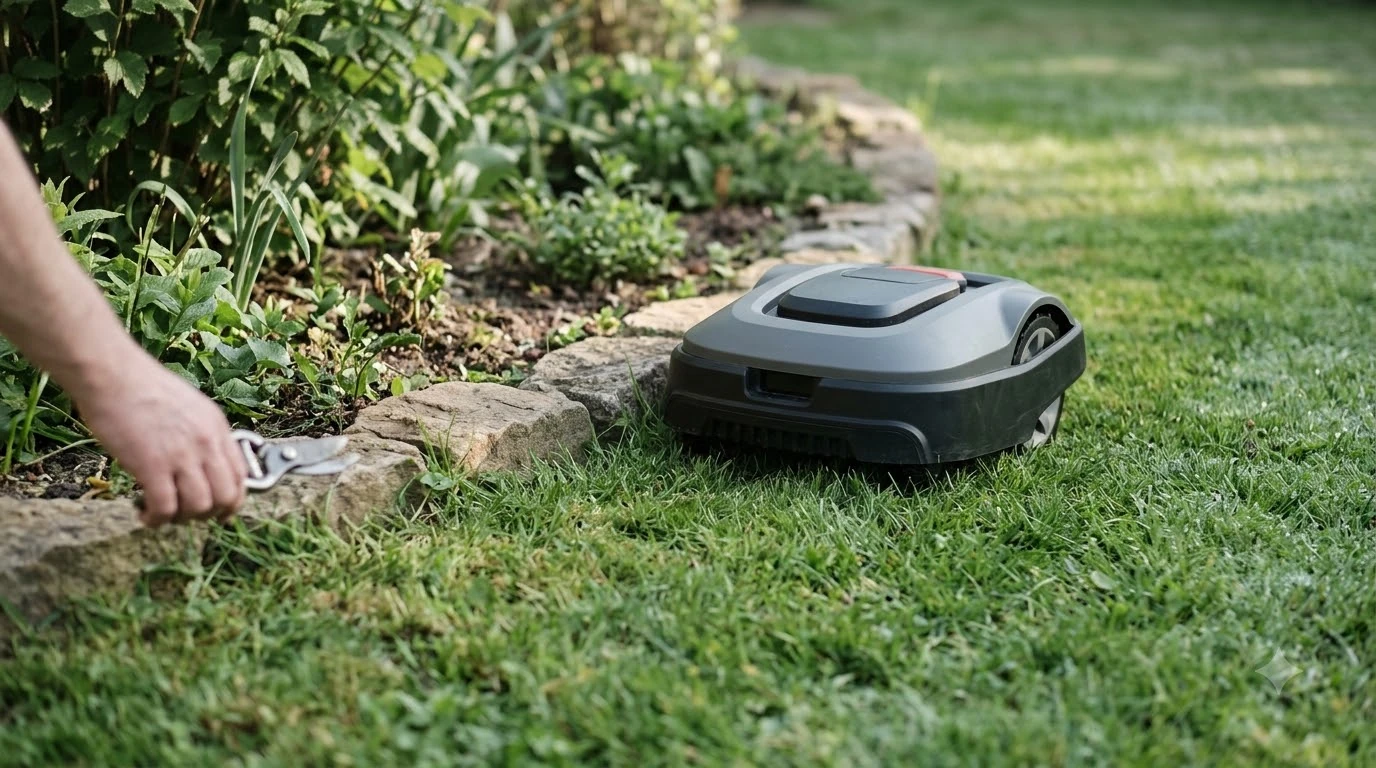

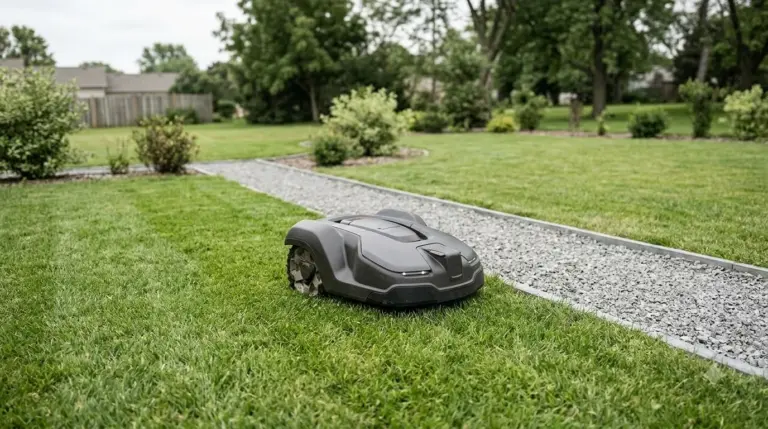
A robot mower for a lawn with ground cover plants can share the yard, but it should cut the lawn only and stay out of the planted areas. Ground cover spreads over the edge of the lawn, roots where it touches soil, and does not recover well from being run over. Fence the planting with a no-go zone, keep a clear edge between grass and ground cover, and let the mower handle only the grass. Points below are as of Nov 2026.
The short answer
- Zone the planting: for a robot mower for a lawn with ground cover plants, draw a no-go zone around each ground cover bed so the mower never drives over it.
- Edge first: a real lawn edge keeps grass and ground cover apart, which also keeps the mower’s track predictable. STIHL’s planting guide recommends a trench edge as the final step.
- Trim by hand: a robot mower cuts grass, not sprawling plants. Ground cover that reaches the lawn needs pruning with a trimmer or shears.
- Watch the wet season: our reading is that wet ground makes the mower slip and push into soft beds, so keep the zone wider after rain.
- Check the map: look for beds the mower keeps brushing, because that is where a zone is missing.
Why ground cover and a robot mower do not mix well
A robot mower for a lawn with ground cover plants has to be set up with that edge in mind. Planted areas of any kind benefit from clear lawn edges, and flower bed layout for robot-mowed yards describes how to set them.
Ground cover is a low planting that spreads sideways instead of growing tall. Its shoots can creep onto the lawn, and the mower then has a shape it cannot cut cleanly. STIHL’s guidance on ground cover notes that a lawn edge is needed so that “both the grass and ground cover will remain in their respective areas,” which is the same boundary a robot mower needs to stay on track.
The bigger risk is the mower itself. A wheel on a dense planting can flatten the foliage and tear the stems, and a blade set low can cut into the crown of a plant. We could not find a manufacturer guide that tests specific ground cover species such as creeping thyme or vinca, so treat the damage as a practical risk rather than a measured rate.
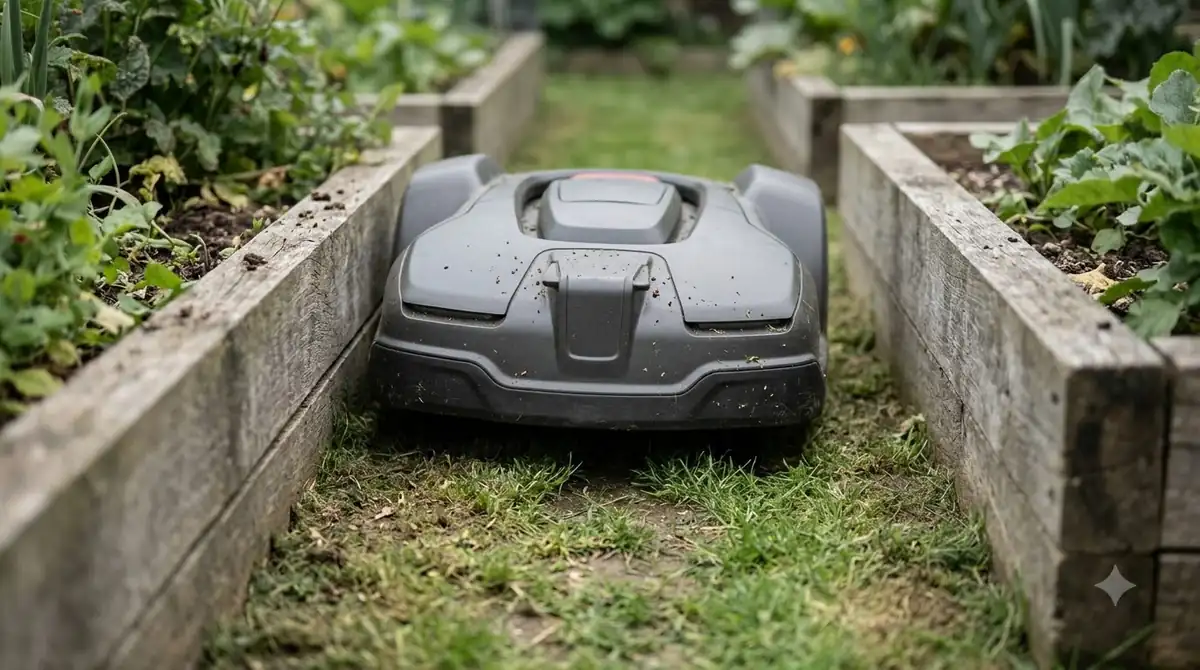
Robot mower for a lawn with ground cover plants: draw the zones
Map every planted bed as a no-go zone before you run the mower on its own. Walk the mower to the edge of each bed, start the zone, steer around the full outline and return to the start. Keep the zone a little wider than the bed so the mower’s wheels stay on grass when it turns. Ground cover and mulch often share a border, and mulch bed edges beside the lawn describes how to keep the mower off both. Small beds and planted edges are common in compact yards, as covered in robot mowers for a townhouse yard.
- List the beds. Include any low planting that reaches the lawn edge, not only the obvious island beds.
- Map each one. Draw a zone around it with a margin for the wheels.
- Test a pass. Watch the mower turn at the bed edge, and widen the zone wherever it touches the foliage.
- Re-check after growth. Ground cover spreads, so a zone that fit in spring may be too small by late summer.
Heads up
A zone only protects the bed if the mower’s route never has to cross it. Do not place a zone across the only path to the charging station or a passage the mower needs.
Set the lawn edge so the mower can follow it
A clean edge helps the mower and the planting. STIHL’s guide says to make the lawn edge as a final step, by digging a small trench around the new area. Once the edge is in place, the mower can follow the lawn line without pushing into the plants. The guide frames the edge as the way to keep the grass and ground cover in their own areas, so neither needs extra upkeep. Hard edging and stone paths often border low planting, and stepping stone paths through the lawn covers how the mower reads them. A physical edge helps the mower follow the boundary, and metal edging strip around planted beds lists its limits.
Our reading is that a raised or sunken edge also gives the mower a visible boundary in the map. Mark the edge in the app, then compare the map with the actual bed line after the first week.
Trim the ground cover by hand
A robot mower is not a pruner. STIHL’s guide says sprawling plants should be cut back early, pruned to about halfway, with cuttings raked up afterwards. Fast-growing perennials can be trimmed as needed, and bushes every one to two years. Those jobs stay with the trimmer, shears or rake, and the mower takes over only once the planting is back inside its bed. Taller plantings need a separate approach, which clumping ornamental grasses next to the lawn explains in detail.
- Prune on the calendar, not on the mower’s schedule. Evergreens are pruned in spring and deciduous types in autumn, according to the guide.
- Pull weeds by hand around the planting, since the guide warns the shallow roots can be damaged by digging.
- Clear the cuttings from the lawn edge so the mower does not drag them into the dock path.
Planting choice and the mower
If you are still choosing what to plant, a low planting that stays in its bed is simpler than one that spreads onto the lawn. The STIHL guide notes that ground cover can be used instead of lawn on slopes, which is one reason it is common on banks a mower may struggle to climb. Check the grade limit in the mower’s manual before you put a robot on a slope with planting, since wet ground on a bank is where a mower is most likely to slip into a bed. Naturalised planting adds another zone to manage, which mowing near a wildflower patch covers.
Related reads: Beds that sit inside the lawn need stay-out zones, which lawns with island planting beds describes in detail.
Frequently asked questions
Can a robot mower run over ground cover plants?
It can, and it is better to avoid it. Map the planting as a no-go zone so the mower cuts only the grass, then trim the ground cover by hand.
Does a robot mower for a lawn with ground cover plants need a lawn edge?
Yes, if the edge is clear and the zone is drawn around the planting. A physical lawn edge, such as the trench STIHL describes, gives the mower a clear line to follow.
Should I trim ground cover that reaches the lawn?
Yes. STIHL’s guide says sprawling plants should be cut back early, to about halfway, and the cuttings raked up. A robot mower does not prune, so this job stays with a trimmer or shears.
Can a robot mower work on a slope with ground cover?
It depends on the grade and the ground. Check the grade limit in the manual, keep the planting out of the mower’s track, and widen the zone after rain, when wet ground is more likely to cause slipping.
Sources
- STIHL Australia, planting and maintaining ground cover (manufacturer garden guide): used for the planting, lawn-edge trench, pruning and weeding points, and the note on ground cover as an alternative to lawn on slopes.
 Up next9 min readBy YardChoosing and Setting Up a Robot Mower for a Yard With an Above-Ground Pool LadderUpdated Nov 19, 2026
 7 min readBy YardCan a Robot Mower Handle a Yard With Ground Squirrel Holes?Updated Nov 12, 2026
 6 min readBy YardRobot Mower for a Lawn With a Compost Bin: Zone and Route SetupUpdated Nov 14, 2026
 7 min readBy YardBest Robot Mower for Front and Back Yard Multiple ZonesUpdated Nov 13, 2026
 9 min readBy YardChoosing a robot mower for a lawn with bermuda and fescue transition zonesUpdated Nov 19, 2026
 9 min readBy YardCan a Robot Mower Work in a Yard With a Gate Between Zones?Updated Nov 11, 2026