
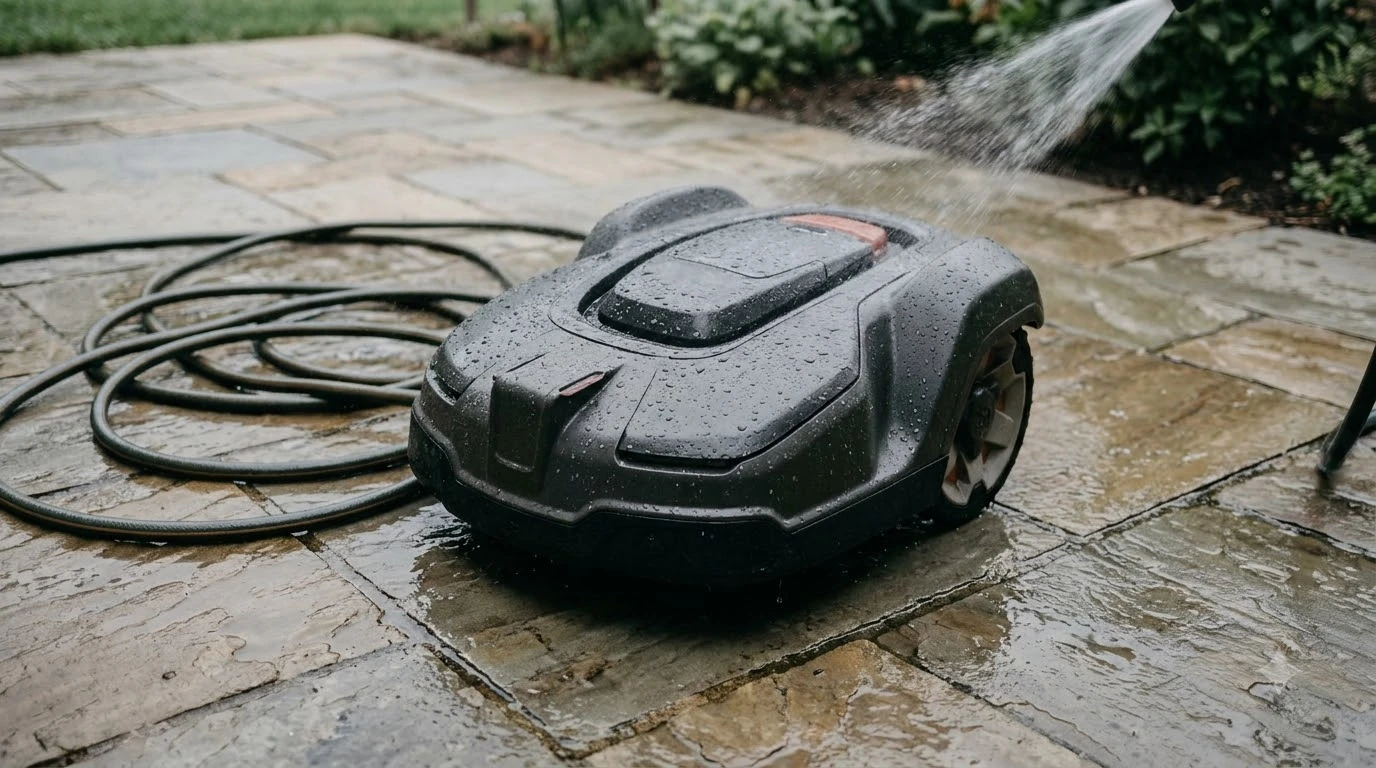

A robot mower for a lawn with stepping stones can work, but only when the stones are set flush with the grass, the gaps are small, and the path is wide enough for the mower to cross without stopping. Manufacturers disagree on exact sizes and some models will not cross stone paths at all, so the answer depends on the model and how the path is built. This guide explains what to check before you install a robot mower for a lawn with stepping stones, so the path works from the first day.
The short answer
- Stone height: the top of each stone should sit level with the lawn, not raised above it.
- Passage width: Robomow advises at least 1 meter, and Anker suggests 80 to 100 cm as a starting point.
- Stone surface: solid, flat stone slabs are the easiest for a robot to cross.
- Some models stop: at least one manufacturer documents a model that will not cut across a stepping-stone path, so check your model first.
- Keep a trimmer handy: the gaps between stones are often left uncut and need a string trimmer.
How a robot mower sees a stepping-stone path
A robot mower does not look at the path the way you do. It follows a boundary wire or a virtual map, and it decides whether to drive across a surface by reading the ground under its wheels and the blades’ contact with the edge. A stone path that looks easy to walk on can still stop the mower if the stones sit at a different height from the lawn, if the gaps are too wide, or if loose material gets pulled toward the blades. Stone paths often run beside planting areas, so flower bed planning for a robot-mowed lawn is a useful companion read. Raised features behave differently from flush stones, and how robot mowers cope with lawn decorations explains what the sensors detect.
For that reason, the stepping-stone question is really a question about the surface, the spacing, and the boundary setup. Each of these can be checked before you buy or install anything.
Robot mower for a lawn with stepping stones: fix the height first
Robomow’s guidance for crossing paved areas is direct: lay the stones so they are level with the ground surface. If a stone sits higher than the lawn, the mower can climb onto it at an angle, lose traction, or scrape the blades along the edge. If a stone sits lower, the wheels can drop into the gap and the robot may treat the spot as an obstacle. Paths are often edged with low plants, and ground cover planted between lawn areas has its own boundary rules.
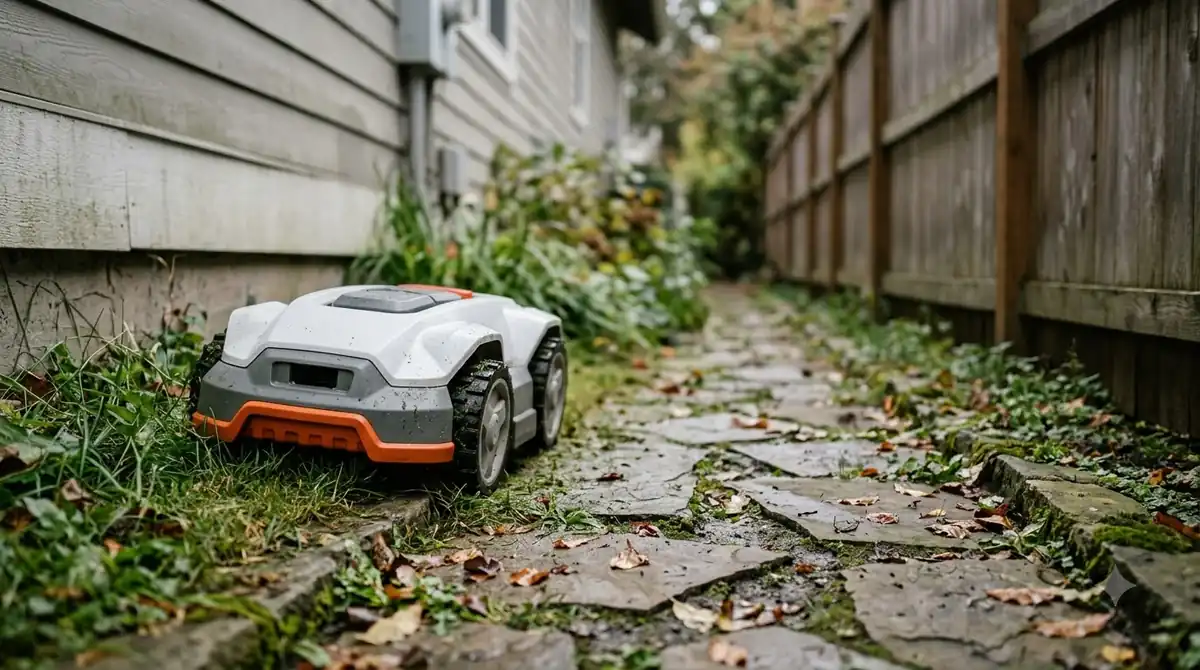
Anker’s notes on cross-path setups describe the same goal from a different angle. The mower should be able to roll onto the hard surface and roll off again without a lip. If the lawn is uneven at the edge, backfill with soil until the transition is smooth. A stone that rocks when you step on it is too loose for a mower to cross reliably.
Heads up
Do not set stones into a path that is already higher than the lawn and expect the mower to manage. Lower the stones or raise the lawn edge first, then test the crossing by hand.
Width and spacing between the stones
Width matters as much as height. Robomow says a passage should be at least one meter wide for the mower to cross reliably. Anker’s guidance uses a smaller starting figure of about 80 to 100 cm, but it also says to check the minimum published for your own model. Use the stricter number when your model’s manual gives one. Gaps between stones can resemble narrow passages, and two-foot lawn passage clearance explains how the mower treats them.
Gaps between stones are the other half of the problem. Two rows of solid pavers, with narrow joints, give the wheels a continuous path. A row of single stones with wide gaps between them gives the wheels nowhere to sit, and the robot can get stuck or shake. Anker describes two flush rows of solid pavers or a narrow bonded-gravel strip for the wheels as a practical layout for loose paths.
- Measure the passage: take the narrowest point, not the average, because one tight spot can trap the mower.
- Close wide joints: fill gaps so the wheels are not dropping between stones.
- Avoid loose gravel between stones: it can be thrown toward the blades and can damage the cutting deck.
Wire, tags, and when the mower will not cross
There are two common ways to keep a robot mower off a path. Some owners run the boundary wire through the joints or under the stones, which keeps the mower out of the path area. Others use a wire-free system and map the path as a non-mowing connection. Either way, the mower should be able to drive across the path, not simply be blocked from it. Raised metal strips can stop a wheel, and lawn edging strips and robot mowers explains where they interfere.
Not every model will cross. Worx support documents a Vision model that will not cut across a stepping-stone path, and says the crossed area needs a string trimmer. That setup relies on RFID tags placed on each side of the path. If your model uses tags, the tags need to sit close to the path edges so the mower knows where the crossing starts and ends.
A quick check before you install
Use this order to decide whether the path will work. It takes less time than fixing a stuck mower later. Mulch next to a path adds its own risks, covered in mulch bed borders around the lawn.
- Read your model’s path rules. Look for the minimum passage width and any note about stone paths or cross-path crossings.
- Measure the narrowest point. Compare it with the minimum in the manual, not a general rule of thumb.
- Test the height by hand. Walk across the path and check for any lip, rock, or dip at the stone edge.
- Supervise the first crossings. Watch the mower cross in both directions. Stop it if the wheels slip, the blades scrape, or the mower recalculates in the middle of the path.
- Plan the gaps. Decide how you will handle the uncut strips between stones, usually with a string trimmer on a regular schedule.
Do not expect a stepping-stone path to be fully hands-off. Even when the mower crosses, you will probably still trim the joints and check the stones after heavy rain, when soil can wash out from under them.
Related reads: A solid paved path is treated differently from separate stones, and paved path crossings for robot mowers covers wire and height guidance. Another small feature that needs a stay-out zone is a bird bath, discussed in working around a garden bird bath.
Frequently asked questions
Can a robot mower drive over stepping stones?
Often yes, if the stones are flush with the lawn, solid, and spaced so the wheels do not drop between them. Robomow describes solid stone slabs laid level with the ground as safe to cross. Loose or raised stones are the common cause of trouble.
How wide should a stepping-stone path be for a robot mower?
Robomow advises at least one meter. Anker gives 80 to 100 cm as a starting point and tells owners to check the minimum for their own model. If your path is narrower than the manual allows, the mower may refuse to cross or get stuck.
Will a robot mower cut the grass between stepping stones?
Usually not reliably. Many setups leave the gaps uncut, so plan to trim them with a string trimmer. The exact behavior depends on your model and how the path is mapped or wired.
Do I need to change my boundary wire for a stepping-stone path?
It depends on the system. Wire-based models often need the wire routed through the joints or under the stones, while wire-free models can map the path as a crossing zone. Read the installation guide for your model before you lay the stones.
Sources
- Can a robotic lawnmower cross paths? (Robomow): flush solid stone slabs, one-meter minimum passage width, gravel caveats.
- Robot lawn mower cross path (Anker UK): flush paver rows, 80 to 100 cm starting width, supervised test.
- Mower will not cross a stepping stone path (Worx support): RFID tags on each side, uncut crossing area and trimmer use.
 Up next8 min readBy YardRobot Mower for a Lawn With Holes and Dips: What to Check FirstUpdated Nov 11, 2026
 8 min readBy YardBest Robot Mower for Hilly 1 Acre Lawn: What to Check FirstUpdated Nov 11, 2026
 8 min readBy YardRobot Mower for Sandy Soil Lawn: What to Check FirstUpdated Nov 11, 2026
 8 min readBy YardRobot Mower for Compacted Soil Lawn: 4 Checks FirstUpdated Nov 11, 2026
 9 min readBy YardBest Robot Mower for a Small Backyard in the City: What to Check FirstUpdated Nov 12, 2026
 7 min readBy YardBest Robot Mower for Bahia Grass: Check the Cutting Range FirstUpdated Nov 12, 2026