
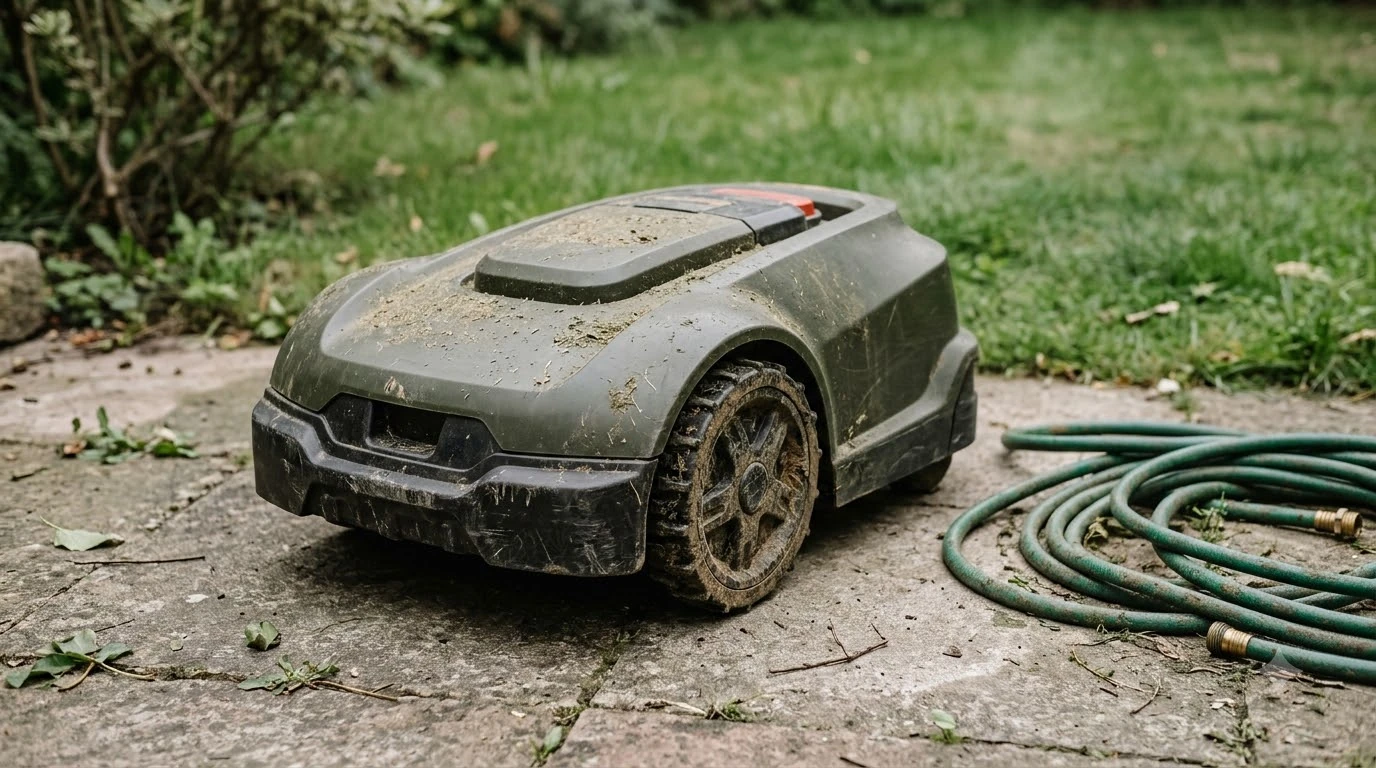

A robot mower for a lawn with an RV parking pad works best when the pad stays outside the mowing area and the lawn edge beside it is set with a clear buffer. The pad itself is usually concrete, gravel, or compacted stone, so the mower should never try to cross it. The bigger questions are the wheels, the leveling jacks, the drips from a parked vehicle, and the long stretches of time an RV can sit in one spot. This guide walks through the layout, the clearances that installation guides describe, and what to check before each season.
The short answer
- Pad edge: if the pad sits level with the lawn, keep the boundary wire about 10 cm inside the lawn edge.
- Soft edges: if the pad borders gravel or mulch, keep the wire about 25 to 30 cm from that soft edge.
- Parked RV: treat the vehicle’s footprint, wheels, and jacks as fixed obstacles, not as ground to mow around.
- Drips and spills: clean fluids off the grass before a run, because the mower will track them across the lawn.
Why a robot mower for a lawn with an RV parking pad needs a plan
An RV parking pad is not a single obstacle. It is a hard, flat surface that sits beside the lawn, and it often holds a large vehicle that stays put for days or weeks. A robot mower for a lawn with an RV parking pad has to deal with three things at once: the pad’s edge, the vehicle’s footprint, and the space the vehicle needs to pull in and out. An RV pad is a hard surface that behaves like other fixtures, and the mower guidance for yards with fixed structures gives the wider view.
Robot mowers rely on a boundary wire, a virtual map, or a camera and GPS system. Each of these tells the mower where to stop, but none of them is meant to replace a sensible layout. The safest approach is to keep the pad fully outside the mowing area, then add buffers on the lawn side so the mower never presses against the vehicle.
Setting the boundary along the pad edge
Where the pad is level with the lawn, the Robomow installation guide suggests keeping the wire about 10 cm from a slab or path at or below lawn level. That is the figure to start with for a concrete pad flush with the grass. Anker’s installation guidance uses a similar 10 to 15 cm distance where a patio sits level with the lawn. A hard edge with a drop at the grass is covered in walkway and paved edge handling.
If the pad is raised above the lawn, the mower can usually cut close to the step, but the wire needs a slightly wider margin so the mower does not wedge against the edge. Lay the wire on the lawn side and test the loop before burying it. A short test run around the pad often shows a tight corner that needs one more peg.
Keeping soft edges and gravel outside the path
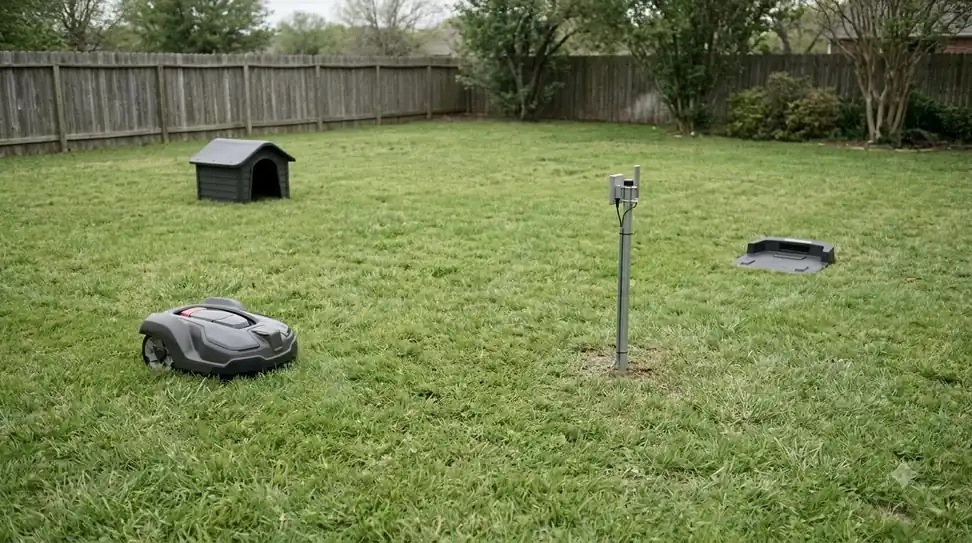
Many RV pads are finished with gravel, crushed stone, or a mulch border. Soft surfaces need more room because a mower can slip or push loose material into the blades. The lawnmowers.com setup guide suggests 25 to 30 cm from soft edges such as beds, gravel, and mulch, and that figure is a good starting point for a gravel pad. Loose stone beside the pad can stall a mower, as gravel and rocky ground stuck risk shows.
The pad border is also where grass clippings and small stones tend to collect. Edge the lawn once before installation and keep the gravel raked back from the grass line. A clean edge helps the mower’s wheels stay on the turf instead of climbing onto loose material.
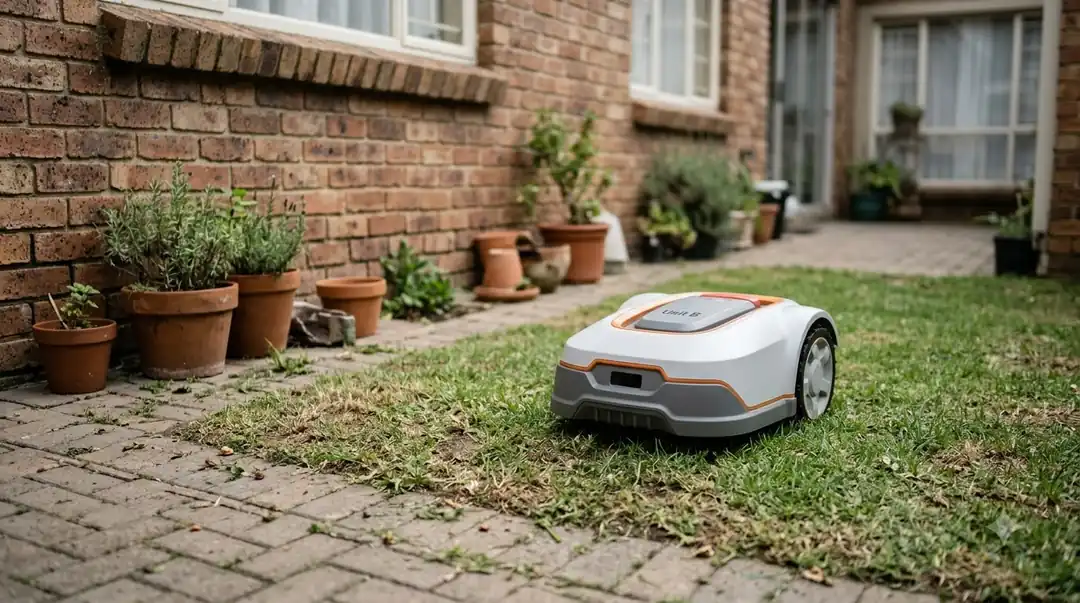
- Concrete pad, flush with lawn: about 10 cm inside the lawn edge.
- Gravel or mulch border: about 25 to 30 cm from the soft surface.
- Raised pad or curb: a wider margin so the mower does not rub against the step.
Working around the parked vehicle
The vehicle itself is the part most owners forget. An RV has wheels, leveling jacks, a hitch, awnings, and sometimes a slide-out that extends beyond the body. None of these belong in the mowing path. Keep the grass beside the vehicle clear for the full length of the parked area, and do not leave the mower’s stay-out zone open to the rear wheels. Another large vehicle stored on grass raises similar issues, covered in parking a trailer on the lawn.
Because an RV can sit in one place for a long time, the grass under and around its tires can go patchy, especially in shade. Move the vehicle periodically when you can, and keep the mowing schedule regular so the rest of the lawn stays even. Our reading is that a steady schedule matters more than the exact spot where the vehicle stops.
Heads up
Do not assume a robot mower will avoid a vehicle just because it sees the body. A stay-out zone or wire is the reliable tool, and the zone should cover the wheels and any jacks on the grass.
Drips, fluids, and spills near the pad
A parked vehicle can leak oil, coolant, or washer fluid, and the mower will track any spill across the lawn. Before a scheduled run, check the grass beside the pad for fresh drips and clean them up. Standing fluid can also damage the turf and attract dirt that wears down the blades. Fluids on concrete can be tracked onto the lawn, and covered parking near the lawn shows a similar setup.
If the RV is stored for a season, place a drip tray under the engine or generator area and keep the pad edge clear of stored items. Anything left on the grass, such as hoses, chocks, or spare tires, is an obstacle the mower can bump into or drag.
Seasonal checks for a robot mower and an RV pad
An RV’s time on the pad changes through the year, so the mower setup should follow it. In spring, check that the wire is still clear of the pad edge after the grass has grown. In summer, when the RV is used most, check the drips and the stored items. In autumn, decide whether the vehicle stays or moves, and recheck the boundary once the grass slows down.
Winter is a good time to look for cut wire and loose pegs near the pad. Frost and freezing can lift pegs, and a loose wire near a hard edge is easy to miss until the mower stops working.
What to check before you set up or buy
Before you install a robot mower for a lawn with an RV parking pad, sketch the yard and mark the pad, the lawn edge, and the place where the vehicle parks. Then match that layout to the mower’s setup method. A wire model needs a clear buffer on the lawn side, while a map-based model needs a clean zone drawn around the pad and the vehicle footprint. Check the mower’s lowest cutting height, the slope the lawn sits on, and how easily the boundary can be changed if the RV moves. Big fixed items need generous room, as large structure footing clearance shows.
Related reads: Driveway-side fixtures such as posts and lights are another good comparison, and lamp posts along a driveway covers how mowers handle them.
Frequently asked questions
Can a robot mower cut right up to an RV parking pad?
It can cut close to a flush concrete pad when the wire or map sits about 10 cm inside the lawn edge. Keep a wider margin for gravel or a raised curb.
Should the RV be inside the mowing zone?
No. Keep the vehicle’s wheels, jacks, and footprint outside the mowing area, and treat the parked spot as a fixed obstacle in your layout.
What about oil or coolant drips from the RV?
Clean fresh drips from the grass before each scheduled run. Use a drip tray under leak-prone areas if the vehicle sits for a long time.
How far should the wire stay from gravel beside the pad?
The setup guides we read suggest about 25 to 30 cm from soft surfaces such as gravel, mulch, or beds. Check your mower’s manual for the exact figure.
Sources
- Robomow boundary wire guide (manufacturer): spacing from slabs and paths at lawn level.
- Anker perimeter wire guide (manufacturer): distances from walls, fences, and level patios.
- lawnmowers.com boundary wire setup guide (retailer guide): soft-edge spacing for gravel, mulch, and beds.
 Up next9 min readBy YardSetting Up a Robot Mower for a Yard with a Gravel Parking Pad TransitionUpdated Nov 19, 2026
 6 min readBy YardRobot Mower Concrete Basketball Pad Edge: Set the Wire RightUpdated Nov 14, 2026
 7 min readBy YardRobot Mower for a Lawn With a Cistern LidUpdated Nov 13, 2026
 6 min readBy YardRobot Mower for a Lawn with Gopher Mounds: What HelpsUpdated Nov 13, 2026
 6 min readBy YardRobot Mower for a Lawn with a Putting Green: Fence It OffUpdated Nov 13, 2026
 6 min readBy YardRobot Mower for a Lawn With Utility BoxesUpdated Nov 13, 2026