
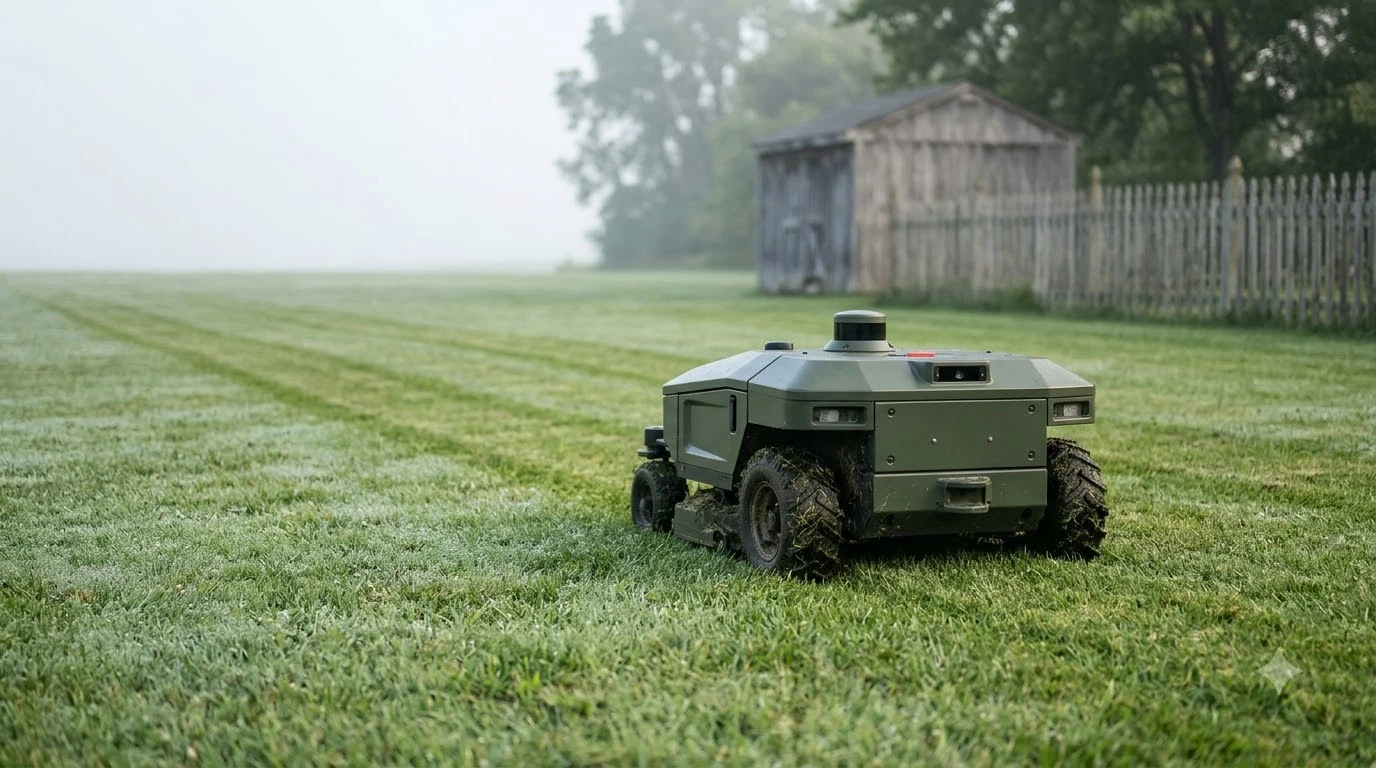

Choosing the best robot mower for a lawn with a long thin strip along the fence starts with one measurement: how wide the strip is from the boundary wire to the fence. Manufacturer guidance sets the minimum passage width, and it depends on whether a guide wire is installed. Husqvarna lists 60 cm (24 in) between boundary wires with a guide wire and 2 m (6 ft 6 in) without one. Gardena gives 60 cm for its narrow passage with a guide wire and at least 1.5 m without one. This guide explains what those numbers mean for a thin strip and what to check before you buy.
The short answer
- Measure first: the usable width is the distance between the fence-side boundary and the mower’s path, not the fence post to the house.
- With a guide wire: Husqvarna recommends at least 60 cm (24 in) between boundary wires.
- Without a guide wire: plan on 1.5 m to 2 m, depending on the brand’s guidance.
- Add obstacle clearance: posts, bins, and raised beds take width away, so the number you need grows.
How a long thin strip changes the mowing plan
A strip along a fence is a passage with a wall on one side. The mower does not cut the strip because it fits the machine; it cuts it because the boundary wire and guide wire let it turn in the space available. A strip that is wide enough for one pass with room to turn is a different problem from a strip that is only wide enough for the mower body. Our reading is that the strip is the first thing to measure, because it decides whether the mower can work the area at all, and the answer depends on the wire layout rather than the mower’s stated cutting width. A thin strip is one example of an awkward layout, so robot mowers for awkward layouts offers a broader view of the options. Another hard-edged layout is covered in robot mowers for lawns with patios.
Manufacturers describe this as a passage, not a strip, and their numbers refer to the gap between boundary wires. That means the fence itself is not the limit; the boundary wire must sit far enough inside the fence to leave the minimum gap. Husqvarna’s passage guidance is the clearest starting point, and the Husqvarna passage instructions describe both the guide wire and no-guide-wire cases.
Passage widths with a guide wire
With a guide wire, Husqvarna recommends at least 60 cm (24 in) between boundary wires. The guide wire runs through the passage and leads the mower through it, and Husqvarna places it at least 30 cm (12 in) from the boundary wire. That spacing matters on a thin strip because the guide wire takes up part of the corridor, so the width you measure is not all usable for the mower path. Narrow passages are the key constraint here, so see robot mowers for narrow yards for width limits.
Some models also allow the corridor width to be adjusted if the mower gets stuck. That setting is useful for a strip that is close to the limit, but it does not change the minimum. A strip at 60 cm with a guide wire has no room for error, and any obstacle on the fence side will push it below the minimum.
Passage widths without a guide wire
Without a guide wire, the minimum rises. Gardena’s FAQ states that a passage without a guide wire should be at least 1.5 m, and Husqvarna’s guidance uses 2 m between boundary wires. The gap between the two brands is a reason to read the manual for your exact model, not just the brand headline. The table below puts the figures side by side. Without a guide wire, navigation depends on sensors, which wire-free options for tight passages discuss. Narrow passages are easier to handle without a guide wire, so see how mowing with a virtual boundary treats tight strips.
| Brand | Guide wire | Minimum width |
|---|---|---|
| Husqvarna Automower | Yes | 60 cm (24 in) between boundary wires |
| Husqvarna Automower | No | 2 m (6 ft 6 in) between boundary wires |
| Gardena robotic mowers | Yes (CorridorCut) | 60 cm boundary wire to boundary wire |
| Gardena robotic mowers | No | At least 1.5 m |
Our reading is that a thin strip along a fence is usually a no-guide-wire case unless the strip is wide enough to fit the guide wire comfortably. If the strip sits near the minimum, a guide wire is the difference between a working corridor and an area the mower skips.
Why fences and obstacles add to the width
The minimum is only the gap between wires. Gardena’s FAQ explains that obstacle distance is added to the 60 cm figure. Its example uses 35 cm on each side of an obstacle plus 60 cm for the passage, which gives 130 cm in total. A fence post, a hose reel, or a planter at the edge of a strip can each take up a section of that width, and the total you need is the passage plus those clearances. Fences and hedges both add clearance needs, so read mowing along hedges and shrub borders.
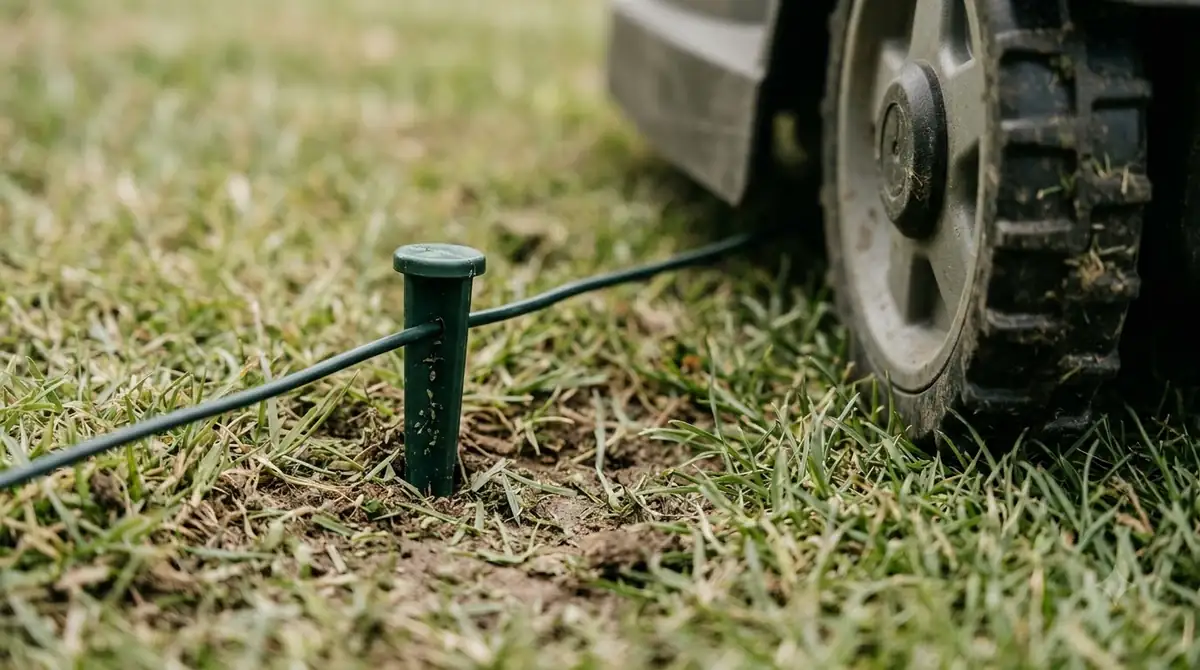
For a fence-side strip, the practical step is to walk the strip with a tape measure and mark the places where the width is narrowest. Those spots are where the boundary wire is most likely to need an extra loop, and where a guide wire may be the only way to keep the mower moving through.
Best robot mower for a lawn with a long thin strip along the fence: what to check
Before you choose a model, check these points against the manual for that model rather than the headline figure. Tight corners can trap a mower, so check robot mowers that rarely get stuck.
- Measured width: the gap from the fence-side boundary to the obstacle on the other side, minus any clearance you need.
- Guide wire support: confirm the model can use a guide wire and whether it is included or sold separately.
- Corridor settings: some models let you adjust the corridor width, which helps near the limit.
- Obstacle clearance: add the space needed for posts, bins, and planters, not just the mower body.
- Stuck recovery: check how the mower reacts when it cannot pass, and whether you can change the setting later.
For the best robot mower for a lawn with a long thin strip, the choice is less about cutting power and more about whether the model’s wire layout fits your measurement. A model that supports a guide wire and a corridor setting gives you more room to adjust than one that does not.
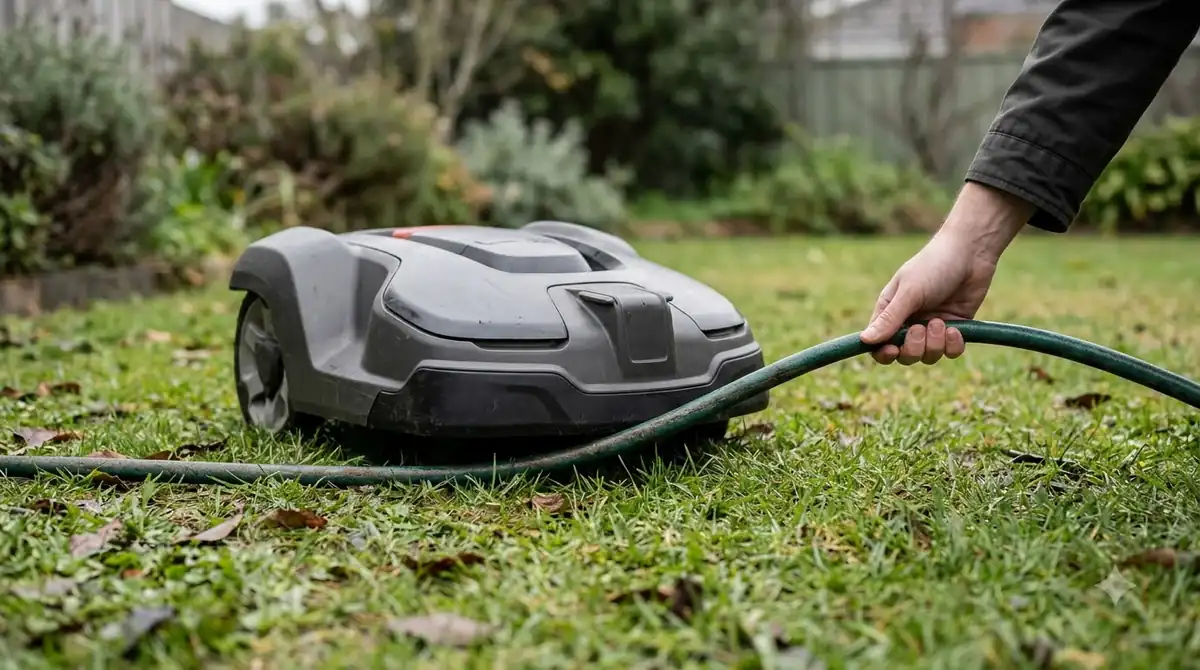
Related reads: A clean edge along the fence helps the mower track, so see landscape edging for fence borders.

Frequently asked questions
How wide does a strip along a fence need to be?
Husqvarna recommends at least 60 cm (24 in) between boundary wires with a guide wire. Without one, plan on 1.5 m to 2 m, and check the manual for your model.
Does the fence itself count toward the width?
The minimum is measured between boundary wires, so the boundary wire must sit inside the fence. Posts and other obstacles on that side add clearance on top of the minimum.
What is a guide wire for?
A guide wire runs through a passage and leads the mower through it. Husqvarna places it at least 30 cm (12 in) from the boundary wire, which allows a narrower passage than one without it.
What if the strip is only slightly too narrow?
Some models let you adjust the corridor width, but that does not change the minimum. If the strip is close to the limit, consider trimming that edge by hand or choosing a model whose guidance fits your measurement.
Sources
- Husqvarna Automower passage installation guide (manufacturer): 60 cm with a guide wire, 2 m without, guide wire 30 cm from the boundary wire.
- Gardena robotic mower FAQ (manufacturer): 60 cm narrow passage with a guide wire, at least 1.5 m without, obstacle clearance example.
 Up next9 min readBest Robot MowersBest Robot Lawn Mower for Thin Patchy Grass: What to Check FirstUpdated Nov 16, 2026
 11 min readBest Robot MowersHow Long Does a Robot Mower Take to Charge?Updated Nov 12, 2026
 9 min readBest Robot MowersHow Long Do Robot Lawn Mowers Last?Updated Nov 11, 2026
 8 min readBest Robot MowersHow Long Do Robot Mower Batteries Last?Updated Nov 11, 2026
 8 min readBest Robot MowersBest Robot Mower for a New Build Lawn with SodUpdated Nov 13, 2026
 9 min readBest Robot MowersBest Robot Mower for Oklahoma Lawns: Grass and Heat GuideUpdated Nov 18, 2026