
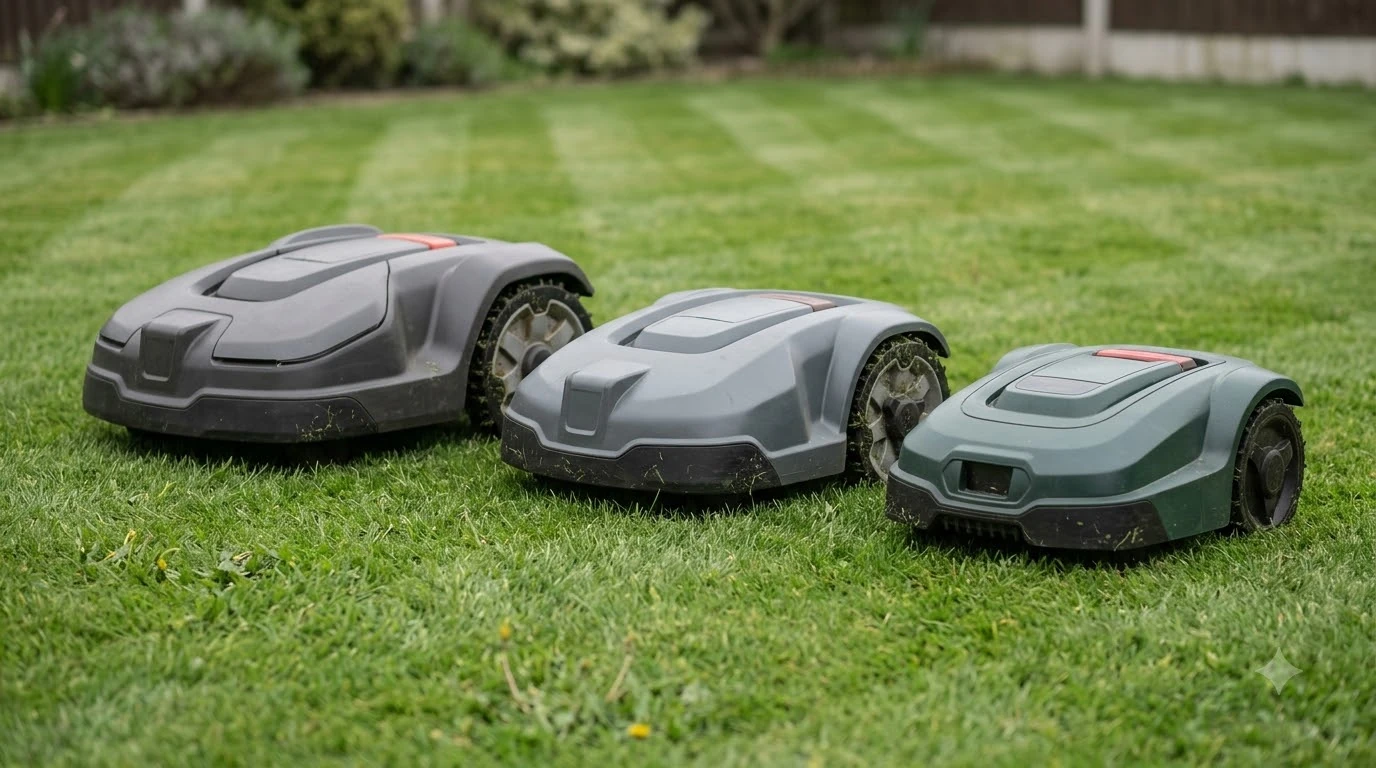

Hookii Neomow X SE vs Dreame A1 Pro: both are described as wire-free mowers, but the Hookii SE has fewer confirmed figures than the Dreame A1 Pro. The published specs do not name a winner, so the gaps below show what to check before buying.
The short answer
- Navigation: both are wire-free. Hookii’s series page describes LiDAR SLAM, and Dreame’s vendor blog describes OmniSense positioning.
- Size and height: the A1 Pro is listed at 22 cm wide and 3 to 7 cm high. The SE’s 11-inch width comes from a retailer listing.
- Area and slope: the SE is rated for up to 0.75 acre, and the A1 Pro 2000 for up to 2,000 square meters. Neither has a fully consistent slope figure.
- Still unknown: the SE’s own height, battery and water rating, and the A1 Pro’s charge time and weight.
Hookii Neomow X SE vs Dreame A1 Pro: how the two navigate
Both mowers are described as wire-free, with Hookii using LiDAR SLAM and Dreame using OmniSense positioning. Hookii’s Neomow X series page lists no perimeter wire and no auxiliary base station. That page covers the X and X Pro, not the SE, so the SE’s navigation is taken from the family. A retailer listing for the SE describes its system as 3D LiDAR SLAM with Vision Fusion. For a single-model view, see the Hookii Neomow X SE review.
Dreame’s vendor blog says the A1 Pro was one of the first robot lawn mowers to ditch boundary wires entirely. It states the A1 Pro needs no RTK, beacons or buried cables. The Dreame A1 Pro review covers that model on its own.
According to a Resident article on LiDAR mowers, the mower is guided around the perimeter during setup and records the boundary shape and fixed obstacles such as trees and garden beds. The article says LiDAR does not depend on satellite signal, so tree canopy and shade do not degrade it the way they can degrade GPS.
Our reading: a mapped LiDAR system removes the wire that can break, but the quality of the setup pass matters more than it does on a simple, open lawn. The guide to RTK vs LiDAR vs vision robot mowers compares the approaches.
Cutting width, cutting height and rated area
The A1 Pro cuts 22 cm wide with a 3 to 7 cm height range, while the Neomow X SE’s 11-inch width and 0.75-acre rating come from a retailer listing. The table shows where each figure comes from. The same retailer listing says the SE has adjustable cutting heights for typical residential turf, but it gives no numeric range.
| Spec | Hookii Neomow X SE | Dreame A1 Pro 2000 | Source type |
|---|---|---|---|
| Cutting width | 11 in | 22 cm (8.7 in) | Retailer for the SE; vendor blog for the A1 Pro |
| Cutting height | Not confirmed for the SE; the X and Pro page lists 30 to 85 mm | 3 to 7 cm, set in the app | Hookii series page; Dreame vendor blog |
| Rated area | Up to 0.75 acre (about 3,035 square meters) | Up to 2,000 square meters (0.5 acre) | Retailer listing; vendor blog |
The two area figures come from different kinds of source, so they are not a like-for-like test. When you weigh the Hookii Neomow X SE vs Dreame A1 Pro pair, our reading is to compare each rating with your own lawn size rather than with each other. The Dreame 2,000 square meter figure applies to the A1 Pro 2000 only, so confirm the model number before comparing.
Slope ratings and where the numbers disagree
Hookii publishes no official slope rating for the Neomow X SE, and the 24 degree (45%) figure belongs to the wider X series. According to the retailer listing, Hookii does not publish an SE rating, so the family figure should not be read as an SE spec.
Dreame’s blog gives 45% (24 degrees) in its body text. Its comparison table lists 45% to 50% (24.2 to 26.6 degrees). The two figures do not match. We recommend planning around the lower figure of 45% until the seller confirms the number in writing. The robot mower slope rating explainer shows why slope figures need that care. On slopes, the Hookii Neomow X SE vs Dreame A1 Pro question has no clean answer from the published numbers.
Robomow’s article says grass-sensor navigation may be less suitable for large slopes. That limit is written about grass-sensor mowers, not LiDAR mowers, so it does not clearly apply to either model here.
Battery, drive and water rating
The Hookii X battery is listed at 13 Ah, and the A1 Pro is listed at 4 to 5 Ah, while the water ratings differ, IPX5 against IPX6. Hookii’s series page gives the X battery as 13 Ah and 234 Wh, with a 180-minute charge and 120 minutes of mowing per charge. The Pro has a 17.5 Ah battery and 180 minutes of mowing per charge. The retailer listing for the SE gives only the power source as “battery”, with no capacity, voltage, charge time or IP rating.
Dreame’s vendor blog gives 4 to 5 Ah and does not state a charge time for the A1 Pro. Battery figures from different brands do not translate directly into runtime, so treat them as a rough comparison only. For battery and drive, the Hookii Neomow X SE vs Dreame A1 Pro comparison rests mostly on family figures and a vendor blog.
The retailer lists the SE as front-wheel drive, and Dreame describes the A1 Pro as two-wheel drive. Our reading is that drive layout matters most on slopes, so check the slope figures above against your lawn before deciding.
Hookii’s page lists IPX5 for the X and Pro, while Dreame’s vendor blog lists IPX6 in its feature list. The two ratings come from different pages, so they do not show which unit handles rain better in use.
What the evidence does not settle, and who each suits
The published specs do not pick a winner in the Hookii Neomow X SE vs Dreame A1 Pro comparison, so the decision depends on lawn size, slope and the gaps listed here. Neither model is a wired mower, so the boundary wire question does not separate them (see wire-free vs boundary wire robot mowers).
Robomow’s article explains why wire faults matter for wired mowers. The wire must make a complete loop, and a break can be hard to find, especially when the wire is buried. Robomow’s boundary wire and grass sensor article also lists limits of grass-sensor wire-free navigation, including leaves being read as lawn and no return to the station. Those limits describe grass-sensor mowers, so they do not clearly apply to the LiDAR system Hookii describes.
Gaps to check before buying: the SE’s cutting height, battery and IP rating, and the A1 Pro’s charge time and weight. The Dreame official product page could not be read in this run, so ask both sellers for the model manual.
Our reading: the Hookii SE fits a buyer who wants the larger rated area on paper and can confirm the slope with the seller. The A1 Pro fits a buyer who needs a published 22 cm cutting width and a 2,000 square meter rating, and who accepts the slope discrepancy until it is confirmed.
Frequently asked questions
Do the Hookii Neomow X SE and Dreame A1 Pro need a boundary wire?
Neither needs a perimeter wire, according to the sources read. Hookii’s Neomow X series page and Dreame’s vendor blog both describe wire-free navigation. The Hookii page covers the X and Pro, so the SE figure is taken from the family.
Which one has the larger rated area?
On paper, the Neomow X SE has the larger rating, at up to 0.75 acre, which is about 3,035 square meters. Dreame rates the A1 Pro 2000 at up to 2,000 square meters. The ratings come from different sources, so compare each one with your lawn size.
Which one can handle steeper hills?
Neither has a fully consistent published slope figure. Hookii gives 24 degrees (45%) for the X series and no official rating for the SE. Dreame’s body text gives 45%, but its table lists 45% to 50%, so plan around the lower figure.
Is one of them worth buying over the other?
The published specs cannot settle that. Check your lawn size, slope and warranty terms against the figures above. Ask each seller for the model manual, since the SE’s height, battery and water rating were not confirmed.
Sources
- Neomow X series page (Hookii): LiDAR navigation, cutting height, width, slope and battery for the X and Pro.
- Neomow X SE retailer listing (retailer): rated area, cutting width, weight, drive and the statement that no SE slope rating is published.
- Dreame A3 AWD Pro vs A1 Pro comparison (Dreame vendor blog): A1 Pro width, height, area, slope, drive and battery.
- Boundary wire vs grass sensors (Robomow): wire loop, break repair and grass-sensor limits.
- LiDAR in robot lawn mowers (Resident): mapping pass, obstacle handling and LiDAR accuracy.
 Up next8 min readReviews & CompareHookii Neomow X SE vs Mammotion YUKA: What the Specs ShowUpdated Nov 12, 2026
 6 min readReviews & CompareIs the Hookii Neomow X SE Worth It? What Reviews ShowUpdated Nov 17, 2026
 7 min readReviews & CompareHookii Neomow X SE Pros and ConsUpdated Nov 18, 2026
 8 min readReviews & CompareHookii Neomow X SE Review: 0.75-Acre Specs and Slope LimitsUpdated Nov 12, 2026
 8 min readReviews & CompareHookii Neomow X SE Problems and Complaints: What Owners ReportUpdated Nov 18, 2026
 9 min readReviews & CompareHookii Neomow X Review: Specs, Coverage and LimitsUpdated Nov 16, 2026