

The single blade disc vs multi blade robot mower question mostly comes down to how the blades are arranged, not how many there are. Most robot mowers use several small blades fixed to one spinning disc, while some lawn mowers use one larger blade. The two layouts trade cut finish, weight, maintenance and blade cost against each other, and the sources below are mainly vendor and hobby blogs, so treat their specifics as a starting point.
The short answer
- Terminology is the first trap. In robot mowers, “multi-blade” usually means three or more small blades on one disc, not several separate spindles.
- Multi-blade discs are the common robot layout, used on models from Husqvarna, Worx and Segway. Each blade is replaced often.
- One larger blade is simpler to maintain and lighter, but the cut can be less even.
- Dual disc designs double the number of blades per service, which means more cost and more sharpening work.
What “multi blade” and “single blade” mean on a robot mower
Before comparing the two, it helps to agree on terms. MowerBot Lab’s blade guide says Husqvarna Automower, Worx Landroid and Segway Navimow all use three blades on a single cutting disc. Those blades are small and pivot, so they behave differently from the single heavy blade on a traditional rotary mower. Blade design is only one factor in cut quality on uneven ground, and mowers tested on slopes show how a mix of designs performs.
Mowrator’s comparison of dual blade and single blade lawn mowers covers lawn mowers in general, not robot mowers. So when a robot brand says “single disc,” check whether it means one disc with several blades or one blade on one disc, because the two are not the same thing.
Single blade disc vs multi blade robot mower: cut quality
Mowrator says dual blade mowers give a finer, more precise cut, while single blades are simple and effective on most lawns but can leave uneven edges. That is a general claim about lawn mowers rather than robot mowers, and it is the reason many buyers expect multi-blade robots to produce a neater finish. Dual-blade designs sit between the two, and single versus dual blade mowers compares that middle option. Width interacts with blade layout, and cutting width and cut quality are covered together in our explainer.
Our reading is that blade condition matters as much as layout. MowerBot Lab describes dull blades as tearing grass rather than slicing it, and says torn tips turn pale within about a day. That makes blade condition at least as important as the blade layout.
Weight, power and noise trade-offs
Mowrator says single blade mowers are generally lighter, which helps on uneven ground, and that a single blade gets the engine’s full power, so it spins faster. Dual blades share that power, so each one turns slightly slower but the cut is described as more powerful overall. These are general statements with no measurements attached, and they describe lawn mowers rather than robots. Motor type affects noise and efficiency, and brushless and brushed motors are compared in a separate guide.
For robot mowers, weight and power are set by the manufacturer, so the practical question is less about the design and more about the specific model. Noise was not discussed in either source we read, so this guide does not make a claim about it.
Maintenance and blade replacement costs
Here the layouts differ most clearly. A single blade is easier to maintain because there is only one blade to check and sharpen. A multi-blade disc has more parts, and each one wears. Blade count changes spending, and annual blade replacement spending adds up the figures by brand. The material matters as much as the count, and blade material differences explain how plastic and metal compare.
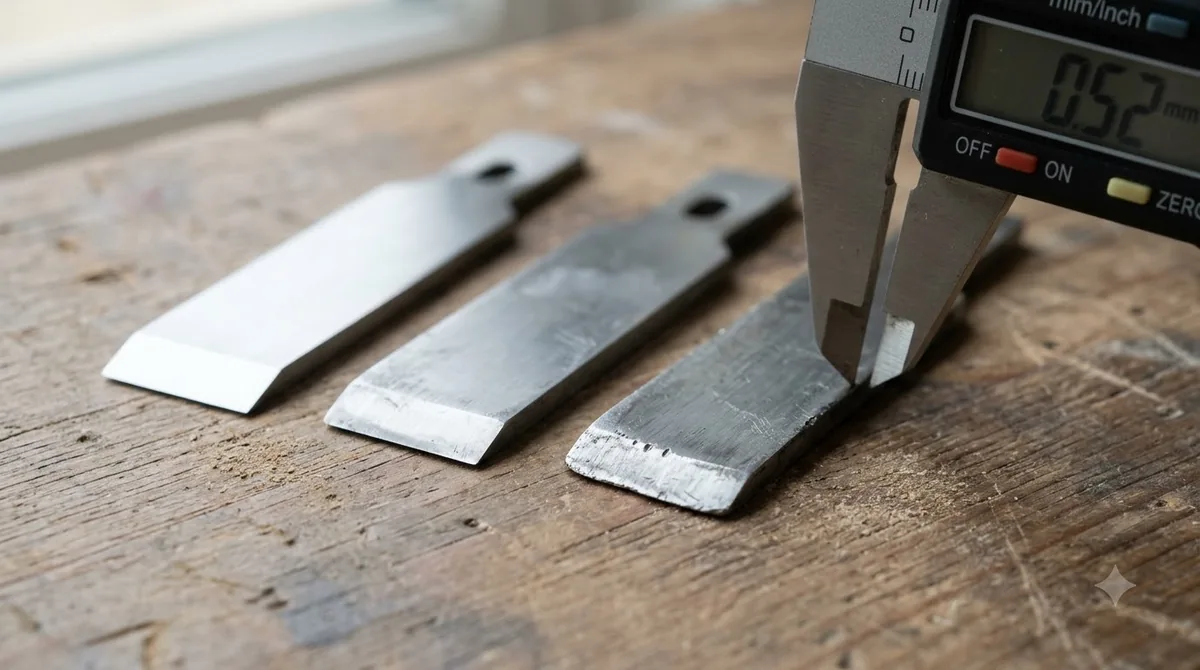
MowerBot Lab lists the replacement intervals that manufacturers give. Husqvarna’s main-disc blades are listed at three to six weeks, and EdgeCut edge blades at nine to twelve weeks. Segway Navimow asks for a change every 80 working hours, tracked through the app. Mammotion’s LUBA and YUKA models use two cutting discs and eight blades per change, so each service uses almost three times as many blades as a three-blade disc.
| Layout | Typical example in the sources | Replacement pattern |
|---|---|---|
| Three blades on one disc | Husqvarna, Worx, Segway | Main-disc blades about every 3 to 6 weeks (Husqvarna); app-tracked hours (Segway) |
| Two discs, eight blades per change | Mammotion LUBA and YUKA | Flip around 50 hours, replace around 150 hours |
| Single larger blade (general mower) | Traditional lawn mowers, per Mowrator | One blade to check and sharpen, the simplest to maintain |
Heads up
MowerBot Lab says third-party blades often cost about a third of the OEM price, with larger packs available. Its main caution is fitment: thickness and weight variation can affect balance, so buy one brand and replace the full set together.
Who a single blade disc suits and who should choose multi blade
A single larger blade suits a buyer who wants low maintenance and a lighter machine, and who accepts a less refined finish. It fits small, simple lawns where a neat edge matters less than convenience. A multi-blade disc suits a buyer who wants the cleanest cut that robot mowers offer, and who is ready to replace blades every few weeks or change a full set on a schedule. Dual disc designs, by our reading, suit larger lawns and buyers who want the most cutting coverage, with the understanding that they cost more to run.
The simplest check before buying is to ask the seller for the blade count, the number of discs, and the replacement interval, then compare the cost of one full set over a season. That number says more about the real trade-off than the layout name.
Frequently asked questions
Do robot mowers use a single blade or multiple blades?
Most robot mowers use several small blades on one cutting disc, according to MowerBot Lab. Some models use two discs, which means more blades in total.
Which blade layout gives a better cut?
Mowrator describes dual blades as giving a finer, more precise cut on lawn mowers, though it does not test robots. Sharp blades matter as much as the layout, because dull blades tear grass.
How often do multi-blade robot mower blades need changing?
Intervals depend on the brand. MowerBot Lab lists Husqvarna main-disc blades at three to six weeks, and Segway Navimow at every 80 working hours, tracked in the app.
Are third-party blades a safe choice?
MowerBot Lab says third-party blades can cost about a third of OEM price, with the main risk being fitment and consistency rather than the steel. Buying one brand and replacing the full set together is the advice it gives.
Sources
- MowerBot Lab, “Robot Lawn Mower Blades 2026” (independent guide): blade layouts, replacement intervals, OEM vs aftermarket.
- Mowrator, “Dual Blade vs. Single Blade Lawn Mowers” (vendor blog): cut quality, weight and power claims for lawn mowers.
 Up next9 min readReviews & CompareSingle Blade vs Dual Blade Robot Mower: What the Sources ShowUpdated Nov 11, 2026
 7 min readReviews & CompareRobot Mower vs Artificial Turf: Heat, Upkeep, and CostUpdated Nov 14, 2026
 7 min readReviews & CompareRobot Mower Blade Replacement Cost Per Year: Brand FiguresUpdated Nov 17, 2026
 7 min readReviews & CompareIs the Lymow One Worth It? Coverage, Slope and Blade CostsUpdated Nov 16, 2026
 7 min readReviews & CompareLUBA 3 AWD 3000H vs Navimow X430: High-Cut Specs ComparedUpdated Nov 12, 2026
 7 min readReviews & CompareWhich Robot Mower Has the Best Edge Cut? Brand Figures ComparedUpdated Nov 11, 2026