
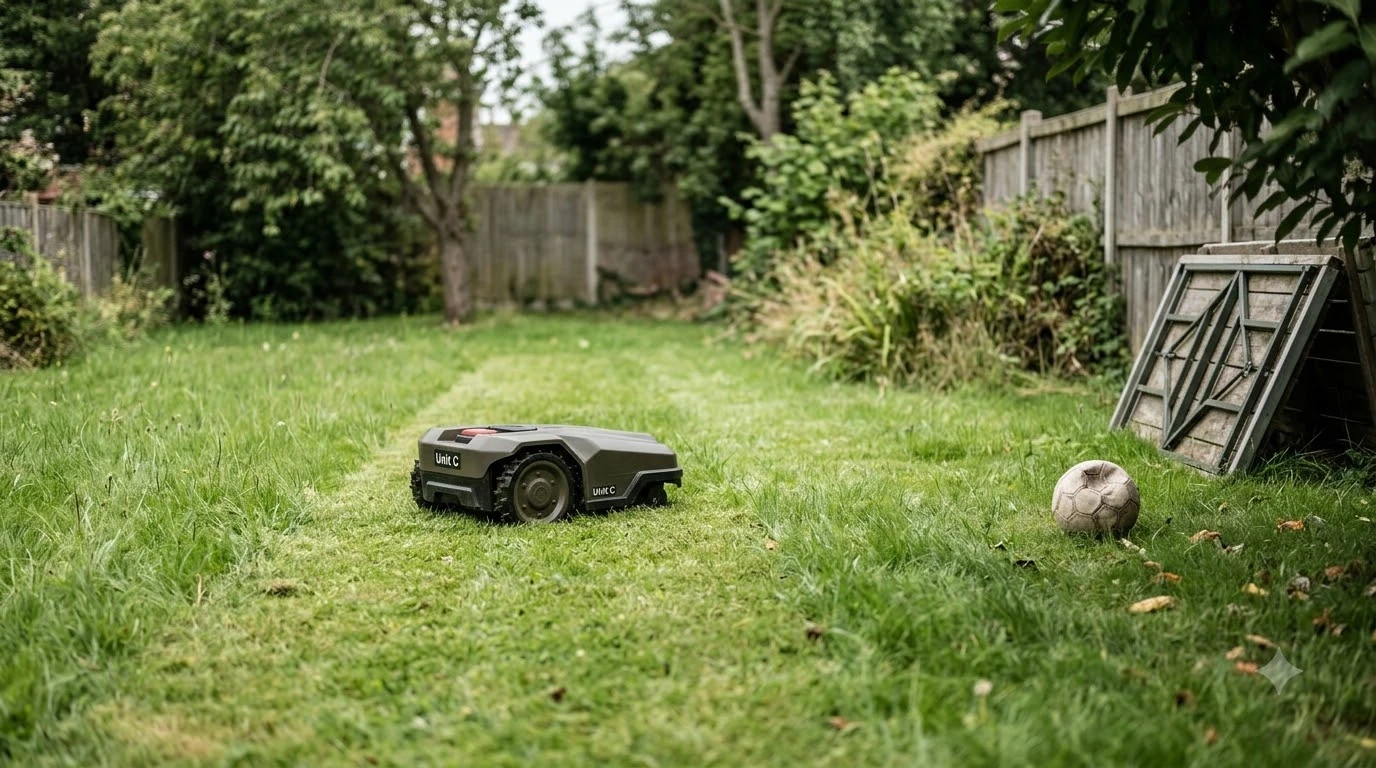

A robot mower for a lawn with a sandbox can work well, but the mower must be kept off the sand. Sand gets into wheels, drive parts and the blade housing, and it wears them down. The practical fix is a boundary wire around the sandbox, or a stay-out zone in the app on a wire-based system, plus a physical barrier at the edge. This guide covers how to set that up and what to check before you buy.
The short answer
- Keep the mower out: fence the sandbox with boundary wire or use a stay-out zone on a wire-based mower.
- Do not rely on an app zone alone for anything you do not want the mower to reach, such as sand or water.
- Leave a clear path from the lawn to the charging station so the zone does not block the mower’s return route.
- Check the sand after each run for any that has been carried onto the lawn or into the mower.
Why sand and a robot mower do not mix
A sandbox is loose material, and a robot mower’s wheels and blades are built for grass and bare soil. Sand that works into the wheels or under the deck can grind the drive system and the cutting parts over time. Loose sand can also be thrown around the lawn as the blades spin, which is a nuisance for kids and pets on the grass. Play equipment of all kinds needs a plan, and mowing a yard with children’s toys gives the wider picture. Another large play item that needs a clear boundary is covered in trampoline lawn mower picks.
Flymo’s manual for one of its models warns that a robotic mower must never run over gravel, mulch or similar loose material, because it can damage the blades. Sand is the same kind of loose surface, so the same rule applies. The sandbox should be treated as a no-go area from the start, not as a spot the mower will sort out on its own.
Keep the mower out with a wire or a stay-out zone
On a wire-based system, a boundary loop around the sandbox is the most reliable option. Husqvarna’s guidance for its AIM stay-out zones is that they only apply to installations with a physical boundary wire. The zone is drawn in the app, and the mower follows the wire where it runs around the area, so the more of the wire that sits inside the zone, the better the mower can navigate around it. Another low play feature is a paddling pool, which kiddie pool fencing for mowers covers.
The same guidance is clear that a stay-out zone is not enough for every hazard. For pools and streets, Husqvarna says not to rely on a zone and to fence the area with the boundary wire and a barrier of at least 15 cm (6 in) in height. Our reading is that a sandbox deserves the same caution, because sand is a surface the mower can drive onto, not just an obstacle it bumps into. A low wooden or plastic border with the wire laid just outside it gives a physical edge the mower can detect, and it keeps the sand from spreading onto the grass.

Robot mower for a lawn with a sandbox: plan the layout
Before installing anything, sketch the lawn and mark where the sandbox sits in relation to the charging station and the main mowing paths. Three rules keep the setup working: Fixed play features shape the layout as well, as basketball hoop clearance explains.
- Keep the charging route open. Husqvarna warns not to place a zone over the charging station or over any part of the guide wire, because the mower may not return to charge.
- Do not block a passage. A zone that cuts off a route the mower needs to reach other parts of the lawn can leave sections unmowed.
- Keep the wire away from the edge where it can be caught. Makita and Flymo manuals both describe leaving a gap between the wire and walls or large objects, and the same spacing is a sensible starting point around a sandbox border.
Husqvarna also notes that zones cannot be scheduled. They can only be switched on or off in the app, so a zone around the sandbox stays active every time the mower runs unless you turn it off.
Clean sand off the mower and the lawn
Even with a good barrier, some sand can get onto the lawn from kids or from the wind. Brush the sand off the lawn with a stiff broom or a leaf blower on a low setting, then check the mower’s wheels and underside after each run. Remove any sand you find from the wheels and blade housing before it can work into the bearings. Loose fill under play structures causes similar issues, which wood chip ground under swings describes.
Our reading is that a quick check once a week is enough for most sandboxes, and more often during heavy use. A mower that starts making a grinding sound or cuts unevenly may have sand in its drive or deck, so stop it and clean it out before running it again.

What to check before you buy a robot mower for a lawn with a sandbox
Not every robot mower for a lawn with a sandbox works the same way. Before you buy, check these points against the manual or the spec sheet: Posts need protected islands, much like a sandbox needs fencing, as hammock post islands explains for robot-mowed lawns.
- Zone support: does the model offer stay-out zones in its app, and does it need a physical boundary wire for them to work?
- Wire or wireless: a wire-based mower can follow a fenced sandbox border more reliably than a mower that relies only on a map.
- Charging station position: confirm you can place the station where the sandbox will not block the return route.
- Cleaning access: check how easily the wheels and underside can be reached and cleaned.
Related reads: General play-lawn advice for whole yards appears in suburban lawn mower for play areas, including blade-stop sensors. Larger structures are covered in playset lawn mower choices, with safety notes.
Frequently asked questions
Can a robot mower drive over sand?
It is better not to let it. Loose material like sand can get into the wheels and cutting parts. Keep the mower on grass and fence the sandbox so it stays out.
Is a stay-out zone enough to keep the mower away from a sandbox?
On a wire-based mower a zone can help, but Husqvarna advises against relying on one for hazards such as pools and streets. Our reading is that a physical border with the wire laid just outside it is the safer choice for sand.
Can a zone block the mower from returning to its charger?
Yes, if it covers the charging station or any part of the guide wire. Husqvarna says the mower may not return to charge in that case, so keep the zone clear of the return route.
How often should I clean sand off a robot mower?
Our reading is a quick check about once a week, and more often when the sandbox gets heavy use. Clean the wheels and underside if you notice grinding or uneven cutting.
Sources
- Creating stay-out zones with AIM Technology (Husqvarna): stay-out zones need a physical boundary wire, the 15 cm/6 in barrier advice for pools and streets, and the charging station and guide wire placement warnings.
- Flymo 1200 R manual, working area boundaries (Flymo): the warning against running over gravel, mulch and similar loose material.
 Up next8 min readBy YardRobot Mower Around Flower Beds: How to Keep It OutUpdated Nov 11, 2026
 7 min readBy YardRobot Mower for a Lawn With a Gravel Driveway: Keep It Off the DriveUpdated Nov 14, 2026
 6 min readBy YardRobot Mower and Wood Chips Under a Swing Set: Keep It Off the ChipsUpdated Nov 14, 2026
 7 min readBy YardRobot Mower for a Lawn with Fairy Rings: What to ExpectUpdated Nov 13, 2026
 8 min readBy YardRobot Mower for a Lawn with a ClotheslineUpdated Nov 13, 2026
 7 min readBy YardRobot Mower for a Lawn with a French Drain: What to KnowUpdated Nov 13, 2026