
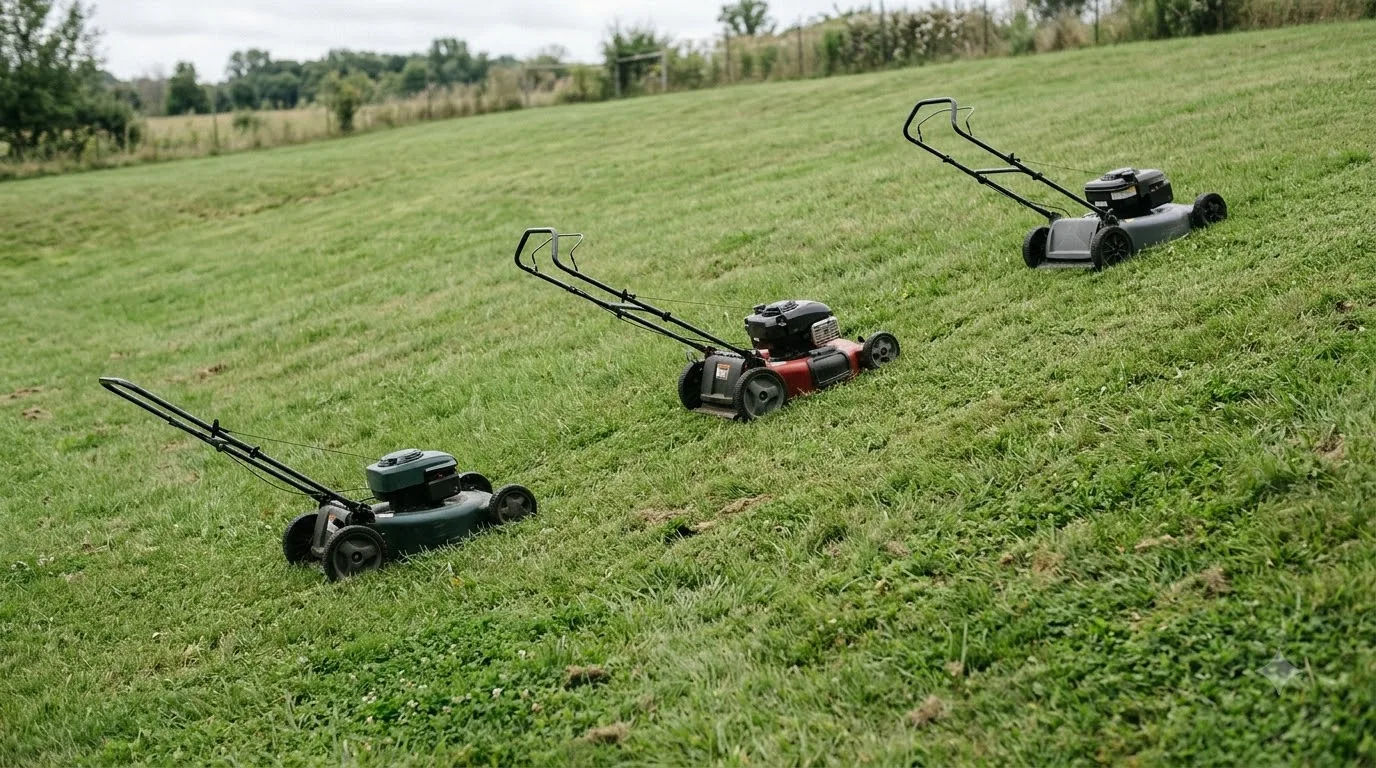

What cutting height should a robot mower use on a slope? Cut at the upper end of your grass species’ range. A taller blade keeps more leaf on the slope, where soil dries out faster and the roots matter more. Start from the height your grass needs, then move it up if the slope is steep, the grass is stressed, or the soil drains quickly.
The short answer
- Tall fescue: 3 to 4 inches per UMD, with the highest setting in hot, dry weather.
- Kentucky bluegrass: 2.5 to 3.5 inches per UMD, or 1.5 to 2.5 inches when planted alone per NC State.
- Bermudagrass: 1 to 1.5 inches per UMD, so a bermuda slope needs a mower that can reach that low.
- The one-third rule: never remove more than one-third of the blade in one mowing, slope or not.
What cutting height should a robot mower use on a slope
None of the extension pages we read gives a separate cutting height for sloped lawns. The advice below starts from the species ranges and then applies what those pages say about stress, wet grass, and the one-third rule. The slope-specific part is our reading, not a published figure. Any height change should still respect the standard cutting limit, which the one-third rule for mowing grass explains in detail.
Start from the species range
The grass type sets the floor. University of Maryland Extension gives 3 to 4 inches for tall fescue, 2.5 to 3.5 inches for Kentucky bluegrass, and 1 to 1.5 inches for bermudagrass. NC State Extension gives a narrower tall fescue range of 2.5 to 3.5 inches and says it should never be mowed shorter than 2.5 inches. Species ranges set the baseline, and the Kentucky bluegrass mowing height range gives one example for cool-season turf. Warm-season turf follows a different range, which St. Augustine grass height settings describes for robot mowers.
The two sources do not match exactly on Kentucky bluegrass. UMD’s range is higher than NC State’s 1.5 to 2.5 inches for bluegrass planted alone. When sources disagree, the higher setting is the safer starting point on a slope, because it leaves more leaf to recover between cuts.
Check your grass before you set anything. A mixed lawn of bluegrass and fescue usually sits closer to the fescue range, and NC State gives 2.5 inches or higher for bluegrass mixed with tall fescue. If you cannot tell the species, look at the seed or sod label, or ask the company that installed the lawn.
Why slopes call for a higher cut
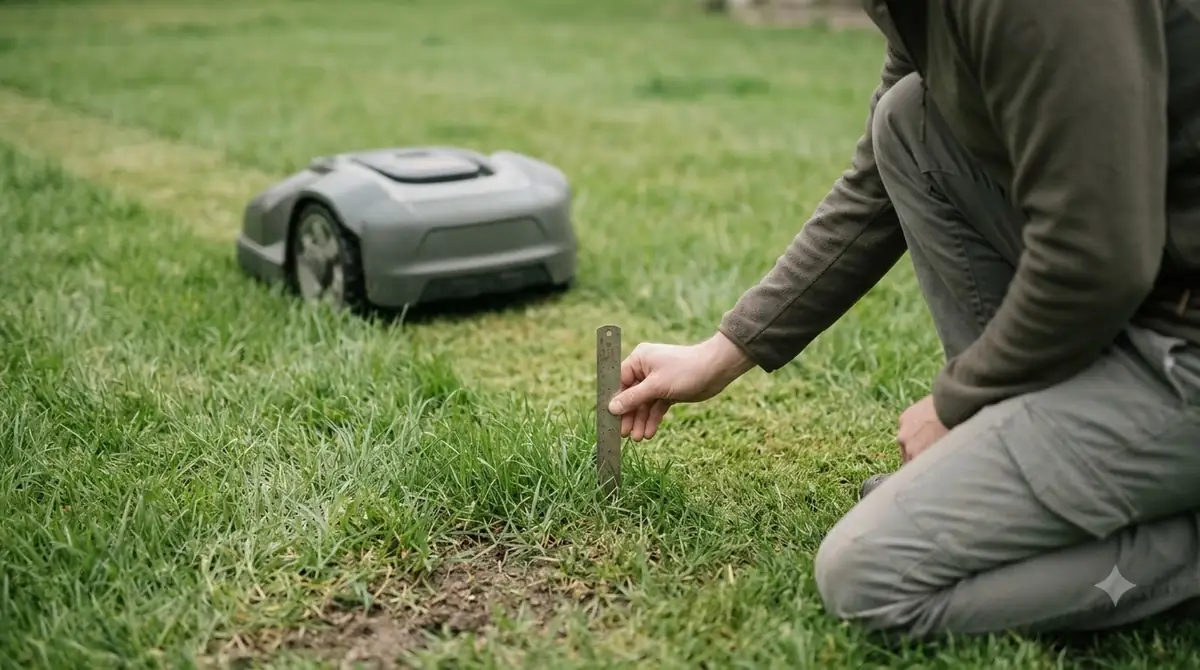
A slope dries faster than flat ground, because water runs off before the soil can soak it up. A shorter blade has less leaf to shade the soil and a shallower root system to hold moisture, so the stress shows up sooner. On a slope that stress also affects how well the grass holds the soil, which is one more reason to avoid cutting it short. Steep ground changes more than cutting height, as mower features for hilly lawns shows when comparing traction and slope ratings.
UMD advises using the highest mower setting for tall fescue during the hottest, driest part of summer. The same page says to avoid mowing lawns that have stopped growing from drought or heat, and to skip mowing when the grass is wet. Wet grass matters more on a slope, because the mower has less grip on wet ground and the blades can lie flat and be cut lower than the setting suggests. That is our reading, not a figure from the sources.
A higher cut also gives a robot mower more margin. Small changes in ground level and in grass growth push the actual cut up or down, and a higher setting keeps that variation away from the root zone.
Practical checks for a sloped yard
Once the height is set, a few routine checks keep the cut steady across the slope: Species with fine blades behave differently on slopes, and perennial ryegrass height and schedule gives the detail.
- Look after rain: wait until the grass is dry before the mower runs, and check the lawn after a wet week for scalped patches.
- Raise the blade before dormancy: UMD says the final mowing before winter can be about a half-inch higher than usual.
- Skip the steepest strip in drought: a stressed slope recovers slowly, so it is better to leave a section uncut than to push the blade lower there.
- Watch for bare spots: a patch that stays bare after a few runs usually means the blade is too low or the mower is struggling on that grade.
The one-third rule still sets how often the mower should run. On a slope where the grass grows quickly, that means more frequent, shorter cuts rather than one long session.
When a higher setting is not enough
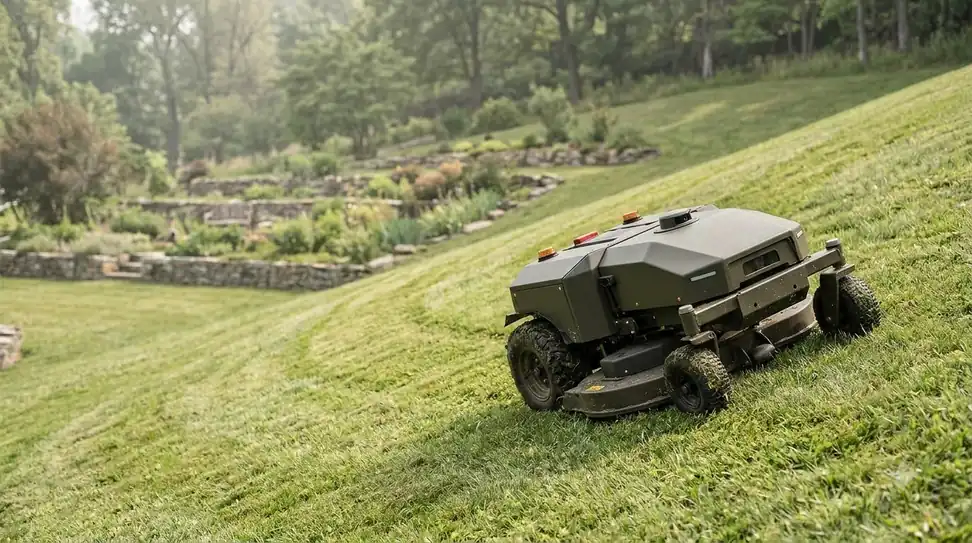
Some slopes are too steep for any mower to climb safely, whatever the blade height. Cutting height cannot fix a grade problem. Check the mower’s slope rating and the yard’s grade before you choose a height, because a mower that cannot hold the slope will leave bare patches even when the blade is set correctly.
Our reading is that the height setting helps the grass, while the slope rating decides whether the mower can work the lawn at all. Treat them as two separate checks, and make the slope check first.
Also check the boundary. A mower can drift toward the edge of a slope if the boundary is set too close to the drop. Leave a margin, and keep the path clear of loose stones or roots that could make the mower slip.
Related reads: Many sloped lawns in cooler regions use these species, which the cool-season lawn mower roundup covers by grass type.
Frequently asked questions
Should a robot mower cut a sloped lawn higher than a flat one?
Usually yes. Start from the species range for your grass, then use the upper end on a slope, where soil dries faster and the grass is more stressed.
What height is right for tall fescue on a hill?
UMD gives 3 to 4 inches for tall fescue and says to use the highest setting in hot, dry weather. NC State gives 2.5 to 3.5 inches and says never cut tall fescue shorter than 2.5 inches.
Can I cut bermuda on a slope at the same height as flat ground?
UMD gives 1 to 1.5 inches for bermudagrass. A slope may call for the upper end of that range for stress, but the mower must reach the low setting for bermuda to be cut at all.
Does the one-third rule still apply on a slope?
Yes. UMD advises removing no more than one-third of the grass blade at each mowing. On a slope, that means running the mower often enough that each cut stays small.
Sources
- Maintaining an Established Lawn (University of Maryland Extension): species mowing heights, the one-third rule, and mowing advice in hot, dry weather.
- Extension Gardener Handbook: Lawns (NC State Extension): tall fescue and Kentucky bluegrass mowing heights.
 Up next8 min readBy YardWhat Cutting Height Should a Robot Mower Use for St Augustine Grass?Updated Nov 10, 2026
 7 min readBy YardWhat Cutting Height Should a Robot Mower Use for Kentucky Bluegrass?Updated Nov 10, 2026
 6 min readBy YardShould a Robot Mower Cut Across or Up and Down a Slope?Updated Nov 14, 2026
 7 min readBy YardBest Robot Mower for Bahia Grass: Check the Cutting Range FirstUpdated Nov 12, 2026
 8 min readBy YardCan You Use a Robot Mower for a Lawn With Pecan Trees and Fallen Shells?Updated Nov 19, 2026
 9 min readBy YardCan You Use a Robot Mower for a Lawn With Red Imported Fire Ant Beds?Updated Nov 19, 2026