
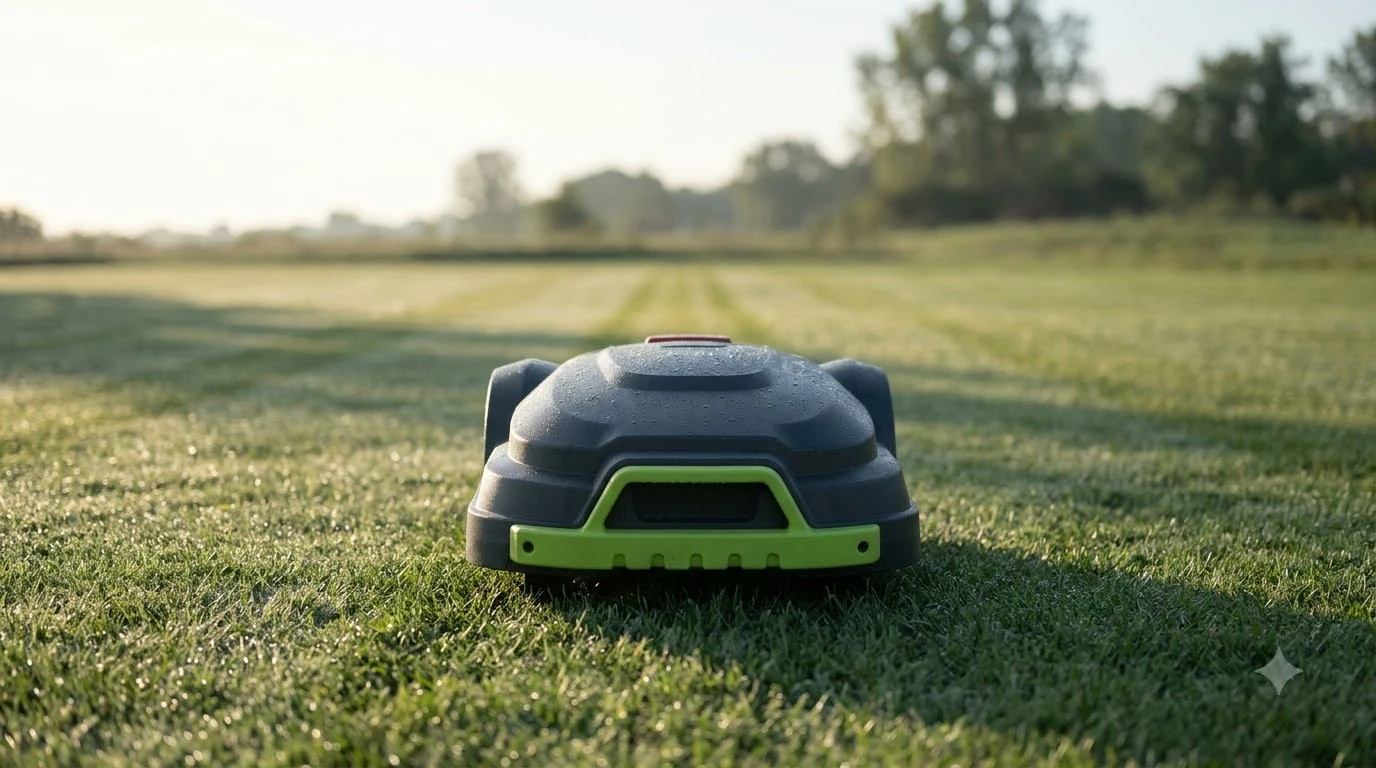

The best robot mower for Indiana lawns is the one that handles cool-season grass, humid summers and wet springs without cutting the lawn too low. Indiana yards are mostly Kentucky bluegrass and tall fescue, and both grasses are managed well above a scalped height. Humidity and frequent rain add a layer of demands, so the mower’s height range, its weather routine and the layout of the yard matter as much as the cutting power. This guide explains what to check, using university extension guidance where it applies.
The short answer
- Know the grass: Kentucky bluegrass is commonly kept between about 2 and 3.5 inches, while tall fescue sits higher at about 3 to 4 inches.
- Size by usable lawn: subtract beds, trees, the garden and the play area before trusting a rated area.
- Plan for wet weather: pick a mower with a rain routine, and avoid cutting soaked turf.
- Raise the cut in summer: humid heat stresses cool-season grass, so a higher setting helps.
- Choose the boundary for the layout: a physical wire or a virtual boundary, depending on beds and trees.
Kentucky bluegrass and tall fescue need different heights
Many Indiana lawns are a mix of Kentucky bluegrass and tall fescue, so the grass type is not always clear. Purdue’s optimum mowing-height table lists Kentucky bluegrass at 2.0 to 3.5 inches and tall fescue at 3.0 to 4.0 inches. The overlap is around three inches, which is a reasonable starting point for a mixed lawn. Indiana belongs to the central Midwest, so the regional robot mower guide for the Midwest provides a broader comparison. Ohio has a comparable mix of Kentucky bluegrass and tall fescue, so see the Ohio robot mower picks for similar lawns.
Iowa State Extension gives Kentucky bluegrass a seasonal split of about 2.5 to 3 inches in spring and fall and 3 to 3.5 inches in summer, with taller leaf area shading the crowns in heat. Our reading is that an Indiana robot mower should start the season near three inches, step up slightly in the hottest months, and not drop below the lower end of the range.
Heads up
Purdue’s table warns that mowing significantly below the optimum range creates weak turf that needs more inputs. A mower set low to chase a manicured look can leave a lawn thin and more open to weeds, especially in humid summers.
Size the mower to the usable lawn
An Indiana yard often includes mature shade trees, perennial beds, a garden, a patio and a play area. The rated area on a spec sheet assumes open ground, so the figure you need is the usable turf area after those features are removed. Measure the grass the mower will actually cover, and pick a model with a comfortable margin above that number.
| Factor | What to check | Why it matters in Indiana |
|---|---|---|
| Usable turf area | Measure after trees, beds and garden | Shade and obstacles reduce the area the mower can cover |
| Height range | Minimum and maximum cut height | Bluegrass and fescue sit in different bands |
| Slope rating | Inside-area and boundary slope limits | Older lots and drainage swales can be steeper than they look |
| Weather rating | Water resistance and rain routine | Humid, wet springs mean more mowing in damp conditions |
| Boundary method | Physical wire, virtual boundary, or both | Affects install effort around trees and beds |
Our reading is that a margin of around 20 percent above the usable turf area is a sensible buffer, since shade and obstacles slow the mower and extra capacity helps it finish within a scheduled window.
Cutting by growth in a wet spring
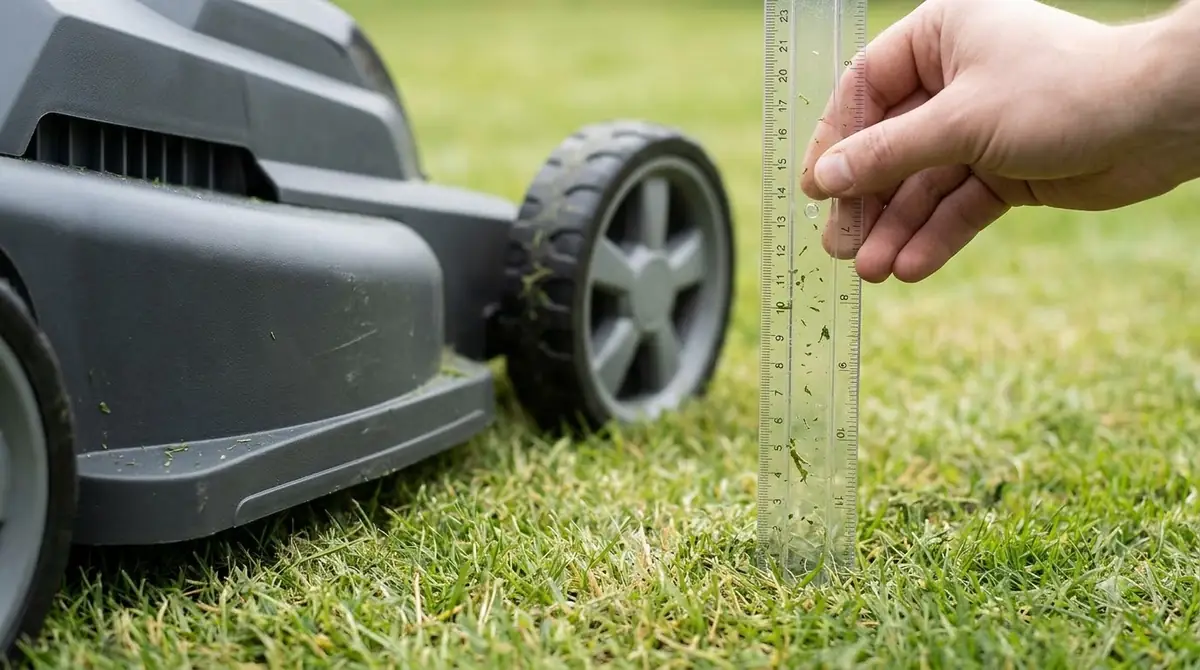
The University of Wisconsin extension advises mowing based on the rate of grass growth rather than a weekly calendar, and that advice applies in Indiana’s wet springs. A cool, damp spring may need more frequent cuts, while a drier summer may need only occasional mowing. A robot mower with a flexible schedule can follow that pattern without a fixed weekday plan. A wet spring pushes growth in other eastern states too, so Pennsylvania lawn picks for robot mowers are worth a look.
- Start with the grass. Begin cutting when the lawn needs it, not on a set date.
- Set the spring height. Use the middle of the grass’s range to keep the crowns covered.
- Raise the cut in humid summer heat. Move up when temperatures and humidity stress the lawn.
- Respect the one-third rule. Remove no more than one-third of the leaf in a single cut.
- Keep the clippings. Short clippings filter back and return nutrients, and they do not cause thatch according to UW-Madison Extension.
Humidity, rain and wet grass
Humid summers and frequent storms are harder on a robot mower than dry climates. Wet grass clumps clippings and can leave ruts in soft soil, so avoid running the mower on soaked turf. A mower with a rain routine that parks during storms protects the blades and the battery, and keeps the docking station clear of standing water. Humid, rainy stretches are common here, so check robot mowers that keep working in rain before you set a schedule. A rain sensor can hold the mower back on wet grass, which the page on robot mowers with a rain sensor explains. Humidity and wet grass call for particular mower settings, which are described in the guide to mowing Wisconsin lawns with a robot in a cool, wet spring.
Keep the lawn’s airflow in mind as well. Our reading is that dense, wet, unmowed patches under trees stay damp longer, so a mower that can keep those edges trim helps, but it should not be run over saturated ground.
Slopes, edges and boundary wire
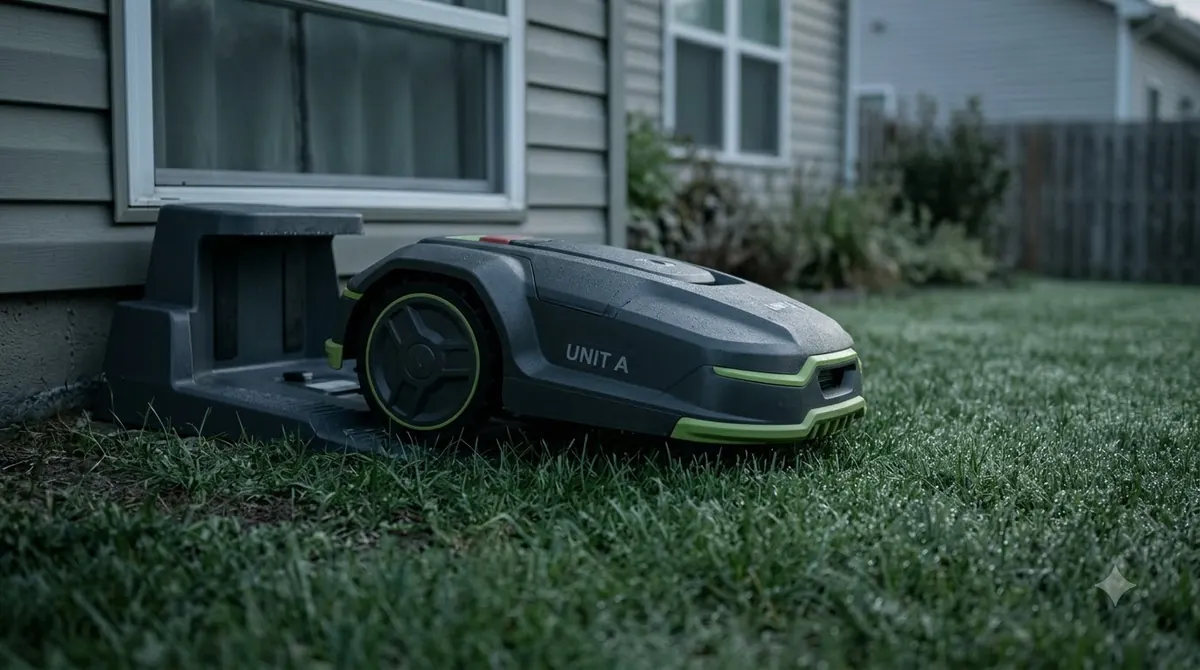
Many Indiana lots are flat, but older neighborhoods can have drainage swales, low spots and banks along a fence line. Read both slope numbers on the spec sheet, the one for the inside of the cutting area and the one for the boundary, and check the grade of your yard before buying. Slopes, edges and boundary wire come up in almost every regional guide, and robot mowing in Missouri yards is the Missouri version of that advice.
A physical perimeter wire gives a clear edge around beds and tree rings, which keeps the mower off planting areas. A virtual boundary can be faster to set up on an open lot. Our reading is that a yard with many trees and beds benefits from a physical edge, while a simple rectangular lawn can use the simpler method.

What to check before you buy
Before ordering, confirm the usable turf area against the rated area, check that the height range covers both bluegrass and fescue bands, read the slope and weather ratings, and ask how the mower handles wet weather. Check whether replacement blades and the charging dock are available locally, because a mower spends its life outdoors through heat, humidity and rain.
Plan the boundary and dock placement before the purchase. Trees, beds and drainage low spots all need to be mapped so the boundary is placed correctly the first time.
Frequently asked questions
What cut height should a mixed bluegrass and fescue lawn have?
Around three inches is a sound starting point. Purdue’s table lists 2.0 to 3.5 inches for Kentucky bluegrass and 3.0 to 4.0 inches for tall fescue.
Should I raise the mower in summer?
Yes. Iowa State Extension advises a higher summer cut for Kentucky bluegrass, because taller leaf area shades the crowns and helps during heat.
Can a robot mower run after heavy rain?
Avoid it on soaked turf. Wet grass clumps clippings and soft soil can rut. Choose a mower with a rain routine that parks during storms.
Do I need a physical boundary wire?
Not always. A physical wire helps in yards with many trees and beds. A virtual boundary can work on simpler, open lots.
Sources
- Purdue Turfgrass Science, Turf 101: Optimum mowing heights for turf (university extension): optimum ranges for Kentucky bluegrass and tall fescue, and the warning about cutting too low.
- Iowa State University Extension, summer mowing height FAQ (university extension): spring, fall and summer heights for Kentucky bluegrass.
- UW-Madison Extension, Mowing can make or break lawns (university extension): mowing by growth rate, the one-third rule, and leaving clippings.
 Up next7 min readBest Robot MowersBest Robot Mower for a Lawn With Thatch BuildupUpdated Nov 13, 2026
 6 min readBest Robot MowersBest Robot Mower for Louisiana Lawns: Heights and What to CheckUpdated Nov 13, 2026
 7 min readBest Robot MowersBest Robot Mower for Humid Southern SummersUpdated Nov 18, 2026
 7 min readBest Robot MowersBest Robot Mower for a Lawn with Short Growing SeasonUpdated Nov 18, 2026
 7 min readBest Robot MowersBest Robot Mower for Alabama Lawns: Grass and Height GuideUpdated Nov 13, 2026
 8 min readBest Robot MowersBest Robot Mower for Wisconsin Lawns: Cool-Season Cut GuideUpdated Nov 18, 2026