
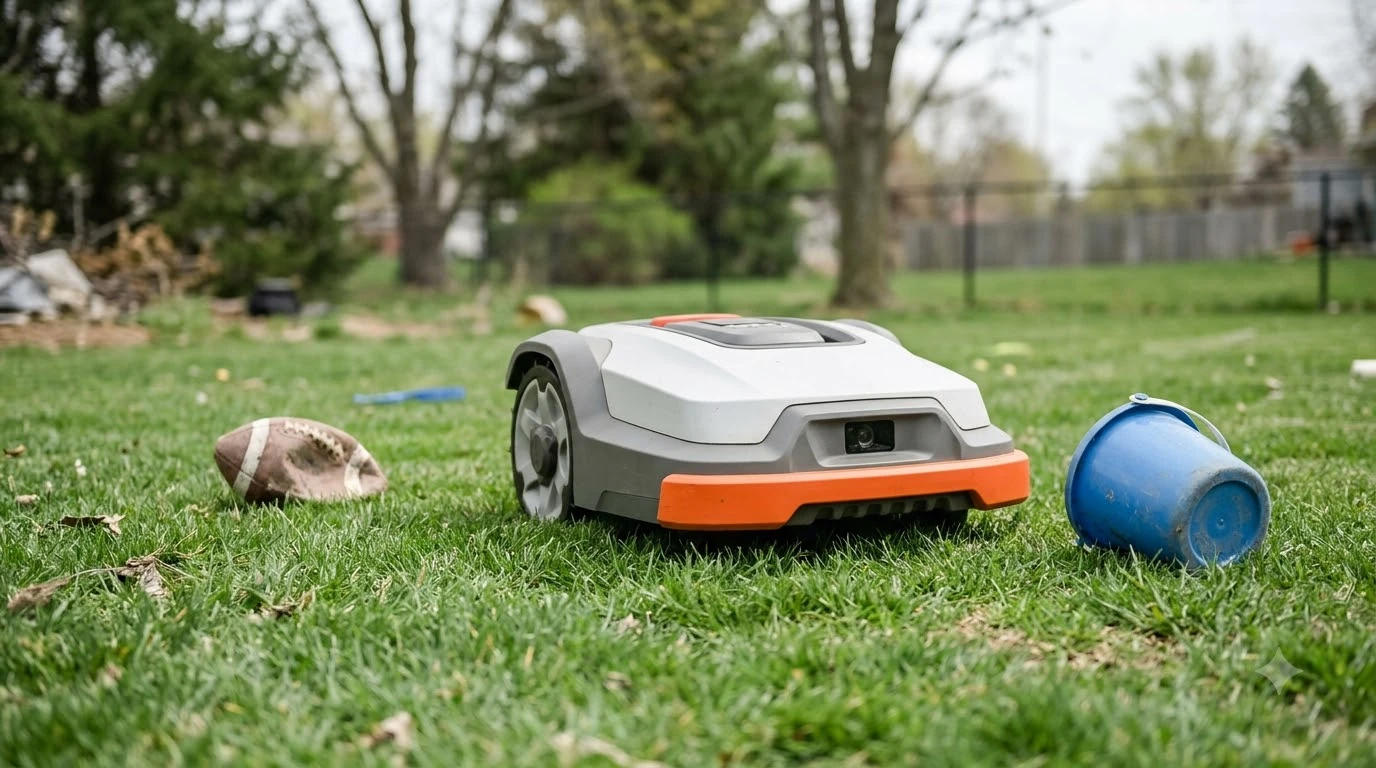

A robot mower tree root guard is a way to keep the mower off exposed roots and the base of a tree, so the blades and wheels do not hit them. Robot mowers use sensors to avoid trunks, but a sensor will not protect a root that is low and exposed. The practical fix is to fence the root zone with the boundary wire or a no-go area, and where needed to add a physical guard.
The short answer
- Trunks are easier: the mower’s obstacle sensors are designed to stop and turn around at trees.
- Exposed roots are the risk: roots and the flare where the trunk meets the lawn can be struck by the blades or wheels.
- Fence the zone: route the boundary wire or a no-go area around exposed roots and the root flare.
- Protect saplings: young trees may need a physical guard, and raised beds help with prized plants.
Why the root zone needs more than sensors
Gardenia Organic’s guide to robot mowers and trees describes how the mower handles trunks: ultrasonic sensors pick up an obstacle, the mower stops, reverses, and changes direction, and it repeats this from each direction until the lawn is cut. It treats objects within about 15 cm as hazards. That works well for a trunk standing upright. It is less clear for a root lying low in the grass, which the article does not say the sensors reliably detect. Physical fencing is the most direct approach, and garden fencing for protected zones covers common materials.
The same article is direct about the risk. The root flare, where the trunk meets the turf, is especially vulnerable, and it warns that “exposed roots could be damaged by the mower running over them.” Damage at the flare can harm the tree’s cambium, so the cut here matters more than the cut on an open lawn.
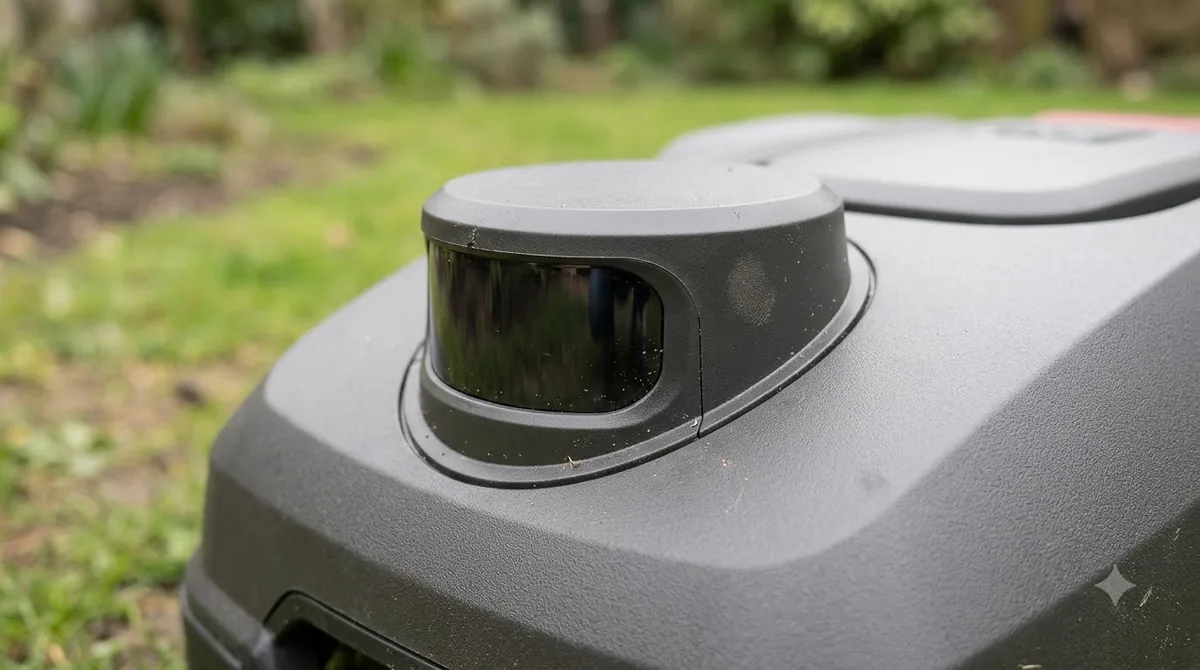
Map the robot mower tree root guard zone before you mow
Walk the lawn around each tree after a dry spell, when the soil is firmer and roots are easier to see. Mark any root that stands proud of the soil, any flare the mower could scrape, and any spot where the grass has thinned to show a root. Those are the areas to fence. Without a physical guard, virtual fence markers for marked zones can define the same area digitally.
Our reading is that a root zone is a layout problem. Once you have marked it, the next step is to decide whether the boundary wire or a no-go area is the better way to keep the mower out.
Fence the root zone with boundary wire
Gardenia Organic’s guide suggests a perimeter wire around the tree as one protection. The idea is to route the wire so the mower turns before it reaches the exposed root, and the root stays outside the cutting path. This works best when the wire can be laid with a gentle curve, since sharp bends stress the wire and can lead to breaks. An island loop needs its own cable, and stapling an island wire into turf keeps it flat while the perimeter is installed.
Husqvarna’s installation guidance says to avoid sharp bends, to remove rocks and sharp objects that could damage the line, and to stake the wire down firmly. In soft or compacted soil, stakes can rise, so check them periodically. Mow the grass before you lay the wire, because long grass can lift it. These same points apply to a wire loop around a root zone.

Use a no-go area or a physical guard
If your mower’s app supports no-go areas, mark the root zone there as well. A map-based keep-out can be quicker to set up than laying wire, but it is only as good as the map, so re-check it after you change the lawn edge or the bed next to the tree. The same barrier concept applies elsewhere, and pet fences and similar physical guards show how they are built.
For young saplings, Gardenia Organic suggests physical guards. A guard is a rigid barrier around the trunk that holds the mower away from the base. It should sit outside the root flare and be tall enough to show up on the mower’s path. Avoid placing a guard so close to the trunk that it damages bark or traps moisture.
Raised beds and planting around trees
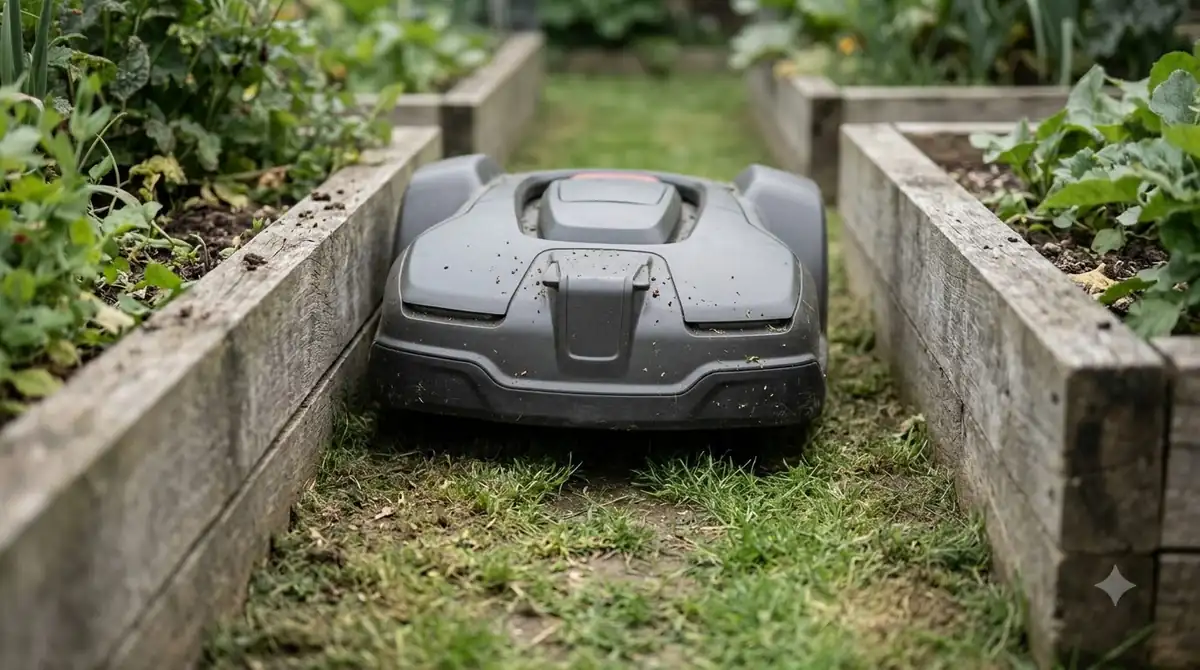
Gardenia Organic also mentions raised beds for prized plants. A raised bed takes the mower’s path away from the root zone and gives you a clear edge to work from. This is most useful around shrubs and young trees where the grass has been worn thin by foot traffic. Planted areas can also hold hoses, so hose guards around planted areas deserve a place in the same plan.
Keep in mind that a bed does not stop the roots from growing into the lawn. Check the roots each season and fence any new ones as they appear.
A seasonal check for trees
- In spring. Walk each tree and mark new exposed roots before the grass grows tall enough to hide them.
- After heavy rain. Soil washes away from roots, so check whether the flare is more exposed than before.
- After a change. Re-check the wire path and no-go area after you add a bed, a path, or a new tree.
- Before winter. Confirm that guards are still in place and that stakes have not lifted the wire.
Related reads: Seasonal checks can include fences too, such as combining a pet fence with wire zones near the tree line.
Frequently asked questions
Can a robot mower run over tree roots?
It can, especially exposed roots that sit low in the grass. Gardenia Organic’s guide warns that exposed roots can be damaged by the mower, and that the root flare is particularly vulnerable.
Do robot mower sensors protect tree roots?
They protect trunks and other upright obstacles well. The article we read does not say whether low roots are reliably detected, so do not rely on the sensors alone. Fence the root zone with wire or a no-go area as well.
How far should a guard or wire keep the mower from a tree?
There is no single distance in the pages we read. The goal is to keep the mower off the exposed root and the flare. Mark the actual roots first, then set the wire or zone just outside them, and adjust after you see how the mower runs.
Do I need a guard for a mature tree?
Not always. Gardenia Organic suggests physical guards mainly for young saplings. A mature tree with a clear, fenced root zone may need only the wire or no-go area, as long as the flare stays outside the cutting path.
Sources
- Can robot mowers cut around trees? (Gardenia Organic): ultrasonic sensor behavior, root flare risk, perimeter wire and physical guards for saplings, raised beds.
- Tips to prevent wire break in an Automower installation (Husqvarna): avoid sharp bends, clear sharp objects, staking, mow before laying wire.
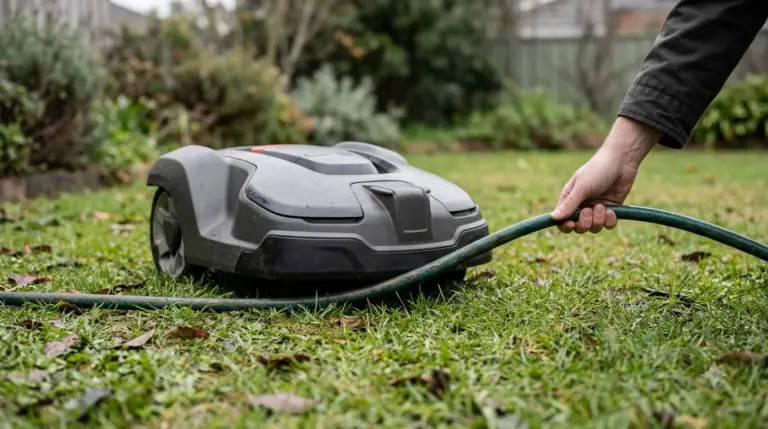 Up next6 min readGearRobot Mower Garden Hose Guard: Keeping a Hose Out of the Mower PathUpdated Nov 13, 2026
 7 min readGearBest Replacement Cutting Disc Guard for Rocky Lawns: Materials, Fit, and CareUpdated Nov 19, 2026
 7 min readGearRobot Mower Base Station Solar Panel: Is It Enough?Updated Nov 20, 2026
 7 min readGearBest Outdoor Power Strip for RTK Base Station: 5 ChecksUpdated Nov 16, 2026
 8 min readGearRTK Network Service for Robot Mower Without Base StationUpdated Nov 19, 2026
 8 min readGearBest Weatherproof Enclosure for RTK Base Station: 6 Checks Before You BuyUpdated Nov 13, 2026