
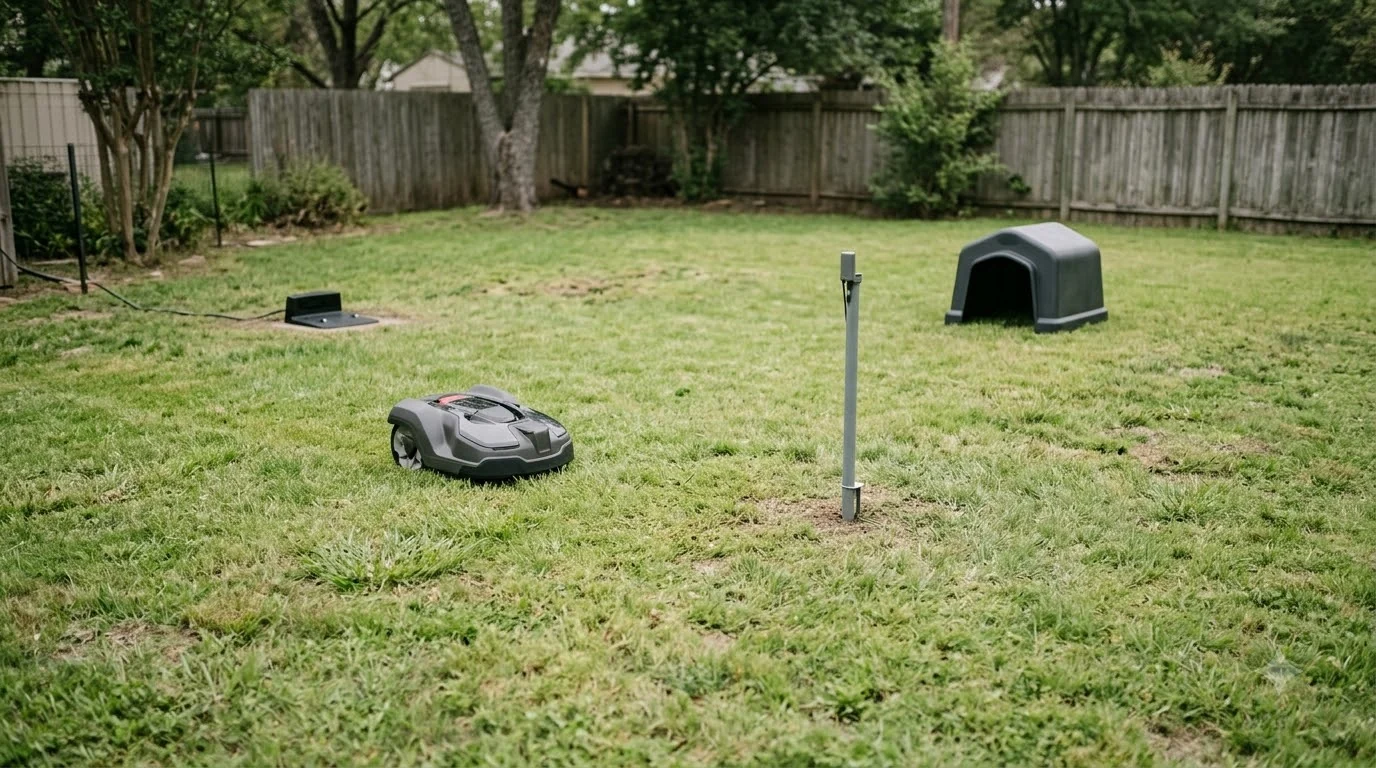

The best robot mower for a lawn with short growing season is one that fits a window of only a few months, with a dock you can protect over winter: Iowa State Extension says cool-season lawns keep growing until daytime highs stay consistently below 50 degrees Fahrenheit, and in central Iowa that usually happens in early to mid-November. Everything about the mower, from its height range to its storage plan, should be built around that short active season.
The short answer
- Run until growth stops: keep mowing until the grass stops growing, not until a fixed date on the calendar.
- Step the height down in fall: Iowa State suggests lowering from 3 to 3.5 inches to 2.5 to 3 inches in mid to late September.
- Keep the one-third rule: remove no more than one-third of the leaf area in any one cut.
- Plan the storage: once growth stops, the mower and dock can be stored for winter.
- Check the spring start: the robot’s first run should wait for the grass to green up and firm up.
What a short growing season means for a robot mower
A short growing season is not only a question of how cold the winter is. It also shortens the period in which a robot mower has useful work to do. In cool-season regions, the grass may grow strongly in spring and early fall, then slow in the cold, then stop altogether. The mower is needed for a few months, and it sits idle for the rest. Growth is fast in summer and slow near the end, as the guide to mowing thick grass through the season explains. Northern climates face the same short window, as mowers for Michigan lawns shows.
That pattern changes what you should buy. A mower that is simple to set up and easy to store can make more sense than a complicated system that needs weeks of tuning. The base and boundary setup also matter, because they have to survive a full winter outdoors if they are not moved indoors.

Best robot mower for a lawn with short growing season: fall height
Iowa State Extension’s fall advice is specific. In mid to late September, lower the mowing height from 3 to 3.5 inches to 2.5 to 3 inches. That step prepares the lawn for its last weeks of growth without scalping it. Keep the blade sharp, and do not remove more than one-third of the total leaf area at once. Autumn leaves add another factor, covered in lawns with heavy leaf fall. New seed needs a different first mow, as lawns that were just hydroseeded describes.
For a robot mower, the key question is whether the height range goes low enough for that fall step and high enough for the spring. Check both ends of the range. A model that cannot reach 2.5 inches will not follow the extension guidance, and one that cannot go above 3 inches will struggle with the early spring flush.
When to stop running the mower
Iowa State’s rule is to keep mowing until the grass stops growing. For cool-season grasses like Kentucky bluegrass, growth stops when daytime highs stay consistently below 50 degrees Fahrenheit. In central Iowa, bluegrass usually stops growing in early to mid-November. Once that happens, the mower can be stored for winter.
That rule is more useful than a fixed date, because the season changes from year to year. A robot mower can be set to a schedule, but the schedule should follow the weather. Our reading is to review the schedule every few weeks in late fall, and switch the mower off once the grass has clearly stopped growing.
Protecting the dock and battery over winter
The charging station is the piece that sits outside longest. Once growth stops, the simplest plan is to bring the mower in, clean it, and store it under cover. If the dock must stay outside, check the manual for the manufacturer’s guidance on cold weather and battery storage, since those rules vary by model. Our reading is that a sheltered spot, away from standing water and snow piles, is the safest place for a base that will sit idle through winter.
Spring start and the first run
In spring, the first runs should wait until the grass has greened up and the ground is firm. A robot mower on soft, wet ground can leave ruts and disturb the turf, and the grass will need time to thicken after winter. Start with the high end of the height range, then lower the setting in steps as the lawn fills in. After a winter break, handling tall grass after a pause offers a useful comparison.
Cool-season grass and the one-third rule
The one-third rule applies in every season. Iowa State says never to remove more than one-third of the total leaf area at one time, and that rule matters most in the fall, when the grass is slowing down and the last cuts are the ones that set up the winter lawn. A robot that cuts a little every day can keep each pass small, but only if the height and the schedule are set together. Weak turf responds differently, as thin and patchy cool-season lawns shows as a useful companion to the points in this section.
What to check before you buy
For the best robot mower for a lawn with a short growing season, check four things. Confirm the height range reaches down to 2.5 inches for fall and up past 3 inches for spring. Check that the schedule can be set to follow the season, and can be switched off in one step. Find out how the base is powered and whether it can be stored indoors without a long setup. Read the manual for the cold-weather guidance and the battery storage rules.
Frequently asked questions
When should a robot mower stop running in the fall?
Iowa State Extension says to keep mowing until the grass stops growing. For cool-season grasses like Kentucky bluegrass, that happens when daytime highs stay consistently below 50 degrees Fahrenheit, which is usually early to mid-November in central Iowa.
What height should a robot mower use in late fall?
Iowa State suggests lowering the mowing height from 3 to 3.5 inches to 2.5 to 3 inches in mid to late September. Keep the blade sharp and never remove more than one-third of the leaf area at once.
Can I leave the charging station outside all winter?
It depends on the model. Check the manual for cold-weather and battery storage guidance. Storing the mower and base indoors is the simplest way to protect them over a long, cold winter.
When can a robot mower start again in spring?
Wait until the grass has greened up and the ground is firm. Start with the high end of the height range and lower the setting in steps as the lawn fills in.
Sources
- Iowa State University Extension, When can I stop mowing the lawn in the fall? (university extension): mow until growth stops, 50 degrees threshold, storage timing.
- Iowa State University Extension, Late Summer and Fall Lawn Care (university extension): September height step-down and the one-third rule.
 Up next8 min readBest Robot MowersBest Robot Mower for Wisconsin Lawns: Cool-Season Cut GuideUpdated Nov 18, 2026
 8 min readBest Robot MowersBest Robot Mower for Idaho Lawns: Cool-Season Grass GuideUpdated Nov 18, 2026
 7 min readBest Robot MowersBest Robot Mower for Oregon Lawns: Wet Season GuideUpdated Nov 14, 2026
 7 min readBest Robot MowersAre Robot Mowers Cheaper on Black Friday? What to CheckUpdated Nov 18, 2026
 7 min readBest Robot MowersBest Robot Mower for a Lawn With Thatch BuildupUpdated Nov 13, 2026
 7 min readBest Robot MowersBest Robot Mower for Indiana Lawns: Bluegrass and FescueUpdated Nov 18, 2026