
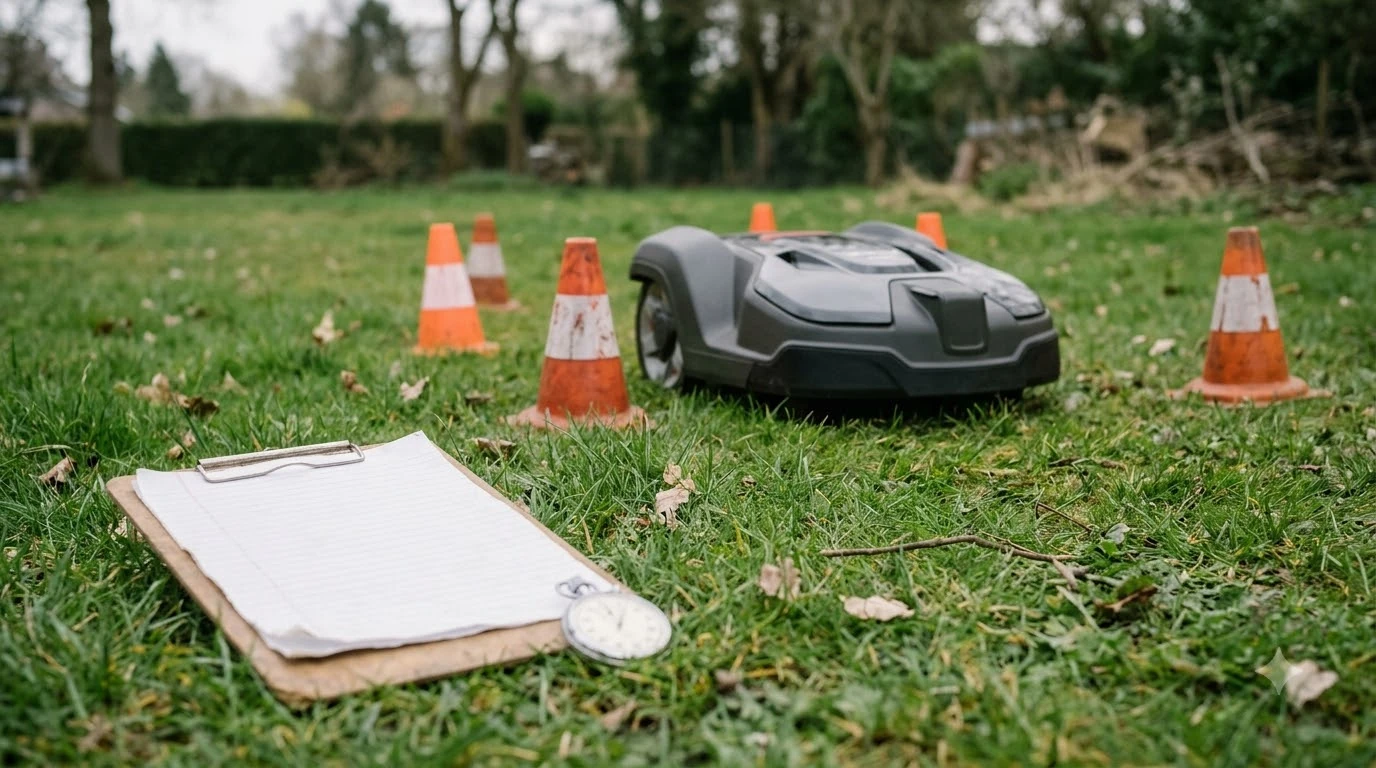

Which no base station robot mower is the most accurate? No single model can be named from published numbers alone. Accuracy depends on the positioning method, the sky view around the lawn, and the correction service the mower uses. Some brands, including Husqvarna, offer a cloud correction option so you do not need a station of your own. This guide explains what the published figures do and do not tell you, and what to check before you trust any accuracy claim.
The short answer
- There is no verified winner. We found no independent side-by-side test that covers every brand without a base station.
- Husqvarna’s published figures for its cloud correction option are typically 1 to 6 cm, and its own reference station options are typically 1 to 2 cm.
- Conditions matter more than the headline number. Tree cover, tall walls and narrow passages can block satellite signals.
- Ask for the correction source, the stated fix behavior and the coverage area before you compare brands.
What “most accurate” means for a robot mower
Accuracy here means how closely the mower knows where it is on the lawn, so it can follow a virtual boundary or stay inside a perimeter. Lower centimeter figures do not automatically mean a cleaner cut. A mower can still miss strips or drift near an edge if the signal drops for a few seconds, and that is a matter of signal quality more than of the headline number. Accuracy claims only make sense next to the other positioning methods, which the overview of how navigation accuracy is compared lays out side by side.
Brands also describe accuracy in different ways. Some quote a typical figure, some quote a best case in open sky, and some quote a figure that depends on a correction network you pay for. Those differences make it hard to rank mowers on a single number. The useful question is what the figure assumes.
How no-base-station mowers get their corrections
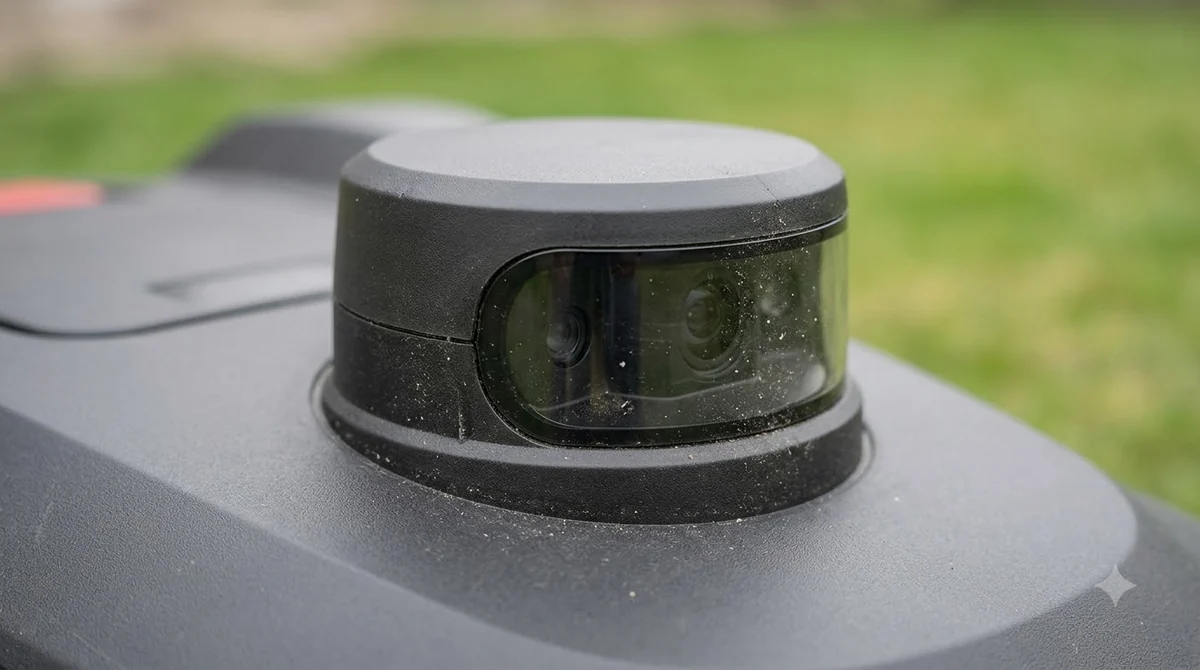
A satellite receiver on the mower works on its own with only moderate accuracy, so most accurate navigation systems add a correction signal. A mower with a home base station receives corrections from that station. A mower without one usually receives corrections from a network service over the internet, typically through cellular data. Husqvarna describes its cloud option this way: positioning relies on at least two cooperating receivers, and in that setup the second receiver is the Husqvarna Cloud rather than a station in your yard. Many stationless designs lean on satellite corrections, and the guide on RTK GPS mowers and fixed corrections explains the fixed and float states. Some mowers pair satellite data with cameras, an approach covered in the notes on combining RTK with a camera.
That design removes one piece of hardware, but it adds a dependency. The cloud option needs cellular coverage on the site, and Husqvarna notes that it is not available in every country or region. If your lawn has weak cell service, a no-base-station mower may not be the accurate option you expect, even when its specification looks strong.
Which no base station robot mower is the most accurate on paper
The table below lists the figures Husqvarna publishes on its own EPOS and wire-free pages. We are quoting the manufacturer, not testing the mowers ourselves. Other brands publish different figures and conditions, and we have not verified them here, so treat them as separate claims. For camera-led positioning, the roundup on vision camera mower accuracy lists what the published figures actually describe. Satellite-only systems have their own limits under tree cover, which the guide to satellite navigation mower accuracy walks through.
| Source | Correction setup | Stated accuracy |
|---|---|---|
| Husqvarna EPOS page | Husqvarna Cloud, no station of your own | Typically 1 to 6 cm |
| Husqvarna EPOS page | EPOS RS 4G reference station, range up to 25 km | Typically 1 to 2 cm, within a 10 km range |
| Husqvarna EPOS page | EPOS RS5 reference station, range up to 500 m | Typically 1 to 2 cm |
| Husqvarna wire-free FAQ | Satellite-based positioning for wire-free mowers | Typically within 5 cm |
The spread is informative. A mower that depends on a cloud service is quoted at 1 to 6 cm, while the station options are quoted tighter. The cloud figure is still a few centimeters, which is enough for a boundary on most lawns. The gap matters more when the lawn is near a fence, a flower bed or a driveway edge.
Heads up
Husqvarna’s FAQ warns that passages narrower than 4 m, with tall hedges or walls on both sides, can block satellite signals. Severe weather that interferes with satellites can also affect performance for a time. A low published figure does not cancel these conditions.

Why conditions matter more than the headline number
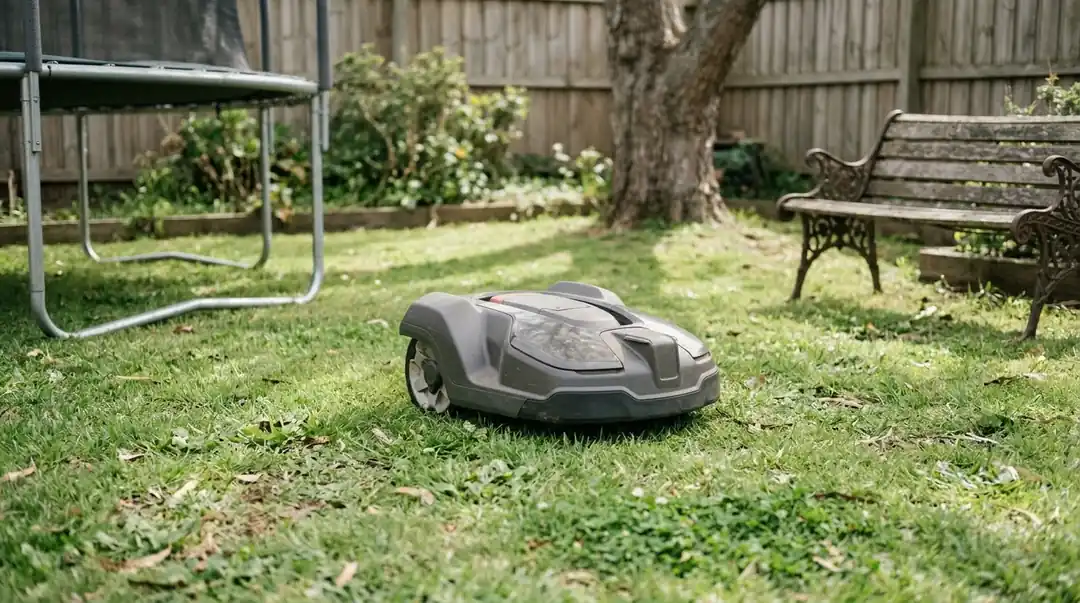
Most accuracy complaints come from the yard, not the spec sheet. Trees with dense canopies, a house wall on one side of the lawn, and a narrow side passage all reduce the signal a mower can use. The mower may still run, but it will fall back to less precise positioning or stop until the signal returns. Buried loops remain the reference point many buyers use, and boundary wire accuracy for comparison shows how they measure up. Conditions matter more than a headline figure, and accuracy of 4G cellular robot mowers is a related question for the cellular models.
Our reading is that the best guide to real performance is the lawn itself. Walk the yard and note where trees, walls, sheds and tall hedges sit, and where the sky is most open. If most of the lawn is open, a cloud or station-based system can work well. If the lawn is mostly shaded, a system that depends on satellites alone will struggle, and you should ask the vendor how the mower behaves in that case.
What to check before you buy
- The correction source. Ask whether corrections come from your own base station, a cloud service, or a network you pay for, and what each one needs.
- The stated accuracy and its condition. Look for “typical” versus “best case” wording, and whether the figure assumes open sky.
- Cellular coverage on the lawn. If the mower needs cellular data for corrections, test the signal at the spot where the mower will charge.
- Coverage range. Reference stations have a range limit. Husqvarna lists RS 4G at up to 25 km and RS5 at up to 500 m.
- Behavior under obstruction. Ask what the mower does when the signal drops, and whether it stops, slows or keeps cutting in a fallback mode.
Related reads: A wider view of how robot mower navigation is judged helps when two models claim similar accuracy.
Frequently asked questions
Is a base station always more accurate than a cloud service?
Not always, but Husqvarna’s published figures are tighter for its own reference stations (1 to 2 cm) than for its cloud option (1 to 6 cm). The actual result depends on your sky view and your cellular coverage, so the station is not guaranteed to win on your lawn.
Can a no-base-station mower work under trees?
It can run under partial cover, but dense canopies and narrow passages can block the satellite signals it relies on. Expect the mower to slow or pause in those areas, and test the spot before you assume full coverage.
Do I need a monthly subscription for cloud correction?
The cloud option depends on the manufacturer’s service terms, which can change. Check the current terms with the seller before you buy, and confirm that the service is available in your country.
Why do the accuracy numbers differ between brands?
Brands measure under different conditions and describe them differently, so a “typical” figure from one vendor is not directly comparable with a “best case” figure from another. Compare the conditions behind each number, not just the number.
Sources
- Husqvarna EPOS (manufacturer): stated accuracy for cloud and reference-station setups, coverage range and cellular requirements.
- Husqvarna robotic mower FAQ (manufacturer): wire-free positioning figure of within 5 cm, and the narrow-passage and weather limits.
 Up next10 min readBest Robot MowersBest No Base Station Robot Lawn Mower 2026: What to Check Before You BuyUpdated Nov 13, 2026
 7 min readBest Robot MowersWhich AWD Robot Mower Is the Most Accurate? Traction FactsUpdated Nov 18, 2026
 7 min readBest Robot MowersWhich Boundary Wire Robot Mower Is the Most Accurate?Updated Nov 13, 2026
 6 min readBest Robot MowersWhich RTK GPS Robot Mower Is the Most Accurate? What MattersUpdated Nov 18, 2026
 7 min readBest Robot MowersWhich Virtual Boundary Robot Mower Is the Most Accurate?Updated Nov 18, 2026
 6 min readBest Robot MowersWhich RTK and Vision Robot Mower Is the Most Accurate?Updated Nov 13, 2026