


How to stop a robot mower from mowing flower beds: turn each bed into an island in the boundary wire. The mower follows the wire around the bed and does not cut inside it. Manufacturers describe the same basic method, with a return wire routed so the mower can pass over it safely, though the exact spacing and size limits differ by brand. This guide covers the layout, the common mistakes, and the options if you cannot run a wire.
The short answer
- Use an island: route the boundary wire out to each flower bed, around it, and back along the same path.
- Keep return wires together: lay the two return wires side by side so the mower can cross them.
- Never cross the wires: Husqvarna warns the mower will not recognise the island and will stop.
- Respect the size limit: Worx says islands should be smaller than 6m x 6m (19ft x 19ft).
- Trim the edge: the bed border may still need hand trimming, depending on the model.
Why flower beds are hard for a robot mower
A robot mower works inside a boundary wire and has no way to see a bed as a no-go area unless you tell it. Left alone, it will cut right up to the edge of a bed and sometimes into the soil or the plants at the edge. The fix is not to fence the bed in with a board but to define the bed as a space the wire excludes.
Knowing how to stop a robot mower from mowing flower beds starts with planning the layout. That means planning the bed layout before you bury any wire. A bed with a narrow neck, a path through a hedge, or a corner against a fence needs more care than a bed in the middle of an open lawn.
How to lay the wire around a flower bed
Husqvarna’s island guide gives a simple sequence. Start on the side of the bed nearest the lawn’s approach, lay the wire from the border to the bed, and go around it. Do not cross the wire on the way. On the way back, lay the two wires close together so their signals cancel, and the mower can pass over them without a fault. Irrigation lines sit near beds too, as drip lines near planted beds explains. Trees need a similar island layout, as wire layout around trees shows.
Worx describes a similar route. Start at the lawn edge, run the wire at a right angle toward the bed, go around it, and return to the edge along the same path. It also says to lay the wire clockwise so the mower stays out of the island, and to match the two strands side by side at the crossover point.
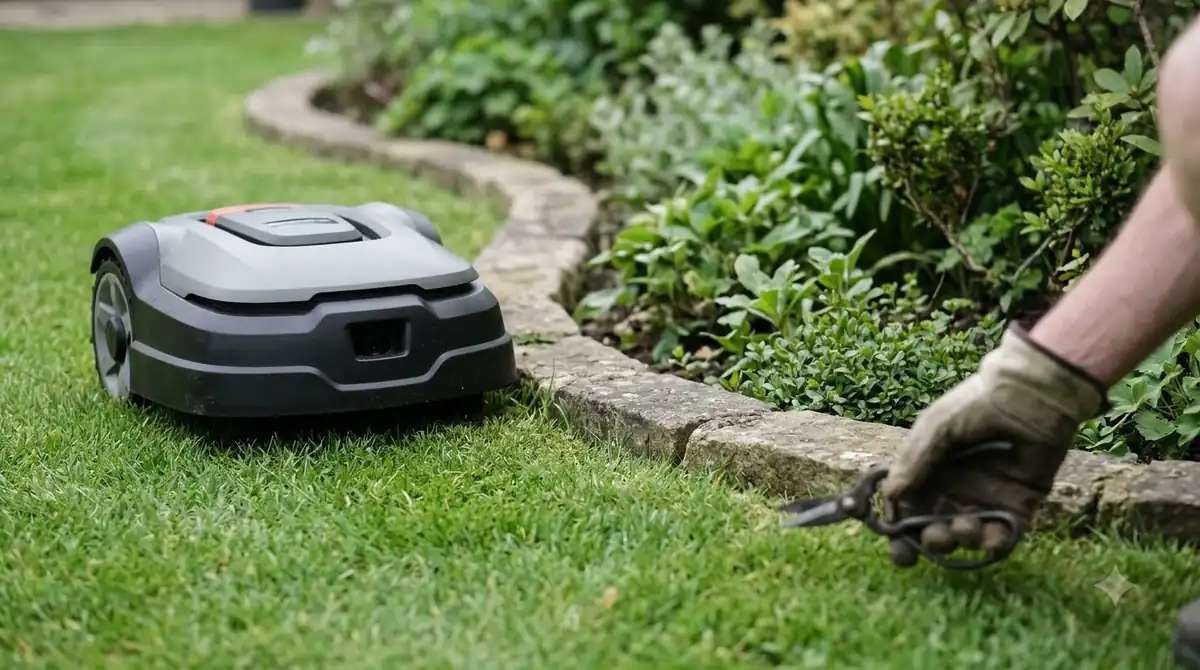
Keep the island under the size limit
An island that is too large may not be recognised as an island. Worx says to keep islands under 6m x 6m (19ft x 19ft). If the island is larger than the limit, the mower may keep circling the area until its battery runs out, which wastes time and can leave the lawn partly cut.
For a larger bed, Worx suggests leaving a 30cm gap between the outgoing and returning wire. Our reading is that a larger gap is safer than a tight one, but the gap also leaves a strip the mower will not cut, so plan for hand trimming there.
Heads up
Worx warns that on a model without Cut-to-Edge, a 12cm (5-inch) uncut strip will remain around the bed. You can trim it by hand or cover it with level stones so it does not need trimming.
Set the wire distance from the bed
The distance between the wire and the bed decides how close the mower gets to the plants. Worx gives 26cm from the bed as its layout spacing. Other brands use different distances, so check the installation guide for your mower before you bury the wire. As a practical matter, keep the wire far enough out that the cutting deck does not reach into the bed when the mower turns.
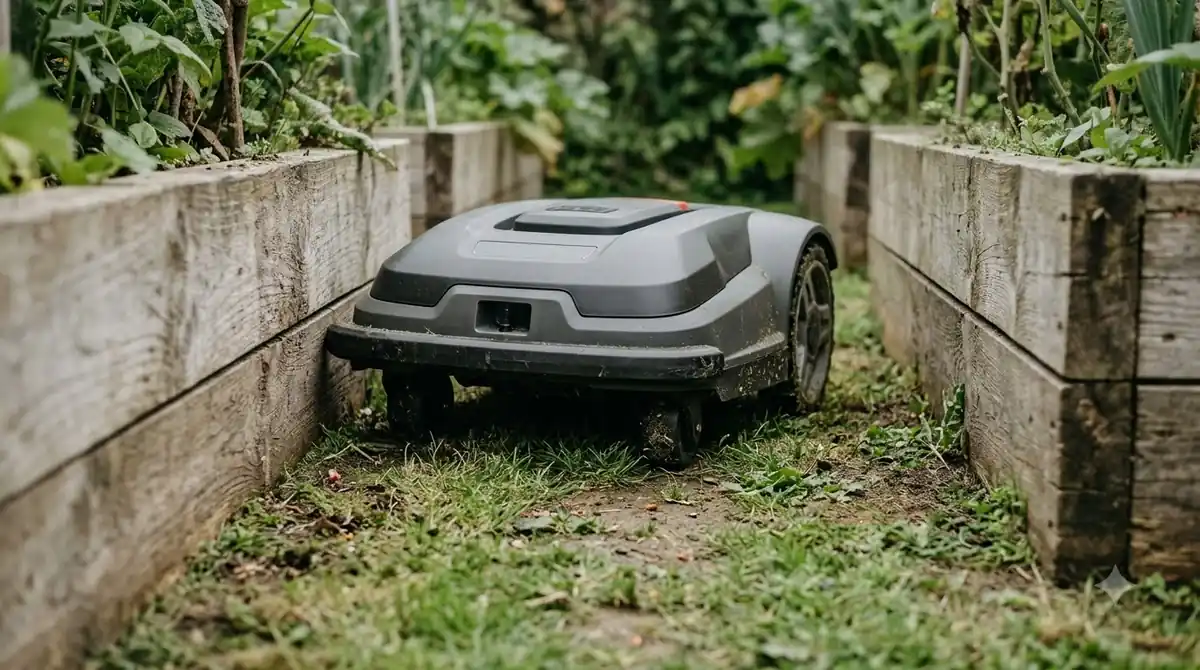
How to stop a robot mower from mowing flower beds: check the layout first
Test the layout before you bury the wire, because wire is hard to move later. Lay it on the surface first, run the mower’s setup routine, and check that the mower goes around the island without stopping. Look for three common faults: Check the checklist in tools for laying the wire before you start digging.
- Crossed strands: the mower stops or does not recognise the island.
- Narrow passages: a tight neck into the island can make the mower turn back. Keep the passage wide enough for the mower to turn.
- Bed too close: if the wire runs right against the plants, the mower may catch leaves or stems at the edge.
Options if you cannot run a boundary wire
Some brands offer wire-free ways to keep the mower out of a bed. Husqvarna’s FlexiFence is a battery-powered wire for temporary stay-out zones, and its virtual no-go systems work on supported models. Worx’s Off Limits feature lets you define a no-mow zone in the lawn without the boundary wire. These options depend on the model and firmware, so check the specifications before you buy. The app method is shown in drawing no-go areas in the app.
Our reading is that a wire island is still the most reliable method for a permanent bed. A temporary zone works well for a bed you plant each season, but it may need moving when you change the layout.
Frequently asked questions
Can a robot mower be stopped from cutting one flower bed?
Yes. The usual method is to route the boundary wire around the bed as an island so the mower does not enter it. Wire-free no-go zones are also available on some models.
Why does my robot mower stop at the flower bed?
A common cause is crossed wires in the island. Husqvarna says the mower will not recognise the island and will stop if the wires cross. Check that the return wires run side by side and that nothing has shifted the wire.
How big can a flower bed island be?
Worx says islands should be smaller than 6m x 6m (19ft x 19ft). For a bigger bed, consider two smaller islands or a different layout, and check your model’s manual.
Do I still need to trim around the bed?
Often yes. Worx notes that on a model without Cut-to-Edge, a 12cm strip will be left uncut, which you can trim by hand or cover with stones.
Sources
- Husqvarna: how to create islands in an Automower installation (manufacturer): the wire route around an island, the return-wire rule, and the warning about crossed wires.
- Worx Landroid setup an island (manufacturer): the 26cm spacing, the 6m x 6m size limit, the 30cm return gap, and the Cut-to-Edge strip.
 Up next7 min readLearnWhy Does My Robot Mower Drive Into the Flower Bed?Updated Nov 13, 2026
 7 min readLearnWhat Is Spot Mowing on a Robot Mower and How Does It Work?Updated Nov 13, 2026
 7 min readLearnWhy Does My Robot Mower Start Mowing at the Wrong Time?Updated Nov 13, 2026
 6 min readLearnWhat Is Zone Mowing on a Robot Mower?Updated Nov 13, 2026
 8 min readLearnCrabgrass Control With a Robot Mower: What Mowing Height DoesUpdated Nov 12, 2026
 7 min readLearnWhat Is Mowing Efficiency on a Robot Mower?Updated Nov 11, 2026