
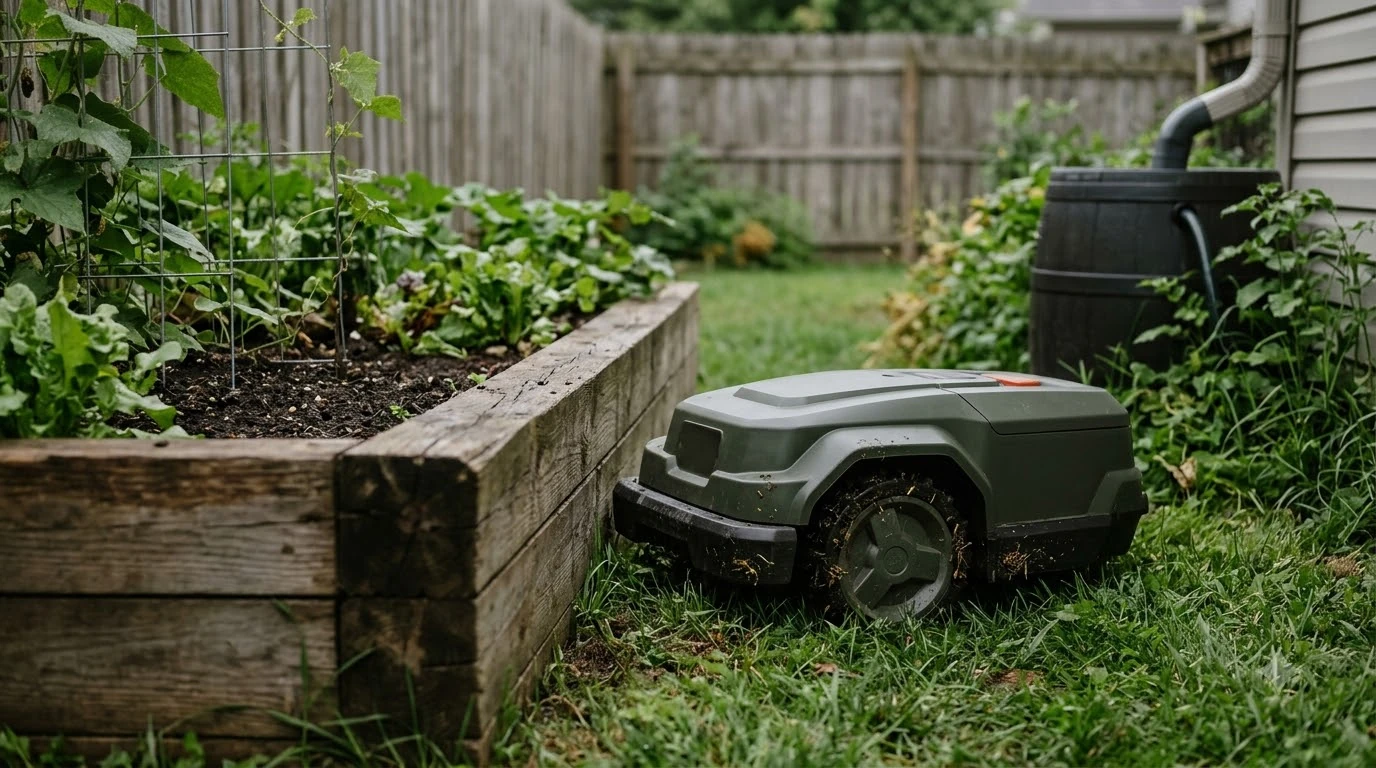

Why does my robot mower drive into the flower bed? Usually because the boundary wire sits too close to the bed or runs the wrong way around it. The mower follows the wire as its signal for where to stop, so any gap, island, or crossing that is laid wrong can let the wheels or the blades reach the planting. Most cases are fixed by moving the wire, adding a no-go zone, or checking how the wire loops around the bed.
The short answer
- Wire too close to a bed leaves too little room for the mower to stop and turn before it reaches the plants.
- Island direction: a bed loop laid the wrong way can lead the mower straight into the island.
- Wires too close together can be read as an ordinary obstacle, so the mower drives over them.
- Edges that drop or rise can pull the wheels into the bed when the wire is not inside the working area.
- Quick check: measure the gap between the wire and the bed, then add a no-go zone if it is too small.
The wire is the stop signal, not the bed
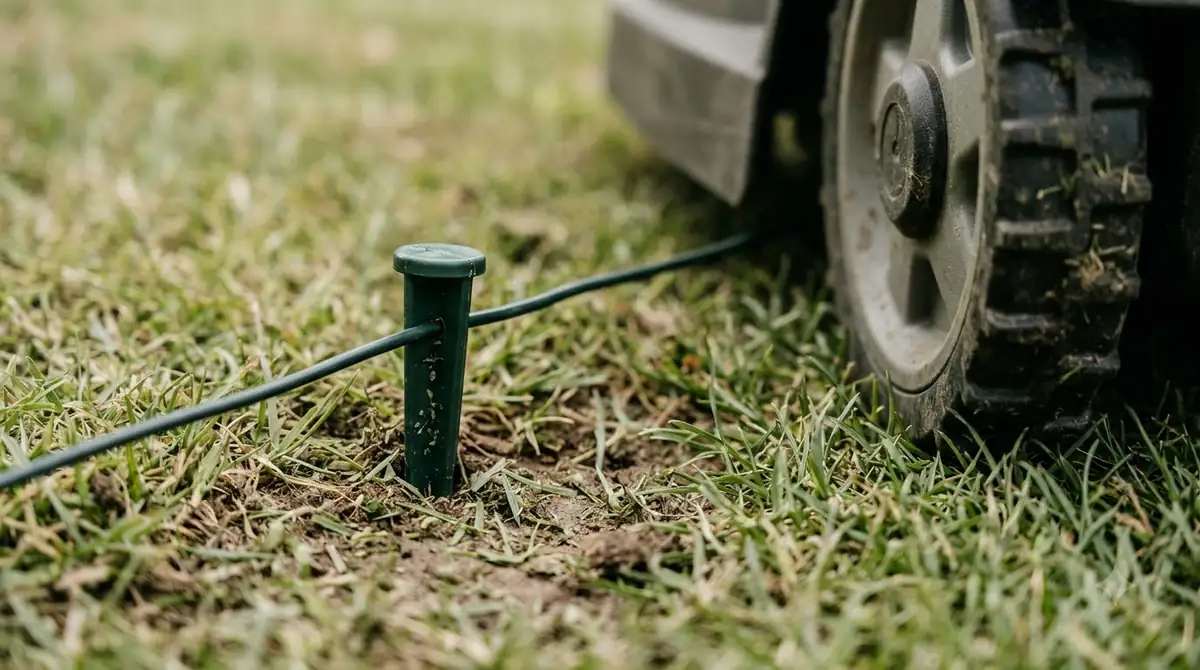
A robot mower does not see a flower bed as a wall. It follows the boundary wire, which sends a weak magnetic signal to the mower and tells it where to turn. Robomow, a robot mower maker, describes the wire as working like a stop sign that keeps the robot off the cable. The mower then needs room between the wire and the bed to turn before its wheels or blades reach the soil. The layout fixes are covered in protecting beds from a robot mower.
That room depends on the bed type. Robomow gives a guide value of about 10 cm from beds and hedges, and about 35 cm from walls and tall stones, and says manufacturers set these distances to protect the blades. Anker, another maker, advises keeping the wire around 30 to 35 cm away from raised beds and other solid obstacles. The two figures differ, so check your model’s installation manual for the exact distance before moving the wire.
Wire too close to the bed
If the wire runs right up to the edge of a bed, the mower reaches the bed before it has space to stop and turn. A bed that rises above the lawn is especially risky, because the wheels can ride up onto the soil edge. Measure the gap between the wire and the bed at several points along the edge, since a bed can look far from the wire in one spot and close in another. Getting the wire distance right starts at installation, as laying wire correctly during installation shows.
The fix is to move the wire outward to the distance your manual specifies, or to set up an exclusion zone in the app around the bed. Our reading is that an exclusion zone is the easier fix when the bed is already planted, because it avoids digging up the wire. Start with a small zone and widen it only if the mower still gets too close.

Island direction and wires that run close together
An island is a loop of wire around an obstacle. Robomow says to run the wire out from the edge, circle the obstacle once, and return along a path parallel to the outward lead, so the robot can bypass the area. If the loop goes the wrong way, the mower can head into the island rather than around it. Some installation manuals warn that the loop direction matters for this reason, so follow the direction shown in yours. Wire-free models handle islands with exclusion areas, which no-go zones around islands explains in plain terms.
The two wire runs should sit close together but must not cross. Robomow says the wire must not cross at any point to avoid signal interference. Some manuals advise keeping parallel runs apart by a set gap, since closer runs can make the mower treat the wire as an ordinary obstacle and drive over it. Check the outward and return lead for any crossing or touching before testing.
Edges that drop or rise next to the bed
Where a flower bed sits level with the lawn, a path, or a curb, the wire placement matters in a different way. Anker says a flush border, such as a path or patio level with the lawn, usually allows the wire to sit about 10 to 15 cm away. A wider gap can leave uncut strips, and a wire placed too far out can let the wheels climb onto the edge. If the bed borders a ditch or a raised curb, keep the wire inside the working area so the wheels do not drop or climb. Hoses near borders are another hazard, discussed in garden hose run-over damage. Irrigation lines often run along planted edges, as drip irrigation near flower beds explains.
Our suggestion is to walk the edge with the mower’s wheel path in mind. The point where the wheels will hit the bed is the point to check, not the middle of the lawn.
Checklist for a bed the mower keeps entering
- Measure. Check the gap between the wire and the bed at several points, and compare it with the distance in your manual.
- Move or zone. Move the wire outward to the recommended distance, or add an exclusion zone around the bed.
- Loops. Confirm each island loop runs in the direction your manual shows, and that the two runs do not cross.
- Spacing. Keep parallel wire runs apart by the gap your manual specifies, so the mower does not treat them as an obstacle.
- Test. Watch the first few passes near the bed before leaving the mower to run alone.
If the mower still reaches the bed after these steps, check the wire for damage or a shift, since a cut or sunken section can weaken the signal. A short repair or re-laying of that section usually restores the boundary. Not every incident involves the wire, as other reasons a mower hits objects shows. Planting edges can also trap mowers, as mowers stuck under shrubs explains. Raised ground near trees causes similar trouble, as tree roots and trunks explains.
Frequently asked questions
How far should the boundary wire be from a flower bed?
It depends on the bed and the maker. Robomow gives a guide value of about 10 cm from beds and hedges, while Anker advises about 30 to 35 cm from raised beds and solid obstacles. Use the distance in your own model’s manual.
Can I stop a robot mower from driving into a flower bed without moving the wire?
Yes, in many apps you can add an exclusion zone around the bed. Make the zone just large enough to keep the mower clear, and test it on the first few passes.
Why does the mower go over the wire near a bed?
Two wire runs placed too close together can be read as an obstacle, so the mower may drive over them. Keep the parallel runs apart by the gap your manual specifies and make sure they do not cross.
Does a raised bed need a different wire distance?
Usually yes. A raised bed is a solid obstacle that the wheels can climb onto, so makers often recommend a wider gap than for a flush border. Check the figure in your installation guide for that type of edge.
Sources
- Laying the lawn boundary wire: how the robotic lawnmower works (Robomow): the wire signal, guide distances from beds and walls, island loops, and the no-crossing rule.
- Robot lawn mower perimeter wire (Anker): exclusion zones around flower beds, 30 to 35 cm from solid obstacles, and 10 to 15 cm for flush edges.
 Up next6 min readLearnWhy Does My Robot Mower Bump Into Things?Updated Nov 14, 2026
 6 min readLearnHow to Stop a Robot Mower from Mowing Flower BedsUpdated Nov 13, 2026
 7 min readLearnWhy Does My Robot Mower Make a Clicking Noise?Updated Nov 13, 2026
 7 min readLearnWhy Does My Robot Mower Smell Like Burning?Updated Nov 13, 2026
 7 min readLearnWhy Does My Robot Mower Keep Stopping at the Boundary Wire?Updated Nov 13, 2026
 7 min readLearnWhy Does My Robot Mower Get Stuck Under Bushes?Updated Nov 13, 2026