


Why does my robot mower keep stopping at the boundary wire? Usually because the wire has a break or a poor connector, or because it runs too close to a slope or obstacle. The mower reads the wire as its limit, so when the signal is weak or reads as the wrong way round, it stops and shows an error. Most cases are fixed by finding the break, cleaning the connectors, or moving the wire to the clearance your manual specifies.
The short answer
- A broken wire makes the mower stop and show an error, and the charging station LED often flashes.
- Poor connectors at the splice or the station pins weaken the signal and can keep the error on.
- Wire too close to a slope or obstacle can make the mower read its position as outside the work area.
- Wire on the wrong station pin or looped the wrong way can reverse the signal.
- Quick check: read the error code in the app, then look for a break near the spot where the mower stops.
A break in the wire stops the mower
A boundary wire takes a lot of abuse. Mowers, rocks, frost, and digging can all cut or weaken it, and the mower then stops at that point. Robomow notes that the mower usually stops and shows an error when the wire breaks, and that an LED often flashes on the charging station. That is the first sign to check, because it tells you the problem is in the loop rather than in the mower. If the stops started after a change to the yard, review how a robot mower boundary wire works to confirm the basics first. For a Worx mower, Worx Landroid wire signal faults lists the checks that apply to that system.
The easiest way to find a break is to follow the wire rather than guess. Robomow describes using a medium-wave AM radio tuned to an empty frequency and moving it along the wire. A hiss is heard where the wire is intact, and it goes quiet at the break. A pasture fence tester or a multimeter can also locate the fault, but disconnect the cable from the charging station first.
Connectors and the charging station
A break is not always in the open lawn. Splices and terminals are the most common weak point, because moisture and corrosion get into them over time. Robomow recommends gel-filled connectors for repairs, since they resist moisture, and says to press the connector firmly together with a pipe wrench. If the wire is too short to reach, add a section using two connectors rather than a single twist. Some owners ask whether a bad earth connection matters, which is answered in whether mowers need a ground rod. If a section of wire has to be replaced, universal boundary wire for Worx mowers shows what cable type that brand uses.
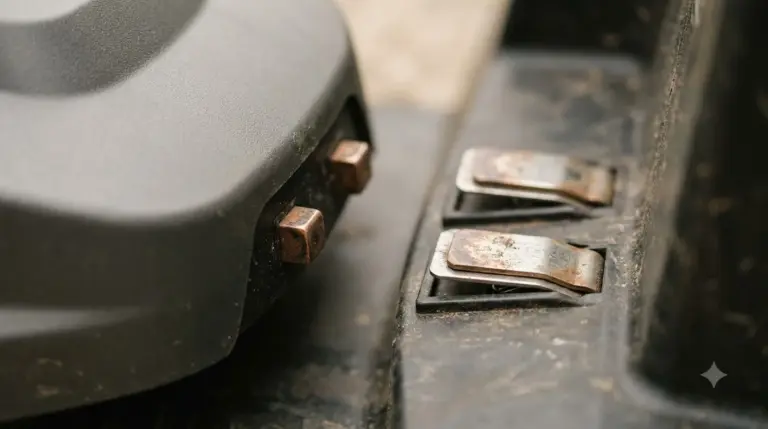
Always disconnect the charging station from power before you work on the wire. After the repair, check whether the error clears. If the LED stays lit, press the connector together again, because a second break somewhere along the loop can leave the error on.
Wire too close to a slope or obstacle
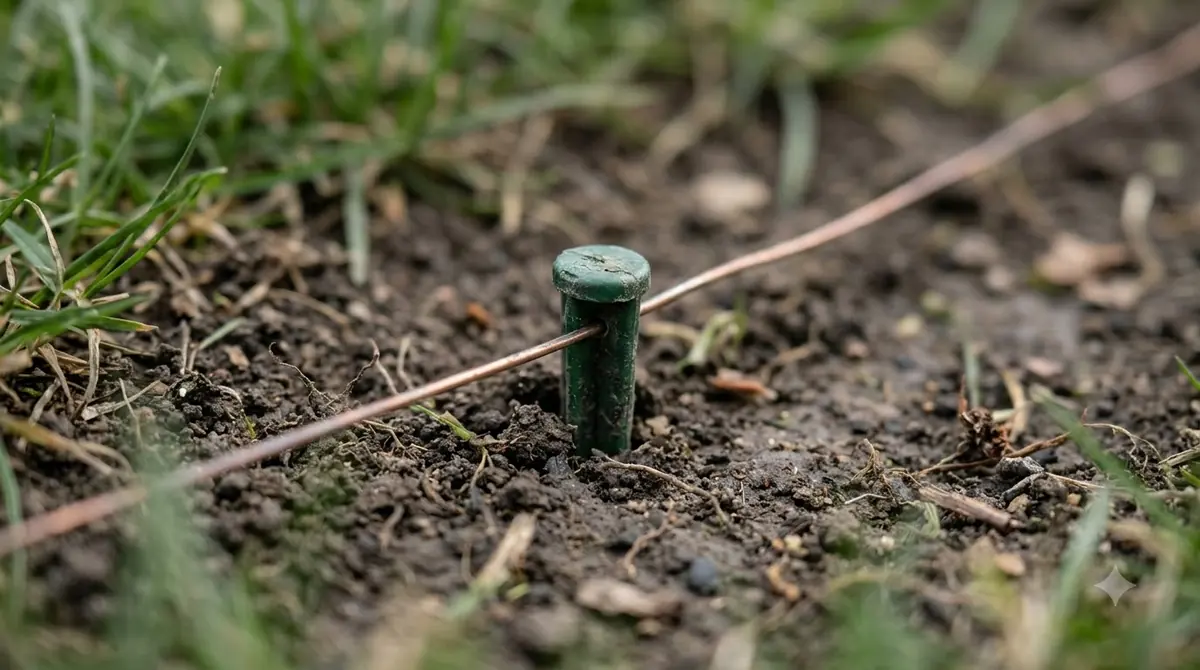
Sometimes the wire is intact but placed where the mower does not expect it. Husqvarna describes an “outside work area” error as a loop signal that tells the mower it is outside rather than inside the work area. One of its listed causes is a boundary wire placed too close to a slope or obstacle, and the article says the wire should normally keep a minimum margin of 35 cm. A path that wanders near the edge can be mistaken for a wire fault, as described in a mower drifting outside the boundary.
That margin is a manufacturer figure, so check your own model’s manual before moving anything. Our reading is that a wire running close to a retaining wall, a steep bank, or a garden bed is the most likely place for this problem, so measure there first.
Station pins and the direction of the loop
The same Husqvarna article lists two more causes that reverse the signal. The first is a boundary wire connected to the wrong pin on the charging station, which produces an outside-in loop signal. The second is a wire routed the wrong way around an island, which does the same thing. Both are fixed by checking the wiring rather than the mower. Husqvarna owners will find Husqvarna Automower guide wire faults useful when the station loop is the likely culprit.
Check the wire at the station against the diagram in your manual, and confirm that each island loop runs in the direction shown there. If the wire was reconnected after a repair, this is the first place to look, because a swapped pair is easy to miss.
Read the error code before you dig
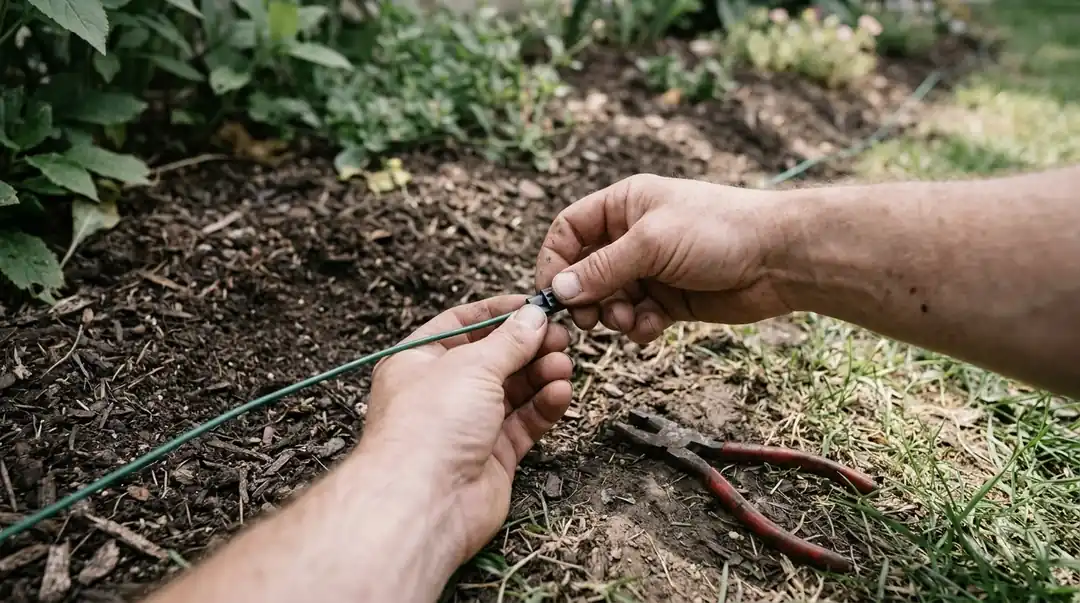
Before you walk the whole wire, look at what the mower says. A message about the loop or the work area points to the wire or the station, while a message about a bump or a stuck wheel points to the mower’s sensors or the ground. Writing down the code and the time it appeared helps, because the same error can come from different causes depending on where the mower was when it stopped. Most error codes point to the loop itself, and what a no loop signal error means explains the usual causes.
Next, note where the mower stops. If it always stops at one spot, the wire near that spot is the first suspect, since a break or a tight bend is usually fixed locally. If it stops at random points across the lawn, the problem is more likely the station connections or a loop that has become too long for the signal, and that is worth checking with the manual’s loop length figure.
Shortening the wire is sometimes suggested as a fix when a mower stops inside the work area. That should only be done if the loop is genuinely too long for the signal, and only after the connectors have been checked. Cutting wire without a reason just creates another joint to fail.
Frequently asked questions
What does a flashing light on the charging station mean?
Robomow says an LED often flashes on the charging station when the boundary wire is broken or the connection is weak. Check the wire from the station outward, starting at the connectors near the station.
How do I find a break in the boundary wire?
One method is to tune an AM radio to an empty frequency and move it along the wire. A hiss is heard where the wire is intact, and the hiss stops at the break. Disconnect the charging station before testing.
How far should the boundary wire be from a slope?
Husqvarna says the wire should normally keep a minimum margin of 35 cm from slopes and obstacles. Use the distance in your own model’s manual, since makers differ.
Will the error clear after a repair?
It should, once the break or poor connection is fixed. If it does not, check for a second break, a connector that is still loose, or a wire that was reconnected to the wrong pin.
Sources
- Repair defective boundary wire (Robomow): signs of a broken wire, how to find the break, gel-filled connectors, and testing the repair.
- Outside work area: Automower error message (Husqvarna): the outside-in loop signal, the 35 cm margin, station pin and island direction causes.
 Up next6 min readLearnWhy Does My Robot Mower Keep Going Back to the Charger?Updated Nov 14, 2026
 6 min readLearnWhy Does My Robot Mower Keep Going Back to the Dock?Updated Nov 14, 2026
 8 min readLearnWhy Does My Robot Mower Keep Losing RTK Signal?Updated Nov 10, 2026
 7 min readLearnWhat Is a Boundary Wire on a Robot Mower? How It WorksUpdated Nov 11, 2026
 9 min readLearnHow to Install a Robot Mower Boundary WireUpdated Nov 11, 2026
 7 min readLearnWhy Does My Robot Mower Smell Like Burning?Updated Nov 13, 2026