

Can a robot mower work in a lawn on both sides of the house? Yes, if the two sides are set up as one work area or as two linked areas. The deciding factor is whether the mower can drive from one side to the other through a passage. If it cannot, the far side needs its own boundary wire loop, or the mower has to be moved there by hand.
The short answer
- Connected by a drivable passage, one setup works. Husqvarna’s passage guidance asks for at least 60 cm (24 in) between boundary wires when a guide wire leads the mower through, and 2 m (6 ft 6 in) without one.
- Not connected, the far side needs a secondary area or its own loop. Husqvarna says the mower must be moved there by hand, and Robomow says a separate zone is out of the mower’s reach.
- Wire-free mowers can use a mapped path. Anker’s eufy guidance describes a flat, passable pathway of 1 to 60 m between zones.
Most of the decision comes down to the gap between the two sides, not the house itself. That is the practical answer to “can a robot mower work in a lawn on both sides of the house”. Measure the passage, find where the charging station can go, and check whether your model supports the layout you need before you buy or install anything.
Can a robot mower work in a lawn on both sides of the house?
So can a robot mower work in a lawn on both sides of the house? Only when the mower can reach the far side and return to its charger from there. A house usually cuts a lawn into a front and a back section that are not joined by open grass. The mower has to be able to reach the far side, and it also has to be able to return to its charger from there. A zone that is far from the dock needs a safe route back to the charger.
Wired systems define the layout with boundary wire, and wire-free systems define it with points set in an app. In both cases the route between the two sides has to be planned during setup.
Option 1: one loop with a drivable passage
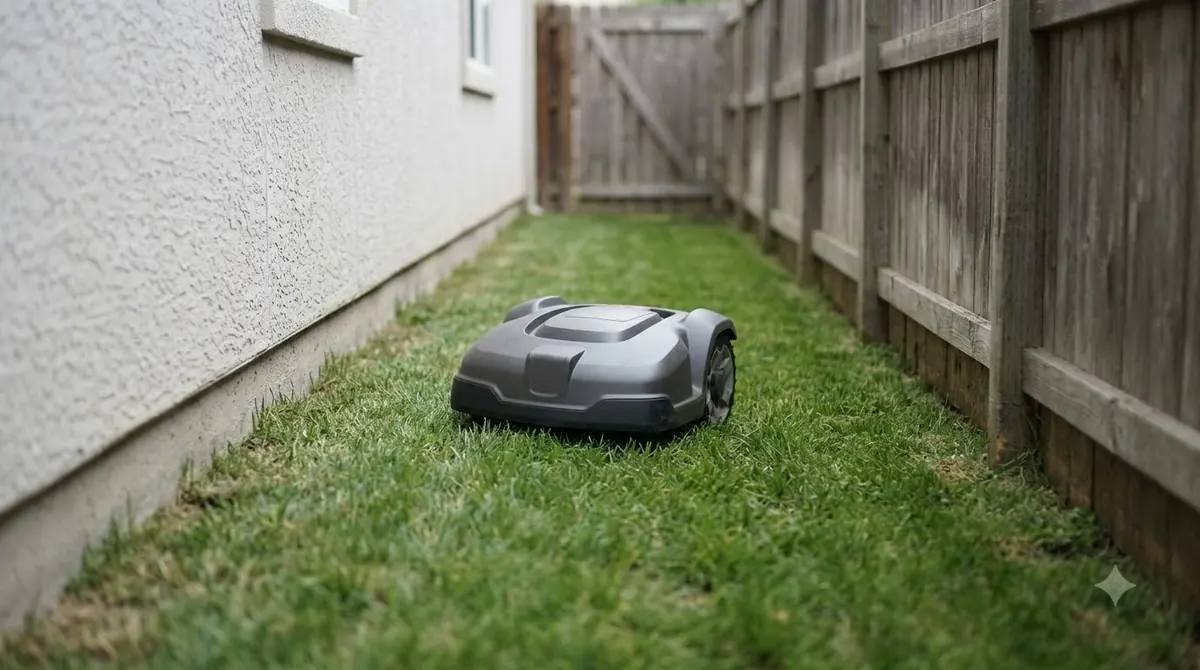
If the two sides are linked by a strip of lawn or a drivable path, the simplest setup is one boundary wire loop around the whole area, and laying boundary wire around trees and obstacles covers the routing basics. Husqvarna’s guidance describes a passage as a narrow section with boundary wire on each side that connects two parts of the work area. Robomow describes the same idea as a secondary zone that is much smaller than the main zone and linked to it by a passage.
Passage width is where most setups go wrong, and our guide on how robot mowers deal with narrow paths goes deeper on the manufacturer figures. Husqvarna recommends at least 2 m (6 ft 6 in) between the boundary wires when there is no guide wire. With a guide wire, which steers the mower through the gap, the minimum drops to 60 cm (24 in). The guide wire itself should sit at least 30 cm (12 in) from the boundary wire. Our reading: a guide wire saves space, but it leaves less margin for error, so measure the real gap before you assume it fits.
Husqvarna also says its 435X AWD and 535 AWD models should use a 2 m (6 ft 6 in) passage for a good cutting result.
Option 2: a secondary area or a separate loop
When there is no drivable connection, you have two common choices. The first is a secondary area. Husqvarna describes it as a part of the lawn that is not connected to the main area by a passage the mower can travel. The boundary wire still forms one loop around the full work area, but the mower is moved to the secondary area by hand and runs there for a set time or until the battery is empty. It does not search for the charger, so you must bring it back yourself and switch it back to Main area mode.
The second choice is a separate zone with its own setup. Robomow says a separate zone cannot be reached from the main zone, so the mower cannot get there on its own. Its suggested routes for linking it include running one shared wire around the house, for example along the gutter or through the basement, laying a passage, adding a second charging station, or using a signal transmitter. Robomow notes that a transmitter is simpler but is not available on every model.
Husqvarna’s secondary area guidance gives a recommended maximum boundary wire length of 800 m (2,600 ft), or 300 m (980 ft) for Aspire R4 models. These are recommendations, not hard limits, but they are a useful check if you plan to run one long wire around both sides of a large house. How much boundary wire you need helps with the estimate.
Wire-free mowers and transit paths
Wire-free mowers do not need a passage wire, so for some owners the question “can a robot mower work in a lawn on both sides of the house” is easier to answer with an app. Instead, you map the lawn and draw a route between the two areas in the app. Anker’s guidance for the eufy C15 describes a pathway of 1 to 60 m that should be flat and fully passable. It advises mapping the route as a non-mowing connection and running supervised tests in both directions.
The same page gives a general clearance of around 80 to 100 cm as a starting point, but it is not a C15 specification and it says your model may need more or less. Anker says the mower must be able to return to its charger from every connected zone, not just the far lawn.
Passage numbers, and where sources disagree
The sources do not give the same passage width, so it helps to see them side by side before you measure. The table below lists the figures from each source as they appear on the page. It is a reading guide, not a recommendation for one brand over another.
| Setup | Figure from the source | Source |
|---|---|---|
| Passage, no guide wire | At least 2 m (6 ft 6 in) between boundary wires | Husqvarna passage article |
| Passage, with guide wire | At least 60 cm (24 in) between boundary wires | Husqvarna passage article |
| Guide wire placement | At least 30 cm (12 in) from the boundary wire | Husqvarna passage article |
| Passage, general | Passages about 1 m wide | Robomow blog |
| Wire-free pathway | 1 to 60 m long, flat and passable; around 80 to 100 cm clearance as general guidance | Anker UK (eufy C15) |
The Husqvarna and Robomow figures do not match, and that is worth noting. Our reading: treat the manufacturer’s manual for your exact model as the final word, and use the 2 m figure as a safe target when the gap allows it. A gap near 60 cm should be tested carefully, with the guide wire placed and the mower watched through the passage before you rely on it.
What to check before you decide
To answer “can a robot mower work in a lawn on both sides of the house” for your own lawn, check these in order. Each step can rule out an option quickly.
- Measure the gap. Find the narrowest point between the two lawn areas and compare it with 60 cm, 1 m and 2 m.
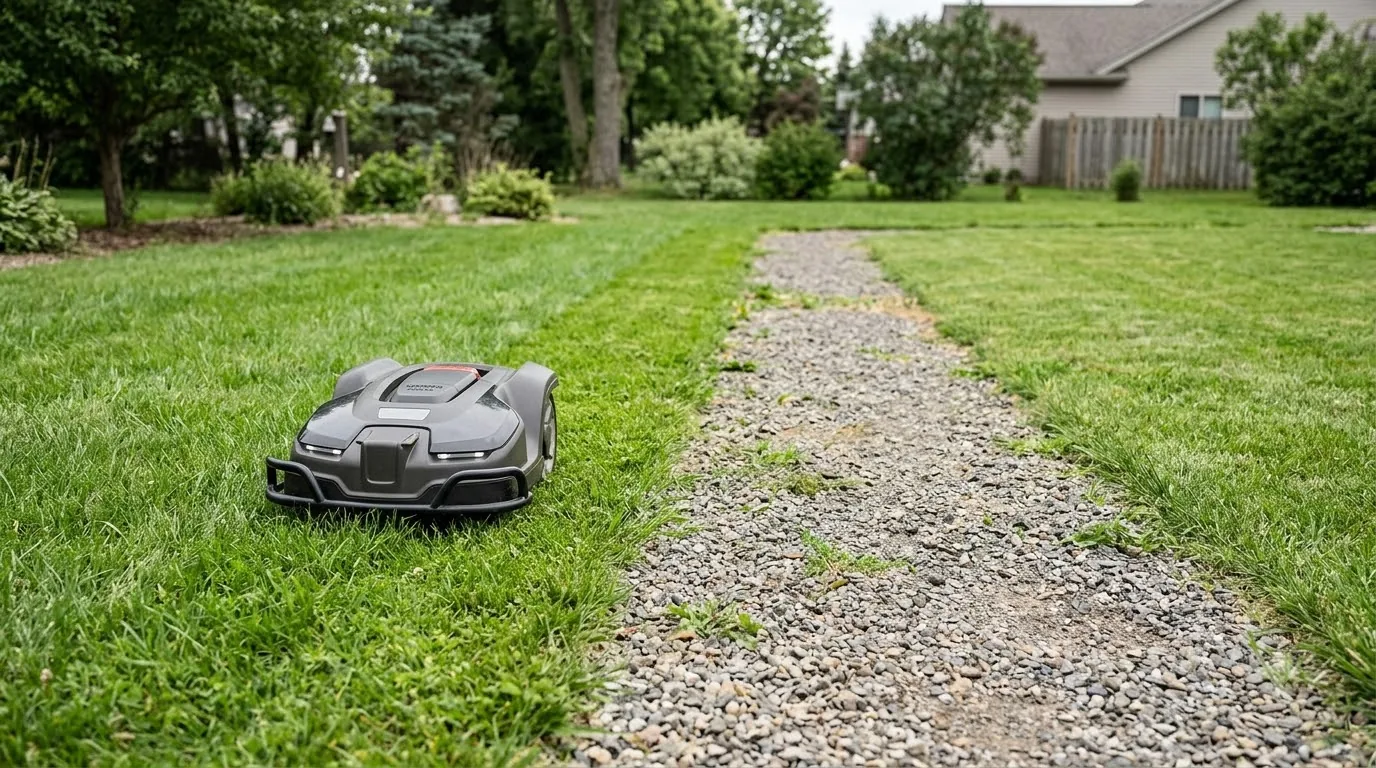
- Check the surface. A wired passage can be grass, but a wire-free path must be flat and passable, so gravel or steps change the answer. Gravel path crossings are a common example.
- Find the charger spot. Each side should be able to reach the charger, or you need a second station or a manual return plan. See where to put a robot mower charging station.
- Mark stay-out zones. Flowerbeds, a gravel patch or a garden bed beside the passage must stay clear of the route. Our reading: draw the route first, then the zones.
- Confirm the model supports it. Secondary areas, transmitters, transit paths and guide wires are not offered on every model, so check the manual before you buy.
Frequently asked questions
Can a robot mower work in a lawn on both sides of the house if there is no passage?
Yes, with conditions: the two sides need a passage the mower can drive through, or the far side must be set up as a secondary area. Husqvarna’s secondary area guidance says the mower must be moved there by hand and returned to the charger manually.
How wide does the passage between the two sides need to be?
Husqvarna recommends at least 2 m (6 ft 6 in) between the boundary wires without a guide wire, and at least 60 cm (24 in) with one. Robomow gives about 1 m. The manual for your model is the final guide.
Can the mower find its own way back to the charger from the far side?
Only if the far side is part of the connected loop and the route is open. In a secondary area, Husqvarna says the mower does not search for the charger, so the owner must return it. Wire-free mowers should be able to return from every connected zone.
Do wire-free mowers handle two sides of a house better?
They can map a route between two areas, but the path has to be flat and passable. Anker’s guidance for the eufy C15 gives a pathway of 1 to 60 m. Our reading: a wire-free mower is worth considering if the gap is awkward for a wire, but test the route in both directions before you rely on it.
Sources
- How to create a passage in an Automower installation (Husqvarna): passage widths with and without a guide wire, guide wire placement, and the 435X AWD and 535 AWD note.
- How to create a secondary area in Automower boundary wire installations (Husqvarna): secondary area definition, single loop, manual return, and wire length recommendations.
- Can the robotic lawnmower mow multiple areas or zones (Robomow): separate zones, wiring routes, transmitters and the roughly 1 m passage figure.
- Robot lawn mower cross path (Anker UK, eufy C15): pathway length, flatness, mapping and charging from linked zones.
 Up next8 min readBy YardRobot Mower for Narrow Side Yard Passages: What Widths Work?Updated Nov 11, 2026
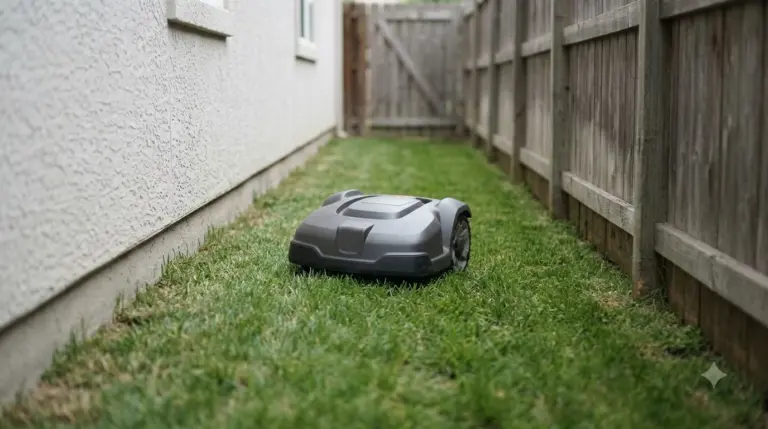 8 min readBy YardRobot Mower for Lawn Next to a Two-Story House: What to CheckUpdated Nov 11, 2026
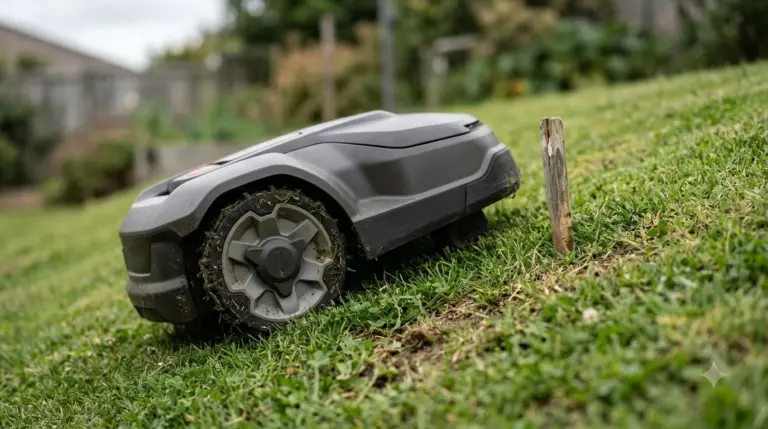 9 min readBy YardRobot Mower for Side Slopes and DitchesUpdated Nov 11, 2026
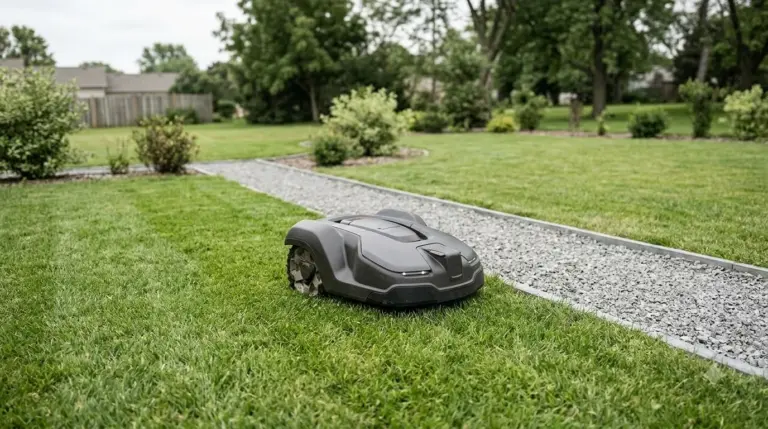 9 min readBy YardCan a Robot Mower Work in a Yard With a Gate Between Zones?Updated Nov 11, 2026
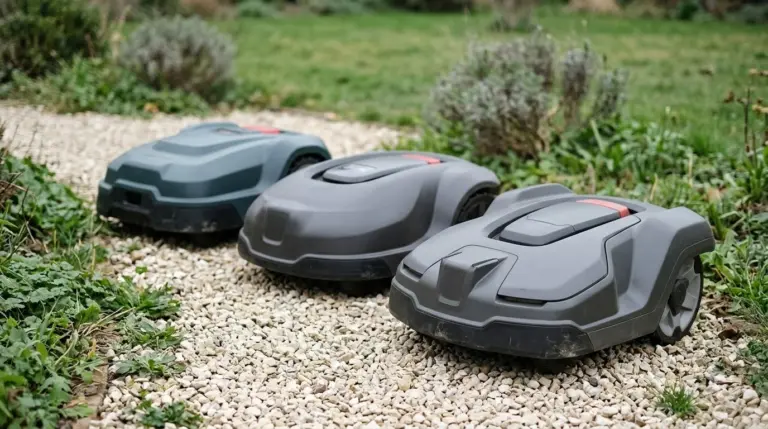 8 min readBy YardCan a Robot Mower Work in a Yard With Gravel Path Crossings?Updated Nov 11, 2026
 8 min readBy YardDo Robot Mowers Work on Bumpy Lawns? What to Know FirstUpdated Nov 11, 2026