
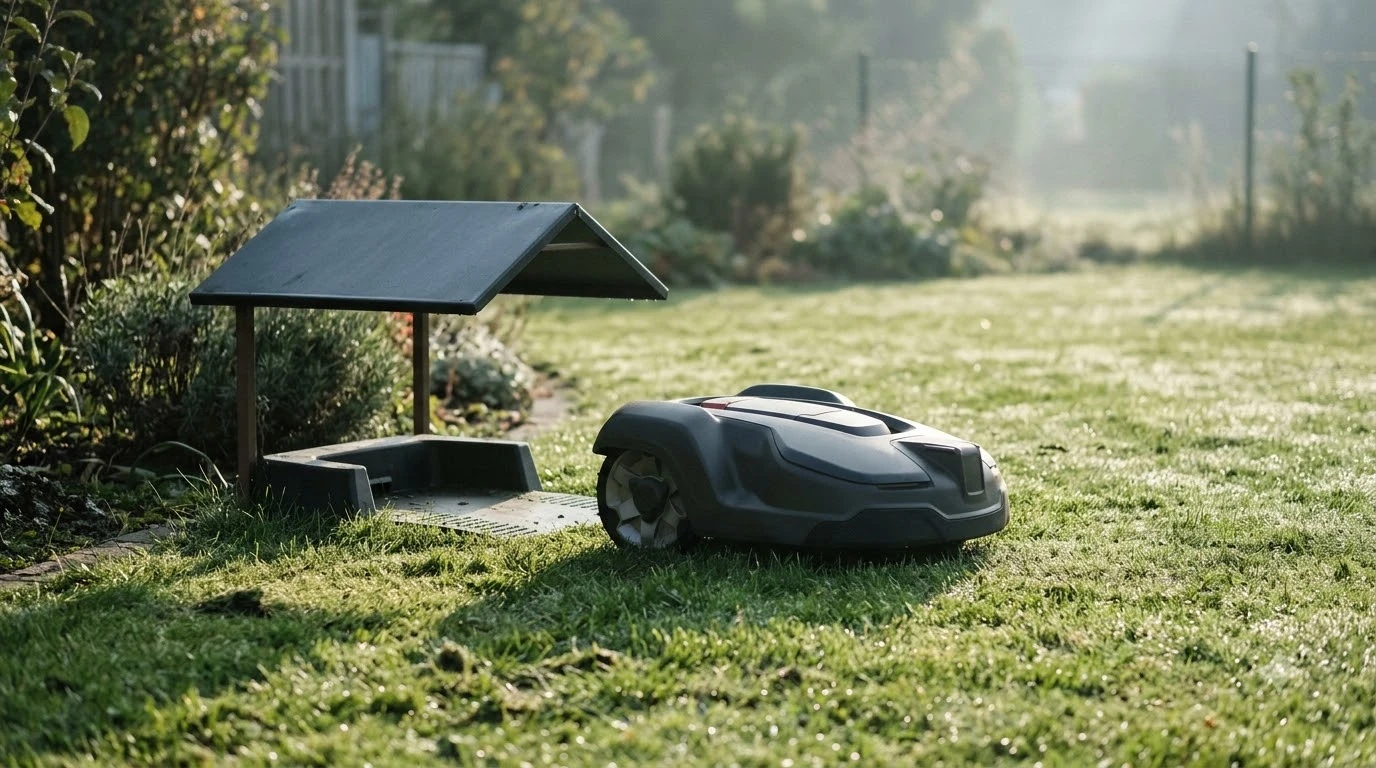

The best pet fence to keep dogs away from robot mower areas depends on how your mower finds its boundary. Two routes are common: a buried containment wire that a dog’s collar responds to, or the mower’s own no-go zones. Wire systems need careful placement, because nearby signals can disturb each other.
The short answer
- Match the fence to the mower. Check whether your mower uses a buried boundary wire or a wire-free boundary.
- Keep the wires apart. DogWatch says the two signals should be far enough apart not to interfere, and the wires should not cross.
- Do not rely on sensors alone. Manufacturer material says small or still pets may not be detected.
- Supervise dogs. One manufacturer advises mowing in daytime and keeping pets indoors while the mower runs.
How a pet fence and a robot mower share a yard
Most dog fence systems and most robot mowers both use radio-type signals, so they can share a yard but may interfere when placed close together. DogWatch, a dog fence maker, says most dog fence systems use an AM radio frequency similar to most robot mower signals. Its own system uses a digital FM signal, which it describes as less susceptible to interference.
That detail matters because a pet fence and a mower boundary are two separate loops of wire. Our reading is that the signal type is a question to ask before you buy, not a guarantee of trouble. These are statements from a fence vendor, so check the frequency listed in both the mower and fence manuals.
Why the two wires can interfere
Interference usually happens when the two wires run close together or cross, and moving one of them is the usual fix. DogWatch advises that wires should not come close to each other or intersect. Its UK dealers report that moving the wires can solve the problem, and in other cases a quick change of the fence frequency does the trick. The article gives no distance, so do not treat any number as a rule.
Gardenia Organic, a garden products website, makes the same point from another angle. It says interference depends on the particular mower, the pet fence transmitter and the installation, and it advises asking both manufacturers or a qualified installer about compatibility and the separation each system allows. Our reading is that the safest answer is a written spacing figure from the two makers, not a general rule.
The mower’s own wire is also a single point of failure. According to Robomow, the charging station sends an electrical impulse along the boundary wire, and a break stops the mower and shows an error until it is fixed. A second wire laid nearby adds one more place where a fault can start.
Keep the mower wire and the fence wire apart
Lay the pet fence wire on its own route, sketched before anything is buried, so the two loops never touch. The steps below follow the advice from DogWatch and Robomow, which are the two sources we read on this point. See also how to install a robot mower boundary wire covers the basics.
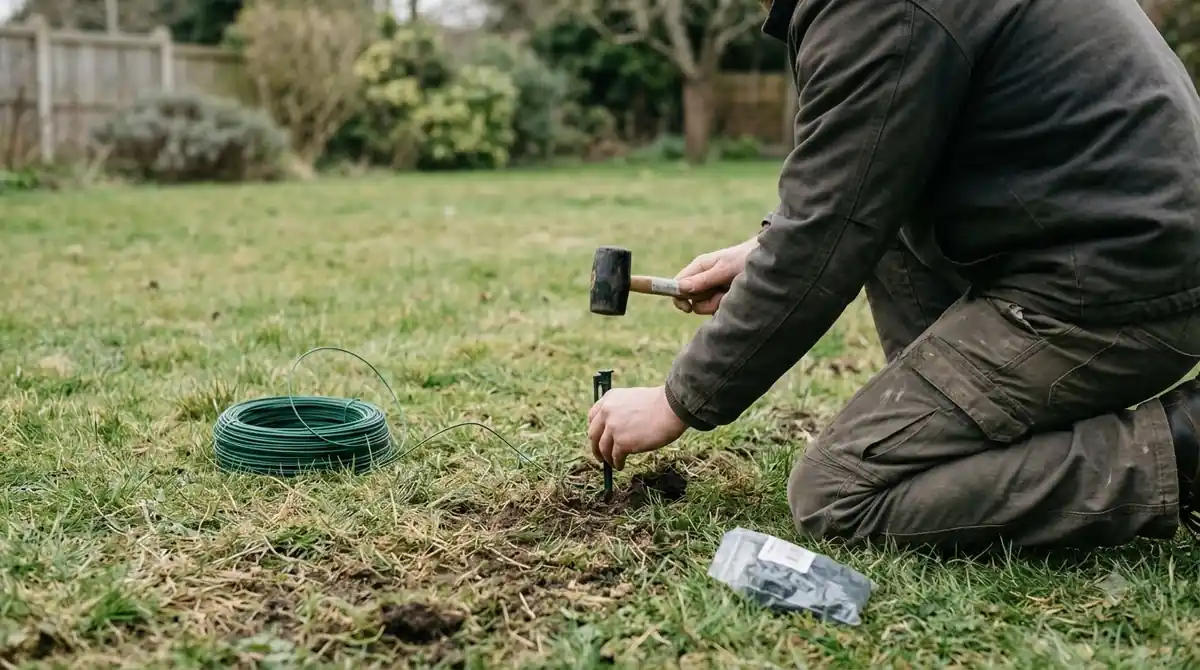
- Map both loops. Sketch the mower boundary and the pet fence on paper before you dig or stake anything.
- Keep the wires apart. DogWatch says the wires should not come close or intersect. Gardenia Organic adds that the mower wire must not touch or cross itself at any point in the loop. Follow your mower manual for the spacing it requires.
- Do not pull the mower wire tight. Robomow says above-ground cable must not be too taut, which can damage the mower’s wire.
- Test after installation. Robomow describes a fast red LED on the charging station for a broken connection and a slow red LED for a weak one. The Robot Mower, a UK robot mower website, says the most likely break points are wire joints, and it recommends a good-quality connector rather than tape.
Best pet fence to keep dogs away from robot mower: options compared
Three approaches can keep dogs out of the mowing area, and the sources we read support each one with different limits. The table compares how each works and what the source material says about it.
| Option | How it works | What the sources say |
|---|---|---|
| Buried pet containment wire | A collar receiver responds to a boundary wire around the yard | Usually AM, can clash with mower wire if placed too close (DogWatch) |
| Mower no-go zones (RTK or virtual boundary) | Exclusion areas are set in the mower’s app | Company claim. RTK accuracy may weaken under dense trees or near buildings (Anthbot) |
| Physical fence or gate | A barrier keeps the dog off the lawn | No signal to interfere with the mower. We did not find a sourced product spec for this option |
A physical barrier is the simplest option, but it does not fit every yard. Our reading is that the choice comes down to whether you need the dog to stay out of one zone or stay inside a whole yard. Gardenia Organic also recommends a secure physical boundary, or keeping pets elsewhere, while any pet fence is being tested. For a barrier-based yard, see robot mowers in a fenced backyard, and for the app side see how to set up no-go zones on a robot mower.
Do robot mower sensors protect dogs
Lift and tilt sensors stop the blades when a mower is picked up or flipped, and a front bumper handles light contact, according to Anthbot. The company says the blades stop within seconds after an obstruction, but it gives no measured response time, so treat that as a claim.
Heads up
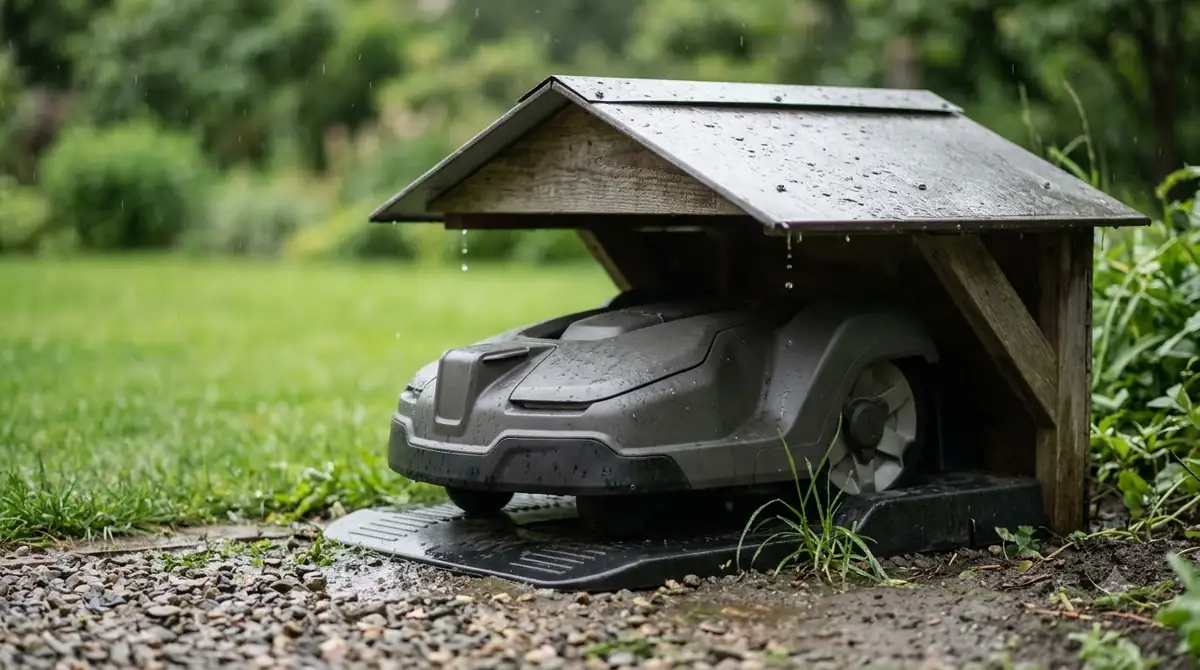
Anthbot says very small animals may not be recognized in time. Still or sleeping pets in tall grass or shade may not trigger detection, and dust or mud on sensors reduces accuracy. The page does not mention small dogs by name, so that is a gap in the evidence.
Sensor claims come from manufacturers, and we did not find independent testing of pet detection rates. For that reason, sensors should be treated as one layer of protection, not a substitute for the best pet fence to keep dogs away from robot mower areas. Anthbot itself recommends supervising pets and keeping them indoors while the mower runs. For more on the behavior side, see whether robot mowers stop for animals and how a robot mower works with a dog in the yard.
What to check before you buy
When you shop for the best pet fence to keep dogs away from robot mower yards, start with how the mower finds its boundary, then match the fence to it. Use these checks before you buy either system.
- Whether the mower uses a buried boundary wire or a wire-free boundary such as RTK or LiDAR
- The signal type listed for the pet fence, and whether it is AM or FM
- A wire route that keeps both loops apart, with no crossings
- The sensor and no-go zone limits in the spec sheet, including what the vendor says about small pets
Our reading is that the best pet fence to keep dogs away from robot mower yards is the one whose signal, wire route and fault checks you have confirmed with both manufacturers. Even then, a pet fence does not replace supervision while the mower runs.
Frequently asked questions
Can a dog fence and a robot mower work together?
Often, but not always. DogWatch says most dog fences and most robot mowers use AM signals, and its digital FM design is less susceptible to interference. Wire placement matters most, so keep the two loops apart.
Do robot mowers stop when a dog touches them?
Lift and tilt sensors stop the blades when a mower is lifted or flipped, and a bumper handles light contact, according to Anthbot. Sensors may miss small or still pets, so supervise dogs while the mower runs.
What does a broken mower wire look like?
Robomow says the charging station shows a fast red LED for a broken connection and a slow red LED for a weak one. The mower stops and shows an error until the fault is fixed.
Do wire-free mowers avoid this problem?
A wire-free mower avoids the boundary wire clash, but its no-go zones depend on RTK or LiDAR. Anthbot says RTK accuracy may weaken under dense trees or near buildings, so check the spec sheet for your yard.
Sources
- DogWatch article on robot mowers and pet fence signals (fence maker): AM/FM signal type, wire spacing and interference fixes.
- Robomow, repair defective boundary wire (mower maker): boundary signal, break behaviour, LED codes and wire tension.
- Anthbot, how safe are robot mowers around pets (mower maker): lift and tilt sensors, bumper, detection limits and no-go zones. Company claims, not independent tests.
- Gardenia Organic, do robotic mowers have issues with dog fences (garden products website): compatibility advice, wire rules and testing precautions.
- The Robot Mower, what happens if the perimeter wire gets broken (UK robot mower website): common break points and how to find a break.
 Up next8 min readGearBest Garden Hose Reel to Keep Away From Robot MowerUpdated Nov 11, 2026
 8 min readGearBest Garden Fence for Robot Mower No-Go Zone: What Works and What Doesn’tUpdated Nov 11, 2026
 7 min readGearBest Cut Resistant Gloves for Changing Robot Mower Blades: What to CheckUpdated Nov 11, 2026
 8 min readGearBest Metal Robot Mower Shelter: What to Check Before You BuyUpdated Nov 11, 2026
 8 min readGearBest Leaf Blower for Robot Mower Lawn CleanupUpdated Nov 11, 2026
 7 min readGearBest Outdoor Surge Protector for Robot Mower: What to Check Before You BuyUpdated Nov 11, 2026