
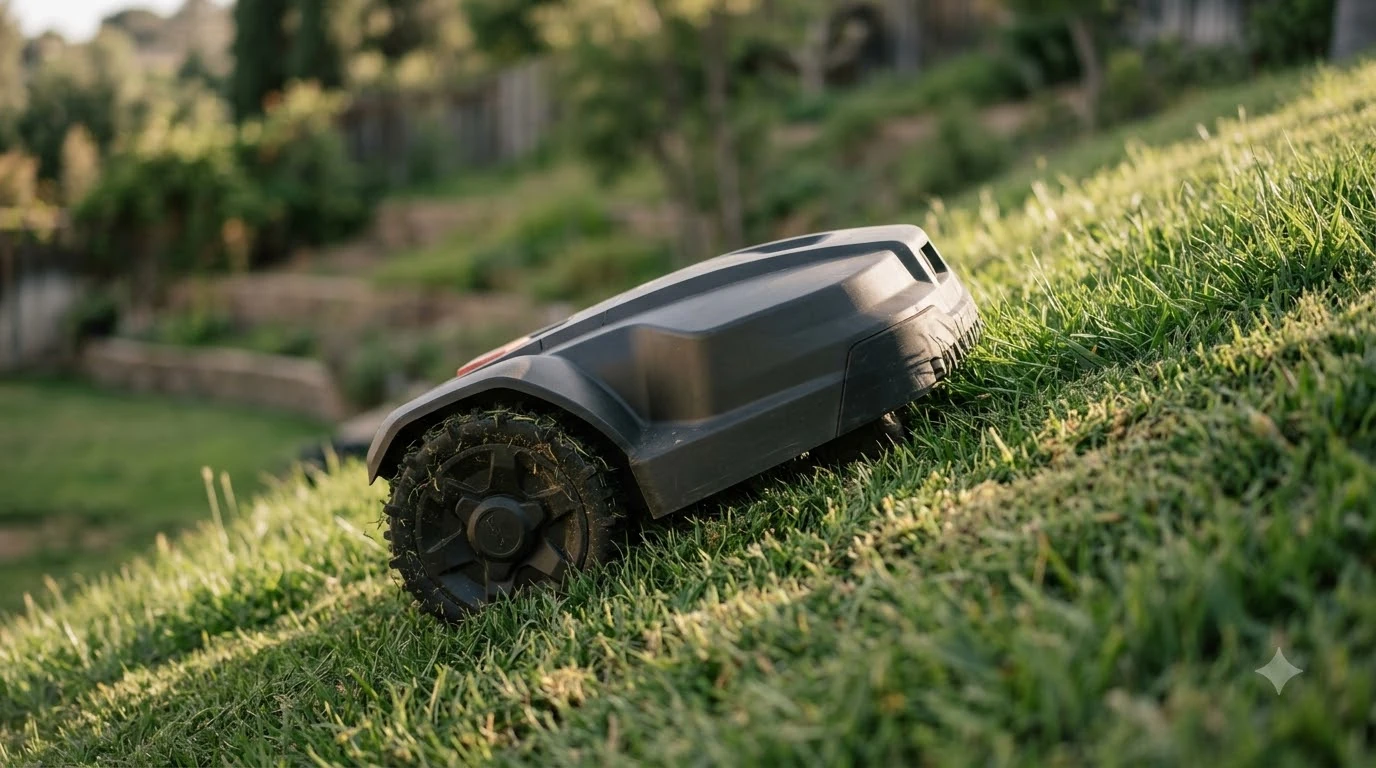

A robot mower for terraced yard lawns can work well if the boundary stays back from every bank, wall and drop, and each steep bank is checked against the model’s slope limit on its own. A terrace is a level tread joined to the next one by a steeper bank, so the flat treads and the banks need different answers. Read the work-area and boundary limits in the manual before you choose a model.
The short answer
- Treat each level like its own zone: flat treads are usually the easy part, while the banks between them decide whether the mower can go there.
- Measure each bank separately: use rise over run on the steepest part of each bank, not the average across the terrace.
- Keep the boundary off the edges: stop the wire well short of a bank top, wall or drop, and move it inward where the outer edge is too steep.
- Isolate what the mower cannot climb: use a wire island or a stay-out zone for banks above the model’s limit, and leave the steepest banks to plants.
Why a terraced yard is a different job for a robot mower
Iowa State University Extension describes terraces as flat areas created on a slope with retaining walls, boulders, field stones, bricks or wooden timbers, usually to slow runoff. For a robot mower, that means a terraced lawn is really a stack of small, mostly level lawns with steep banks in between. The level treads are the part a robot mower can usually cover, and the banks are where slope ratings, boundary rules and obstacle clearances start to matter.
Our reading is that the question to ask is not “is my yard steep?” but “which parts are steep, how steep are they, and where does the boundary need to stop?” A yard with three treads and two banks may need three different answers, even if the overall lot looks uniform from the street.
Measure each tread and each bank separately
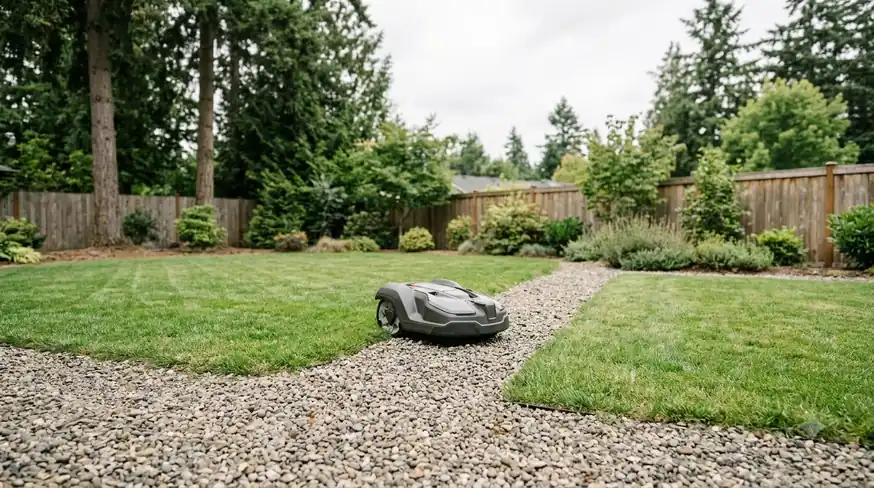
Measuring is the first step for any robot mower for terraced yard lawns, since the answer changes from bank to bank. Iowa State describes slope as rise over run, and it can be written as a ratio or a percentage, so a 1:12 slope equals 8.33 percent. Measure the drop across the steepest part of each bank, and keep the largest figure you find (our guide on how to measure yard slope shows the method). Averaging the whole terrace hides the spot where the mower would be asked to climb hardest.
The extension also gives useful thresholds for planting and mowing. Slopes of 20 percent (1:5) or more are considered steep, and slopes of about 30 percent (1:3) or more are too steep to mow, which is why plants other than turfgrass are recommended there. Those figures are landscape guidance, not robot mower ratings, but they help you sort banks into “mowable with a robot,” “borderline” and “keep out.”
- Mark the bank edges. Note where each tread ends and each bank begins, since the boundary has to be placed relative to those lines.
- Measure the drop. Lay a straight board across the bank, level it, and read the vertical drop with a tape at the steepest point.
- Divide and convert. Divide the drop by the horizontal run and multiply by 100 for percent, then check the manual’s unit before comparing it with a model rating. See how robot mower slope ratings work if percent and degrees confuse you.
Keep the boundary off the bank edge
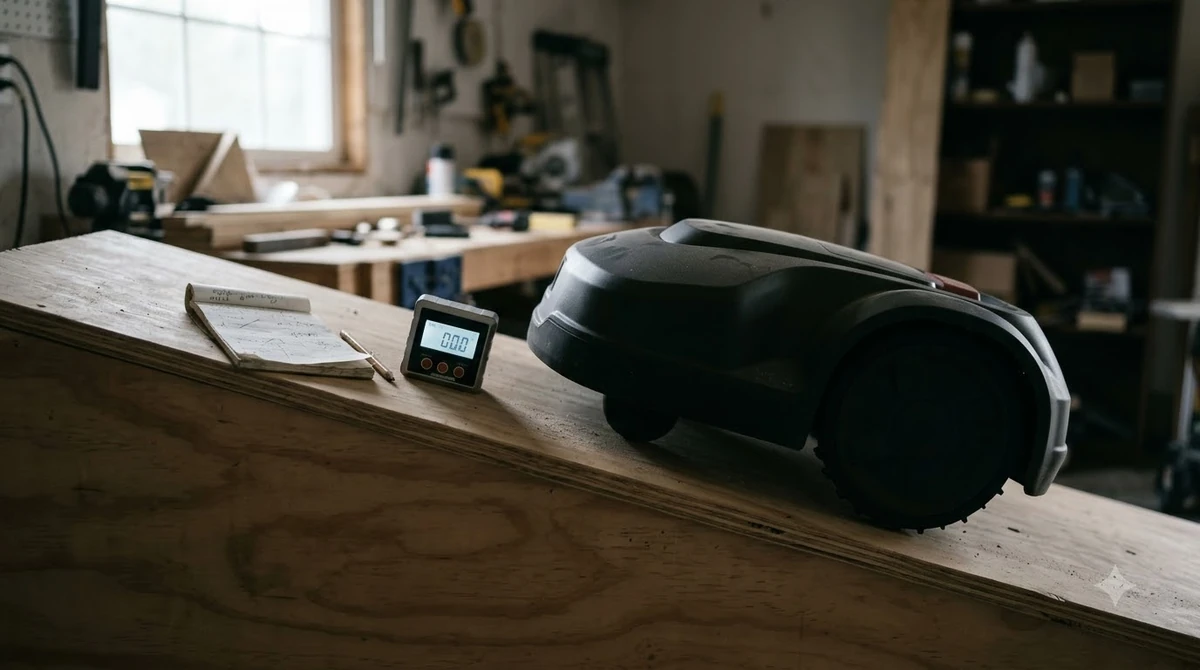
Husqvarna’s installation guidance for steep slopes says that if the outer edge of the work area is steeper than the mower’s limit, the boundary should move inward onto flat ground before the slope begins. On AWD models working slopes between 50 and 70 percent, the page gives a clear figure: keep 1.5 m (5 ft) from the bottom of the slope to the boundary wire.
The same page does not cover drop-offs or retaining walls, so it gives no number for the gap at the top of a terrace wall; our page on a robot mower for a yard with retaining walls looks at that case. Our reading is that a wall or drop at the top of a bank needs at least the same margin as a slope edge, and that you should confirm the exact clearance in the manual for your model.
Plan the transition from tread to bank
Where a flat tread meets a steep bank, the transition matters for any robot mower for terraced yard use. Husqvarna’s AWD guidance calls for at least 50 cm (1.6 ft) of level ground between flat areas and steep slopes. That gap gives the mower a place to straighten out before it starts to climb, rather than turning on the incline itself.
For AWD models on slopes up to 50 percent, the same page asks for 1.5 m (5 ft) between the boundary wire and obstacles, so in our reading a bench or planter near a bank should be counted into that clearance (see laying boundary wire around obstacles). In a terraced yard, that often means the mower’s usable width on each tread is smaller than the tread looks.
Wire layout and stay-out zones
Husqvarna says that areas steeper than the mower’s limit should be isolated, not left inside the work area. On physical-wire models, that means a boundary wire island around the bank, or an AIM stay-out zone where the model supports it. On wire-free systems, the same page describes stay-out zones around slopes beyond the limit. It also states that areas too steep for the mower must be excluded from the installation.
For the guide wire, the page advises laying it diagonally across the slope on physical-wire installs, for better traction and less grass wear. For AWD models, it suggests a straight line or a diagonal running from the bottom of the slope to the top.
| Option | What it does | Where it fits |
|---|---|---|
| Boundary wire island | Keeps the mower off a bank with physical wire | Wire-based installs where the bank is too steep to mow |
| AIM stay-out zone | Excludes a bank without an extra wire loop, where supported | Models that list the feature in the manual |
| EPOS stay-out zone | Excludes a bank in a wire-free setup | Wire-free models that support zones |
| Bank left unmowed | Plants or turf kept by hand or by another method | Banks above the model limit, or near a wall top |
Do not mow the steepest banks
Iowa State notes that mowing on an incline is “inconvenient and possibly dangerous,” and that slopes of about 30 percent or more are too steep to mow at all. In our reading that applies to robot mowers too, so the robot mower is not a reason to keep a very steep bank in turf; the guide on whether robot mowers tip over on hills adds the safety angle.
If a bank is too steep, the extension suggests planting it with something other than turfgrass, so the bank stays covered. Where new turf is laid on a slope steeper than 10 percent, it should be staked, with two or three wooden stakes or sod staples per strip. Our reading is that a robot mower works best on a bank that is turf now, with a margin below its rated limit, and that a bank that has been replanted may be a better place for a border than for turf.
Check work-area and boundary limits per model
Manufacturers often give two slope figures: the work-area limit and the boundary limit. Husqvarna’s steep-slope page lists per-model values, and standard Automower models are rated from 25 to 50 percent, with the 435X AWD up to 70 percent. The boundary figure can be lower. For the 435X AWD, the page lists a higher work-area figure than its boundary figure, so the edge of a terrace is not always rated the same as its middle.
Our reading is that a robot mower for terraced yard lawns should be compared against the lower of the two figures for any bank that sits near the boundary, and against the work-area figure for banks inside it. A rated limit is a ceiling, not a daily target, so a bank close to the rating is better treated as a bank to avoid.
What to check before you buy a robot mower for terraced yard use
Use this checklist with your own measurements in hand, before you compare any robot mower for terraced yard lawns against the manual’s limits.
- Map the treads and banks. Sketch each level and each bank, with its approximate length and width.
- Measure the steepest point of each bank. Record rise over run, then convert to percent so it matches the manual.
- Compare with both limits. Check the work-area and boundary figures for each model, and keep a margin below the lower one.
- Plan the boundary line. Keep the wire off bank edges and wall tops, and leave level ground at each transition.
- Decide what stays out. Mark banks for a wire island, a stay-out zone, or planting, and confirm the installer knows which.
Frequently asked questions
Can a robot mower for terraced yard lawns go up and down the banks?
It depends on the steepest bank and the model’s rated slope. Iowa State describes steep ground as 20 percent or more, and too steep to mow at about 30 percent or more. Check each bank against the manual’s work-area and boundary figures before you assume the mower can reach it.
Do I need a boundary wire around the wall at the top of a terrace?
Keep the boundary well back from the edge of the wall or drop. The Husqvarna steep-slope guidance gives a 1.5 m (5 ft) setback from the bottom of an AWD slope, but it does not cover drop-offs or retaining walls, so confirm the clearance for your model in its manual.
What is the difference between a work-area slope limit and a boundary limit?
In Husqvarna’s table the work-area limit is the maximum slope inside the work area and the boundary limit is the maximum slope at the boundary. The two can differ, and for some AWD models the boundary figure is lower, so a bank at the edge of a terrace may need the lower number.
Should I mow the steepest banks on a terrace or plant them instead?
Iowa State says slopes of about 30 percent or more are too steep to mow and are better planted with something other than turfgrass. Banks below that point may still be mowable, but our reading is to keep a margin below the model’s rated limit and to avoid banks that sit close to it.
Sources
- Husqvarna support: how to optimise an Automower installation for steep slopes (manufacturer): stay-out zones and wire islands, 1.5 m setbacks, 50 cm transition, guide wire direction, boundary move inward, 15 cm barrier.
- Iowa State University Extension: gardening on slopes and hillsides (university extension): rise over run, ratio conversion, 20 and 30 percent thresholds, terraces, sod staking above 10 percent, mowing on inclines.
 Up next7 min readBy YardBest Robot Mower for Bahia Grass: Check the Cutting Range FirstUpdated Nov 11, 2026
 9 min readBy YardBest Robot Mower for a Small Backyard in the City: What to Check FirstUpdated Nov 11, 2026
 8 min readBy YardRobot Mower for Compacted Soil Lawn: 4 Checks FirstUpdated Nov 11, 2026
 8 min readBy YardRobot Lawn Mower for Bumpy Uneven Lawn: What to Check FirstUpdated Nov 11, 2026
 8 min readBy YardRobot Mower for Yard With Retaining Walls: What to CheckUpdated Nov 11, 2026
 8 min readBy YardBest Robot Mower for a Duplex Yard: What to Check Before You BuyUpdated Nov 11, 2026