
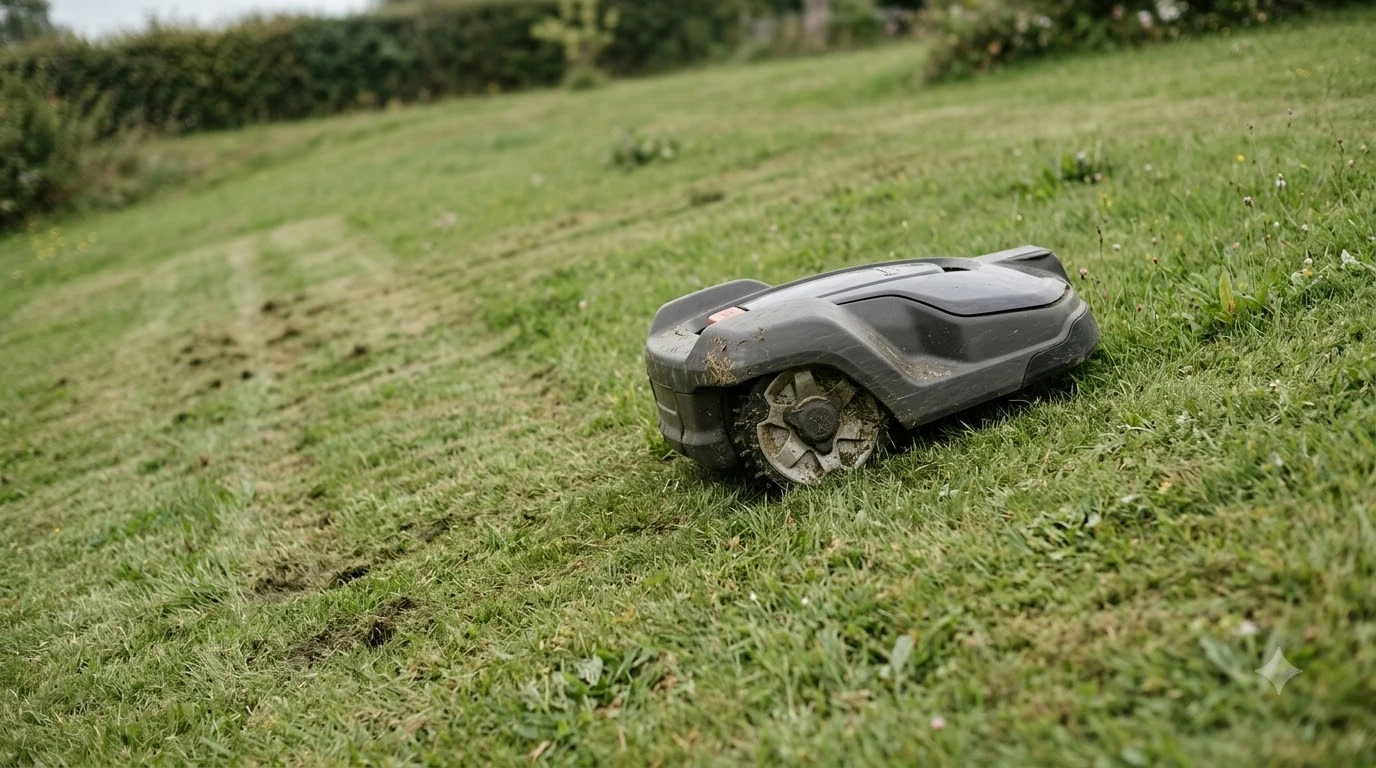

The best AWD robot lawn mower 2026 buyers can pick depends on one measurement: the steepest slope in their own yard. All-wheel drive (AWD) sends power to all four wheels, which can give more grip on steep or wet grass than a two-wheel layout. Ratings and drive designs differ by model, so this guide explains how to read the numbers instead of ranking products. The facts below are as of November 2026, and where a claim comes from a manufacturer or retailer, we say so.
The short answer
- Measure your steepest real slope as a percentage before you compare models.
- Compare that number with the work-area limit and the boundary-wire limit, not just the headline rating.
- Choose AWD when steep sections or long wet spells are common in your yard.
- Skip AWD if your lawn is mostly flat, since the extra drive adds cost, weight and upkeep.
What AWD means on a robot mower
AWD, or all-wheel drive, means a robot mower sends power to all four wheels. A two-wheel design drives only one pair. Sunseeker, a robot mower maker, describes its layouts this way: front-wheel drive uses a central motor to drive the front wheels while the rear wheels are unpowered, rear-wheel drive drives only the rear pair, and AWD drives all four for better grip on steep, wet or loose ground (manufacturer blog).
Best AWD robot lawn mower 2026 slope ratings: the number that decides the purchase
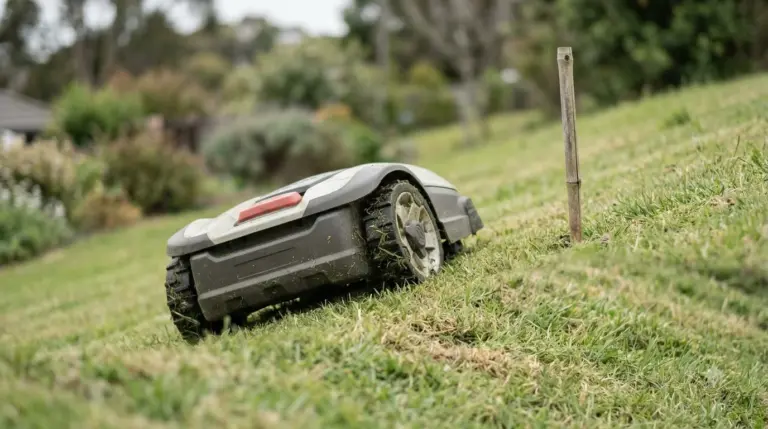
According to Husqvarna’s steep-slope installation guide, standard Automower models are rated for slopes of 25% to 50%, which the company gives as roughly 14 to 26 degrees, depending on the model. Its 435X AWD is rated for slopes up to 70%, or about 35 degrees, in the work area. Those are two different numbers from the same manufacturer, and they answer different questions, so read both before you decide. For a plain-language primer, see how robot mower slope ratings work.
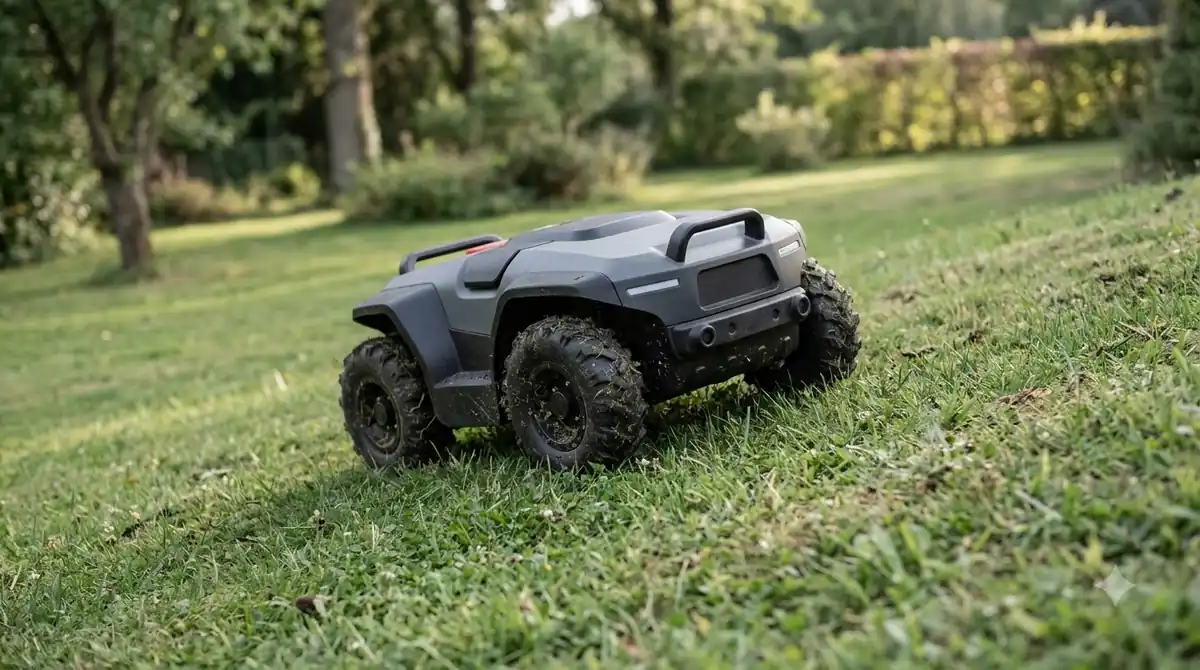
Husqvarna sets a separate limit for the boundary wire, the buried cable that marks the edge of the mowing area. Near steep ground, that limit is often lower than the work-area limit. The table below lists the ranges Husqvarna publishes for the groups most buyers compare.
| Husqvarna model group | Work-area slope limit | Boundary-wire slope limit |
|---|---|---|
| Aspire R4 and one 105-series model | 25% | 10% or 15% |
| 305, 310, 315 and 405X, 415X, 420, 430X, 440, 450X series | 40% | 15% |
| 320 NERA, 430X NERA, 450X NERA | 50% | 25% |
| 435X AWD and 435X AWD NERA | 70% (about 35 degrees) | 50% |
Husqvarna’s formula for slope is the vertical height divided by the horizontal distance, multiplied by 100. A rise of 15 cm over a 100 cm run is a 15% slope. Eufy, another robot mower maker, adds an important reading of the rating: the maximum slope is an absolute limit, not a target for daily mowing. Running at the top of the range strains the motor, drains the battery and increases wheel slip (manufacturer blog). In our reading, a yard that sits just under a model’s rating will feel tougher than the spec suggests.
Where AWD helps and where it does not
AWD helps most on steep, wet or loose grass, where the extra driven wheels can keep traction when one pair starts to slip. Sunseeker says front-wheel drive performs poorly on wet grass and that AWD gives the most consistent grip there (manufacturer blog). Mammotion makes the same case from the other side: a two-wheel mower can slip on soft, wet or muddy ground, while AWD handles wet grass with minimal slipping (manufacturer blog). Both are vendor claims, and neither gives a test method or a measured slip rate. Our note on whether robot mowers slide on wet slopes covers the same question from the yard side.
Wet grass is also a limit AWD does not remove. Eufy notes that wet grass reduces tire grip, so a slope within the rating can still cause slides on a damp morning (manufacturer blog). The practical point is that the slope rating and the weather are separate questions, and a mower can be correctly rated for a hill and still struggle on that hill after rain.
Heads up
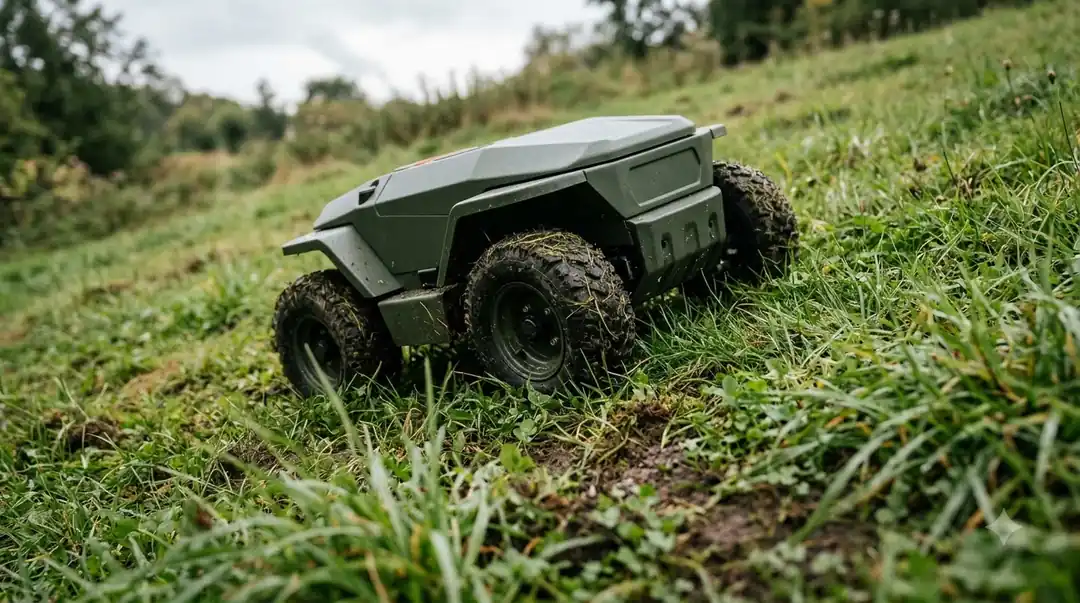
AWD has real costs. Mammotion says AWD typically costs significantly more, weighs more and has more motors and gears, which adds some maintenance. Sunseeker says AWD has the highest maintenance complexity of the three layouts, uses more energy and can give a shorter runtime on flat lawns.
The trade-off is simple to state. You pay more, carry more mechanical parts and may see shorter runtime on flat ground, in exchange for better grip on steep or wet sections. If your steepest slope is well inside a two-wheel model’s rating and the lawn is mostly level, the extra drive is probably paying for capacity you will not use.
Set up the yard for AWD traction
Installation matters as much as the drive system for any best AWD robot lawn mower 2026 pick, because a boundary wire placed too close to a steep edge can stop the mower before its wheels run out of grip. Husqvarna’s AWD guidance sets out a few distances to follow when you lay the wire.
- Keep 1.5 m (5 ft) from the slope to the wire. Husqvarna asks for 1.5 m between the bottom of the slope and the boundary wire.
- Leave level ground between flat and steep areas. Husqvarna asks for at least 50 cm (1.6 ft) of level ground between the flat area and the steep one.
- Clear obstacles on the steepest sections. On slopes between 50% and 70%, Husqvarna says to avoid obstacles on the slope itself.
- Run the guide wire up the slope. For AWD models, Husqvarna suggests a straight line or a diagonal from the bottom of the slope to the top, while standard models do better with a diagonal across the slope.
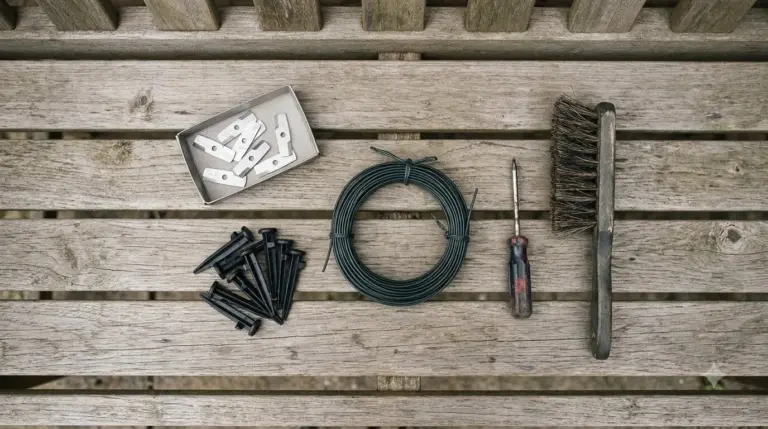
- Keep the wheels clean. Clogged wheels make slopes harder to manage, so clear grass from them with a soft brush or hose, and a set of robot mower wheel brushes is one option. Husqvarna also offers an optional Terrain Kit with heavier rear wheels and wheel brushes for more grip.
How to measure your slope before you buy
To shortlist the best AWD robot lawn mower 2026 for your yard, measure your slope first with a tape measure, a level and a straight stick or string; you do not need special tools. Our guide to how to measure your yard slope walks through it in more detail. Measure the steepest path the mower would actually cross, because an average figure for the whole lawn can hide the one stretch that causes trouble.
- Find the run. Lay a straight board or string from the bottom of the slope and measure the horizontal distance to the top.
- Find the rise. Measure the vertical gap between the board and the ground at the uphill end.
- Divide and multiply. Divide the rise by the run, then multiply by 100 to get a percentage.
Husqvarna’s example is a rise of 15 cm over a run of 100 cm, which is a 15% slope. Compare your figure with the work-area limit, and then with the boundary-wire limit, since the wire limit can be the one that stops you.
What to check before you buy an AWD model
Check the steepest slope, the work-area and boundary-wire limits, wet-grass behavior and the maintenance you can keep up with, in that order. Use this list to narrow any best AWD robot lawn mower 2026 shortlist before you read marketing copy. Each row below names a fact you can confirm on the maker’s own pages before you spend money.
| What to check | Why it matters | Where to look |
|---|---|---|
| Steepest slope in your yard | It must sit inside the model’s work-area rating | Your own measurement, then the maker’s spec page |
| Boundary-wire slope limit | Often lower than the work-area limit near steep edges | Maker’s slope and installation guide |
| Wet-grass behavior | A slope within the rating can still cause slides on wet grass | Maker FAQ and independent write-ups where they exist |
| Motors and maintenance | AWD adds motors and gears and can use more energy | Maker manual and parts list |
| Lawn size and shape | A flat or small lawn may not need the extra drive | Maker coverage figures against your measured area |
Who an AWD mower suits
The best AWD robot lawn mower 2026 for one yard may be a poor fit for another. An AWD mower suits yards with steep sections or grass that stays wet for long stretches, where a two-wheel model would run close to its limit. Our reading is that it also suits owners who want a margin above the slope they actually mow, rather than one that sits right at the rating. It is less useful for a flat, dry lawn, where a two-wheel model with a suitable boundary layout may do the same job for less money and upkeep.
Frequently asked questions
Is an AWD robot mower always better than a 2WD model?
No. AWD adds grip on steep or wet ground, so the best AWD robot lawn mower 2026 for a sloped yard is not always the right pick for a flat one. It usually costs more, weighs more and has more parts to maintain. Sunseeker also notes higher energy use and shorter runtime on flat lawns, so a flat yard may not need it.
What slope can the Husqvarna 435X AWD handle?
Husqvarna rates the 435X AWD for up to 70% in the work area, about 35 degrees. The company says it operates normally up to 50%, and that obstacles on slopes between 50% and 70% should be avoided.
Does AWD solve slipping on wet grass?
Not fully. Mammotion and Sunseeker both claim better grip for AWD on wet grass, but those are vendor views. Eufy notes that wet grass reduces tire grip, so a slope within the rating can still cause slides.
How do I measure a slope for a robot mower?
Divide the vertical rise by the horizontal run, then multiply by 100. Husqvarna’s example of 15 cm over 100 cm gives a 15% slope. Measure the steepest path the mower would cross, not the average of the lawn.
Sources
- Husqvarna steep-slope installation guide (manufacturer): slope limits, AWD layout distances, guide wire and wheel advice.
- Sunseeker, FWD vs RWD vs AWD robot mowers (manufacturer blog): drive layouts, wet-grass grip and maintenance claims.
- Mammotion, 2WD vs 4WD robot mower (manufacturer blog): wet-grass traction and cost claims, read as a vendor view.
- Eufy, robot lawn mower slope limits (manufacturer blog): the meaning of a slope rating and the effect of wet grass.
 Up next7 min readBest Robot MowersBest Mid-Range Robot Lawn Mower: How to Choose OneUpdated Nov 11, 2026
 10 min readBest Robot MowersBest Robot Mower With Auto Return to Dock: How to Choose One That Docks ReliablyUpdated Nov 11, 2026
 9 min readBest Robot MowersWhat Is the Best Cheap Robot Lawn Mower? How to Choose One That FitsUpdated Nov 11, 2026
 7 min readBest Robot MowersBest Automatic Lawn Mower: How to Choose One in 2026Updated Nov 13, 2026
 9 min readBest Robot MowersWhat Does AWD Mean on a Robot Mower?Updated Nov 11, 2026
 7 min readBest Robot MowersWhich AWD Robot Mower Is the Most Accurate? Traction FactsUpdated Nov 18, 2026