
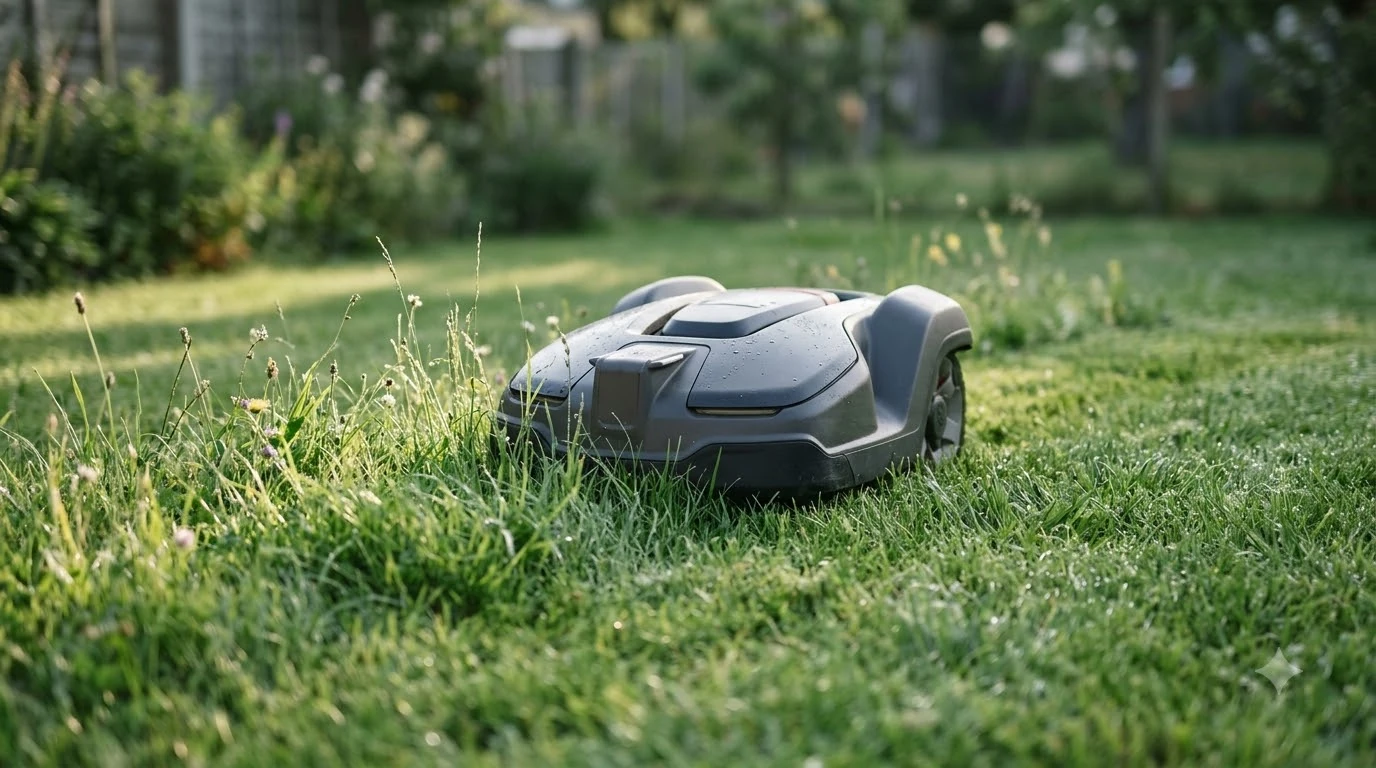

The best robot lawn mower for North Carolina lawns is the one whose cutting height range, slope rating and storm handling fit your grass and yard. No single model suits every NC lawn, so start by identifying your grass. NC State Extension publishes separate mowing height ranges for each common turf type, and those numbers are the starting point for any robot mower choice.
Start with what you grow, then check the mower’s height range, slope limit and rain handling. The sections below use NC State Extension and Husqvarna figures, and label our own reading where the sources are silent.
The short answer
- Match the height: the mower must cut at your grass’s height, not just lower than it.
- Check the slope: compare your steepest area with the model’s rated slope.
- Plan for rain: many robot mowers are rated for rain, but storms still call for a shutdown.
- Mow often enough: late-spring tall fescue may need cutting every 5 to 7 days.
The best robot lawn mower for North Carolina lawns: match the grass height
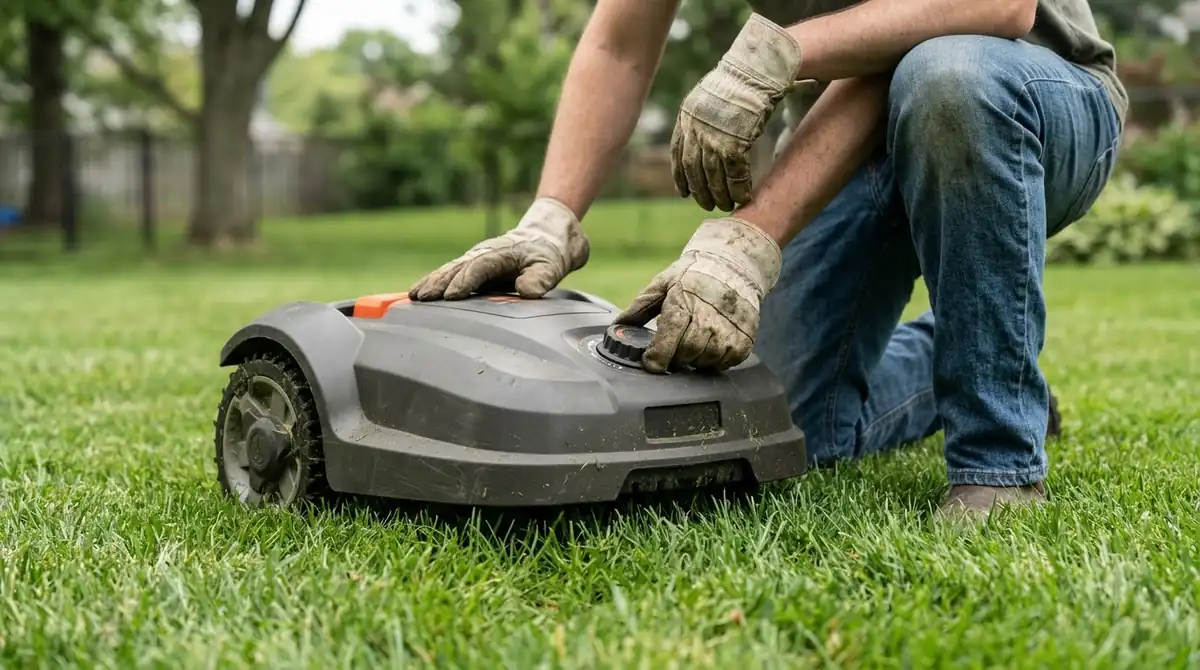
The best robot lawn mower for North Carolina lawns is only a good fit if its cutting range covers the height your lawn needs. NC State Extension gives 2.5 to 3.5 inches for tall fescue, 0.75 to 2 inches for Bermudagrass and zoysia, and 1 to 1.5 inches for centipede grass in its handbook table. Those ranges are very different, so the grass type decides which mower settings matter.
| Grass type | NC State height range | What to look for in a robot mower |
|---|---|---|
| Tall fescue | 2.5 to 3.5 in | A maximum height setting of at least 4 in |
| Bermudagrass and zoysia | 0.75 to 2 in | A low minimum setting, with a fine cut |
| Centipede grass | 1 to 1.5 in | A low, stable setting for a dense turf |
For tall fescue, Caldwell County Extension advises lowering the blade to 3 inches for the first few spring mowings, then raising it to 4 inches. The same extension office states that maintaining tall fescue at 4 inches provides effective crabgrass suppression. A separate NC State field study at Lake Wheeler reported crabgrass cover of 95, 48, 13 and 0 percent for tall fescue kept at 1, 2, 3 and 4 inches. That was a single study, so treat it as a clear direction rather than a guarantee.
Our reading is that a mower stuck at a low setting is a poor fit for a tall fescue lawn, because it will cut too short for the recommended range. Check the maximum height on the model’s spec sheet before you compare any other feature.
How often the mower should run
Mowing frequency depends on grass growth, not on a fixed schedule. NC State’s tall fescue calendar says the mowing interval may be every 5 to 7 days in late spring. It also advises not letting tall fescue grow taller than 5 inches before mowing from June through August.
Bermudagrass works the other way. NC State’s Bermudagrass calendar notes that a lower cutting height needs more frequent mowing to prevent scalping. A mower that runs often at a low setting can keep Bermudagrass tidy, but only if it has enough run time for your lawn size. For the grass itself, see how often to mow Bermuda grass, and for sizing see how to choose a robot mower by lawn size.
Slopes, hills and wire layout
Slope is the next limit to check on hilly yards. Husqvarna’s support guide gives a simple formula: rise divided by run, multiplied by 100. A rise of 15 cm over 100 cm is a 15 percent slope. Husqvarna lists 25 to 50 percent for standard Automower models and up to 70 percent for its all-wheel-drive models, with the exact limit depending on the model.
- Measure the steepest area with a level and a tape, then compare it with the model’s rating.
- Leave a flat transition of at least 50 cm between flat and steep areas for AWD models, according to Husqvarna.
- Lay the guide wire diagonally across the slope for better traction and less grass wear.
- Add a barrier of at least 15 cm on any outer edge that borders a road, per Husqvarna.
Wire-free navigation changes the layout work, but not the slope limit. Husqvarna also warns that obstacles on slopes raise the risk of slipping, especially in wet conditions. These are Husqvarna’s figures for its own models, so compare the numbers for any other brand on that brand’s documentation. Our guide to how robot mower slope ratings work explains the units.
Rain, heat and storms
For the best robot lawn mower for North Carolina lawns, rain handling is the fourth check, and our guide on whether robot lawn mowers can mow in the rain adds context. UGA Extension says robotic mowers can operate in a light rain, though it does not address heavy rain. Husqvarna says many of its robot mowers are certified for operation in wet conditions, while still advising a wait of at least 24 hours after rain before mowing a general lawn.
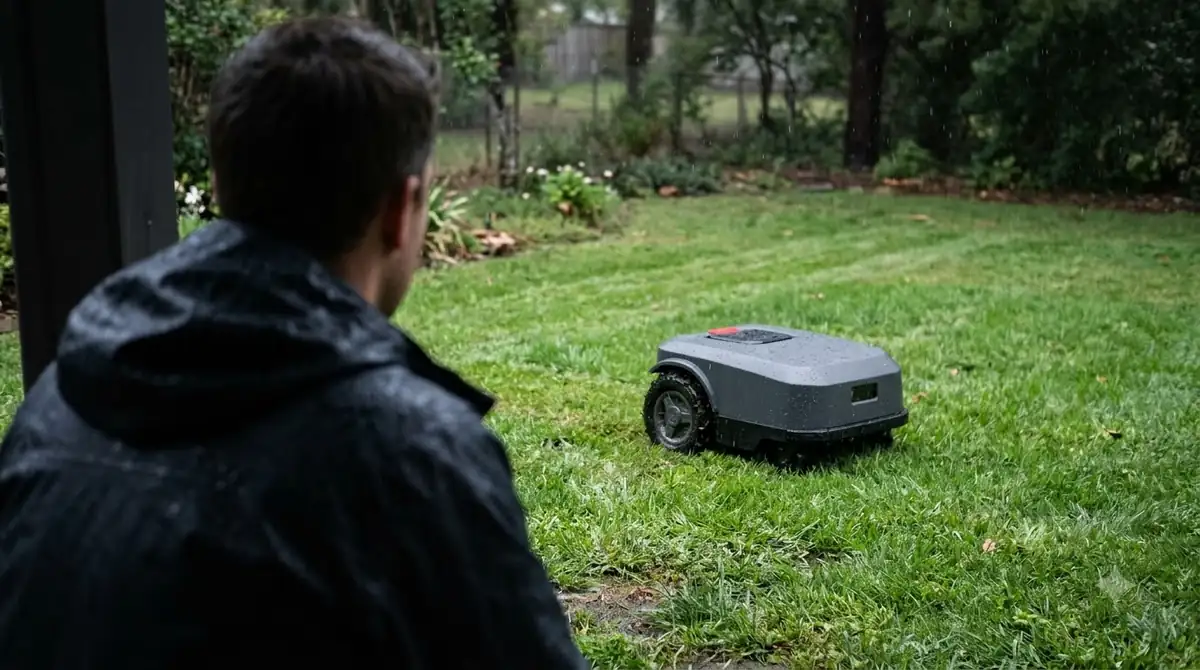
Storms need a different approach. Husqvarna advises closing the charging station cover to protect the connections from rain, and disconnecting power before lightning and heavy rain. Its rain page also states that the mower is designed to cut grass in rain or shine, but it gives no temperature or snow figures. Heat tolerance for North Carolina summers is therefore our reading, not a sourced number.
Use these steps every time a storm is forecast, whichever model you own.
- Close the charging cover. This protects the charging contacts from rain.
- Disconnect power before lightning and heavy rain, as Husqvarna advises.
- Wait 24 hours after heavy rain before mowing a general lawn.
- Check the charging station for pooled water after storms.
What to check in the best robot lawn mower for North Carolina lawns
Before you buy, check the cutting height range, slope rating, navigation type and storm handling against your own yard. A mower that cannot reach your grass height is the most common mismatch, by our reading, so start there.
- Grass type and height from NC State Extension’s table
- Maximum cutting height on the model’s spec sheet
- Steepest slope measured with the rise-over-run formula
- Navigation: boundary wire or wire-free, and how it handles trees and obstacles
- Rain and storm rules in the manual, including the charging cover
Check the manufacturer specifications for the best robot lawn mower for North Carolina lawns on the day you buy, since model ranges change and this guide reflects sources as of Nov 2026.

Frequently asked questions
How do I find out which grass my North Carolina lawn has?
Identify the grass first, because NC State Extension gives separate mowing height ranges for tall fescue, Bermudagrass, zoysia and centipede grass. Compare your lawn’s growth habit against those ranges before you choose a mower. Our page on centipede grass cutting height covers one of the lower ranges.
Can a robot mower cut tall fescue at 4 inches?
Only if the model’s maximum height setting reaches 4 inches. Caldwell County Extension recommends raising tall fescue to 4 inches after the first spring mowings, so the cutting range is the first spec to verify on any model.
Do robot mowers work in North Carolina rain?
Many can run in light rain. UGA Extension says robotic mowers can operate in a light rain, and Husqvarna lists rain certification on many models. Heavy rain is not covered by these sources, so follow the manual and shut the mower down during storms.
How steep a slope can a robot mower handle?
It depends on the model. Husqvarna lists 25 to 50 percent for standard Automower models and up to 70 percent for its all-wheel-drive models, with lower limits near the boundary wire. Check the rating for your exact model before you buy.
Sources
- NC State Extension, Caldwell County Center (NC State University): tall fescue spring height of 3 then 4 inches, and crabgrass suppression at 4 inches.
- NC State TurfFiles, mowing height and weed populations: crabgrass cover by tall fescue mowing height in one field study.
- NC State Extension Gardener Handbook, lawns: mowing height ranges by turf type.
- NC State Extension, tall fescue lawn maintenance calendar: spring mowing height and late-spring mowing interval.
- NC State Extension, Bermudagrass lawn maintenance calendar: acceptable height range and scalping risk.
- Husqvarna Automower support, steep slope installation (Husqvarna): slope formula, model slope ranges and installation rules.
- UGA Today, robotic mower advantages (UGA Extension): robotic mowers in light rain.
- Husqvarna, can you mow wet grass (Husqvarna): rain certification and the 24-hour wait after rain.
- Husqvarna, protecting your Automower during thunderstorms (Husqvarna): charging cover and power shutdown.
 Up next6 min readBest Robot MowersBest Robot Mower for the Carolinas: Match the GrassUpdated Nov 14, 2026
 8 min readBest Robot MowersWhich Gardena Robot Mower Should I Buy? Limits to Check FirstUpdated Nov 13, 2026
 7 min readBest Robot MowersBest Robot Lawn Mower for Colorado Lawns: What to Check FirstUpdated Nov 11, 2026
 8 min readBest Robot MowersBest Robot Lawn Mower for Arizona Lawns: What to Check FirstUpdated Nov 11, 2026
 8 min readBest Robot MowersBest Robot Lawn Mower for California Lawns: What to Check FirstUpdated Nov 13, 2026
 7 min readBest Robot MowersWhich Dreame Robot Mower Should I Buy? Limits to Check FirstUpdated Nov 13, 2026