
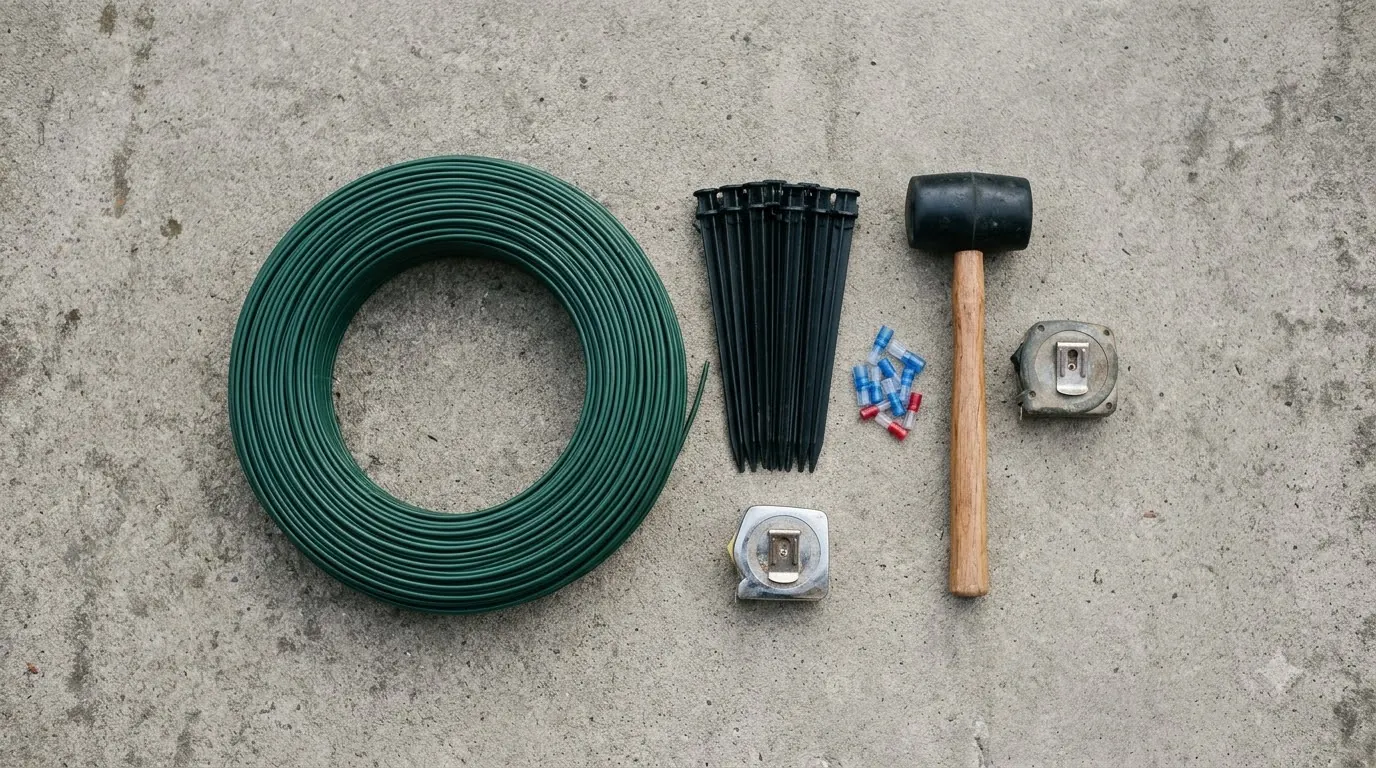

The best lawn edging to bury robot mower wire is flat stone or concrete set level with the lawn. A robot mower can cross that edge, and the boundary wire can sit in the same trench beneath it. Metal, raised, sloped and plastic borders are the poor choices if the wire goes underground.
The short answer
- Pick: smooth stone, concrete or dovetail pavers laid at lawn level.
- Depth: most guidance puts the wire at 3 to 7 cm, with about 4 to 5 cm as the target.
- Avoid: metal edging, raised borders, sloped edging and plastic or rubber edging that sits above the lawn.
- Check first: the manufacturer’s manual for maximum burial depth, because it overrides general guidance.
Best lawn edging to bury robot mower wire: which types work
The edging decides two things: whether the mower can drive over the border, and whether the wire can be buried beside or under it without trouble. The table below summarizes what the robot mower maker Robomow says about lawn edging for common materials. Its guidance is the main source here, and we present it as reported, not as our own testing.
| Edging | Can the mower cross it? | Buried wire | Note |
|---|---|---|---|
| Smooth stone or concrete at lawn level | Yes, the source calls it suitable | Works, in a trench with sand | Best match for a buried wire |
| Rough-hewn stone | Possible, but gives a bumpy ride | Works, but the surface is uneven | Choose smoother stone |
| Plastic or rubber edging | Not usually, it is rarely level | Possible, with care | Trimming remains along the border |
| Metal edging | Not recommended by the source | Avoid metal conduit and metal edging near the wire | Metal can interfere with the signal |
| Sloped English edging | Not optimal | Not a clean fit | The slope can cause uneven cutting |
Ranking the materials is less useful than matching each one to the job. For a buried wire, the question is simple: can the mower cross the border, and can the cable sit beside or under the edge without a metal part nearby? Only stone or concrete at lawn level passes both tests in the guidance we read.
Stone and concrete edging is the best match
Robomow says the most suitable lawn edging stones have a smooth surface, with concrete or dovetail stones working well. Rough-hewn stones give the robot a bumpy ride that can lead to bouncing over the edge or an uneven cut. The same source recommends digging a trench and laying a layer of sand so the stones sit flat. Two staggered rows of stone also help keep weeds out of the border.
Pick stone as your best lawn edging to bury robot mower wire beside, and the wire can go in that same trench. The manufacturer’s rule still applies, so the wire follows the maximum depth in the manual.

- Mark the border. Keep the wire slightly inside the lawn edge rather than on the outer edge of the grass.
- Dig the trench. Cut it to the depth of the stone plus the sand bed, so the stones sit level with the lawn.
- Lay the sand and the stone. Add a sand layer, set the stones, and check that no stone sits higher than the grass.
- Run the wire. Lay the boundary wire in the trench at the depth the manual allows, then backfill and test the mower’s path.
Burial depth under edging
The depth question matters most when the wire is buried under a border, because the edging is the first thing a scarifier or a spade will hit, so the best lawn edging to bury robot mower wire beneath still has to respect it. Robomow’s general guidance puts boundary wire between 3 and 7 cm deep, with about 4 to 5 cm as the optimal depth. Burying the wire too deep risks signal interference, and burying it only 1 to 2 cm deep risks the wire resurfacing the next time you scarify the lawn. Those two limits are why the target sits in the middle.
Paving changes the picture. A retailer guide, Robolever, says most models should be buried no deeper than about 4 inches (roughly 10 cm), and that wire under cobblestones can go up to that depth. Robomow also notes that the wire can be laid under stone walkways or flagstones. Our reading: treat 4 to 5 cm as the practical target under stone edging, and use the manual’s figure if it is lower.
Heads up
Do not put the wire directly under the stones. Robolever advises leaving a layer of sand or soil between the stone and the cable.
Conduit under paths and edges
If the wire has to cross a path, a conduit gives you a way to repair or replace it later, and laying boundary wire around obstacles shows how the loop handles paths and other breaks in the lawn. Robolever’s guidance is specific on the parts that matter: use corrugated plastic tubing or a rigid PVC or rubber pipe, and avoid metal, because metal disrupts the boundary wire signal.
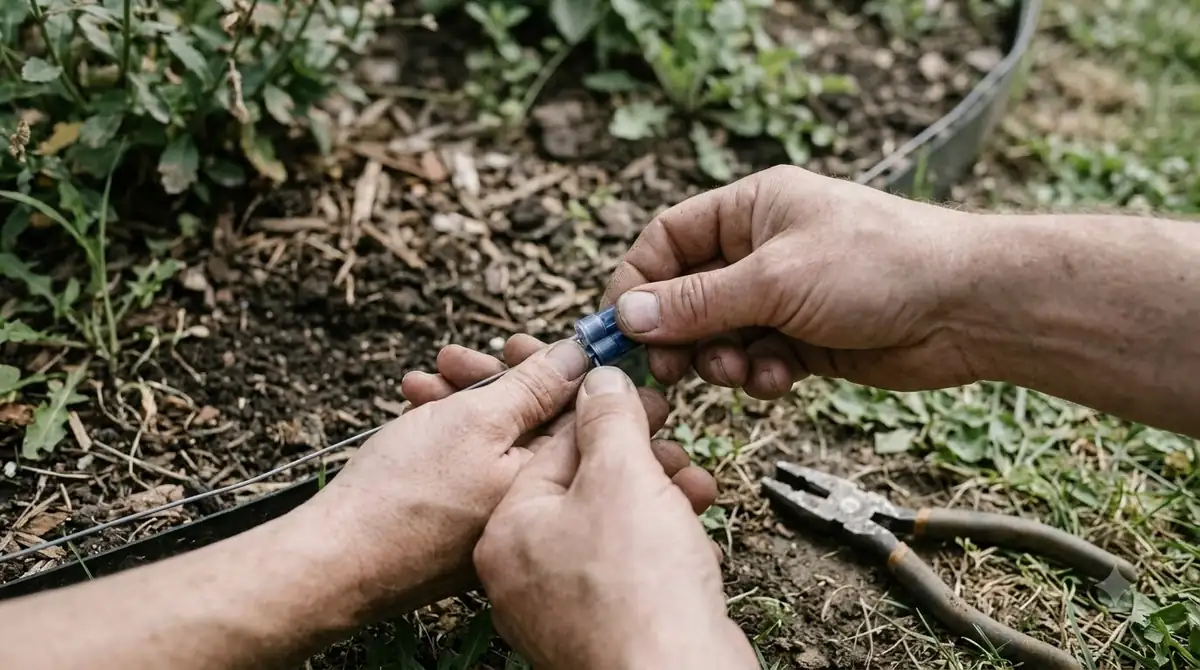
- Set the conduit on the base layer under the paving, as Robolever describes.
- Run one cable per pipe. The guide wire should not share a pipe with the boundary wire.
- Pull a line through the empty pipe before you pave, and bury the pipe only after the line passes freely.
Peg first, then bury
Burying is optional in many installations, and the wire can be pinned to the surface first; bury or peg the boundary wire weighs the two options. Pegging first lets you find layout problems before you dig, and a peg is far easier to move than a buried cable. Wire pegs for robot mowers are cheap to adjust, and installing a boundary wire step by step shows the order of work.
For the best lawn edging to bury robot mower wire under, the test matters as much as the material. Robolever also advises testing the cable route before you do any paving. Once the route works, you can bury the conduit or the wire with more confidence. Our reading: if the edging or the lawn shape might change, keep the wire surface-laid until the layout is settled.

Edging to avoid when you bury the wire
Four materials cause most trouble with a buried wire. Metal edging is not recommended, and metal conduit disrupts the signal. Raised borders act as a barrier, and the mower will not cross them, so they add a physical limit rather than a driveable surface. Sloped English edging is not optimal, because the slope can make the mower stick or cut unevenly. Plastic and rubber edging usually sits above the lawn, so the mower cannot drive over it and trimming remains.
Even with the best lawn edging to bury robot mower wire beside, the mower will not cut the full border. Robomow gives blade reach of about 6 to 20 cm from the housing edge, depending on the model. That gap is why an edge-cut model or a hand trimmer still matters near the edging.
What to check before you dig
Check these points before you buy stone or dig a trench. Each one changes whether the best lawn edging to bury robot mower wire will work in your yard, and each one is easy to confirm before any digging starts.
- Edging height: the stone should sit level with the lawn, so the mower can cross it.
- Surface: smooth stone or concrete, not rough-hewn stone.
- Metal content: no metal edging or metal conduit in the trench.
- Manual depth: the maximum burial depth from your mower’s manual.
- Path crossing: whether the wire needs a non-metal conduit with a pull line.
- Layout: whether the lawn shape is settled, so you do not need to dig again.
Our reading: the edging choice rarely fails on its own. It fails when the border material blocks the mower, when metal sits in the trench, or when the wire is buried at a depth the manual does not allow. Check those three points, and the rest of the install is routine. Our reading: before you backfill, sketch the final wire route with measurements, so a later repair or extension is quicker.
Frequently asked questions
Can a robot mower cross stone edging with the wire buried under it?
Robomow says smooth stone or concrete edging at lawn level works with its mowers, and the boundary wire can go in the trench. Follow the manual’s maximum depth.
Can I bury the wire under plastic or rubber edging?
You can, but plastic and rubber edging is usually not level, so the mower cannot drive over it. Expect some trimming along the border.
Is metal edging safe to use with buried boundary wire?
Robomow does not recommend metal edging for its mowers, and Robolever says metal conduit disrupts the boundary wire signal. Choose stone or concrete instead.
Do I still need trimming if I use stone edging?
Usually yes, at least a little. Robomow gives a blade reach of about 6 to 20 cm from the housing edge, so the strip next to the stone may need a hand trimmer or an edge-cut model.
Sources
- Robomow: which lawn edging is suitable for robotic mowers (manufacturer): edging materials, stone trench steps, wire position and blade reach.
- Robomow: how deep must the boundary wire be laid (manufacturer): 3 to 7 cm range, 4 to 5 cm optimal, risks of too deep and too shallow, walkways and flagstones.
- Robolever: laying boundary wire under paving stones (retailer guide, sources differ on depth): cobblestone depth, buffer layer, conduit material and pull test.
 Up next7 min readGearBest Landscape Edging for Robot Mower Borders: What Works and What to AvoidUpdated Nov 13, 2026
 9 min readGearBest Rubber Edging for Flower Beds with Robot Mower: What the Rules SayUpdated Nov 14, 2026
 6 min readGearRobot Mower Lawn Edging Strips: 3 Simple Setup StepsUpdated Nov 14, 2026
 8 min readGearRobot Mower Wheel Brushes: What to Use and What to AvoidUpdated Nov 19, 2026
 9 min readGearBest Compressed Air Duster for Robot Mower Sensors: What to Use and What to AvoidUpdated Nov 11, 2026
 8 min readGearBest Robot Mower Cleaning Brush: What to Use and What to AvoidUpdated Nov 11, 2026