

The best value robot lawn mower for the money is the one whose rated lawn size, slope limit and navigation fit your yard. No single model wins on price alone, because a low-cost mower that cannot climb your slope or cover your acreage costs more in lost time and frustration. Consumer testers note that robot mowers usually cost more than standard mowers, and a UK buyers guide last updated in July 2026 starts automated models at around £400. This guide shows which specs to check first and how to read them.
The short answer
- Fit the lawn first: compare your lawn with the rated area, and leave margin because Husqvarna rates its sizes with a plus or minus 20% tolerance.
- Read the slope correctly: check the percentage or degree rating, and the boundary wire limit, which can be lower than the drive limit.
- Pick navigation for your sky view: wire suits poor satellite reception, while wireless saves setup time but needs a clear view of the sky.
- Look past the price: cutting height range, a rain sensor, battery replacement and warranty length often separate a good buy from a cheap one.
- Check local terms: prices and warranty terms change by country, so confirm them on the official site before you buy.
What “value for the money” means for a robot mower
The best value robot lawn mower for the money is the one that fits the specs your yard needs, not the one with the lowest price on a listing. Consumer NZ’s guide gives no price range at all, which means a sticker price tells you little without the specs behind it. Our reading is that a mower offers value when it covers your lawn, handles your slope, can be set up without repeated work, and comes with a battery, parts and a warranty you can actually use.
Start with lawn size, using the rated area
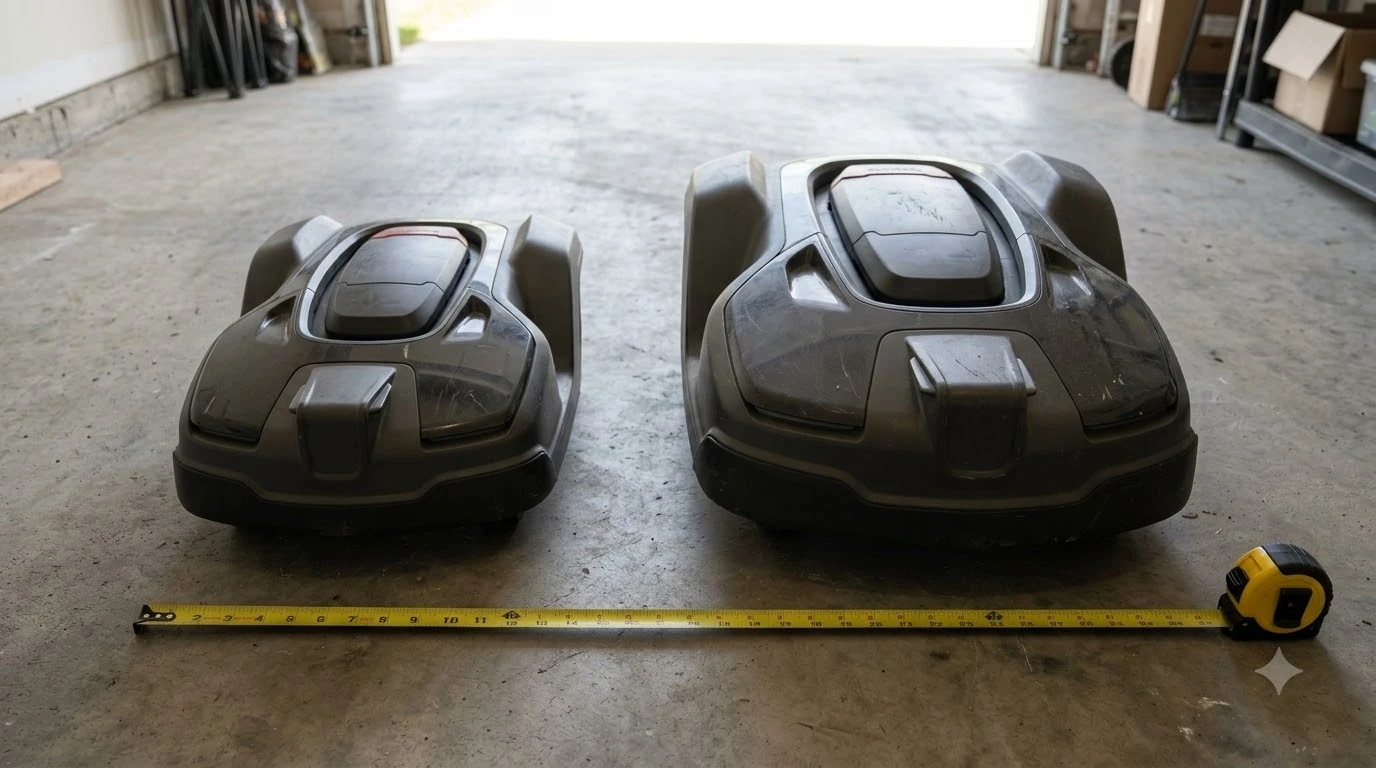
Lawn size is the first filter, and a rated area is a planning figure, not a guarantee. Husqvarna’s US range lists the following ratings, each with a plus or minus 20% tolerance.
| Husqvarna model | Rated lawn size |
|---|---|
| Automower 410 iQ | 0.5 acre |
| Automower 435X AWD | 0.9 acre |
| Automower 420 iQ | 1 acre |
| Automower 435 iQ AWD | 1.3 acres |
| Automower 560 EPOS | 1.5 acres |
| Automower 440 iQ and 580 EPOS | 2 acres |
Consumer NZ tested models on lawns up to 2,000 square metres, which is about half an acre by our conversion. Our reading is that a cheaper model earns its place only when your lawn sits comfortably inside its rating, not at the edge of it, and our guide to choosing a robot mower by lawn size explains how to measure that margin. The UK listing from Gardeners’ World pairs a 2.5Ah WORX battery with lawns up to 300 square metres, which shows how battery size often follows lawn size. For the full US line-up, see Husqvarna’s robotic lawn mower range.
Check the slope rating and how it is measured
A slope rating helps only when you know its unit and whether it covers the whole lawn. Slope is written as a percentage or in degrees, and the two are easy to confuse. Husqvarna’s support page gives the formula as rise divided by run, times 100, so 15 cm of rise over 100 cm of run is a 15% slope. By our calculation, 35% is about 19 degrees. Our explainer on how robot mower slope ratings work covers the conversion in more detail.
| Model (UK buyers guide) | Slope rating |
|---|---|
| Budget models in the guide | 17 to 19 degrees |
| Stihl iMOW 5 | 22 degrees (31 with upgrade wheels) |
| Ecovacs GOAT O600 | 24 degrees |
| Luba mini 2 | 38 degrees, all-wheel drive |
Consumer NZ tested models on a 19-degree (35%) slope and reports that some performed better than their makers’ claims. It also found that some claims of up to 39 degrees (80%) come with manual notes saying the maximum slope should be used only for short spells, not across the whole mowing area. Husqvarna’s Irish support page is more specific: standard models are rated between 25% and 50%, its all-wheel-drive model up to 70%, and the boundary wire has a separate limit that runs from 10% on one model to 50% on another, with most at 15% or 20%.
Heads up
A mower that climbs a steep area can still fail if the boundary wire is laid across that slope with a lower limit. Check the wire limit in the manual for your model, not only the drive rating on the box.
Navigation decides setup time and upkeep
Boundary wire and wireless navigation trade setup effort against sky view and maintenance. Consumer NZ says a boundary wire suits smaller properties, poor satellite reception and fixed mowing areas. The wire can be damaged, and it must be moved to change zones. Wireless models are usually quicker to set up and let you change boundaries without moving wire, but tall trees, buildings and valleys can interfere with the satellite signal. For a fuller comparison, see our guide to wire-free versus boundary wire robot mowers.
| Factor | Boundary wire | Wireless (satellite-based) |
|---|---|---|
| Setup | Lay and pin the wire around the lawn | Usually quicker to set up |
| Poor satellite reception | Consumer NZ favours wire here | Signal can be affected by trees and buildings |
| Changing zones | Wire must be moved | Boundaries changed without moving wire |
| Damage | Wire can be cut or damaged | No perimeter wire to repair |
If you choose wire, plan the passages early. Husqvarna’s US support page recommends at least 60 cm (24 in) between boundary wires for a passage that uses a guide wire, and at least 30 cm (12 in) between the guide wire and the boundary wire. Husqvarna’s page also notes that a mower can get stuck in a passage and suggests adjusting the corridor width, so measure the passages before you buy. Gardeners’ World notes that the OcuMow 16 “only works on lawns with clearly defined boundaries”, while the Stihl iMOW 5 “requires a boundary wire around the perimeter of the lawn”.
Cutting width, cutting height and rain sensor
Cutting width, the height range and a rain sensor are specs that separate basic machines from better-equipped ones. Gardeners’ World lists these cutting widths for UK models, which gives a sense of how deck size varies across the market.
| Model (UK buyers guide) | Cutting width |
|---|---|
| OcuMow 16 | 16 cm |
| Stiga A4 | 18 cm |
| Ecovacs GOAT O600 | 19 cm |
| Luba mini 2 | 20 cm |
| Navimow i208 | 22 cm |
| EGO AURA-R2 | 24 cm |
A wider deck covers more ground on each pass. Our reading is that width matters most on larger lawns and matters less on small ones, where a narrow model may be enough. Cutting height matters for the grass as much as for the machine. Consumer NZ reports that most tested models cut as low as 20 mm, some stop at 30 mm, and the best models offered a 40 to 45 mm range with nine or more heights. If your turf needs a higher or wider range of heights, a cheap model with a narrow range will not suit it.
For a best value robot lawn mower for the money, a rain sensor is worth paying for if rain is common where you live. Consumer NZ found that fewer than half of the models it tested had one. Consumer NZ says a robot mower with a rain sensor returns to its base station when it detects rain, so it does not keep cutting in the rain.
Running costs: battery, power and parts
The price tag is only the first cost. Battery replacement and local parts shape what you spend over the years. Consumer NZ advises checking that you can replace the battery yourself, because a service visit may cost more. It also says to confirm that replacement batteries are sold locally and to check their price, and notes that batteries need replacing every few years.
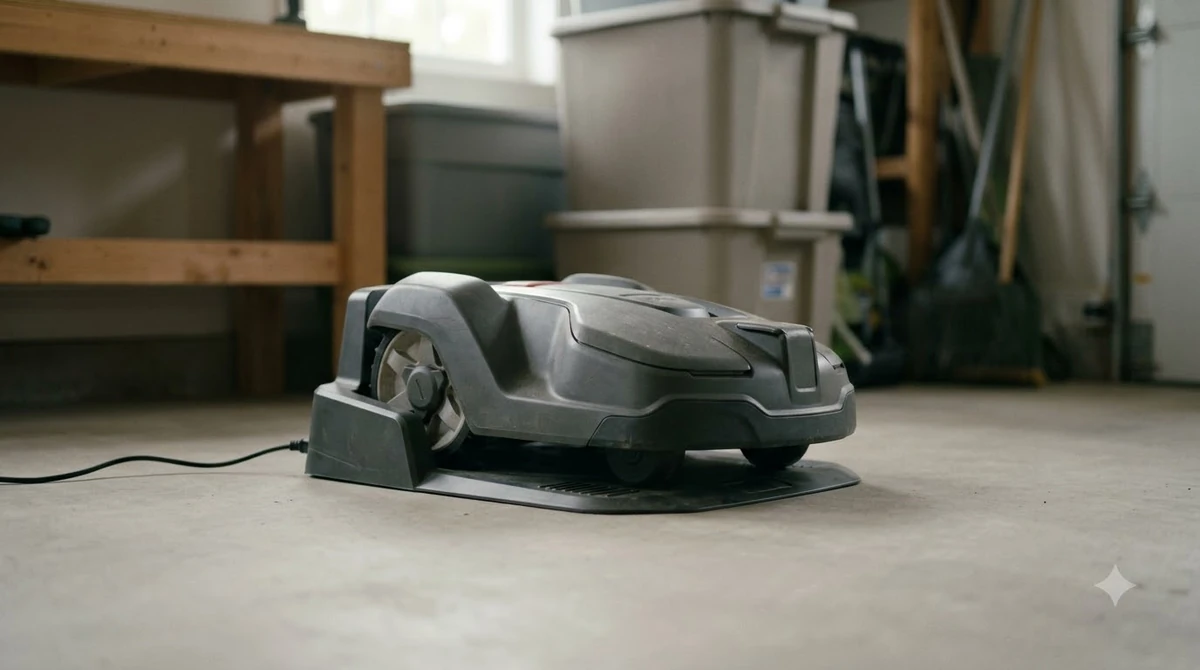
Running costs decide a lot of the value in any robot mower. The sources we read do not give a power-use figure, so this guide offers no kWh number; our explainer on robot mower electricity cost covers that side. Our reading is that the charging station stays plugged in, which means the battery’s replacement cost and warranty matter more to your long-run spend than the electricity line. When you compare two models, ask three questions: can you swap the battery yourself, can you buy a replacement locally, and does the seller stock blades and other wear parts?
Best value robot lawn mower for the money: what to check before you buy
A longer warranty can keep a best value robot lawn mower for the money good value after the first year. Warranty length differs a lot between models, but the terms also change by country, so a UK table is only a reference point. Gardeners’ World lists a 2-year warranty for the OcuMow 16, WORX and Cobra Mowbot 800, a 3-year warranty for the Ecovacs, Navimow i208, Luba mini 2 and STIGA A 6v, and a 5-year warranty for the Stihl iMOW 5 and Husqvarna 308V.
A longer warranty helps with faults, but it does not replace a check of what the warranty covers. Consumer NZ’s guide does not cover warranty terms, and our robot mower warranty guide explains what to look for in the small print.
Before you buy, work through this list for your own yard.

- Measure the lawn. Compare your area with the rated size, and keep a margin because ratings carry a plus or minus 20% tolerance.
- Check both slope figures. Compare the drive rating and the boundary wire limit, in percent and degrees.
- Choose navigation. Wire suits poor satellite reception and fixed zones, while wireless needs a clear sky view for a best value robot lawn mower for the money.
- Measure the passages. If you use wire, allow at least 60 cm between boundary wires for a guide-wire passage.
- Confirm the battery and parts. Make sure you can replace the battery yourself and buy blades and batteries locally.
- Compare the warranty for your country. Read what is covered, how long it lasts and who carries out the repair.
- Check the garage fit. Mammotion’s US garage guide gives a general rule of the mower width plus at least 4 to 6 inches per side, and RTK models may need more room.
Limits of this guide
No source here names a single best value robot lawn mower for the money, and the sources we read did not include independent US price tests or build-quality data, so this guide does not rank models or give a fixed dollar price. Prices quoted here come from a UK buyers guide and should be checked against your local listing.

Frequently asked questions
Is there one best value robot lawn mower for everyone?
No. Value depends on lawn size, slope, navigation, cutting width, battery replacement and warranty. A mower that is a bargain on a small, flat, open lawn can be a poor buy on a large or steep yard.
Is a cheaper robot mower worth it for a small lawn?
It can be, if the lawn sits well inside the rated size and the sky view is clear for satellite navigation. Check the cutting height range and whether the model has a rain sensor before deciding.
How much does a robot lawn mower cost?
Prices vary by country and model. A UK buyers guide last updated in July 2026 starts automated models at around £400 and premium models for very large lawns at £3,000 to £4,500. Check your local listing for current prices, as of November 2026.
Does a longer warranty make a robot mower better value?
A longer warranty can reduce the risk of expensive repairs, but terms differ by model and country. Read what is covered, how long it lasts and who performs the repair before you count it as value.
Sources
- Consumer NZ, robot lawn mower guide (consumer testing organisation): slope tests, cutting height, rain sensor, navigation and battery replacement.
- Husqvarna US, robotic lawn mowers (manufacturer): rated lawn sizes with a plus or minus 20% tolerance and the 70% slope claim for the AWD model.
- Husqvarna US support, passage in boundary wire installation (manufacturer): minimum spacing for a passage with a guide wire.
- Husqvarna support, steep slope installation (manufacturer): slope percentages, boundary wire limits and the slope formula.
- Gardeners’ World, robotic mowers buyers guide (UK publisher): price bands, slope ratings, cutting widths and warranty table.
- Mammotion, robot lawn mower garage guide (manufacturer): general garage width clearance rule.
 Up next7 min readBest Robot MowersBest Robot Lawn Mower Labor Day Deals: Timing and ValueUpdated Nov 14, 2026
 9 min readBest Robot MowersWhat Is the Best Robot Lawn Mower for the Money?Updated Nov 11, 2026
 8 min readBest Robot MowersBest Robot Lawn Mower for New England Lawns: 3 ChecksUpdated Nov 14, 2026
 8 min readBest Robot MowersBest Robot Lawn Mower for New Jersey Lawns: What to Check FirstUpdated Nov 14, 2026
 8 min readBest Robot MowersBest Robot Lawn Mower for Tennessee Lawns: What to Check FirstUpdated Nov 11, 2026
 9 min readBest Robot MowersBest Satellite Navigation Robot Lawn Mower 2026: What to Check Before You BuyUpdated Nov 11, 2026