
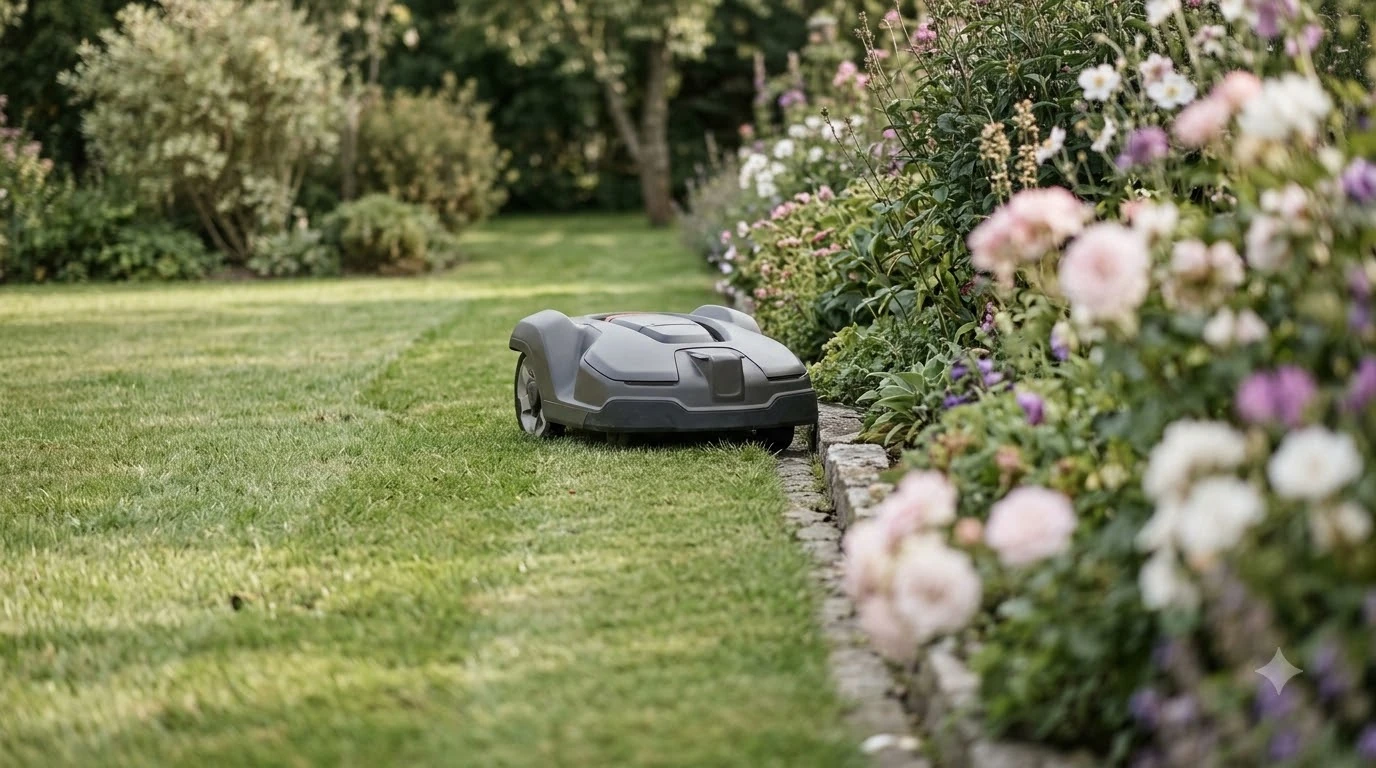

A robot mower for lawn with mulch beds works best when the boundary wire is set back from the bed edge and spilled mulch stays off the grass. The common guidance is 25 to 30 cm (10 to 12 in) from a soft edge such as mulch, and at least 30 cm from a hard edge like a wall or fence. Most trouble comes from the setup and later edits rather than from the mower itself.
The short answer
- Wire distance: keep the boundary wire 25 to 30 cm (10 to 12 in) from a mulch bed.
- Hard edges: keep at least 30 cm from walls, fences and tree trunks.
- Spilled mulch: mulch on the grass is a common source of boundary trouble, so keep it off the lawn.
- Islands: a wire loop around a bed lets the mower drive around it instead of through it.
Robot mower for lawn with mulch beds: how the edge works
A mulch bed counts as a soft edge, and a soft edge is where the mower tends to stop short. The boundary wire, not the mulch, defines the area the mower will cut, so the wire position decides whether the robot works cleanly along the bed. For a mower working beside beds, that single setting matters more than almost any other choice.
According to the lawnmowers.com setup guide, the mower leaves a strip next to soft edges that you finish with a string trimmer, usually every couple of weeks (our list of cordless string trimmers for robot mower edges covers the gear). That is a maintenance task you should plan for, not a sign that the model has failed.
Mulch is not listed as a blade hazard in the manufacturer pages we read for this guide. Our reading is that the mulch itself is rarely the problem; the wire line and the edge height are. Check your model manual for any stated mulch limit before you buy, because a robot mower for lawn with mulch beds is only as reliable as its setup.
Wire distance from mulch beds
The wire distance depends on the type of edge on the other side. Setting the wire too close to a soft edge makes the mower work into the bed, while setting it too far leaves an uncut strip that you must trim by hand. Measure from the edge of the mulch bed itself, not from the spilled mulch on the grass, because the spill is what the mower meets first.
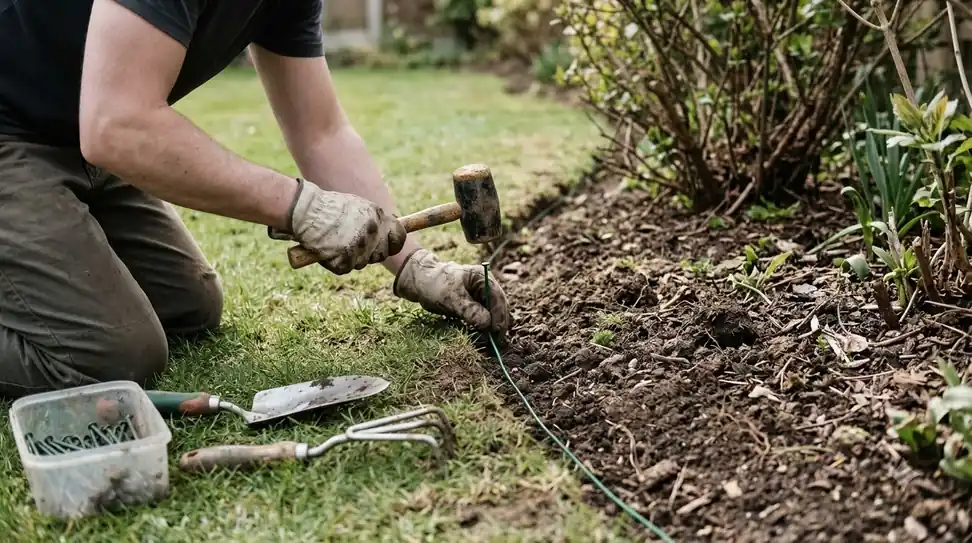
- Soft edge (mulch, flower bed, gravel): 25 to 30 cm (10 to 12 in) from the edge.
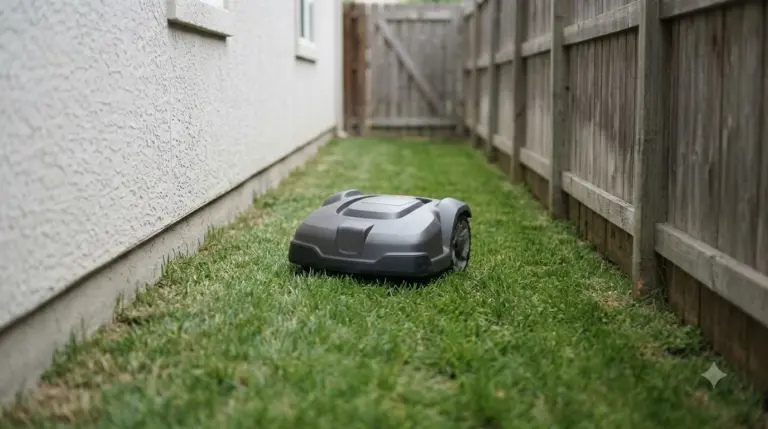
- Hard edge (wall, fence, tree trunk): at least 30 cm, so the mower can turn without scraping.
- Metal near the wire: keep wire runs away from metal fencing or rebar, because metal can distort the field.
- Trim-free option: a mowing strip along the bed can reduce hand trimming.
The same setup guide advises burying the wire 2 to 5 cm deep, with stakes every 50 to 80 cm, and running a loop test after the connection is made, as our robot mower boundary wire installation guide also walks through. Skip any of these steps and a bed edge is harder to get right on the first attempt. Our reading is that a robot mower is easiest to set up beside mulch beds when the wire is laid before the mulch is spread, so the distances can be checked on bare soil.
When mulch spills onto the lawn
Spilled mulch causes trouble when it builds up over time, because the wire was laid for an earlier edge. Lawnlove quotes an installer who calls homeowner edits over time, such as new bed expansions and mulch rings, the number one issue with boundary setups. That pattern matters for any lawn with mulch beds, since the lawn keeps changing after the first setup.
Our reading is that the best prevention is to re-check the wire path after any bed change, rather than waiting for the mower to get stuck. A new mulch ring can sit inside the old boundary, and that changes where the mower meets the edge.
A simple habit helps here. Walk the boundary each spring, after the first heavy mulch top-up, and look for mulch that has crept past the wire line. The check takes minutes, and it keeps the mower running on the layout you originally set.
Using islands for mulch beds
An island is a loop of boundary wire around a bed, which tells the mower to drive around the bed rather than into it. This is the cleanest option when a bed sits in the middle of a lawn instead of along the edge, and our guide to laying boundary wire around obstacles shows the layout. For a robot mower for lawn with mulch beds, an island often avoids a long wire run that would otherwise follow every curve of the bed.
- Plan the loop. Draw the wire around the outer edge of the mulch bed, with the wire kept clear of the bed itself.
- Keep the wires from crossing. According to Husqvarna’s island installation guide, crossing wires stop the mower from recognising the island.
- Lay the return path close. Run the two wire lines close together on the return path, so the signal cancels and the mower passes over.
- Test the loop. Run a loop test after connection, as the setup guide advises for all boundary wire.
The Husqvarna page gives no clearance distances for islands, so use your model manual for the exact spacing around a mulch bed. Keep the loop as tight as the manual allows, so the lawn beside the bed is not left uncut.
Passages and edges to check before you buy
Husqvarna gives a minimum of 2 m between boundary wires for a passage, or 60 cm when a guide wire is used. These passage figures sit alongside the edge distances above, and the table below puts them in one place. Use the same table to compare each model you consider, so the numbers are side by side.
| Setup | Distance | Source |
|---|---|---|
| Passage, no guide wire | 2 m (6 ft 6 in) between boundary wires | Husqvarna US support |
| Passage, with guide wire | 60 cm (24 in) between boundary wires | Husqvarna US support |
| Guide wire to boundary wire | at least 30 cm (12 in) | Husqvarna US support |
| Soft edge (mulch, flower bed) | 25 to 30 cm (10 to 12 in) | lawnmowers.com setup guide |
| Hard edge (wall, fence) | at least 30 cm | lawnmowers.com setup guide |
| Blade offset from housing edge | 6 cm (edge-cutting model) to 20 cm | Robomow |
Edging matters too beside mulch beds. Robomow advises against metal edging for robotic mowers (see also our explainer on cut-to-edge distance), and notes that plastic or rubber edging is usually not level, so the mower cannot simply drive over it.
What to check before you buy a robot mower for lawn with mulch beds
Before you buy, check the wire layout, the edge materials and the passage widths against the manual for each model. These checks cost little time and avoid most of the boundary problems described above. Work through them in order, because the bed layout decides the wire line, and the wire line decides which passage and island rules apply to your yard.
- Measure the bed edges. Note every mulch bed that sits next to the lawn and whether it is raised or flush.
- Plan the wire line. Mark 25 to 30 cm from each soft edge and at least 30 cm from each hard edge.
- Check passage widths. Confirm the minimum passage distance in the manual, with or without a guide wire.
- Confirm island support. Look for island instructions and the no-crossing rule in the model manual.
- Check the grass type. The UF/IFAS extension reports that most robot mowers were designed for European lawns and cool-season grasses, so confirm the model suits your lawn.
Our reading is that a model whose manual gives clear island and passage specifications is easier to set up beside mulch beds than one that gives none. Choose the bed layout first, then the robot mower for lawn with mulch beds that fits it.
Frequently asked questions
Does a robot mower drive over mulch?
Usually a robot mower for lawn with mulch beds stops at a soft edge such as mulch rather than entering the bed, because the boundary wire defines its working area. Check your model manual for any stated mulch limit before you buy.
How far should the wire sit from a mulch bed?
The lawnmowers.com setup guide puts the wire 25 to 30 cm (10 to 12 in) from a soft edge. Keep at least 30 cm from hard edges such as walls and fences, so the mower can turn without scraping. The same spacing rule applies where a mulch bed meets a fence line.
Does rain change how the mower handles mulch?
The UF/IFAS extension report found no negative impacts from running robot mowers in rainy conditions. Rain does not change the boundary setup, so the wire distance still matters most.
How often should the strips next to mulch be trimmed?
According to the lawnmowers.com setup guide, the strips left at soft edges are finished with a string trimmer about every couple of weeks. Plan this as routine maintenance rather than a fault, and factor it into your time when you compare models.
Sources
- lawnmowers.com robotic mower boundary wire setup guide (publisher): soft and hard edge wire distances, burial depth, stakes and loop test.
- Husqvarna US support: passage boundary wire installation (manufacturer): passage and guide wire distances.
- Husqvarna IE support: islands in a boundary wire installation (manufacturer): island loops, no crossing wires, return path.
- Which lawn edging is suitable for robotic mowers (Robomow, manufacturer): blade offset, metal and plastic edging.
- What is a Robot Lawn Mower and How Does It Work? (Lawnlove, publisher): installer comment on homeowner edits such as new beds and mulch rings.
- UF/IFAS News: robot mowers (University of Florida, June 2026): design origin for European and cool-season lawns, and the rain finding.
 Up next9 min readBy YardWill a Robot Mower Get Stuck on a Lawn with Mulch Beds?Updated Nov 11, 2026
 9 min readBy YardBest Robot Mower for a Yard With Sprinkler Heads: 5 ChecksUpdated Nov 13, 2026
 7 min readBy YardBest Robot Mower for Bunch-Type Tall Fescue: 3.5 Inch CheckUpdated Nov 14, 2026
 8 min readBy YardBest Robot Mower for a Yard With a Dry Creek Bed: What to CheckUpdated Nov 12, 2026
 7 min readBy YardDoes a Robot Mower Cut Clover Flowers? Simple Height TipsUpdated Nov 14, 2026
 8 min readBy YardHow Narrow Can a Robot Mower Passage Be? Simple 2026 RulesUpdated Nov 11, 2026