

What is the best robot mower for a corner lot? There is no single answer, because the deciding factor is the narrowest passage on your property. Our reading is that passage width, corner shape, and how the mower finds its boundary matter more than any brand name.
The short answer
- Measure the narrowest passage first. Husqvarna’s figure is 60 cm (24 in) between boundary wires with a guide wire, and 2 m (6 ft 6 in) without one.
- Guide wire spacing. Keep the guide wire at least 30 cm (12 in) from the boundary wire.
- Corridor width. Husqvarna sets it on a scale from 1 to 9, not in physical units.
- Edges. Toro’s manual describes a 10 cm (4 in) uncut strip at the blade edge, so plan hand trimming near fences and walks.
- Check the manual. Passage and slope figures differ by model, so confirm them before you buy.
What is the best robot mower for a corner lot? Start with the passage
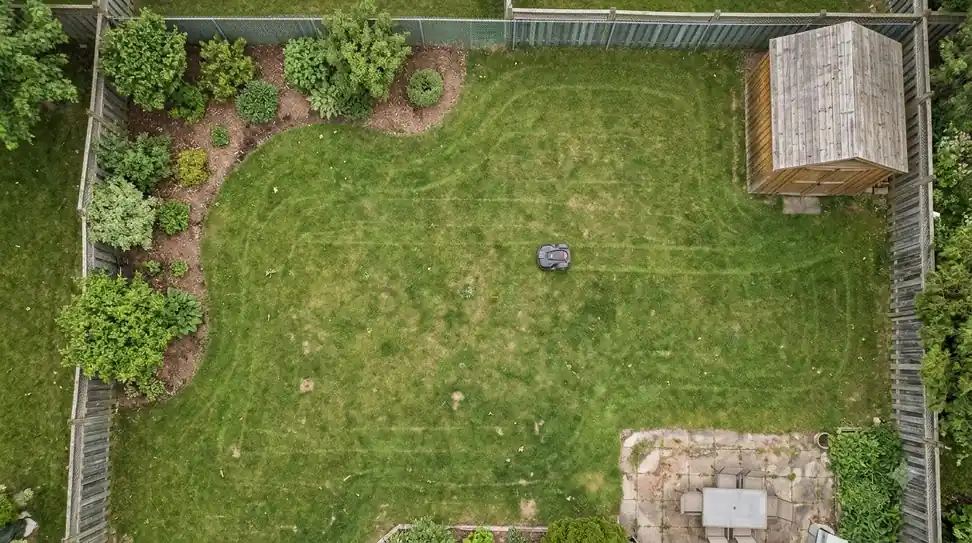
A corner lot is hard mainly because the mower has to pass through a narrow connection between two lawn sections. A side yard reached through a gap beside the house is one example. A front lawn joined to a back lawn by a strip along a fence is another, a layout covered in our guide to a robot mower for front and back yards. For this article, a corner lot means an irregular outline, a lawn split into front, side, and back sections, and sharp angles where the boundary has to turn.
The passage is the key number. Husqvarna measures passage width as the distance between the boundary wires on each side of the passage, not between fence posts or the edge of the grass. Its support page gives 60 cm (24 in) with a guide wire and 2 m (6 ft 6 in) without one. Our reading is that a passage narrower than the figure for your setup is the main reason to plan a guide wire, a separate zone, or a different model. So the answer to what is the best robot mower for a corner lot starts with that measurement.
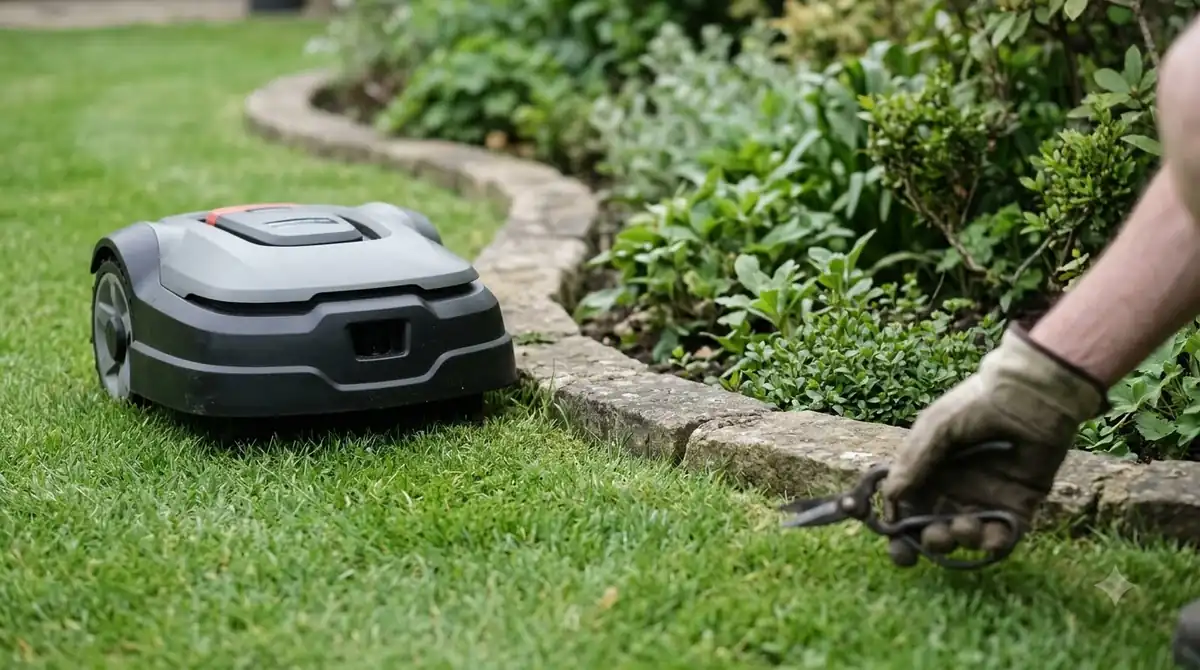
Edges also cost usable lawn. Toro’s trimming guidance says you need to trim at least 10 cm (4 in) of uncut grass periodically, because of the gap between the blade disc and the mower shroud. The same guidance lists the areas between the lawn and a fence, driveway, or sidewalk as places that need trimming. On a corner lot, where two sides may run along fences or walks, that strip adds up along the whole perimeter, which is why it helps to know whether robot mowers trim edges before you buy.
The sources we read do not give deck width for corners, so this article does not rank models by cutting width.
Guide wire or wire-free: what the sources say
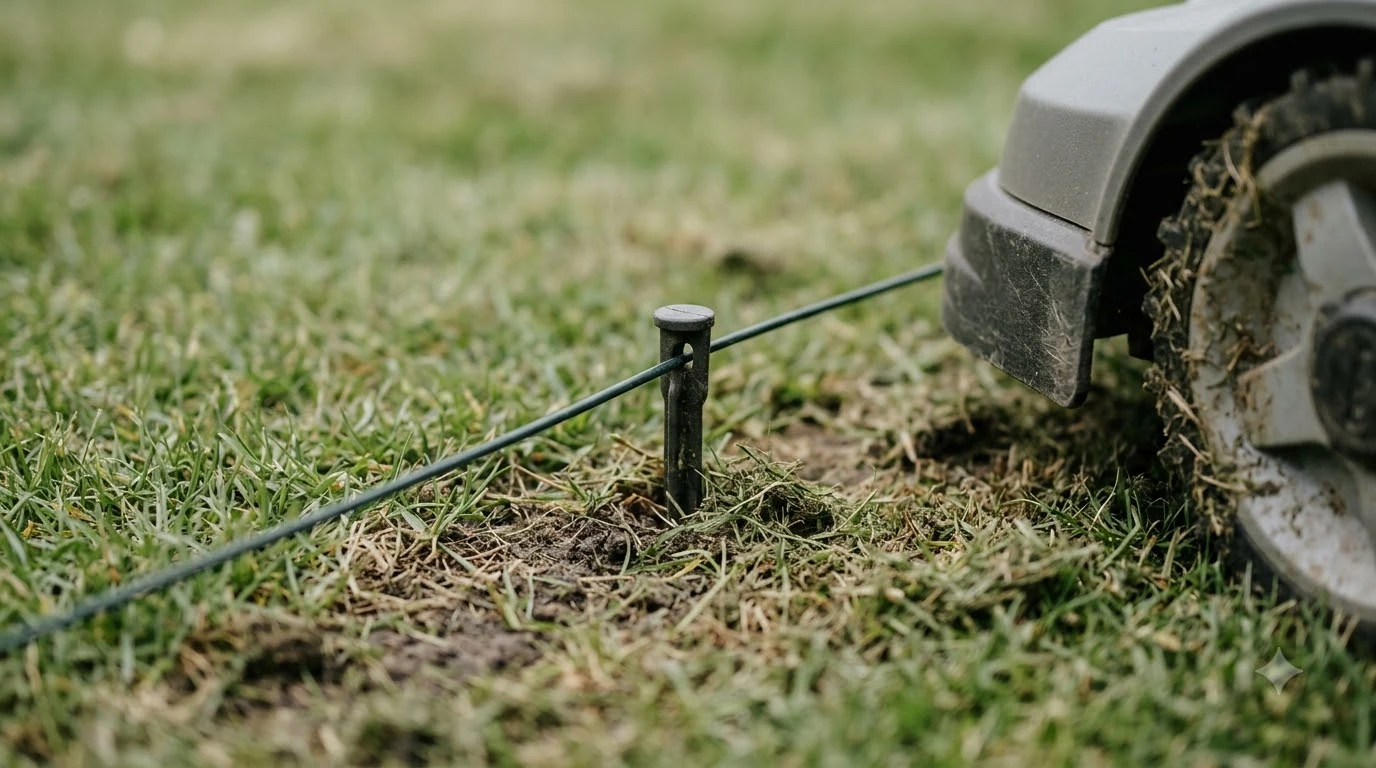
A guide wire is the main tool the sources use to get a robot mower through a narrow passage. Husqvarna gives 60 cm (24 in) between boundary wires when a guide wire is used, and 2 m (6 ft 6 in) when it is not. The guide wire has to sit at least 30 cm (12 in) from the boundary wire. For the 435X AWD and 535 AWD, Husqvarna recommends the 2 m (6 ft 6 in) passage for a good cutting result. Husqvarna’s passage instructions cover the layout in detail.
Worx takes a different line. Its complex-lawns article says its Landroid can handle narrow passages without a guide wire, while other robot mowers need one. That is the manufacturer’s claim, and we did not find an independent source that confirms it. Treat it as a question for the seller, not as a fact about your lawn.
A guide wire adds work: more wire to lay, a clear path from the boundary to the passage, and a spacing rule to follow. Our reading is that for a narrow side yard, that trade-off usually settles the choice. A common mistake is measuring the gap between fence posts and assuming the mower will fit, because the sources measure between boundary wires. For the wire layout itself, see how to lay boundary wire around obstacles.
Corridor width and passage settings
Husqvarna lets owners adjust corridor width on a scale from 1 to 9. The factory values are 6 for a boundary-wire installation and 9 for a guide-wire installation. The scale is unitless, so the menu does not show a distance you can measure. On the mower display, the path is Installation, then Advanced, then Corridor width. In the app, it is More, then Settings, then Installation, then Corridor width.
Our reading is that a corner lot calls for small changes followed by a check of how the mower handles the passage, rather than one large jump. The sources we read do not say which corridor value suits which passage, so check the manual for your model before you change the number.
Zones and obstacles
Zones let one mower treat separate parts of a corner lot differently. Worx says its Landroid supports up to four zones, each with separate rules. Our reading is that zones matter most when a side section is shaded, cut less often, or sloped differently from the main lawn, and our multi-zone robot mower explainer covers how that works. The sources we read do not explain how zones behave across a narrow passage, so confirm that with the manufacturer.
Obstacles near edges need the same care. Toro’s guidance lists the area around a tree and around a fire pit among the places that need trimming by hand, as well as the lawn edge at fences, driveways, and sidewalks. If a tree or fire pit sits in a corner, plan for trimming there too.
What to check before buying the best robot mower for a corner lot
Before you buy for a corner lot, measure the narrowest passage and compare it with the model’s published figures. Work through the passage, the guide wire, the zones, and the edges in that order. Our reading is that these checks settle more of the decision than any general ranking.
- Measure the narrowest passage. Measure between the points where the boundary wires would run, not between fence posts.
- Compare it with the manual. Husqvarna’s figures are 60 cm (24 in) with a guide wire and 2 m (6 ft 6 in) without one.
- Check the mower footprint. Segway’s support article for the Navimow i2 AWD gives a minimum passage of 40 cm (15.75 in) high and 100 cm (39.37 in) wide. That figure applies to that model only.
- Confirm the corridor setting. Ask for the corridor width range and factory value for that model.
- Count the zones. Decide whether a side or back section needs its own zone.
- Check the slope spec. The Worx page gives no maximum climbable gradient, so read the model’s spec sheet.
- Plan the trim strip. Budget hand trimming along fences, driveways, and sidewalks.
For most corner lots, the choice comes down to the narrowest passage, whether that passage needs a guide wire, and how much edge trimming you accept. Our reading is that a buyer with a narrow side yard should confirm the passage figure first, then choose among models that publish it. If your lot has an angled boundary, read whether a robot mower can work in an L-shaped yard too. In short, what is the best robot mower for a corner lot is the one whose published passage figure fits your narrowest gap. Model specs change, so check the current manual before you buy.

Frequently asked questions
Does a corner lot always need a guide wire?
Not always. Husqvarna’s figures show a 60 cm (24 in) passage works with a guide wire, while without one it recommends 2 m (6 ft 6 in). If your narrowest passage is below the figure for your setup, check whether the model supports a guide wire before you buy.
What is the minimum passage width for a robot mower?
There is no single minimum that applies to every brand, so the answer to what is the best robot mower for a corner lot depends on your own gap. Husqvarna gives 60 cm (24 in) with a guide wire and 2 m (6 ft 6 in) without one. Segway’s support article for the Navimow i2 AWD gives 100 cm (39.37 in) as the minimum width for that model. Use the figure from the manual for your model.
Can you change the corridor width?
Yes, on Husqvarna Automower models, using a scale from 1 to 9 on the display or in the app. The scale is not a measurement, so the menu does not give you a distance. Check the factory value and the range in your model’s manual before you change it.
Do corners need extra boundary wire?
The sources we read do not give a standard number of extra wires for corners. Lay the boundary to follow the real shape of the lawn, keep any guide wire at least 30 cm (12 in) from the boundary wire, and follow the corner rules in your installation manual.
Sources
- How to create a passage in an Automower boundary wire installation (Husqvarna): passage widths with and without a guide wire, guide wire spacing, and the 435X AWD and 535 AWD recommendation.
- How to adjust the corridor width (Husqvarna): the 1 to 9 setting range, factory values, and menu paths.
- Trimming areas of the lawn that the robotic mower cannot access (Toro): the 10 cm uncut strip and areas near fences, driveways, and sidewalks.
- Navimow i2 AWD: how much space to pass through a channel (Segway Navimow): minimum passage height and width for the i2 AWD.
- Robot mowers and complex lawns (Worx): the manufacturer’s narrow passage claim and the four-zone limit.
 Up next8 min readBest Robot MowersWhich Wireless Robot Mower Is the Most Reliable? How to Judge ItUpdated Nov 11, 2026
 9 min readBest Robot MowersWhat Is the Best Robot Lawn Mower for a Large Yard?Updated Nov 11, 2026
 9 min readBest Robot MowersWhat Is the Best Robot Lawn Mower for the Money?Updated Nov 11, 2026
 8 min readBest Robot MowersWhat Is the Best Robot Mower Without a Boundary Wire?Updated Nov 11, 2026
 9 min readBest Robot MowersWhich Robot Lawn Mower Is Best for Complex Yards?Updated Nov 11, 2026
 8 min readBest Robot MowersWhat Size Robot Mower Do I Need for 1/4 Acre?Updated Nov 11, 2026