
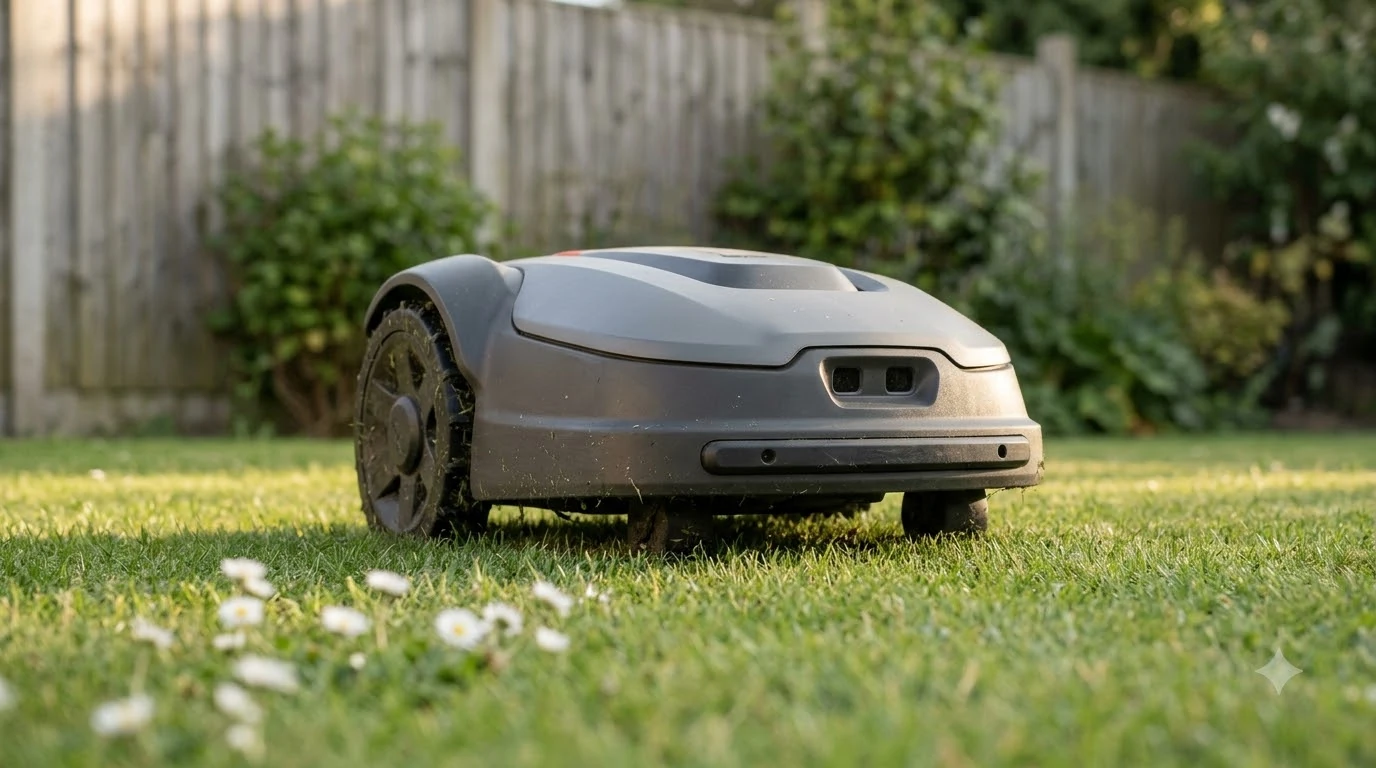

Can a robot mower cut creeping bentgrass? Yes, but only if its lowest cut height is low enough. Oregon State University Extension places the best bench setting between 0.125 and 0.5 inch, while the Husqvarna Automower 410 iQ lists a minimum cut of about 1 inch. This guide covers that gap, the scalping risk, and what to check before setup.
The short answer
- Possible: a robot mower can cut creeping bentgrass if its lowest setting reaches the grass’s preferred range.
- Height band: Oregon State gives 0.5 to 0.125 inch for bench setting, with competitive performance near 0.25 to 0.188 inch.
- Scalping: K-State Extension says puffy patches at lawn height are prone to mower scalping.
- Robot setting: the Husqvarna Automower 410 iQ lists about 1 to 4 inches, so its lowest cut sits above the bentgrass band. Check the spec sheet of any model.
- Practical step: confirm the lowest cut height on the spec sheet before you buy, because it decides whether a robot mower can cut creeping bentgrass well.
What height does creeping bentgrass need?
Oregon State University Extension says creeping bentgrass is best suited to bench setting heights between 0.5 and 0.125 inch. The same Beaver Turf page places competitive performance nearer 0.25 to 0.188 inch, which is the band where the grass is most dense and even.
K-State Research and Extension describes creeping bentgrass as extremely competitive at mowing heights below 1 inch, and says it thrives at one half inch or less. Those numbers come from two different university sources, so they agree on direction but not on the exact top of the range. Our reading is that anything well above 1 inch is outside the range both sources describe.
The gap between the two sources matters less than the direction. A lawn cut at 1 inch or higher is not in the range either source describes for dense, even turf, so it is the wrong target for this grass.
For general limits, see how short a robot mower can cut grass and what height a robot mower should cut grass. These height figures describe the grass itself, not any particular mower. A robot that cannot reach the lower part of the band is a poor match for creeping bentgrass, whatever its brand or price, and that is a scope boundary you should apply before reading further.
Why does a high cut cause scalping and false crowns?
At higher mowing heights, creeping bentgrass gets puffy and develops false crowns, which are raised clumps of growth above the surface. K-State Extension says these puffy patches are prone to mower scalping (our guide explains whether robot mowers scalp the lawn), when the blade cuts into the raised tufts and leaves bare, brown spots.
Heads up
A higher cut is not a safe fallback for bentgrass. The puffy growth can look full at first, but it is the part of the lawn most likely to scalp.
A robot mower runs the same height on every pass, so one setting that is too high repeats across the whole lawn. Our reading is that a slightly high setting can build a steady pattern of puffy, uneven turf rather than a one-off mistake, and that is harder to undo than a single bad run.
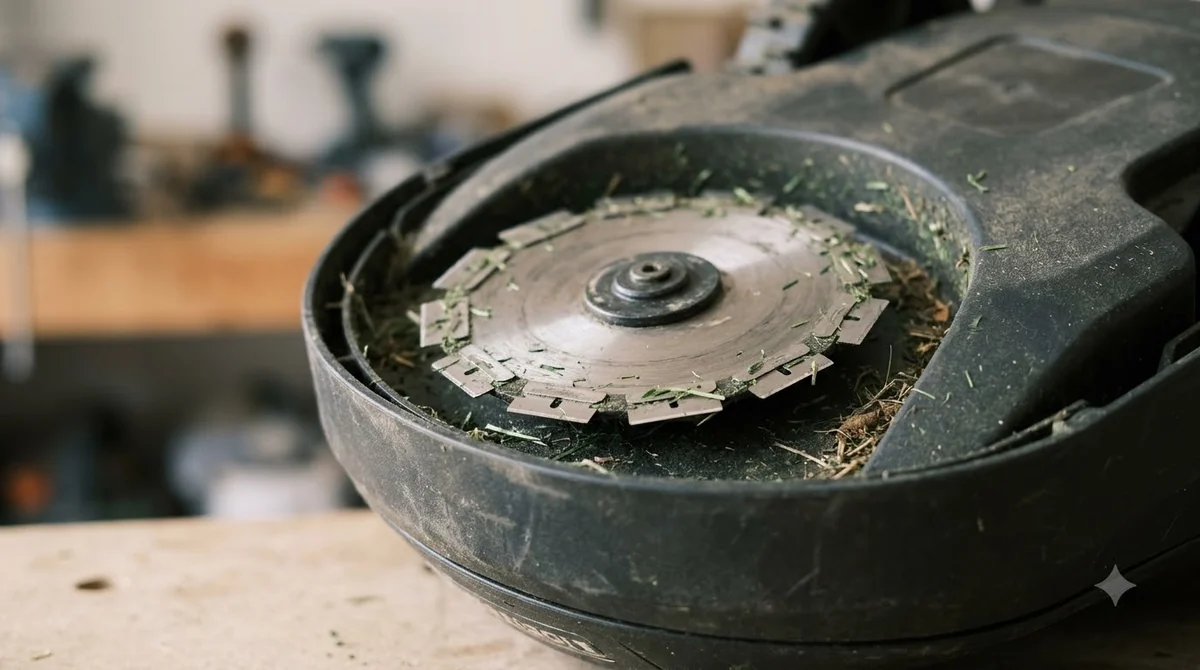
Can a robot mower cut creeping bentgrass at the right height?
Robot mower cut height is adjustable, but it has a floor. The Husqvarna Automower 410 iQ spec page lists a cutting height of about 1 inch minimum and 4 inches maximum, and says the height can be changed in the Automower Connect app. That minimum is above the 0.5 inch or less where K-State says creeping bentgrass thrives, and it sits right at the top of the “below 1 inch” range where the grass is most competitive. Other models differ, so the lowest setting for yours has to come from its manual or spec sheet.
The table below sets the source reading next to the check you need to make on a specific mower.
| Height band | What the source says | What to check on the mower |
|---|---|---|
| Above the 0.5 inch bench band | Puffy growth and false crowns at higher heights (Oregon State) | Avoid as a long-term setting for bentgrass |
| Below 1 inch | Extremely competitive at this range (K-State) | Confirm the lowest setting reaches this range (the 410 iQ minimum is about 1 inch) |
| 0.5 inch or less | Thrives at this height (K-State) | Find the minimum cut height in the manual |
| 0.25 to 0.125 inch | Best bench setting and competitive band (Oregon State) | Compare with the model’s listed minimum cut height; the one robot spec we read starts near 1 inch |
Our reading is that the practical question is not whether a robot can cut at 1 inch, since the 410 iQ can. The question is whether its lowest setting reaches the lower end of the competitive band while still cutting evenly across the lawn. Compare the minimum setting with the band, then ask whether the mower keeps that height on uneven ground, since patchy spots are where the scalping risk sits.
How often should a robot mower cut bentgrass?
K-State Extension says close, frequent mowing favors creeping bentgrass in a mixed lawn. Can a robot mower cut creeping bentgrass often enough? Robot mowers run short cycles on a schedule, so the frequency part of that advice is easy to meet with the machine.
The extension sources do not give a robot-specific schedule, so the number of runs per week is a judgment you make from how fast the lawn grows and what the manual recommends. Our reading is that frequent light cuts suit the grass better than occasional heavy ones.
Frequency and height work together. Short runs at a low setting remove only a little growth each time, which is the logic behind the close mowing advice. That logic is our reading, not a figure the sources give, so treat it as a starting point and adjust from what you see on the lawn.
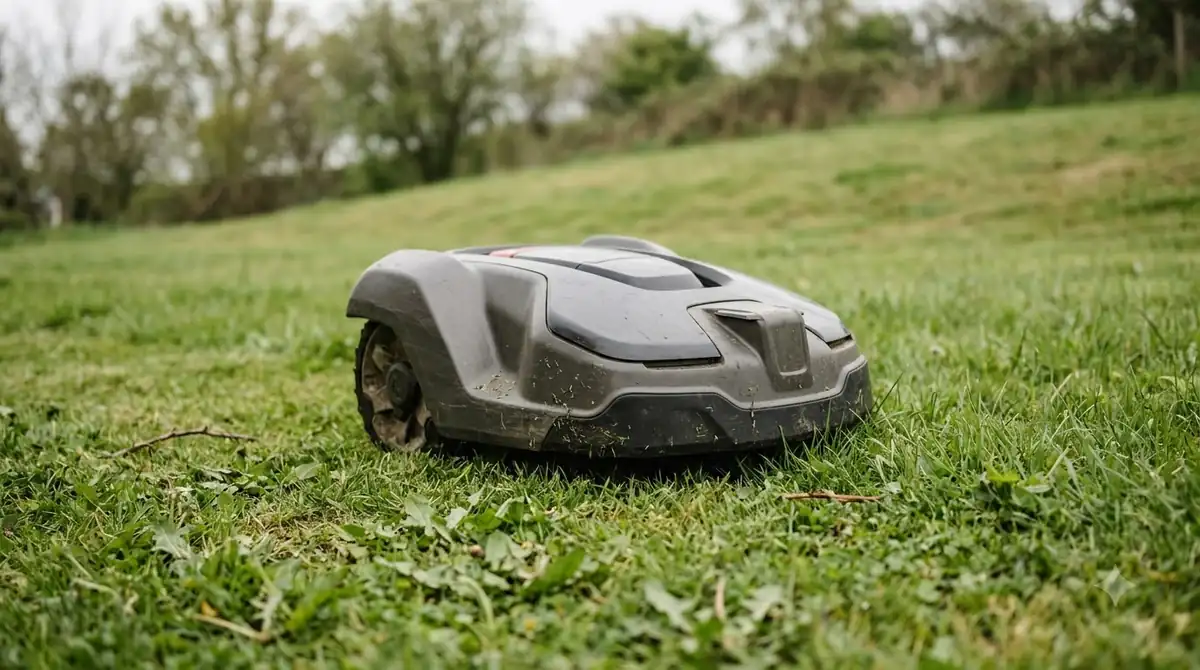
Is creeping bentgrass a weed in other lawns, and can a mower spread it?
K-State Extension treats creeping bentgrass as a grassy weed in many lawns, and notes that mowing equipment can move its stolons to new areas. A robot mower that works across more than one grass type (see whether robot mowers spread weeds) could carry that growth from one area to another, which is our reading rather than a tested result.
K-State says transfer of stolons through mowing equipment may be another way the grass spreads through a landscape. Our reading is that cleaning the cutting deck and wheels when a robot moves between bentgrass and other grass is a sensible precaution. The source does not test robot mowers specifically.
If your lawn is a tall fescue mix, K-State notes that bentgrass is not as deep rooted as turf-type tall fescue, so infrequent irrigation may help the fescue compete. That advice applies to mixed lawns, not to a lawn that is pure bentgrass. For other turf types, read whether a robot mower can cut cool-season grass, and why cutting grass too short harms a lawn.
What to check before you set up a robot mower on bentgrass
Before you set up a robot mower on creeping bentgrass, check the lowest cut height, the blade condition, and how evenly the lawn cuts at the lower setting. These steps follow from the height and scalping sources above.
- Find the lowest cut height. Look for the minimum setting in the manual or spec sheet, and compare it with the 0.125 to 0.5 inch band.
- Set it low, then watch the first run. Check for bare, brown spots or uneven patches, since those are the early signs of scalping.
- Keep the blades sharp. Our reading is that dull blades tear the grass rather than cutting it cleanly, which makes uneven, scalped areas more likely.
- Clean the deck and wheels. If the mower moves between bentgrass and other grass, our reading is that cleaning it after each area limits spread, since K-State notes that mowing equipment can move stolons.
Can a robot mower cut creeping bentgrass well at all? Our reading is that the lowest setting on the spec sheet decides it. If that figure does not reach the lower part of the band, the mower is a poor match for this grass.
Frequently asked questions
Can a robot mower cut creeping bentgrass at 1 inch?
It can cut at that height, since the Husqvarna Automower 410 iQ lists about 1 inch as its minimum. But Oregon State Extension’s bench setting band tops out at 0.5 inch, and it says higher heights make the turf puffy and develop false crowns. Our reading is that 1 inch is a poor long-term target for this grass.
Is creeping bentgrass hard to mow?
It is prone to scalping when it grows in puffy patches at lawn height, according to K-State Extension. Keeping the setting low and even and mowing frequently are the main factors the extension sources point to. Sharp blades are our own suggestion for a cleaner cut.
Does a robot mower spread creeping bentgrass?
K-State Extension says transfer of stolons by mowing equipment may spread the grass through a landscape. The source does not test robot mowers, so this is a general equipment point. Our reading is that cleaning the deck and wheels between areas is a sensible precaution.
How often should I mow creeping bentgrass with a robot?
K-State Extension says close, frequent mowing favors creeping bentgrass in a mixed lawn. The sources do not give a robot-specific schedule, so set the run frequency from how fast your lawn grows and the guidance in the manual.
Sources
- Beaver Turf: Creeping Bentgrass (Oregon State University Extension): bench setting range, competitive range, and false crowns at higher heights.
- Creeping bentgrass (K-State Research and Extension): competitive below 1 inch, puffy patches and scalping, stolon spread, and rooting depth.
- Automower 410 iQ (Husqvarna): cutting height of about 1 to 4 inches and height changes in the Automower Connect app.
 Up next8 min readLearnWhat Is Cut to Edge Distance on a Robot Mower?Updated Nov 11, 2026
 9 min readLearnCan a Robot Mower Cut Long Grass? What the Sources SayUpdated Nov 11, 2026
 7 min readLearnHow Short Can a Robot Mower Cut Grass?Updated Nov 11, 2026
 6 min readLearnCan a Robot Mower Cut Grass That Has Gone to Seed?Updated Nov 14, 2026
 8 min readLearnWhy Does My Robot Mower Beep and Stop Mid-Cut? Common CausesUpdated Nov 14, 2026
 8 min readLearnHow Fast Does a Robot Mower Cut? Speed Figures ExplainedUpdated Nov 11, 2026