
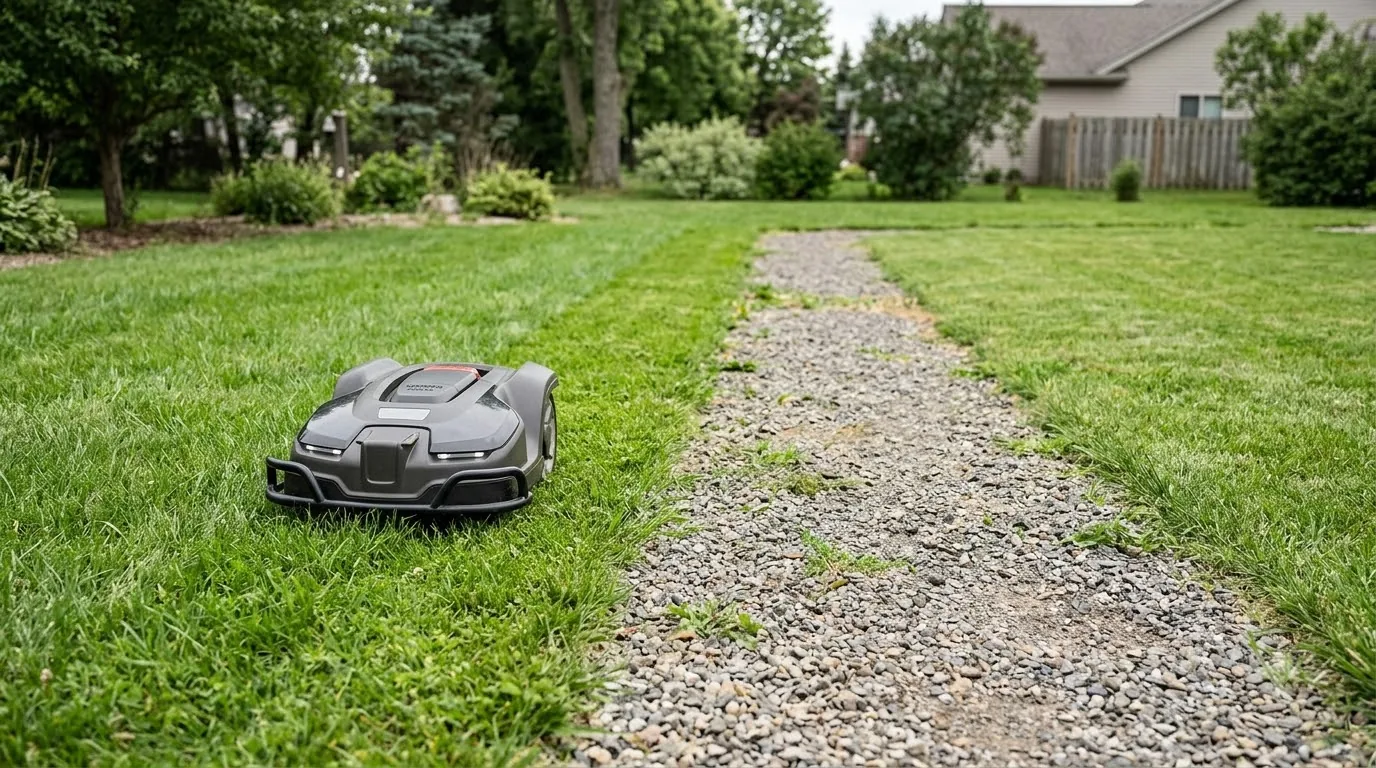

Can a robot mower mow multiple separate lawns? Yes, but the setup depends on the layout. A passage or a secondary area lets one mower reach a second lawn on its own. Lawns with no route between them need a second charging station and their own boundary wire or wire-free setup, or the owner has to move the mower by hand. Model limits also apply, and Husqvarna lists up to 10 installations on some Automower models.
The short answer
- Linked lawns: a passage about one meter wide lets the mower run both areas on one wire.
- Disconnected lawns: each site needs its own charging station and wire or wire-free setup.
- Manual moves: possible on some models, but the mower may not reliably detect the new area.
- Model limits: some Husqvarna Automower models allow up to 10 installations, others up to 3.
Can a robot mower mow multiple separate lawns with one installation?
The limit depends on the model. Husqvarna says the 405X, 415X, 435X AWD, Aspire R6V, 308V, 312V and all NERA models allow up to 10 installations, managed in the Automower Connect app. Other Husqvarna Automower models allow up to 3, managed on the mower’s display. The Aspire R4 does not support profiles at all.
Robomow does not publish a maximum number of zones for its mowers. It says a model needs enough starting points or GPS to cover each area. Our reading is that the installation count in the spec sheet matters more than the lawn count you hope to cover, so check it before you buy.
Lawns linked by a passage
Can a robot mower mow multiple separate lawns linked by a path? Usually yes, on the same wire. Robomow calls this a secondary zone, which is smaller than the main zone and linked to it by a pathway. Passages should be about one meter wide so the boundary signals do not cross and the mower can drive through.
Husqvarna covers the simpler case of two adjacent lawns with a boundary wire and no passage. In that setup the second lawn is set as a secondary area, so only one charging station and one wire are needed. Husqvarna’s page gives a recommended maximum wire length of 800 meters (2,600 feet) for this setup, so start by estimating total boundary wire length. The mower still has to be moved by hand to reach the secondary area, as the next section explains.
The split of mowing time is set with remote start points along the wire. Robomow gives an example in which an 800 m2 main area and a 200 m2 secondary area could share mowing time 80/20. That figure is an illustration from Robomow, not a fixed rule, and your own split will depend on the lawn sizes and the start points you set.
Lawns with no connection
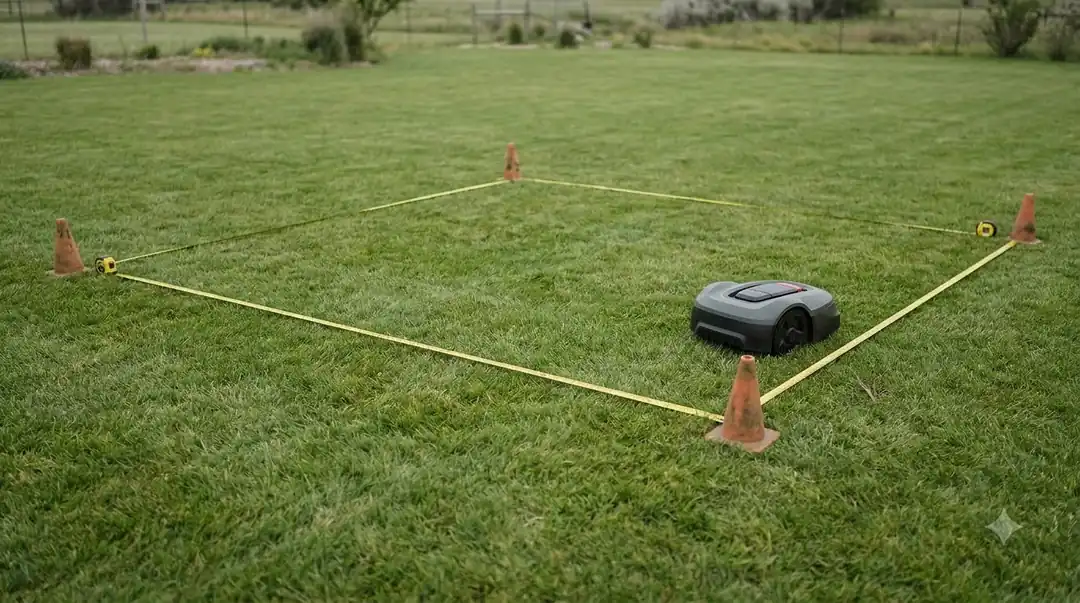
Can a robot mower mow multiple separate lawns that no passage links? Only with a setup of its own. According to Robomow, the options are a separate route, a second charging station, or a signal transmitter. A transmitter is simpler, but it is not available on every model, and a second charging station may need to relearn the signal each time. Before you buy a second dock, read about choosing a charging station spot.
Husqvarna also covers the case of adjacent lawns that are not joined by a passage. With a boundary wire, you can designate the second lawn as a secondary area. Any lawn that is not joined by a passage is treated as a separate site, which means the mower cannot reach it on its own.
Husqvarna’s rule is that each separate site needs its own charging station and a physical boundary wire or EPOS wire-free installation. Profiles can then be switched when the mower moves from one location to another. EPOS via the Husqvarna Cloud is only offered in selected markets, so check availability where you live.
Carrying the mower between lawns
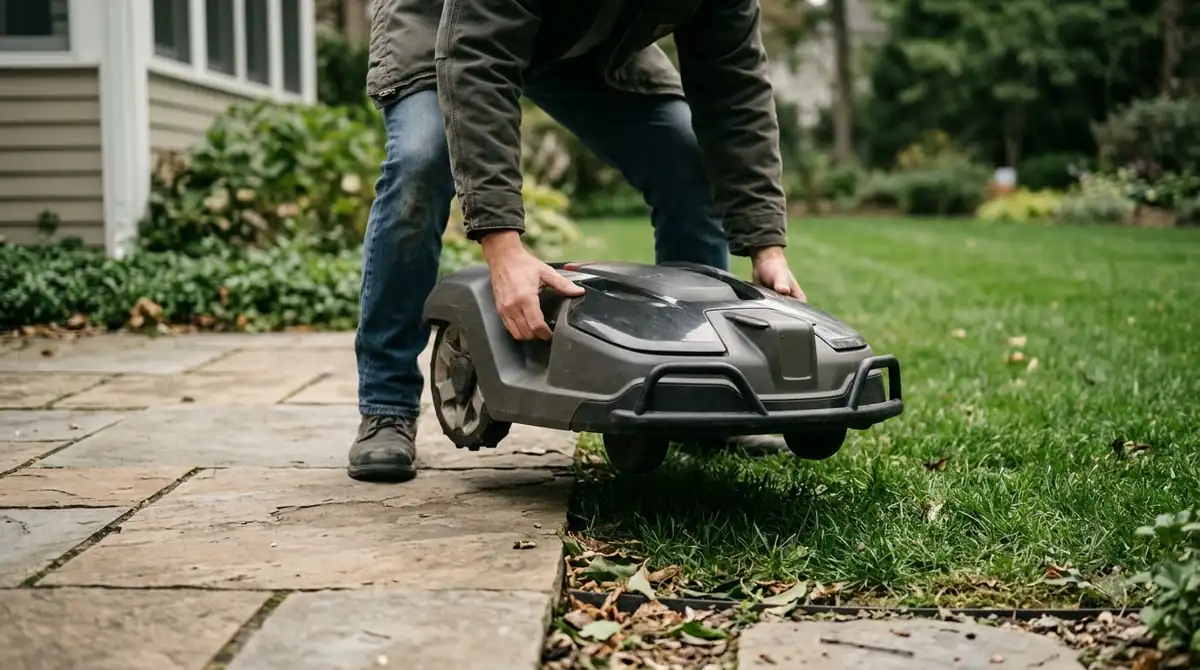
Carrying the mower to a second lawn is the least convenient option, but it is possible on some setups. Husqvarna describes the process for a secondary area with no passage: you move the mower by hand, select Secondary area when you start it, and place it back in the charging station afterward. For wire-free systems, you move the mower and choose the correct work area on the map.
In secondary-area mode, Husqvarna says the mower runs for a selected period or until the battery is empty, and it does not search for the charging station. You then place it in the charging station yourself and switch back to Main area mode, or it will not resume its schedule.
Robomow warns that placing the mower in another zone on the same wire may not be reliably detected. The mower may then mow only the area it was programmed for, and the move takes some physical effort. Our reading is that if you must make this trip every time, a passage or a second installation will save more time over a season.
What to check before you buy
Can a robot mower mow multiple separate lawns on your property? Most of the answer comes down to a few specs. Use this table as a checklist when a product page or manual lists them.
| Feature | What to look for | Why it matters |
|---|---|---|
| Installation count | Up to 10 or up to 3 (Husqvarna) | Sets how many lawns or profiles the mower can store |
| Passage width | About 1 meter (Robomow) | Keeps wire signals apart so the mower can pass |
| Charging stations | One per disconnected site (Husqvarna) | Each unlinked lawn needs its own dock |
| Starting points or GPS | Sufficient starting points, or GPS (Robomow) | Controls how time is split between zones |
| Transmitter | Check whether the model offers one | Helps with a separate zone when no route exists |
On wire-free systems, Husqvarna’s EPOS setup treats each disconnected lawn as a separate work area. You choose that work area on the map before the mower starts, and you move the mower there yourself. Robomow’s transmitter option works in a similar way for a separate zone, but it depends on the model. For the wider trade-off, see wire-free versus boundary wire setups.
Our reading is that a passage is the cheapest path to a second lawn, because it needs only one dock and one wire. A passage across a path or driveway is a common case, covered in how a robot mower crosses a driveway. Disconnected lawns cost more to set up, and they require the most attention from the owner. A front yard and a back yard are the usual example, and front and back yard setups walks through it.
Frequently asked questions
Can a robot mower mow multiple separate lawns across a street?
Both Husqvarna and Robomow describe lawns with no connecting path as needing a separate charging station, a separate route, or a manual move by the owner. Our reading is that a lawn across a street falls in this group, because no passage connects it to the main lawn.
Do I need a second charging station for each lawn?
Not always. Husqvarna says a secondary area with a passage needs only one charging station and one wire. A separate site with its own boundary wire or wire-free setup needs a charging station of its own.
How wide should the passage between two lawns be?
Robomow recommends a passage about one meter wide. A wider path helps the mower pass without the wire signals crossing. Check the wire layout in your model’s manual before you lay the boundary.
How many lawns can one robot mower manage?
It depends on the model. Husqvarna lists up to 10 installations for the 405X, 415X, 435X AWD, Aspire R6V, 308V, 312V and all NERA models, and up to 3 for other Automower models. Robomow does not state a maximum zone count for its mowers.
Sources
- Using a Husqvarna Automower at multiple locations (Husqvarna): installation limits, profiles, secondary area and charging station rules.
- Can the robotic lawnmower mow multiple areas or zones? (Robomow): zone types, passage width, transmitters and manual placement.
- How to create a secondary area in Automower boundary wire installations (Husqvarna): wire loop, 800 m recommended maximum, and how the mower starts in the secondary area.
 Up next8 min readBy YardCan a Robot Mower Mow a Drainage Ditch?Updated Nov 11, 2026
 9 min readBy YardHow Long Does a Robot Mower Take to Mow an Acre?Updated Nov 11, 2026
 9 min readBy YardRobot Mower and Dog Poop: Should You Let It Mow Over Waste?Updated Nov 11, 2026
 10 min readBy YardWhen to Mow New Sod: First Cut Height and Root TestUpdated Nov 11, 2026
 9 min readBy YardWhen to First Mow New Grass Seed (Height, Not Calendar)Updated Nov 11, 2026
 9 min readBy YardHow Often to Mow Kentucky Bluegrass by SeasonUpdated Nov 11, 2026