


Can a robot mower work around a wooden deck? Yes, as long as the boundary wire keeps a safe distance from the deck edge and the space underneath is passable. A deck sits above the lawn, so it behaves more like a raised obstacle than a flat path. Exact clearances depend on the model, and the installation manual for your mower has the final word.
The short answer
- Wire clearance: Robomow lists about 35 cm from walls and tall stones, and about 10 cm from beds or hedges. Use the manual for your model before you set the deck distance.
- Under the deck: The mower can only pass underneath if the gap is open, level with the lawn, and taller than the mower body.
- Hand trimming: Expect a strip of uncut grass along the deck edge, and plan to trim it. A patio at lawn level is handled differently.
Can a robot mower work around a wooden deck and run under it?
Usually no. When people ask whether a robot mower can work around a wooden deck, the honest answer is that the mower can follow the lawn beside it but should not be expected to go underneath. A robot mower needs a clear route, and most decks have posts, joists, and a gap that varies from yard to yard. The safest assumption is that the mower stays outside the deck footprint and the wire loop goes around it.
The boundary wire defines the mowing area. For a deck, that means the wire loop is the rule the mower follows, so a deck that you route the wire around is simply left out of the cutting path.
Under a low deck, the gap may be too small for the mower body or too rough for the wheels. Under a raised deck, the space may be open, but it still needs to be level, free of hazards, and wide enough that the mower can turn without hitting a post. Check the gap before you decide to let the mower enter it.
Our reading: for a wooden deck, treat the area under it as a no-go zone unless the manual for your model says otherwise and you can see a clear, level path.
How far should the boundary wire stay from the deck?
Robomow publishes distances for several obstacle types, and they give the best starting point. Its guidance is about 35 cm from walls and tall stones, about 10 cm from beds or hedges, and about 10 cm from slabs and paths, but only where the surface is at ground level or lower than the lawn. A deck is higher than the lawn, so the path figure does not apply directly to it.
For a deck, the safe approach is to place the wire far enough from the deck edge that the mower does not contact the structure, then check the result with the manual for your model. Robomow notes that exact distances vary by model, so the manual figure should override any general number on this page. If you are asking how far the wire should sit when a robot mower can work around a wooden deck, start from the wall figure and adjust after a short test run. For step-by-step laying, see our guide to installing a robot mower boundary wire.
Handling deck posts and the gap underneath
Deck posts are the most common hazard. A robot mower can bump into them, and a wire laid too close can be overshot. Robomow describes a method for fencing off obstacles: run the wire out from the lawn edge, around the obstacle, and back parallel to the outgoing wire. That approach works for individual posts or a pier cluster, and our guide on how to lay boundary wire around trees and obstacles shows the same loop on a lawn.
Robomow says a passage should be wider than 70 cm in principle, and that narrower passages can cause signal interference between the two boundary wires. If the gap under the deck is open on one side, you can route the wire along that side so the mower stays out of the space. If the gap is closed, the deck edge alone may be enough to keep the mower away. In either case, check that the mower cannot reach the space through a turn or a slope.
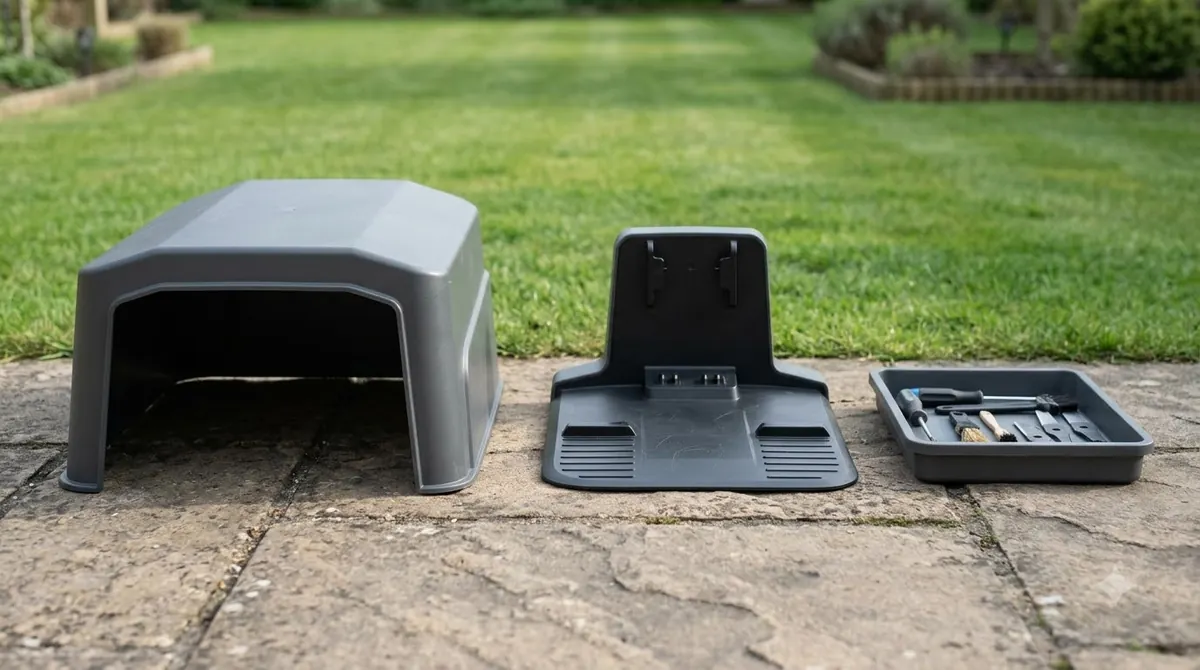
Edges, strips, and hand trimming when a robot mower works around a wooden deck
Expect a strip of grass to stay uncut along the deck. Robomow gives typical figures for uncut strips: about 10 to 20 cm along walls for centered-blade models, and about 6 cm for edge-cutting models. Those figures are useful for planning, but your model and wire placement will change the result.
Plan to trim the strip by hand with a string trimmer or edger. Robomow also warns that wire laid right at an edge can let the mower overshoot it by as much as 30 cm on some models, so keep the wire a little back from the deck instead of pressing it against the wood.
Non-passable edgings, such as wood, metal, or plastic borders, need manual trimming in the same way. A deck edge is usually one of these. Treat the grass right next to the deck as a hand-trim zone, and see our pick of a cordless string trimmer for robot mower edges for that job.
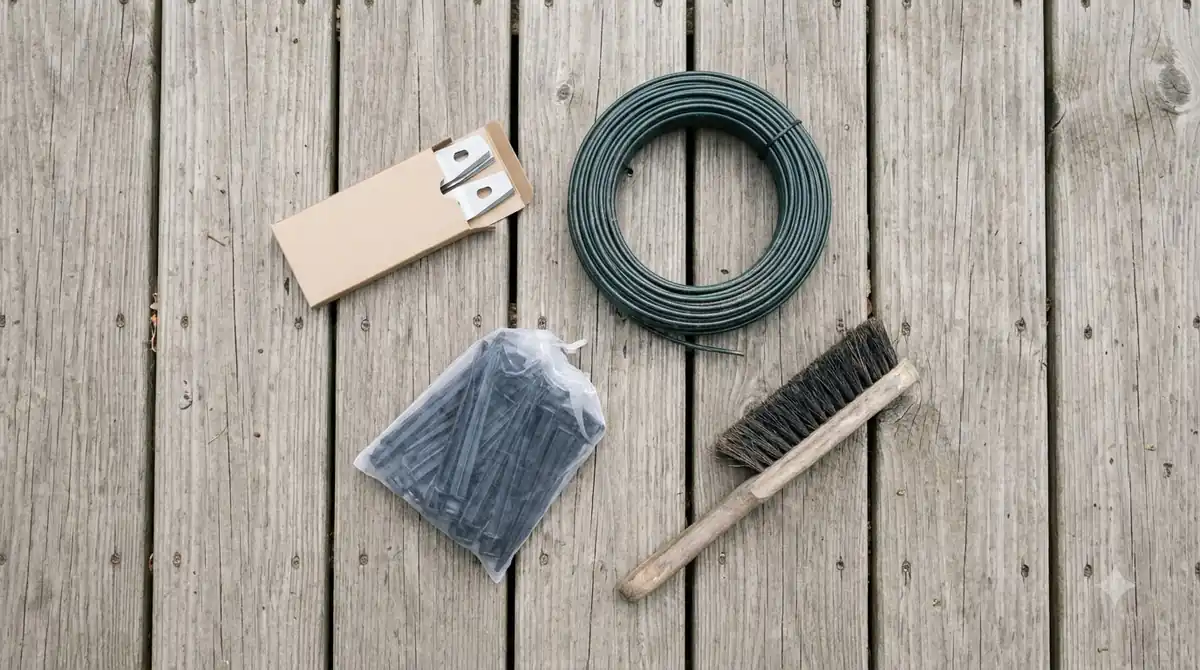
What to check before you lay the wire
So, can a robot mower work around a wooden deck in your yard? Walk the deck area and mark the obstacles on the lawn first. Measure the deck height above the grass, the gap underneath, and the distance from the deck edge to the nearest lawn boundary. Those three measurements tell you whether the mower can pass the deck, whether it needs a wire loop, and how much to trim by hand.
- Measure the deck. Note the height above the lawn, the gap underneath, and any posts.
- Read the manual. Find the wire clearance for walls, raised surfaces, and obstacles for your model.
- Plan the loop. Route the wire around the deck footprint and any posts, keeping the distance from the manual.
- Bury the wire carefully. Robomow gives an optimal burial depth of 4 to 5 cm and says the signal can still be received at up to 7 cm.
- Test the edge. Run a short cycle and watch how close the mower gets to the deck and where it stops.
Frequently asked questions
Can a robot mower work around a wooden deck at low height?
Usually not. Whether a robot mower can work around a wooden deck at low height depends on the gap being open, level with the lawn, and tall enough for the mower body. Most low decks do not meet that test, so the safe default is to keep the wire outside the deck footprint.
How far from a deck should the wire be?
Use the clearance in your model manual. Robomow gives about 35 cm for walls and tall stones and about 10 cm for beds and hedges, but those are general figures, not deck-specific ones.
Will the mower damage the deck boards or posts?
A wire laid too close can let the mower bump the structure. Keep the wire back from the deck edge and check the mower path after installation.
Can a robot mower work around a wooden deck without hand trimming?
Usually not. Robomow lists uncut strips of about 10 to 20 cm for centered-blade models and about 6 cm for edge-cutting models, so a hand trim is usually needed along the deck edge.
Sources
- Laying the lawn boundary wire (Robomow): distances to walls, beds, slabs, passages, burial depth, and obstacle loops.
- How cleanly does a robotic mower cut the lawn edge (Robomow): uncut strip widths, overshoot, and non-passable edgings.
 Up next7 min readBy YardCan a Robot Mower Work Around a Hot Tub?Updated Nov 12, 2026
 9 min readBy YardCan a Robot Mower Work Around a Brick Walkway?Updated Nov 12, 2026
 9 min readBy YardCan a Robot Mower Work Around a Basketball Hoop?Updated Nov 12, 2026
 8 min readBy YardCan a Robot Mower Work Around a Rain Garden?Updated Nov 12, 2026
 9 min readBy YardCan a Robot Mower Mow Around a Wildflower Patch? Setup Rules That WorkUpdated Nov 12, 2026
 10 min readBy YardCan a Robot Mower Work Around a Bird Bath? Wire Setup GuideUpdated Nov 12, 2026