
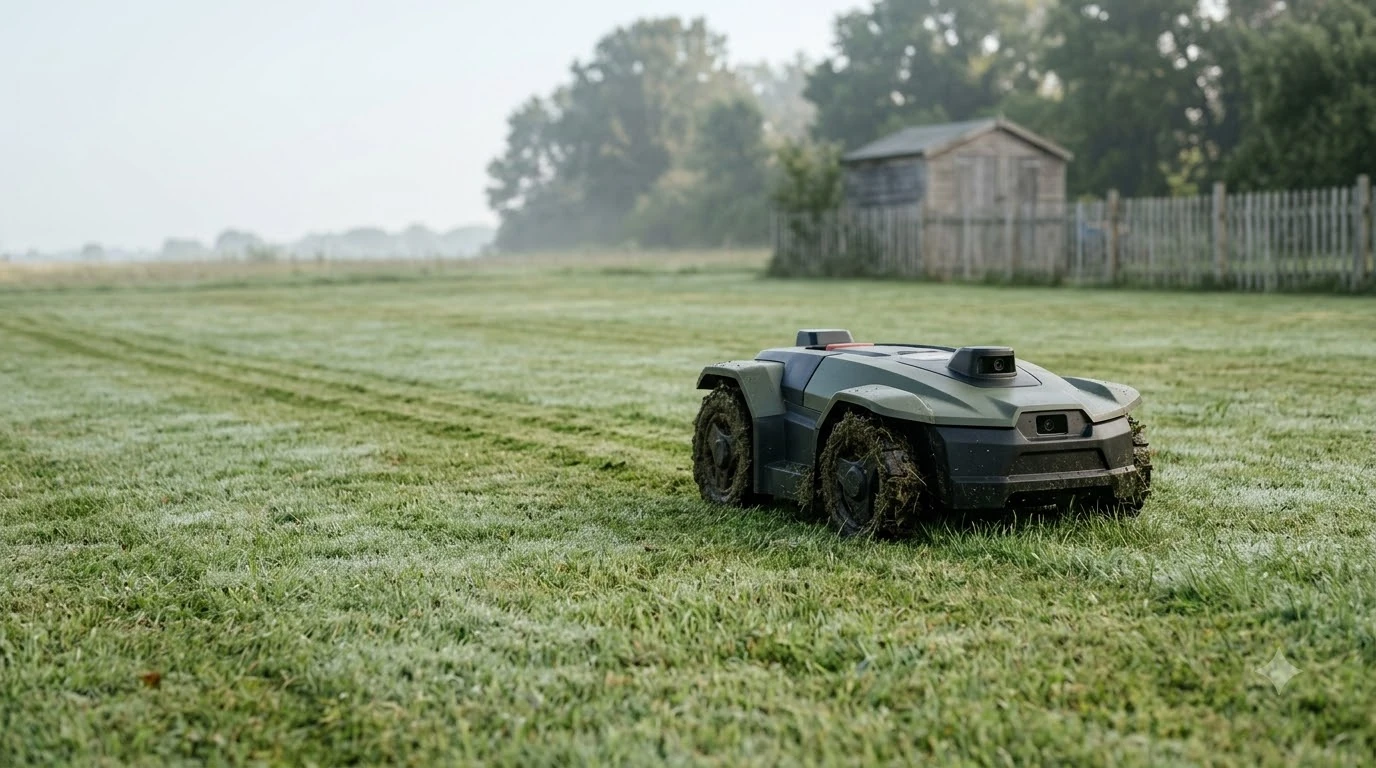

Do robot lawn mowers emit electromagnetic fields? Yes, if they use a boundary wire. A boundary-wire mower is connected to a charging station that energizes a cable laid around the lawn, and that current creates an electromagnetic field along the wire. Wire-free models that navigate with satellite positioning or cameras do not depend on that wire, so the answer depends on the boundary type.
The short answer
- Where it comes from: the charging station energizes the boundary wire, so current flows along the wire.
- Frequency: a 2015 Swedish electrical safety article puts the intended wire signal at some tenths of a kilohertz.
- What has been reported: radio interference, ADSL internet problems, and neighboring mowers disturbing each other.
- What is missing: the sources give no field-strength values for consumer models and no health exposure assessment for them.
Do robot lawn mowers emit electromagnetic fields through the wire?
A boundary wire is a loop of insulated cable laid around the lawn and connected to the charging station. Robomow describes the wire as connected to the charging station, which energizes it. Mammotion describes the same wire as a low-voltage cable installed along the perimeter. Because the wire carries current, it produces a field around itself, and that is the field people ask about when they ask “do robot lawn mowers emit electromagnetic fields?” For the basics of the wire itself, see our explainer on what a boundary wire is and how it works.
Our reading is that the field is present along the wire path and near the charging station, not across the whole yard. None of the sources we read measured the field across a full lawn, so treat that as a reasoned conclusion rather than a measured result.
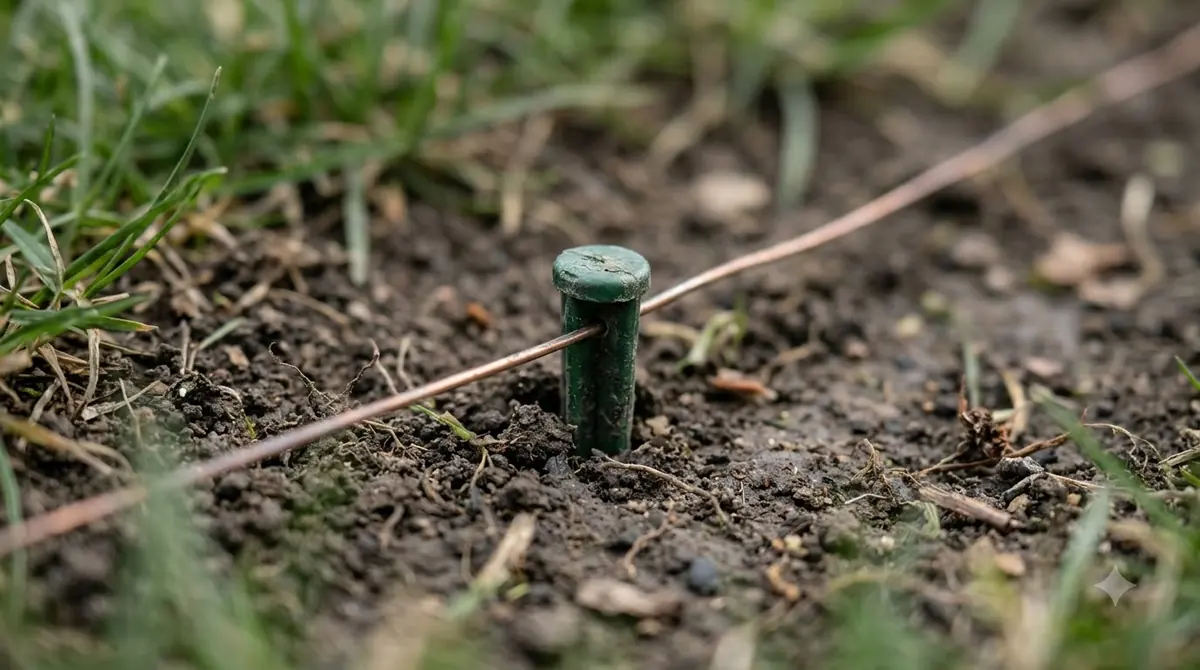
Wire depth also matters for the signal. Robomow gives a general range of 3 to 7 cm, with 4 to 5 cm as the best depth, and warns that burying the wire too deep risks signal interference. Our note on burying or pegging the boundary wire compares the options.
Where the signal sits on the EMF spectrum
The World Health Organization describes electric and magnetic fields as part of the spectrum of electromagnetic radiation. A signal of some tenths of a kilohertz, which is what the Swedish article below gives for the wire, sits at the very low end of that spectrum, far below the radiofrequency range used by phones and Wi-Fi. The WHO EMF project reviews health evidence across frequencies from 0 to 300 GHz, so the wire signal falls inside the range it covers.
The WHO page we read sets that context but does not answer “do robot lawn mowers emit electromagnetic fields” in terms that matter for health. It does not name an exposure limit that applies to boundary wires, so it cannot tell you whether a given mower is safe for people or pets.
What the Swedish EMC article found
The most detailed public source we found is a 2015 article on electromagnetic compatibility (EMC) of robotic lawn mowers by Henrik Olsson of the Swedish National Electrical Safety Board, which enforces EMC rules in Sweden. It is a decade old, names no brands, and covers four mowers the authority bought and pre-tested, so it describes those models rather than the market today. The author says the wanted signal is low frequency and that, with proper design, there is no reason for EMC problems. He then reports trouble from poorly designed examples:
- Radio interference and problems with ADSL internet access had been reported to the authority.
- The boundary wire signal can induce interference in telephone cables, which the author gives as the cause of the ADSL problems.
- In crowded neighborhoods, a mower sometimes does not get on with a neighbor’s mower.
- Pre-tests showed very different wire signals between models, with some at a rather high level of radio frequency signals, which the author calls a sign of poor filtering. No figures are given.
- The worst model was also tested in a real garden near a shortwave antenna, where its wire signal raised the level in the receiver. Its full lab test exceeded levels in harmonised EMC standards, again without specific values, and the author expected that product to be banned.
The author concludes that EMC problems can usually be avoided through good design and awareness of the electromagnetic environment, using zoning, filtering and shielding. He adds that EMC requirements and market surveillance are still needed.
Reported concerns and open questions
The table separates what the article reports from what it leaves unquantified. Readers who need a number for a specific model will need the maker’s test data.
| Concern | What the review reports | What is still open |
|---|---|---|
| Signal frequency | Some tenths of a kilohertz (intended signal) | Current and field strength per model |
| Internet and phone lines | ADSL problems and interference in telephone cables | How often, and which models |
| Neighboring mowers | Sometimes interfere with each other | How often, and at what distance |
| EMC compliance | The worst tested model exceeded harmonised EMC levels | Which model, and by how much |
Charging station and wire-free models
The charging station is the point where the wire is energized, so it is part of the same system. Wire-free designs remove the wire from the boundary question. Our comparison of wire-free versus boundary wire robot mowers covers the trade-offs. Husqvarna describes its EPOS RTK-GNSS virtual boundary as the wire-free option, with a physical wire kept as a fallback where satellite coverage is weak.
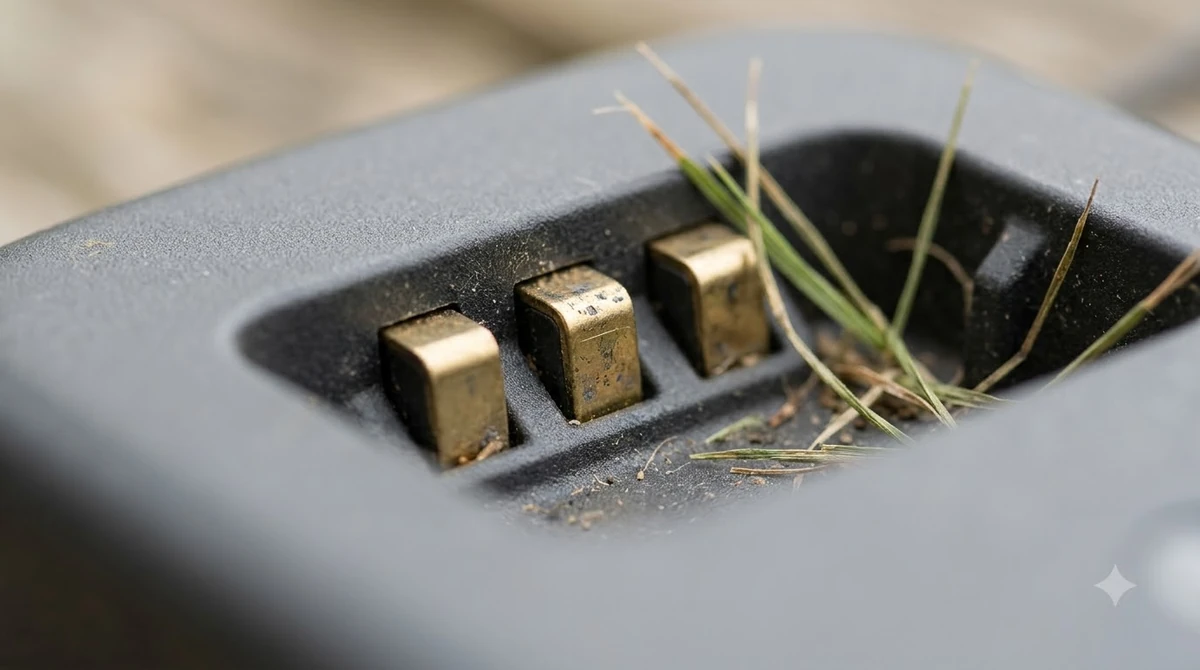
The sources we read do not say whether a charging station with no wire, or the motors inside any mower, produce interference or fields that matter. For that reason, the question “do robot lawn mowers emit electromagnetic fields” has a clear answer only for boundary-wire designs. Raise the rest with the maker before you buy.
Practical checks if you have DSL or a neighbor’s mower
These checks are our reading of the sources above, not a manufacturer instruction.
- Lay the wire at the maker’s depth. Robomow’s 3 to 7 cm range is one example, and the depth it recommends is 4 to 5 cm.
- Watch your internet after installation. If you have ADSL, note when drops begin, since the article links wire signals to ADSL problems. If the mower itself loses the wire signal, see Automower no loop signal causes and fixes.
- Keep the wire away from phone lines where you can. The article says the signal can induce interference in telephone cables, but it gives no distance figure.
- Ask for a model-specific EMC report. The article says one model’s test exceeded EMC levels without giving values, so the maker’s report is the most direct way to check a model.
- Plan zones if two mowers share a lawn. The article says neighboring robotic mowers can interfere with each other. For people and pets, see robot mower safety around kids and pets.
Heads up
The article gives no measured values for any model. Treat these findings as reasons to check, not as a measured safety limit.
Frequently asked questions
Do wire-free robot mowers emit electromagnetic fields?
Wire-free models that use satellite positioning or cameras do not depend on a boundary wire, so the wire field is absent in that setup. The sources we read do not cover whether the charging station or the motors produce fields that matter, so ask the maker.
What frequency is a robot mower boundary wire signal?
The 2015 Swedish electrical safety article puts the intended boundary wire signal at some tenths of a kilohertz. It gives no field-strength values, so the exact level for a given model is not known from that source.
Can a boundary wire interfere with home internet?
The article reports radio interference and problems with ADSL internet, and says the wire signal can induce interference in telephone cables. It does not say how common these problems are, so a DSL user should watch for drops after installation.
Is there a health guideline for EMF from robot mowers?
We did not find a health exposure assessment specific to boundary wires. The WHO EMF project reviews evidence from 0 to 300 GHz, but its page gives no conclusion for this device, so ask the maker for its compliance documentation.
Sources
- Do we really need the EMC requirements? (Henrik Olsson, Swedish National Electrical Safety Board, 2015): reported interference, the signal frequency range and the EMC conclusion.
- WHO electromagnetic fields topic page (World Health Organization): definition of EMF and the 0 to 300 GHz scope of its evidence review.
- Laying the lawn boundary wire (Robomow): the charging station energizes the wire.
- How deep the boundary wire must be laid (Robomow): 3 to 7 cm range and interference risk when buried too deep.
- Do robot lawn mowers need a boundary wire? (Mammotion): the wire is a low-voltage cable along the perimeter.
- How the Automower works (Husqvarna): EPOS virtual boundary as the wire-free option.
 Up next7 min readLearnDo Robot Lawn Mowers Need a Permit?Updated Nov 12, 2026
 7 min readLearnWhat Do Robot Mower Charging Station Lights Mean?Updated Nov 12, 2026
 9 min readLearnShould a Robot Mower Run After Aeration?Updated Nov 12, 2026
 7 min readLearnDo Robot Mowers Damage Drip Irrigation Lines?Updated Nov 12, 2026
 8 min readLearnHow to Register a Robot Mower Warranty: Deadlines and ProofUpdated Nov 12, 2026
 8 min readLearnHow to Clean Robot Mower Sensors Safely, Step by StepUpdated Nov 12, 2026